Palazzo dell’Archiginnasio: Bologna’s University Palace and Municipal Library
Site at a Glance
- Rating
- 4.6
- Popularity
- High
- Country
- Italy
- Primary era
- Early Modern
- External website
- Open
- Eras represented
- Early Modern
- Civilizations
- Papal States
- Site type
- Civic
- Remains
- University
On this page10 sections
History
Palazzo dell’Archiginnasio is a university palace in Bologna, Italy, built in the sixteenth-century Mannerist style, a European art and architectural style of that period. Pope Pius IV commissioned it during the Council of Trent, a major Catholic council held from 1545 to 1563. The pope acted through Charles Borromeo, his representative, and Pier Donato Cesi, a deputy papal legate. They entrusted the design to architect Antonio Morandi, known as il Terribilia. Construction began in late February 1562, and the palace was inaugurated on 21 October 1563.
A shared university home
The palace brought together the university’s law schools, teaching canon and civil law, and its schools of arts, where students studied philosophy, medicine, mathematics, natural sciences, and physics. These schools had previously been spread across Bologna. The University of Bologna occupied the palace from 1563 until it moved to Palazzo Poggi in 1803. The name Archiginnasio draws on a classical term for a university; Bologna’s university had earlier been called the Studium, meaning a place of higher learning. The building project took place during papally ordered remodelling of Piazza Maggiore, in the same period that the Fountain of Neptune was built.
From university to municipal library
After the university moved, primary schools used the palace for several years. In 1838 it became the home of the Archiginnasio Municipal Library, established to preserve books collected after Napoleon, the French emperor, suppressed religious orders. The library’s collections centre on the history of Bologna and its surrounding territory, including their civic, cultural, religious, social, political, literary, artistic, and intellectual life. It is the largest library in Emilia-Romagna.
Events and modern history
In 1842, a hall now used as a congress room hosted the first performance of Rossini’s Stabat Mater, conducted by the composer Gaetano Donizetti. On 29 January 1944, Allied bombing extensively damaged the Anatomical Theatre, which was reconstructed with surviving pieces recovered from the rubble. The palace’s heraldic decoration survived both an order for its destruction issued by the republican government in 1797 and bombing during the Second World War. The building forms part of the Porticoes of Bologna UNESCO World Heritage site.
Remains
Layout and university spaces
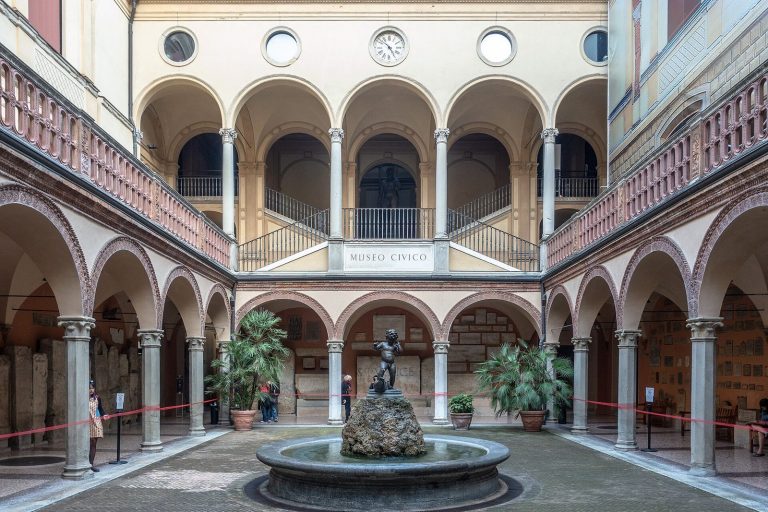
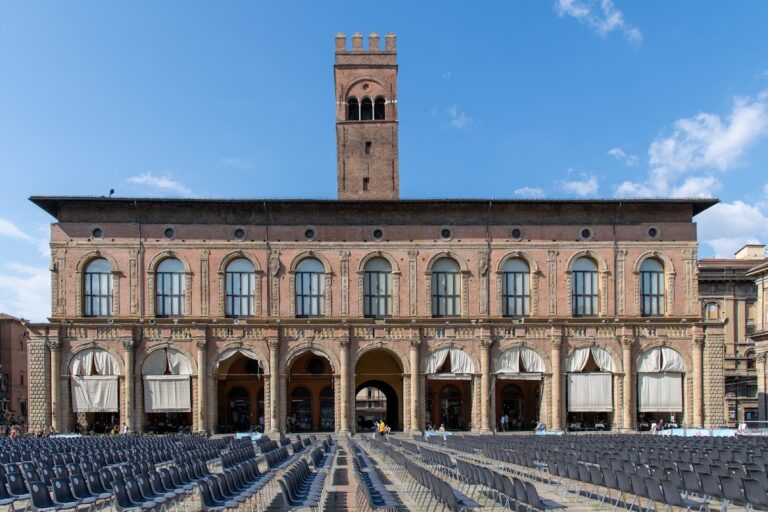
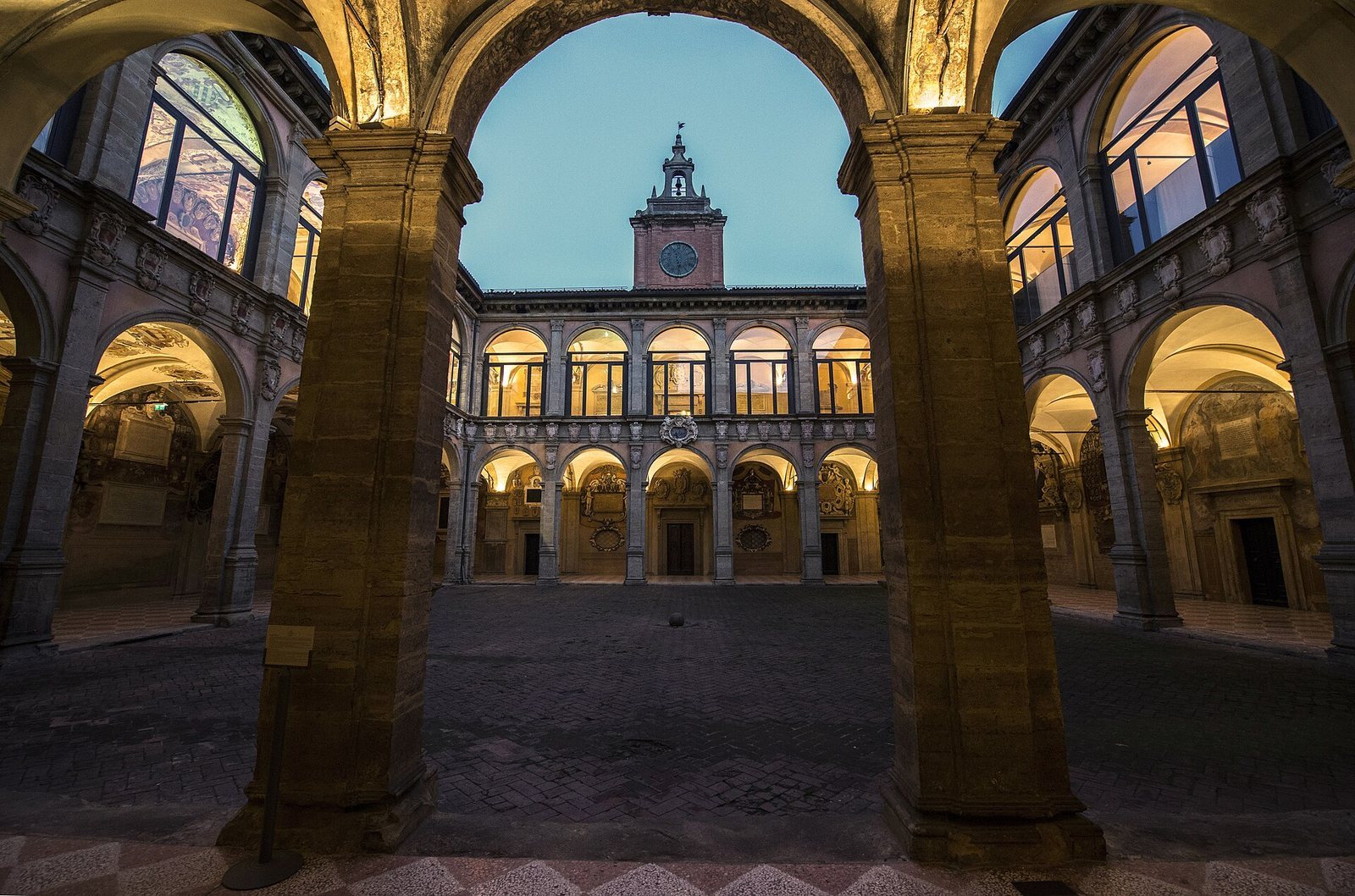
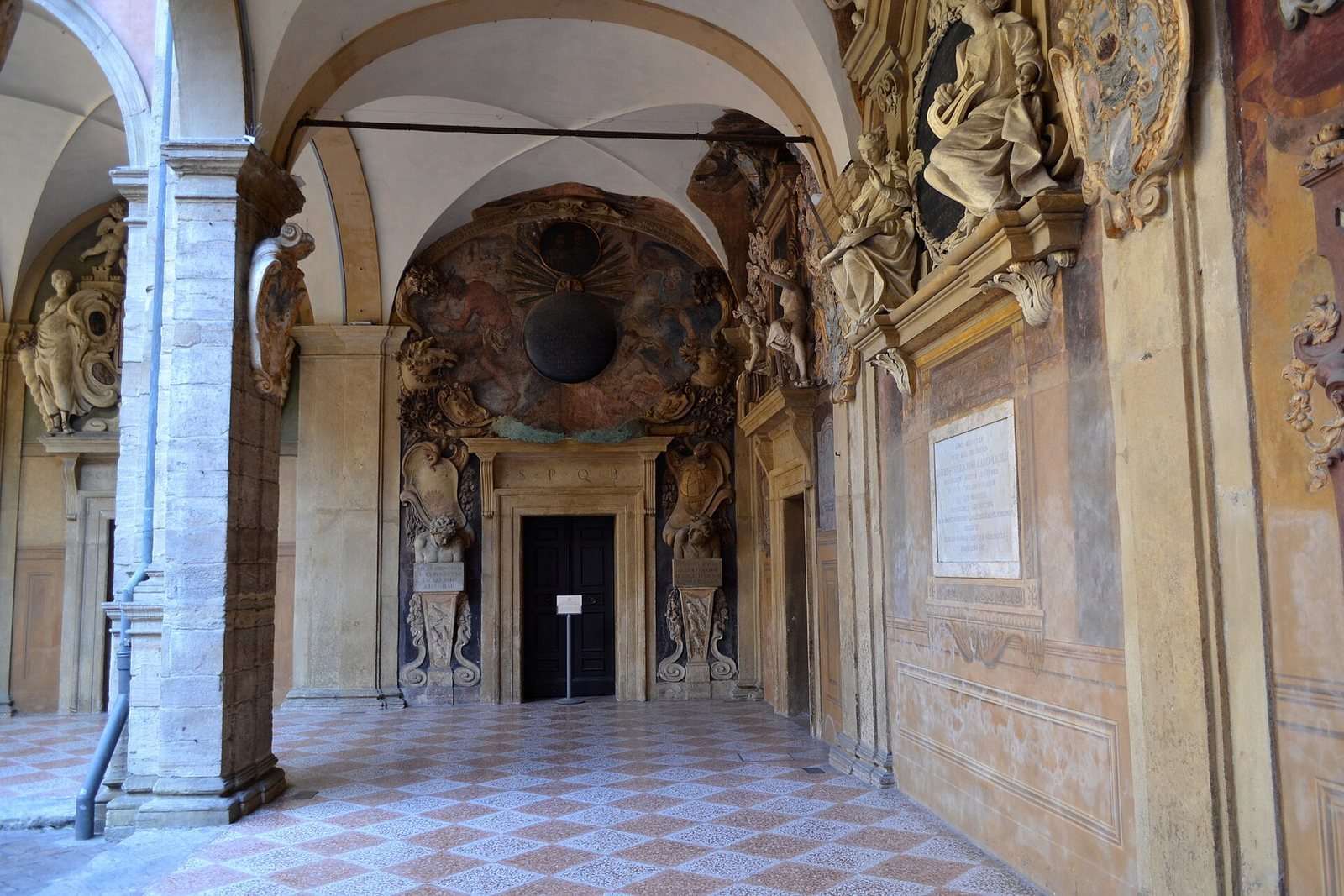
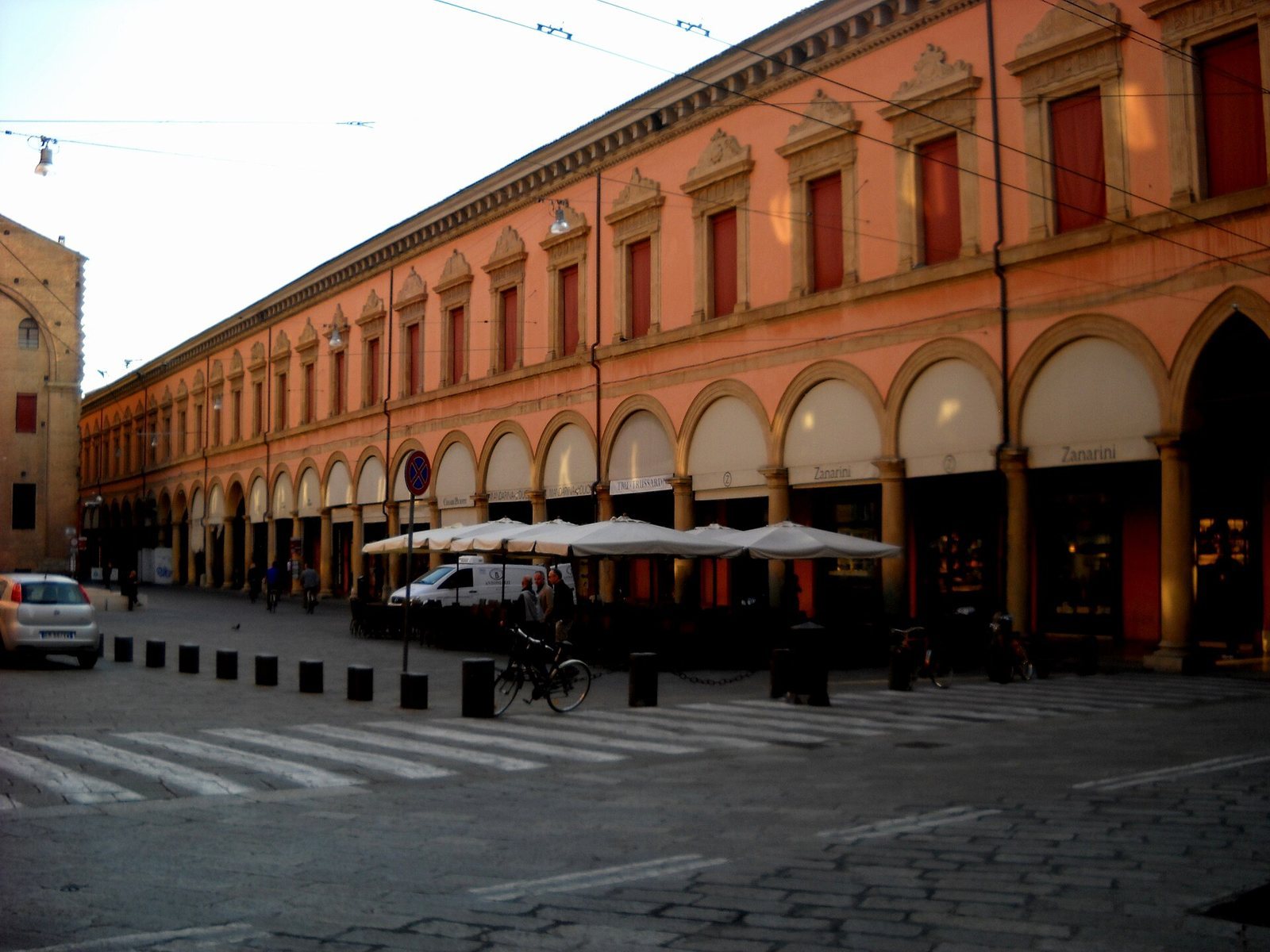
The two-storey palace has a long exterior portico, about 139 metres in length, with 30 arches supported by sandstone columns. Its central courtyard is surrounded by two levels of loggias, roofed galleries open along one or more sides, and encloses the former church of Santa Maria dei Bulgari, which also served as the university chapel. Two stairways lead to the upper floor, one used by law students and the other by students in different fields.
Classrooms and halls
The upper floor contained five classrooms for law students and five for students of other subjects, arranged in separate wings. The law students’ rooms occupied the main corridor. Two large halls stand at the ends of the wings: one is now the library reading room, while the other is the congress room known as the Sala dello Stabat Mater.
Heraldic and sculptural decoration
Several thousand painted coats of arms cover the walls, accompanied by inscriptions honouring students. The arms identify students and their home cities or countries. Students elected by their peers to lead groups organized around shared origins could add their own arms. The decoration also includes emblems of prominent Bolognese families, among them the Bentivoglio, Pepoli, Biancuzzi, and Malvezzi. Triple crowns, the keys of Saint Peter, and clerical hats refer to the palace’s ties to papal authority. Busts of university lecturers from the seventeenth century decorate the lower portico, and an inscription honours Charles Borromeo.
Anatomical Theatre
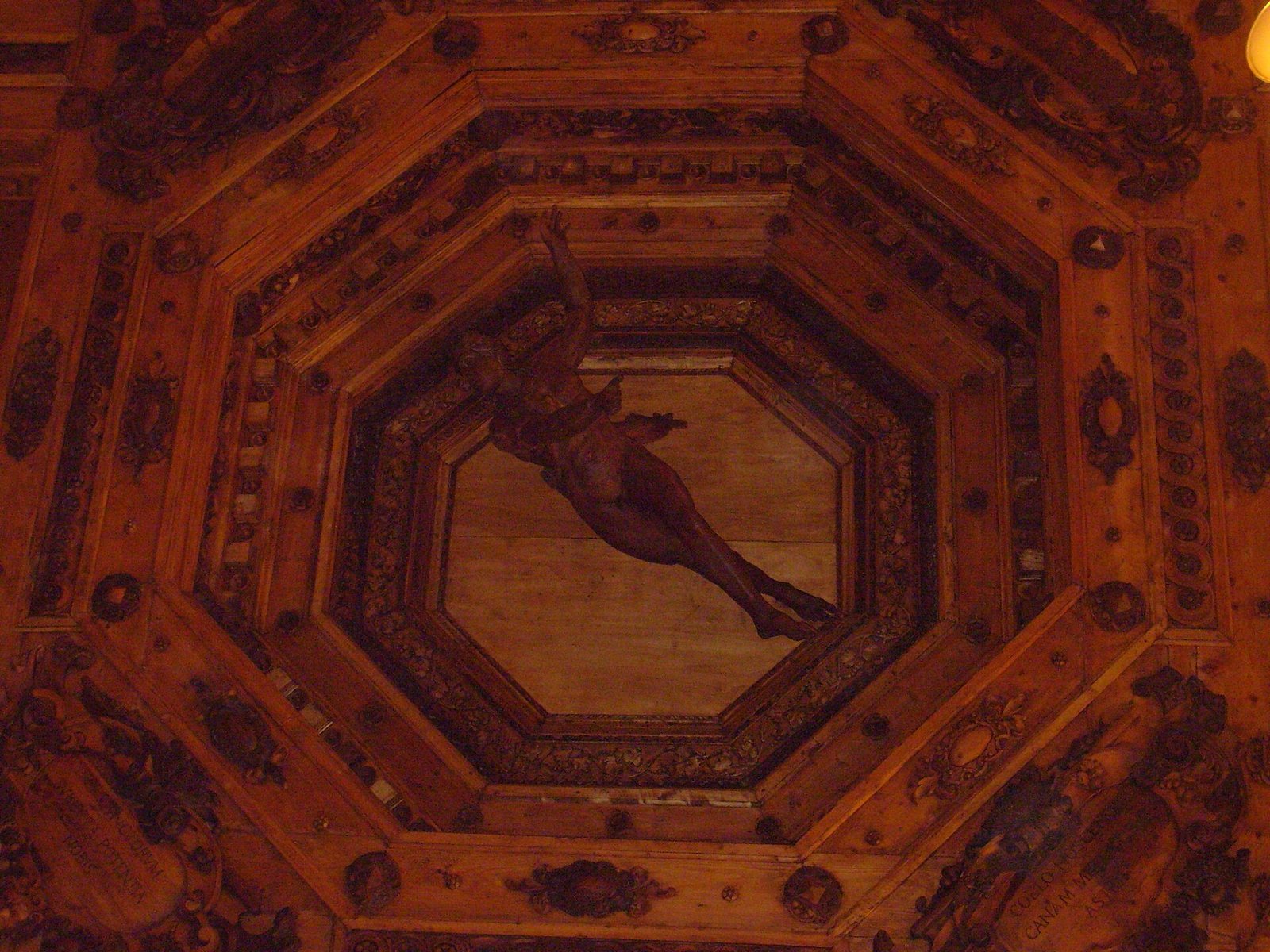
The upper floor contains the Anatomical Theatre, a teaching room for anatomy lectures and demonstrations shaped like an amphitheatre. Made of fir wood, it has a ceiling divided into recessed panels and sculptural decoration that includes Apollo, a major god of ancient Greek religion associated with music and prophecy. A canopy above the professor’s ornate chair rests on statues by Ercole Lelli of two nude, skinless men, known as the Skinned Ones. Sculptures of physicians line the walls: those accorded less prominence appear as busts, while the most revered are shown as full figures. The principal figures represent Hippocrates, an ancient Greek physician, and Galen, an ancient physician whose work influenced Greek and Roman medicine. Opposite the professor’s chair, a statue depicts the Bolognese physician Gaspare Tagliacozzi holding a nose; he was known for early surgical reconstruction of the nose.
Municipal Library collections
The Archiginnasio Municipal Library holds about 850,000 volumes and pamphlets. Its collections include 2,000 incunabula, books printed before 1501, about 15,000 editions from the sixteenth century, and 8,500 manuscripts. The library also holds letters, collections of autograph material, prints, drawings, and 250 archives.