Palazzina Marfisa d’Este: A Renaissance Aristocratic Residence in Ferrara


Site at a Glance
- Rating
- 4.3
- Popularity
- Low
- Country
- Italy
- Primary era
- Early Modern
- External website
- Open
- Eras represented
- Early Modern, Modern
- Civilizations
- Duchy of Ferrara
- Site type
- Domestic
- Remains
- Palace
On this page17 sections
History
Palazzina Marfisa d’Este is a Renaissance palace and civic museum in Ferrara, Italy, built for the Este family during the sixteenth century. It is regarded as one of the city’s finest examples of a sixteenth-century aristocratic residence. Once positioned outside the built-up area, the palace now stands on Corso della Giovecca, east of Ferrara’s historic centre.
Construction for Francesco d’Este
Construction began in 1559 within a larger complex owned by Francesco d’Este, Marquis of Massalombarda. The complex included other buildings and partly landscaped gardens. Francesco belonged to the Este family, the ruling dynasty of Ferrara and an important Italian princely house during the Renaissance. The palazzina was conceived as a refined residence within this wider suburban property.
In 1578 the building passed to Francesco’s daughter, Marfisa d’Este. Born around 1554, she first married Alfonsino d’Este and later Alderano Cybo-Malaspina. She continued to live at the palazzina until her death in 1608.
Marfisa d’Este and the end of Este rule
Marfisa remained in Ferrara after the city was transferred to the Papal States, territories governed by the papacy in central Italy. This change ended Este rule in Ferrara and led the Este family to move to Modena, but Marfisa refused to leave the city. Her long association with the residence helped preserve its connection with the Este dynasty during this political transition.
After her death, the palazzina became associated with the administration of the Cybo-Malaspina family. The family retained ownership or control until 1861, and administrative activity continued there until the middle of the eighteenth century. The building then entered a prolonged period of decline and was used for unsuitable purposes for approximately a century and a half. During this period, its movable artworks and furniture were sold or dispersed.
Municipal ownership and museum restoration
In 1861 the property passed to the city of Ferrara. Restoration began in 1910 and continued until 1915, followed by major work in the late 1930s. The building became a museum in 1938 and was inaugurated on 22 June that year. The former garden had by then been partly occupied by the Tennis Club Marfisa, while the remaining grounds were reorganized. The loggia was restored in 1938, with work that included the contribution of the painter Augusto Pagliarini.
The museum’s furnishings were assembled after the historic contents of the palace had been dispersed. The collection includes period furniture and other objects made in Ferrara, acquired through the antiquities market, or transferred from other residences and collections. Historical photographs of the palazzina and a film by the Istituto Luce documenting the 1938 inauguration are also part of the museum presentation. The building’s preservation as a civic museum and its inclusion in regional cultural-heritage documentation reflect its continuing historical and artistic importance.
The loggia has a long association with music and theatre. It was used for concerts and small performances, and a local tradition holds that Torquato Tasso’s Aminta, a pastoral drama, may have been performed there first. The attribution remains traditional rather than certain.
Remains
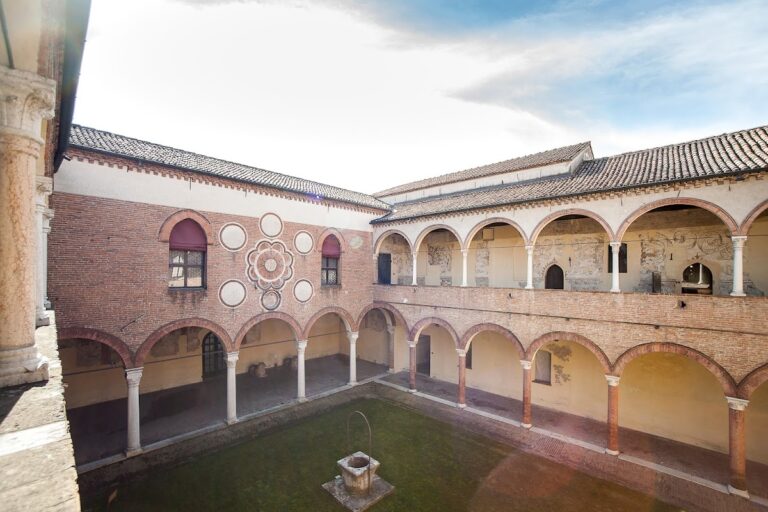
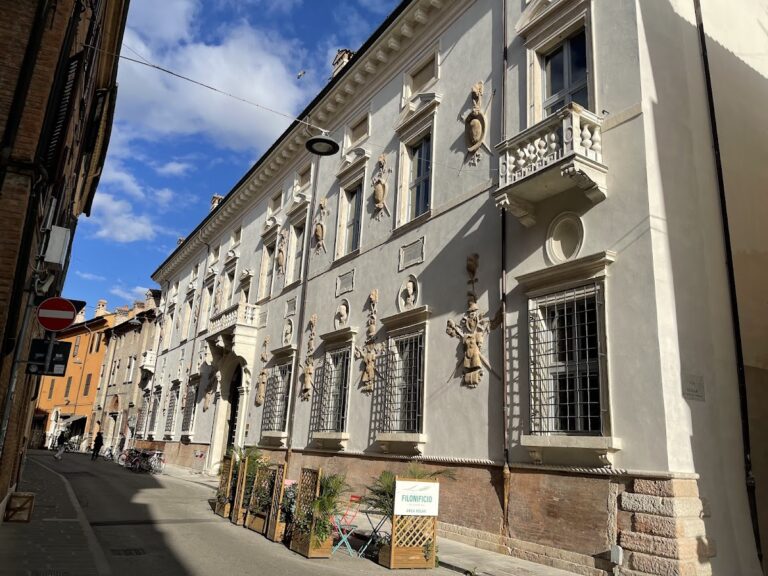
The palazzina is a low, elongated brick building facing a busy street. Its exterior is distinguished chiefly by a prominent portal. Behind it survives part of the larger garden that once extended toward Palazzo Bonacossi. The grounds include a restored fifteenth-century wellhead bearing the emblems of the Este family, as well as the frescoed false loggia and a later fountain.
Garden and loggia
Frescoed false loggia
The remaining garden leads to a false loggia whose painted decoration imitates a vine-covered pergola. Grapes, birds, squirrels, and monkeys animate the frescoed design. The structure was formerly open toward the garden and provided a setting for concerts and small theatrical performances. Its restoration in 1938 included work by Augusto Pagliarini.
Garden fountain
The garden fountain was built during the extensive restoration campaign of the late 1930s. It remained undecorated until 1951, when the city placed Giuseppe Virgili’s Putto, made in 1935, above it. The sculpture was restored in 1998 under the direction of the Civic Museums of Ancient Art. In 2006 Maurizio Bonora made a copy for the fountain, allowing the original to be moved indoors. It was first placed in the Sala di Fetonte and later transferred to the Sala degli Armadi. The fountain, flowerbeds, and water and electrical systems were also restored or renewed, and a commemorative plaque was installed in June 2015.
Interiors and decorative schemes
The interiors contain sixteenth- and seventeenth-century furniture, along with ceilings decorated with frescoes, grotesques, and mythological scenes. Grotesques are ornamental compositions combining fanciful plants, animals, figures, and architectural forms. Several ceiling paintings were remade during twentieth-century restoration, with contributions from Giuseppe Mazzolani, Errico Giberti, Luigi Guerresi, and Augusto Pagliarini. The ceiling decoration is generally attributed to the workshop of the Filippi, a local artistic workshop, whose grotesques are noted for their inventiveness and refinement.
Sala delle Imprese
The Sala delle Imprese, also known as the Sala Rossa, has a richly decorated ceiling attributed to Bastianino, a Ferrarese Renaissance painter. Its imagery contains many representations of the exploits or emblems of Francesco d’Este. The room contains or has displayed medals and coins connected with Francesco, a marble bust of Ercole I d’Este by Sperandio Savelli, and the relief Madonna in trono con San Giorgio a guerriero orante, attributed to the workshop of the Lombardi. A mid-sixteenth-century portrait of Alfonso I d’Este by an unknown artist came from the Donà delle Rose collection in Venice.
Loggetta dei Ritratti
The Loggetta dei Ritratti was formerly open toward the garden and is dominated by elegant grotesque decoration. Two oval portraits show Francesco d’Este’s daughters, Marfisa and Bradamante, as children. The room also displays the presumed Ritratto di Marfisa d’Este, a twentieth-century copy made by Mario Capuzzo after an original preserved in Mantua.
Sala di Fetonte
The Sala di Fetonte has lost its original decorative scheme. One wall contains an elegant sixteenth-century washbasin carved from stone, while examples of Ferrara ceramics are displayed in the room. A ceiling painting shows Apollo driving the sun’s chariot. It was once incorrectly interpreted as Phaethon’s chariot plunging into the Eridanus, and partly echoes a fresco by Primaticcio preserved at Palazzo Te in Mantua.
Sala dei Banchetti
The Sala dei Banchetti retains the characteristic furnishings of a dining room. Its walls show scenes of the Battle of the Amazons in sumptuous carved and gilded frames influenced by the style of Andrea Sansovino, a major Renaissance sculptor and architect. The ceiling is the most complex in the palazzina. Vegetal motifs divide it into compartments filled with scenes from Francesco d’Este’s exploits and episodes from Ovid’s Metamorphoses, the classical poem about myths of transformation.
Studiolo
The Studiolo, a small study or cabinet room, contains important sixteenth- and seventeenth-century furniture. Its displayed works include a portrait of Licia Martinengo by an unknown artist from the second half of the sixteenth century and a mandola from the second half of the eighteenth century. The wooden ceiling was acquired on the antiquities market from a Venetian residence of the Donà family.
Sala Grande
The ceiling of the Sala Grande rises to a central pavilion supported by putti, small winged child figures commonly used in Renaissance and Baroque art. Two large seventeenth-century sacristy cupboards stand against the walls. These are substantial storage cabinets of the kind traditionally used in a church sacristy. The room also displays ancient ceramics from different geographical areas.
Sala del Camino
The Sala del Camino is dominated by a monumental sixteenth-century open fireplace attributed to the sphere of the Lombardi. Its walls display the late-sixteenth-century Ritratto di gentiluomo and the seventeenth-century Flemish tapestry Giuditta decapita Oloferne. The furnishings include a Venetian walnut chest with gilded details, a sixteenth-century Tuscan cabinet shaped as a studiolo with compartments and small sculptures, and a classical bust of the emperor Lucius Verus as a child.
Sala degli Armadi
The Sala degli Armadi takes its name from a cupboard associated with the Venetian area and incorporating original sixteenth-century parts. It preserves the original of Giuseppe Virgili’s Putto, transferred indoors after the copy was installed on the garden fountain.
gatna
Nearby sites