Palacio de las Dueñas: A Historic Palace of the House of Alba in Seville


Site at a Glance
- Rating
- 4.4
- Popularity
- High
- Country
- Spain
- Primary era
- Early Modern
- External website
- Open
- Eras represented
- Medieval, Early Modern
- Civilizations
- Crown of Castile, Spanish
- Site type
- Domestic
- Remains
- Palace
On this page14 sections
History
Palacio de las Dueñas is a historic palace in Seville, Spain, built by Sevillian noble families in the fifteenth century and transformed from a Gothic-Mudejar residence into a Renaissance palace with Plateresque decoration between the late fifteenth and early sixteenth centuries. It became the property of the House of Alba in 1612 and remains associated with that aristocratic dynasty.
From the Pineda property to a noble residence
The earliest houses on the site belonged to Juan de Pineda, a municipal official whose family had been established in Seville by the early fifteenth century. Pedro de Pineda sold the property to Catalina de Ribera in 1496. A seventeenth-century tradition gives the date as 1483 and connects the transaction with the ransom of Pedro de Pineda, but that explanation is regarded as legendary.
Catalina de Ribera, a prominent Sevillian noblewoman and patron of Renaissance architecture, undertook a comprehensive rebuilding of the property. She added the chapel and began its transformation into a Gothic-Mudejar residence, a type of Iberian architecture combining Christian building forms with Islamic decorative techniques. Her son Fernando Enríquez de Ribera inherited the palace in 1505. He completed the chapel’s decoration, commissioned Alonso de León to paint the galleries in 1516, and enlarged the estate through purchases from the Brotherhood of San Bernardo in 1517 and other additions made between 1515 and 1522. The work continued under his widow, Inés de Portocarrero.
Expansion and the House of Alba
Fernando Enríquez de Ribera y Portocarrero inherited the palace in 1546. Restoration and additions followed in 1571 and 1572, when the gardens were also renewed. In 1595 the property passed to Enríquez de Ribera y Córdoba, marquis of Villanueva del Río.
Antonia Enríquez de Ribera, marchioness of Villanueva del Río, married Fernando Álvarez de Toledo y Mendoza, fourth duke of Alba de Tormes, on 9 February 1612. Through this marriage, the palace entered the House of Alba, one of Spain’s major aristocratic dynasties. A duke or duchess of Alba de Tormes holds one of the dynasty’s principal hereditary titles.
The palace takes its name from the nearby Cistercian monastery of Santa María de las Dueñas. Founded in 1251, the monastery housed nuns of a Catholic order that developed from the Benedictine tradition. They served the religious needs of queens and royal wives associated with Ferdinand III of Castile and his son Alfonso X. The monastery was exclaustrated and demolished in 1868.
Later alterations and restoration
The twelfth duke of Alba built the principal entrance portal in 1771. Parts of the property were ceded during the eighteenth century, including land associated with the Colegio del Espíritu Santo. Adjoining parcels were later incorporated, among them land at the eastern end of Dueñas Street in the twentieth century.
During the nineteenth century, Jacobo Fitz-James Stuart y Ventimiglia, fifteenth duke of Alba, divided the palace into apartments and rented them to about twelve families. Restoration began around 1885 and continued during the twentieth century. Jacobo Fitz-James Stuart y Falcó, seventeenth duke of Alba and tenth duke of Berwick, carried out major restoration works. Further restoration and maintenance followed under María del Rosario Cayetana Fitz-James Stuart, eighteenth duchess of Alba.
Antonio Machado was born in the palace in 1875 and lived there with his family until 1879. His writings and a 1913 autobiographical note recalled its patios and rooftops. Seville City Council installed a commemorative plaque on the façade in 1985. Carlos Falcó y Fernández de Córdoba, marquis of Griñón and marquis of Castel-Moncayo and a grandee of Spain, was also born there.
The palace was the Seville residence of Cayetana Fitz-James Stuart, eighteenth duchess of Alba. She held her 1947 wedding reception there, celebrated her third marriage at the palace in 2011, and died there in 2014. In 1947, approximately 3,000 people attended the wedding reception. One thousand meals were distributed to poor residents of Seville, while Cayetana’s father gave 5,000 pesetas to each of the nine couples marrying in the city that day.
Visitors, memory, and protection
During the nineteenth century and the first half of the twentieth, the palace accommodated or received a range of literary, political, artistic, and royal figures. Lord Holland held literary gatherings there in 1808. Antonio Machado Álvarez and Ana Ruiz moved into an apartment in 1875, while the painter Salvador Clemente Pérez maintained a studio that Juan Ramón Jiménez visited in 1896 and 1897. In 1927 the palace hosted a dinner for the Prince of Wales and the Duke of York, later Edward VIII and George VI.
Eugenia de Montijo, wife of Napoleon III and a relative of the House of Alba, stayed at the palace in April 1920 while meeting Alfonso XIII and Victoria Eugenia. Guglielmo Marconi and María Cristina Bezzi-Scali visited in 1928, and Cole Porter and Arthur Rubinstein were also received there. Rubinstein gave a piano performance. In 1966 the palace hosted a dinner for Jackie Kennedy, attended by Prince Rainier III of Monaco and Grace Kelly.
The name Departamento de Montellano recalls the accommodation of members of the Montellano family there in late 1936. The palace also preserves a letter from Prosper Mérimée to the countess of Teba, Eugenia de Montijo’s mother, recounting part of the plot of Carmen, apparently based on a story she had told him. A facsimile of the letter was issued in Paris in 2021.
Palacio de las Dueñas was declared a Spanish asset of cultural interest on 3 June 1931. Its collection of 1,425 movable works was collectively inventoried and protected under Andalusian heritage law in 2009 and 2010. The protected objects cannot be sold or removed without authorization, and the property and its contents are to be preserved together. In 2016, Carlos Fitz-James Stuart y Martínez de Irujo, nineteenth and present duke of Alba de Tormes, authorized public visits to the palace and gardens after the death of the eighteenth duchess, who had maintained it as a private residence.
Remains
Complex, entrance, and gardens
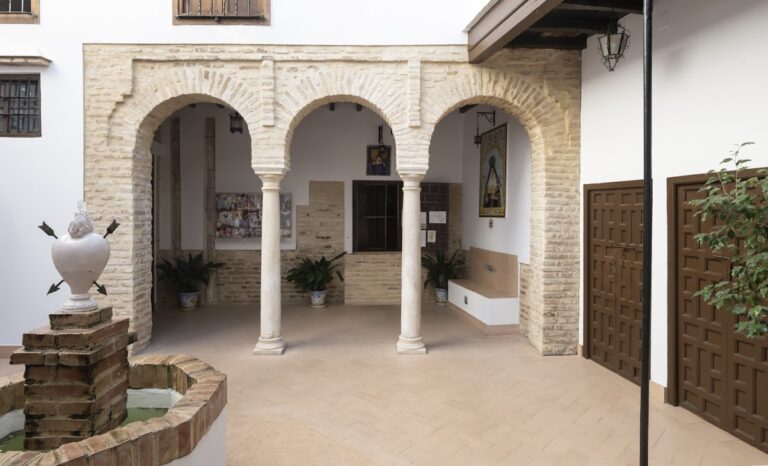
The palace occupies approximately 9,000 square metres, with about two-thirds of the area built over. Several buildings are arranged around patios and gardens, combining Gothic-Mudejar, Renaissance, and Plateresque forms. The principal entrance, constructed in 1771, carries the duke of Alba’s coat of arms. Its main arch also contains a ceramic version of the arms made in Triana during the seventeenth or eighteenth century.
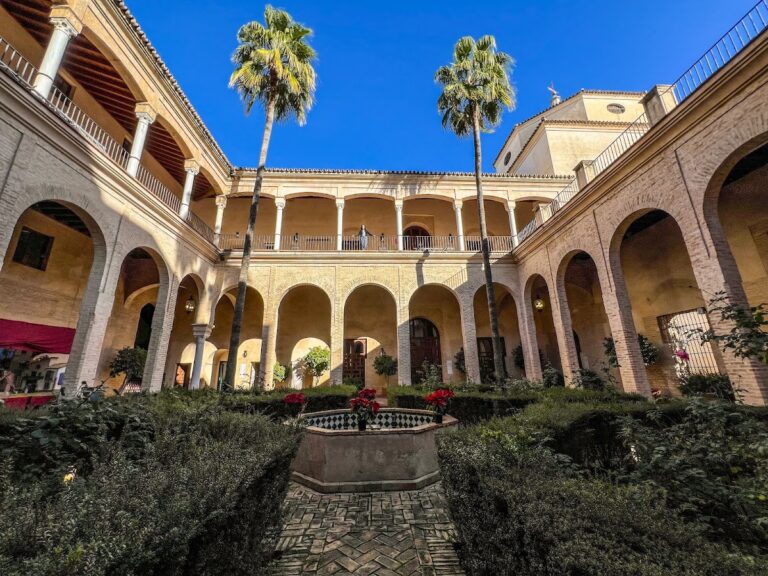
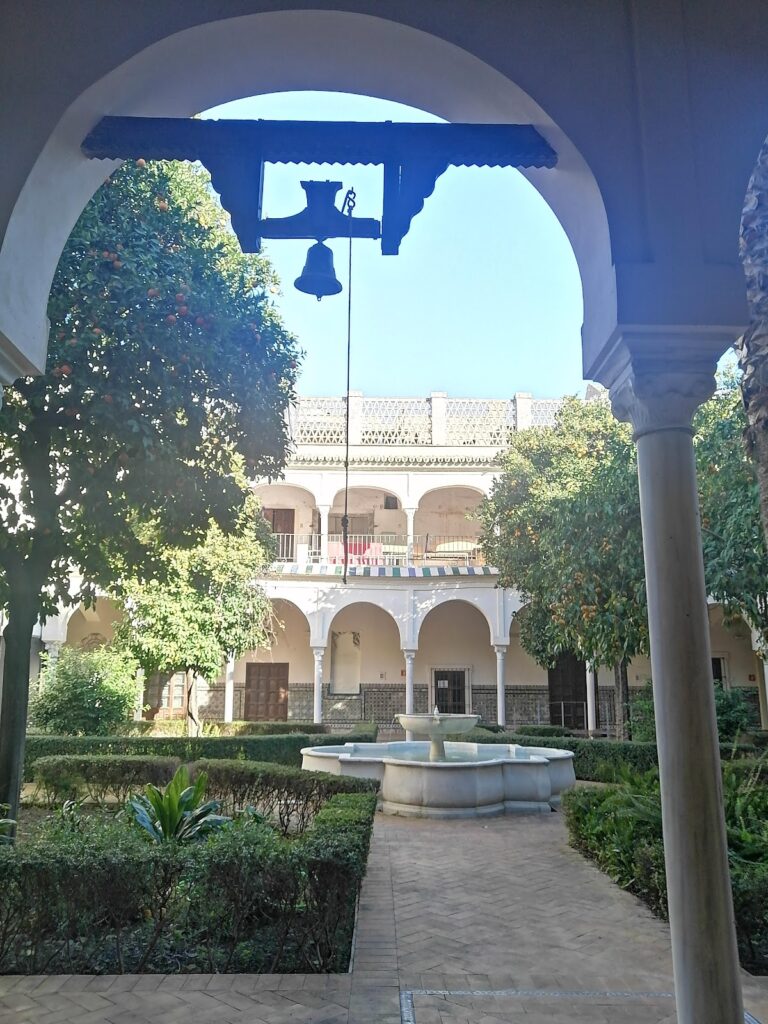
The entrance opens onto a former mounting court, a courtyard used for arrival on horseback or by carriage, and a garden planted with orange trees, palms, and myrtles. Jacobo Fitz-James Stuart created the present landscaping between 1910 and 1920. The eighteenth-century court has pillars resting on Roman cippi, stone monuments or markers that could serve boundary or funerary purposes. Four gardens occupy the north, south, east, and northwest parts of the complex, including the Garden of the Lemon Trees. One follows a traditional Islamic four-part plan with tiled paths and a central fountain.
Principal patio
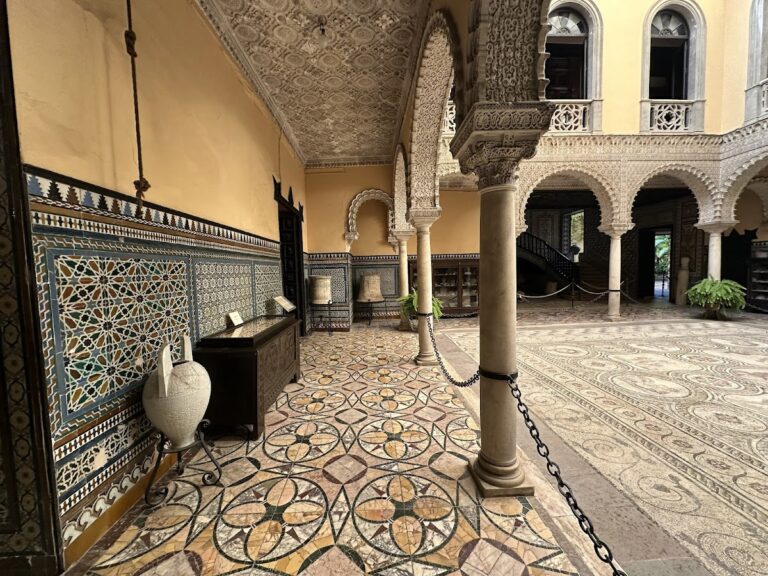
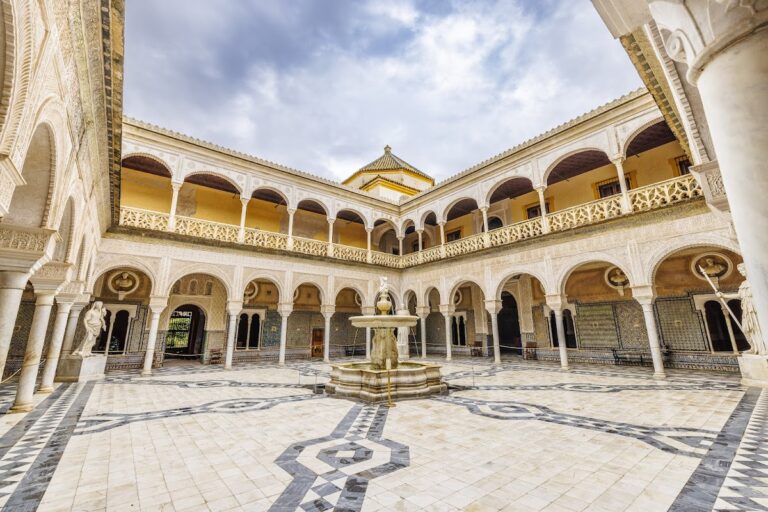
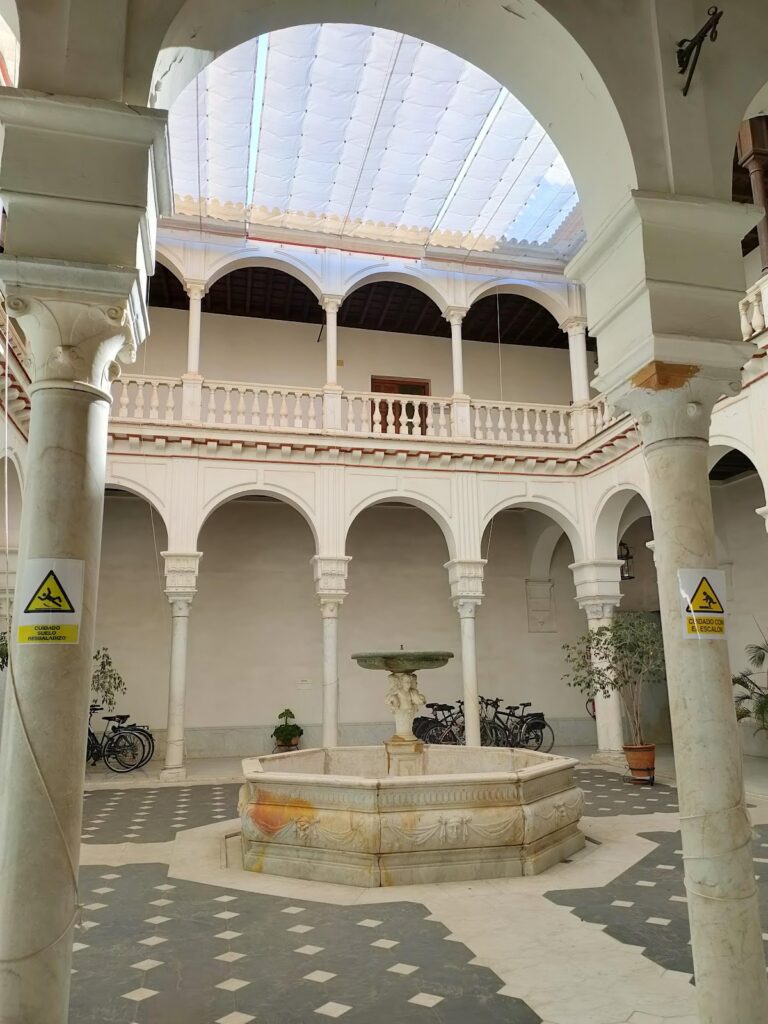
The rectangular principal patio is enclosed on all four sides by two levels of porticoed arches. White-marble columns, pilasters, Plateresque ornament, and friezes shape the lower arcade, while the upper arches are Gothic. The western portico leads to the chapel. The patio fountain has tiles made by the Pulido brothers between 1530 and 1540, and its central stone elements were renewed in 1571. The white-marble columns came from a Genoese workshop around 1540, while heraldic shields were added to their capitals between 1910 and 1920.
The patio preserves several layers of decoration. Fifteenth-century plasterwork survives on the upper arches, later covered by Mudejar alfices, rectangular ornamental frames around arches. Early sixteenth-century plasterwork appears in the frieze and salon doorways, alongside Mudejar plaster friezes from Catalina de Ribera’s period. Mudejar frescoes in the northwest corner of the upper gallery date from the second half of the fifteenth century. Alonso de León painted the frescoes in the remaining upper and lower galleries in 1516, and the lower galleries retain sixteenth-century tiles made by the Pulido brothers.
Patio del Aceite and chapel
The western Patio del Aceite has a tiled central fountain, surviving fifteenth-century paving, and frescoes attributed to Alonso de León and probably painted in 1516. A staircase from the mounting court gives access to its upper rooms. The chapel is rectangular and divided into two bays covered by tierceron vaults, ribbed vaults with additional diagonal ribs. The vaults rest on corbels decorated with angels. Those on the Gospel side carry pincers, a hammer, a column, and the Cross; those on the Epistle side carry the Crown of Thorns, the Holy Face, and a lance.
The chapel has early sixteenth-century tiled dadoes, the decorated lower portions of the walls, a Gothic portal, and a Plateresque interior. Its main altarpiece was made by Neri di Bicci in the late fifteenth century and contains a painting of Saint Catherine of Siena among saints. The chapel also contains images of Christ of the Gypsies, the Virgin of Macarena, and Jesus of Great Power. The fifteenth-century chapel was damaged during a later restoration.
Staircase and reception rooms
The main building is reached by a large two-flight staircase renovated in 1571 by the carpenter Martín Infante, later chief master of carpentry at the Alcázar. Its Mudejar coffered ceiling leads to the main reception hall, hall of honor, and winter dining room. A first-floor room has a gilded octagonal alfarje, a decorated wooden ceiling made from interlaced and carved timber, supported by an arrocabe, the timber framework beneath a ceiling.
The Piano Room has an octagonal domed ceiling from Catalina de Ribera’s period. The Blue Room retains a Mudejar coffered ceiling bearing phrases dedicated to the Virgin Mary. Other interiors include the Chinese Room, the Salón de la Gitana or Ballroom, the Salón Imperio, the library, the Salón de los Carteles, the Chapel Ante-room, and the Montellano Department. The library has a Mudejar artesonado, a coffered or patterned wooden ceiling, decorated with vegetal motifs and heraldic shields.
The Piano Room contains four Flemish tapestries, while the upper gallery has an eighteenth-century Flemish tapestry and a seventeenth-century ceramic shield of the duke of Alba. The Salón de la Gitana takes its name from Mariano Benlliure’s twentieth-century bronze sculpture La gitana flamenca. It contains seventeenth-century Flemish and Brussels tapestries, including works associated with the workshops of Frans van den Hecke and Jan Raes the Younger.
Art and archaeological collection
The palace contains 1,425 inventoried works of art and decorative art, including paintings, sculptures, furniture, ceramics, mirrors, clocks, tapestries, and archaeological pieces. The collection includes Spanish and Italian paintings, Flemish tapestries, Spanish and European furniture, porcelain, baroque furniture, and clocks dating from the eighteenth through twentieth centuries.
The mounting court displays Roman sculptures and archaeological pieces dating from the first century BC to the third century AD. They include a faun’s head, heads of Nero, Drusus, and Tiberius, another Roman head, a bust of a Roman general, a statue of Trajan, a togated bust of Augustus, Priapus, and Diana the Huntress. The archaeological collection also includes an Iberian lion from Olivares, the foundation tablet of the tower of El Carpio, Roman remains, a Mudejar well-rim fragment with a stamped mark, and Almohad lanterns.
Rooms and works associated with Seville
The mounting court contains two eighteenth-century tapestries and four nineteenth-century cloth hangings bearing the duke’s arms. An adjoining room contains Juan Miguel Sánchez’s Flamenco Festival, Gustavo Bacarisas’s View of Seville from a Balcony, a costumbrista scene by A. Madueño dated 1920, two anonymous nineteenth-century garden scenes, and Enrique Marín Higuero’s Exterior of a Granada Carmen.
The Cuarto de la Virgen contains Virgin of the Rose, dating from the seventeenth or eighteenth century, twentieth-century sculptures of Saints Justa and Rufina, nineteenth-century sculptures of a dancing peasant and peasant woman, and an 1840 bullfighting poster for Jerez de la Frontera. Another adjoining room has seven nineteenth-century bullfighting paintings by Joaquín Díez, three anonymous paintings of bulls in pasture, two balcony scenes by Manuel de la Rosa, and two earlier posters for the Spring Festival.
The palace preserves the carriage used by the eighteenth duchess of Alba at the Spring Festival and at her 1947 wedding. The Salón de los Carteles contains late nineteenth- and early twentieth-century Spring Festival posters, the suit of lights given by the bullfighter Curro Romero to the duchess, and a cape belonging to José María Dols Samper. The library includes an anonymous poster for a bullfighting event organized by the Royal Cavalry Maestranza of Seville in 1826 and a nineteenth-century marble bust of a woman.
Chapel, library, and dining rooms
The Chapel Ante-room contains works including The Descent from the Cross by Annibale Carracci, a portrait of Cardinal Íñigo López de Mendoza y Zúñiga, Sebastian I of Portugal by Sofonisba Anguissola, The Annunciation by Baroccio of Urbino, The Crowning with Thorns by José de Ribera, Saint Anthony of Padua and Saint Teresa of Jesus by Luca Giordano, and a nineteenth-century replica of Murillo’s Saints Justa and Rufina. The chapel itself contains paintings by Juan de Villoldo and Francisco Antolínez, an anonymous Virgin of Guadalupe, an anonymous Saint Ferdinand, a seventeenth-century Crucifix, and a nineteenth-century sculpture of Saint Anthony of Padua.
The library includes landscapes and architectural scenes by Jacob Philipp Hackert, Albert, Alexandre Calame, Clément Castelli, Mirjam Kuitenbrouwer, C. H. Giraud, and anonymous artists. Its portraits include an eighteenth-century painting of Amalia of Saxony and a nineteenth-century portrait of Cardinal Ludovisi. The main staircase displays paintings of the delivery of Seville’s keys to Saint Ferdinand, a thirteenth-century king associated with the Christian conquest of Seville, as well as naval scenes, portraits, religious figures, and a Flemish tapestry.
The main dining room contains Giovanni Paolo Panini’s View of the Roman Forum, Ignacio Zuloaga’s childhood equestrian portrait of Cayetana de Alba from around 1939, works by Manuel Cabral Aguado-Bejarano, three nineteenth-century tapestries with the duke’s arms, and an eighteenth-century Chinese screen showing landscapes and buildings. The Salón Chino has anonymous nineteenth-century paintings of a majo with a country blanket and the Immaculate Conception. Its dining-room ante-room contains religious and genre scenes, Mariano Benlliure’s 1916 bronze bust of Pastora Imperio, and a waistcoat from the bullfighter Espartero’s suit of lights.
Portraits, tapestries, and family possessions
The Salón de la Gitana contains paintings from the sixteenth to twentieth centuries, including Pyramus and Thisbe, Salome Receiving the Head of John the Baptist, The Creation of Eve by Francesco Furini, works by Marco Maracuola and Giulio Cesare Procaccini, flower still lifes, flamenco scenes, Andalusian subjects, and landscapes. The Montellano Department contains Panini’s General Belisarius Receiving Alms among Palace Ruins, replicas of portraits of the eighth count of Montijo and the twelfth duke of Alba, Venetian views, genre and bullfighting scenes, and twentieth-century works including Bullfighter, Woman Dancing with Castanets, and View of the Main Patio of Palacio de las Dueñas by Luis Huidobro.
The Patio del Aceite staircase displays portraits by Federico Madrazo of the duke and duchess of Aliaga, along with works by Gustave Boulanger and Manuel Benedito. Its adjoining upper department contains views of Seville, Granada, Venice, the Guadalquivir, the Giralda, the Torre del Oro, Triana, and El Carpio, as well as scenes of flamenco life, gardens, religious processions, rural landscapes, and Alba family members. Artists represented there include Manuel García Rodríguez, José García y Ramos, Julio Romero de Torres, Ignacio Zuloaga, Ramón Casas, Alfonso Grosso, Eduardo Chicharro y Agüera, Rafael Botí, Carmen Laffón, and John Frederick Lewis.
The Salón Imperio contains portraits of duchesses of Santoña, Alba, Berwick, and Medinaceli, as well as portraits of Jacobo Fitz-James Stuart y Ventimiglia and an anonymous woman in black. Four nineteenth-century bullfighting paintings by Joaquín Díez hang there, together with a watercolor of the palace made by Jackie Kennedy during her 1966 visit and dedicated to Cayetana.
The palace also holds a clay model of Pastora Imperio made by Luis Álvarez Duarte in 2005. It served as the model for a bronze statue inaugurated in central Seville in 2006 with the patronage of the eighteenth duchess of Alba. Objects associated with Eugenia de Montijo and Napoleon III include portraits, a porcelain statue made by Savary in Paris, a painting by Philip Villamil, copies of portraits by Franz Xaver Winterhalter, and anonymous nineteenth-century works. The stables preserve her cotton riding saddle with Granada-made bands and tassels, embossed leather saddlebags with Mudejar motifs, and a Mexican poncho.
Across the palace, Spanish and European furniture stands alongside planters, candlesticks, chairs, sofas, tables, chests, vases, mirrors, and clocks. Ceramics, curtains, carpets, and Flemish tapestries dating from the sixteenth through twentieth centuries complete the collection and connect the surviving rooms with the long history of the residence.
Nearby sites