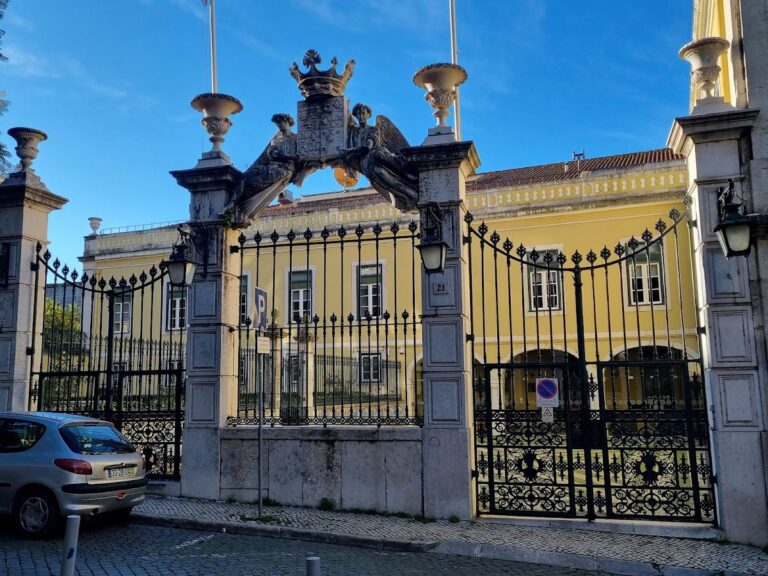
Palácio da Bemposta: A Royal Palace and Military Academy in Lisbon


Site at a Glance
- Rating
- 4.4
- Popularity
- Low
- Country
- Portugal
- Primary era
- Early Modern
- Eras represented
- Early Modern, Modern
- Civilizations
- Portuguese
- Site type
- Domestic
- Remains
- Palace
On this page11 sections
History
Palácio da Bemposta is a royal palace in Lisbon, Portugal, created from 1694 as a residence for Queen Dowager Catherine of Braganza. Its present form is a neoclassical building, while its history reaches back to Catherine’s return from London in 1693 and the earlier chapel already standing on the property.
Catherine of Braganza and the palace foundation
After returning to Lisbon, Catherine initially stayed in the houses of Portuguese nobles. She then purchased houses and land at Bemposta from Francisca Pereira Teles for her own residence. A chapel dating from 1501 stood on the site, and Catherine ordered it incorporated into the palace complex under the dedication of Nossa Senhora da Conceição, or Our Lady of the Conception.
The palace project began in 1694 under the court architect João Antunes, who remained involved by 1702. Catherine was living at Bemposta by that year. She died there on 31 December 1705 and left the palace to her brother, King Peter II of Portugal. A royal chapel was constructed on 29 October 1706.
The Casa do Infantado
In 1707, King John V incorporated Bemposta and its grounds into the Casa do Infantado, the royal estate and household assigned to the younger sons of the Portuguese monarch. The palace subsequently housed Infante Francis, Duke of Beja, and his son João da Bemposta, whose name reflected his residence there.
The Lisbon earthquake of 1755 caused extensive damage and completely destroyed the royal chapel. Manuel Caetano de Sousa directed the rebuilding and remodeling, including the creation of an elaborate new chapel. Bemposta maintained its own singers, including an organist, from 1759, although the organ had been transferred to the Palace of Queluz by 1778.
Decline and royal restoration
As the royal family increasingly preferred other residences, Bemposta was used less often. By 1798, the palace was falling into ruin. In 1803, the Prince Regent, the future King John VI, returned it to use as a royal residence.
After the royal family returned to Lisbon in 1821, John VI ordered renovations in 1822, 1824, and 1825. The work focused principally on rooms behind the chapel and on the floor adjoining the gardens. Political and military struggles over the direction of Portugal’s constitutional monarchy, including the Vilafrancada and Abrilada insurrections, unfolded at Bemposta. John VI died in his personal quarters there on 10 March 1826.
Transfer to the army and modern status
From 1828, King Miguel I held weekly audiences at the palace. The Casa do Infantado designation was removed in 1833, and the property became part of the Crown estate. A formal political administration occupied the building until 18 March 1834, after which it was vacated and returned to the Crown under Queen Maria II.
Maria II transferred Bemposta to the Portuguese Army in 1837. Extensive remodeling in 1850 and 1851 prepared it for use as an Army Academy. Under General Bernardo de Sá Nogueira de Figueiredo, first Marquess of Sá da Bandeira, the building was expanded and its interiors were remodeled. The chapel, previously a private royal hermitage, opened to the wider religious community in 1853.
Urban changes reduced the area in front of the palace, and the widening of the road led to the shortening of the main exterior staircase in 1860. The chapel underwent a complete restoration in 1944. Its electrical and fire-prevention systems were renovated in 1997, and an assessment of the palace’s architectural condition began on 13 September 1999. The palace now houses the Portuguese Military Academy and belongs to the Portuguese Republic. It is a Property of Public Interest, while the attached chapel has been a National Monument since 19 February 2002. A monument to Catherine of Braganza was installed before the façade in 2001.
Remains
Palácio da Bemposta is a neoclassical complex at Largo do Paço da Rainha, on the eastern edge of Pena adjoining Anjos in Lisbon. Its principal building faces the square opposite the clock tower and Mitelo Palace, near the Quartel do Cabeço da Bola, the Jardim do Campo Mártires da Pátria, and Miguel Bombarda Hospital. Limestone and marble appear in many decorative elements, while reinforced steel, wood, and masonry form part of the structure.
Palace façade and entrance
The principal façade is organized around two curving staircases that rise to the main floor and a veranda with balusters. An arched central doorway is flanked by two groups of tall windows. Above them, a secondary-floor veranda and central window are similarly framed by paired window groups. The upper central window is substantially taller than the others and carries a sculpted coat of arms of the royal family. Catherine of Braganza’s coat of arms remains above the principal doors.
The façade terminates in a triangular wall bearing a relief of two seraphs adoring the Virgin Mary. Joaquim de Barros Laborão made the relief, which is surmounted by a cross set above a plinth. The chapel atrium contains two niches with statues of Elizabeth of Portugal and John the Baptist. José de Almeida began these statues, and Barros Laborão completed them.
Chapel interiors
Vestibule and nave
The rebuilt chapel has a rectangular vestibule and nave decorated with polychromatic mosaics. Its main altar holds a portrait of the royal family, including Queen Maria I and Infante John with the court. The painting also presents a view of Lisbon from the Castle of São Jorge. Craftsmen from the Church of São Roque, especially those associated with the Chapel of São João Baptista, contributed to the chapel’s woodwork. Its design adopted an aesthetic similar to that of the Royal Chapel at the Palace of Queluz.
Main chapel
The main chapel contains a figure of its patron saint by Giuseppe Troni. Portraits of members of the royal family, including Maria I, John VI, and Carlota Joaquina, occupy the foreground and were painted by the English artist Thomas F. Hickey. An oval ceiling molding contains a painting of the Virgin attributed to Pedro Alexandrino de Carvalho.
The side walls contain pulpits enclosed by balusters, and the organ is positioned on the left. Pedro Alexandrino’s identifying initials appear on the side altars except for the second epistle altar. His ceiling painting of the Assumption of Mary presents the Virgin being taken into heaven within a complex Baroque composition, surrounded by cherubs and the four Doctors of the Church, Augustine, Ambrose, Gregory the Great, and Jerome. The chapel ceiling also contains his painting of the Transfiguration.
Sacristy
The sacristy opens from the left side of the main altar. Its walls are lined with polychromatic azulejos, painted ceramic tiles widely used in Portuguese architecture, and it contains a credence table made of Brazilwood.
Nearby sites