Palace of Laredo: An Eclectic Neo-Mudejar Residence in Alcalá de Henares


Site at a Glance
- Rating
- 4.4
- Popularity
- Medium
- Country
- Spain
- Primary era
- Modern
- Eras represented
- Modern
- Civilizations
- Spanish
- Site type
- Domestic
- Remains
- Elite Residence
On this page9 sections
History
The Palace of Laredo is an eclectic Neo-Mudejar residence in Alcalá de Henares, Spain, built between 1880 and 1884 during the nineteenth-century revival of medieval Islamic architectural forms in Iberia. Manuel José de Laredo y Ordoño founded and built it as his family’s habitual home, rather than as a hotel, and the building was inaugurated on 14 April 1884. Its combination of historic references and elaborate decoration reflected Laredo’s own activities as a restorer, builder, painter, decorative artist, and scenographer.
Construction and ownership
Laredo himself authored the project, while Juan José de Urquijo served as its architect. The palace was conceived as an isolated single-family residence and was associated with Laredo’s varied artistic interests. He later became mayor of Alcalá de Henares from 1891 to 1893 and a member of the Royal Academy of San Fernando.
In 1895, Laredo sold the palace to his creditor, Carlos Eduardo Lardet Bovet, a watchmaker and Swiss consul. Laredo subsequently moved to Madrid, where he died the following year. Vicente Villazón Fernández acquired the property in 1918 and renamed it Quinta Concepción. In 1942, the Luque brothers and Ángel Aguiar purchased it, divided the surrounding estate, and sold the resulting plots. The Aguiar-Luque heirs donated the palace to the municipality of Alcalá de Henares in 1973.
Protection and university use
The palace was declared a Spanish cultural-heritage monument in 1975 and is listed as a non-movable monument under reference RI-51-0004172. During the 1980s, the architect Genoveva Christoff Secretan directed its restoration. After the work was completed in 1988, the municipality transferred the building to the University of Alcalá. It remains municipal property while being managed by the university.
The building now houses the Cisnerian Museum and the Cisnerian International Centre for Historical Studies. The University of Alcalá created the centre in 1996 to study Cardinal Francisco Jiménez de Cisneros, a Spanish cardinal, church official, political adviser, and patron of learning associated with the historic University of Alcalá. Its research also addresses mendicant orders, religious communities traditionally supported by charitable donations and devoted to preaching and pastoral work, the former University of Alcalá, its founder, and the historical development of Guadalajara and Alcalá de Henares.
The centre’s present facilities were inaugurated in the palace on 20 November 2001. They include a documentation centre containing approximately 150,000 microfilms of historical documents and a specialist library devoted to the history of the former University of Alcalá. The Cisnerian Museum presents documentary and personal material connected with Cisneros, including period portraits, his chalice, and his will.
The museum’s holdings also include an original edition of the Complutensian Polyglot Bible and the Antwerp Polyglot Bible. A polyglot Bible presents several biblical languages in parallel. The museum permanently displays one surviving copy of the six-volume Complutensian edition, printed in Hebrew, Greek, Latin, and Aramaic. It was the first complete polyglot edition of the Bible, and 123 of the 600 copies published are known to survive. Four volumes of the Antwerp Polyglot Bible, also called the Biblia Regia, are held by the museum. Philip II commissioned that edition from Benito Arias Montano, a Spanish biblical scholar and humanist who directed its preparation.
Remains
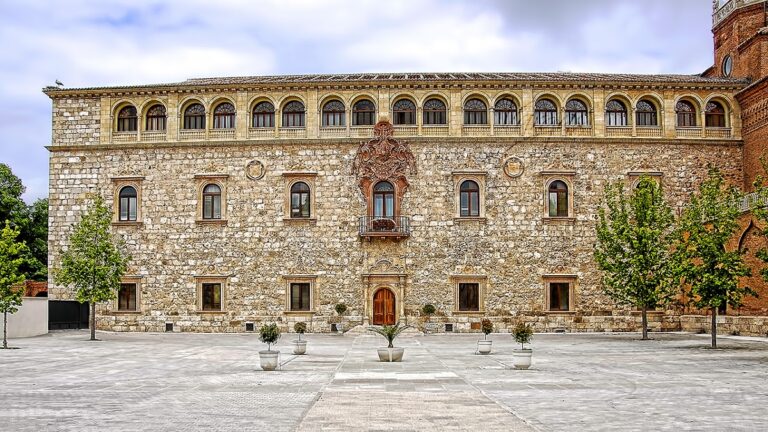
The Palace of Laredo stands on Paseo de la Estación as a richly decorated brick building surrounded by one of Alcalá de Henares’ few surviving Romantic gardens. Its physical character comes from the combination of an eclectic plan and varied historical references. Exposed brick provides much of the exterior decoration, while a projecting minaret with a clock rises above the building. The palace brings together Neo-Mudejar forms with Gothic, Renaissance, Pompeian, and modernist elements rather than adhering to a single stylistic system.
Exterior and garden
The building’s Neo-Mudejar character adapts forms and ornament associated with medieval Islamic architecture in Iberia, including an extensive use of brick and decorative tilework. Its design was also influenced by the Arts and Crafts movement linked with William Morris, a nineteenth-century British reform movement that emphasized craftsmanship and the unity of architecture with the decorative arts. The surrounding Romantic garden forms part of the surviving physical setting of the residence.
Decorated interiors
Rooms and ornamental finishes
Inside, ornamental plasterwork, oriental-inspired tiles, and frescoes with Pompeian and Plateresque motifs create a sequence of individually designed rooms. Some spaces draw on the Alhambra, the historic palace and fortress complex in Granada known for its Islamic architecture and decorative arts. The rooms differ from one another in their painted decoration and atmosphere, so the interior is experienced as a series of distinct decorative environments rather than as a uniform scheme.
Hall of the Kings
The Hall of the Kings contains paintings of different monarchs. Its ceiling depicts the firmament as it was conceived in the Middle Ages. The room now serves as an assembly hall and conference room while retaining its historical painted decoration and celestial ceiling design.
Architectural fragments and reused pieces
Laredo incorporated 15 original archaeological pieces taken from fifteenth- and sixteenth-century buildings. Their presence makes the palace’s interiors a setting for architectural fragments as well as for newly made decoration. The pieces include a vault and columns from Santorcaz Castle, coffered ceilings from the Palace of the Marquises of Tendilla in Guadalajara, and columns from the cloister of the Convent of Jesús del Monte in Loranca de Tajuña.
Other reused elements are tiles from the palace of Peter I the Cruel in Jaén and Toledo. Together, these fragments bring material from several earlier buildings into Laredo’s nineteenth-century residence. They form part of the palace’s distinctive mixture of historical forms, in which original older elements and newly created ornament appear within the same architectural interior.