Colegio Mayor de San Ildefonso: A University College in Alcalá de Henares
Site at a Glance
- Popularity
- Medium
- Country
- Spain
- Primary era
- Early Modern
- Eras represented
- Medieval, Early Modern
- Civilizations
- Crown of Castile, Spanish
- Site type
- Civic
- Remains
- University
On this page15 sections
History
The Colegio Mayor de San Ildefonso is a university college in Alcalá de Henares, Spain, founded in 1499 by Francisco Jiménez de Cisneros, Archbishop of Toledo. Its complex combines late Gothic, Renaissance, and Mudéjar forms, an Iberian tradition drawing on Islamic art. The college anchored the historic University of Alcalá, trained clergy for religious reform, and became the university’s principal building.
Educational foundations and Cisneros’s plan
Alcalá had a history of higher education before Cisneros began his project. In 1293, King Sancho IV supported the establishment of an institution of advanced learning there. Archbishop Alonso Carrillo added chairs in grammar, logic, and theology at the Franciscan convent of Santa María de Jesús in 1473; Archbishop Pedro González de Mendoza added theology, canon law, and secular law in 1487. These foundations helped establish the city as a setting for Cisneros’s larger educational plan.
Cisneros, whose experience as a church official had exposed weaknesses in the theological education of some senior clergy, intended the new college to promote reform across his archdiocese and Castile. He placed special importance on biblical study through Latin, Greek, and Hebrew. Alcalá’s late-fifteenth-century growth offered space for the college and other schools. Choosing the city also limited the influence of Toledo’s cathedral chapter and future archbishops over the institution, despite the archbishops’ feudal authority in Alcalá and their representative palace there.
Cisneros looked to established collegiate institutions for guidance. In his 1498 petition he named the college of San Clemente in Bologna and the Colegio de San Bartolomé in Salamanca as models. The Bologna college, whose buildings were completed in 1367 around an arcaded courtyard, combined student and administrative rooms with teaching halls and a library. The Sorbonne in Paris was another precedent considered in planning San Ildefonso.
Foundation and university authority
Cisneros selected the building plot in July 1496 and sought papal authorization in 1498. A papal response dated 13 April 1499 permitted teaching in theology, canon law, the Church’s legal system, and the liberal arts, with theology taking priority. It also authorized a chapel, chaplains, and a constitution. The college and its community received privileges comparable to those of the colleges of Bologna and Salamanca and the universities of Salamanca and Valladolid. Cisneros’s petition did not propose a secular-law or medical faculty.
The papal rules for degrees allowed a faculty chair-holder to award a bachelor’s degree. Higher degrees required examination under the university chancellor, assisted by three faculty masters or doctors. Graduates were granted standing equivalent to those of Salamanca, Valladolid, and Bologna. Separate papal commissioners were assigned to defend the college’s rights, privileges, and property. The medical faculty began without papal approval, at Cisneros’s insistence, and Pope Leo X authorized it on 3 November 1514.
The abbot of the collegiate church of Saints Justus and Pastor became university chancellor. Because the abbot answered directly to the pope, this arrangement gave the university some independence from the Archbishop of Toledo and the cathedral chapter. The college rector also led the university and held extensive academic, legal, and judicial powers, including authority over civil and criminal cases involving university members. Classes began on 18 October 1508 with Pedro de Lerma lecturing on Aristotle’s moral philosophy.
Constitution, residents, and teaching
Cisneros promulgated the college’s 72-section constitution in its chapel on 22 January 1510. It set out rules for study, offices, organization, and community life. A copy was kept in the library, and the text was read aloud in the refectory at the beginning of each academic year. Later revisions included changes in 1555 and 1565 that were considered partly at odds with Cisneros’s original intentions.
Monthly assemblies brought together 33 voting fellows and 12 chaplains without votes. They decided major matters, including appointments of fellows, chaplains, and professors, and elected the rector, three advisers, and treasurer each year. An annual visitor inspected the college’s property, finances, teaching, elections, conduct, observance of the constitution, buildings, and food, and could impose penalties or require compensation for damage.
The fellows held scholarships and were normally bachelors of the liberal arts. They had to be at least 20, unmarried, outside religious orders, proficient in Latin, and within an income limit when admitted. Their support could continue for up to eight years and included accommodation, meals, clothing, medical care, and other necessities. Fellows could vote in assemblies and had library keys. The 12 chaplains were diocesan clergy selected by the rector, advisers, and fellows. Fee-paying residents, whose number was capped at ten in 1555, did not take part in fellows’ assemblies.
Students first learned Latin at a grammar college, usually for three years. They could then study Greek or dialectic and logic, followed by natural philosophy and metaphysics. At around 16, a public examination could qualify a student for a bachelor’s degree in the liberal arts. Those who continued at San Ildefonso could pursue theology, canon law, or medicine, generally taking four years to earn a bachelor’s degree in that field. The advanced licentiate qualified its holder to teach at universities throughout the Christian world; a doctorate usually followed as an honorary distinction, with the college covering the costs for former fellows.
Cisneros also planned 18 smaller colleges for poor students. He founded six, while San Pedro y San Pablo served Franciscan friars under their order; three more colleges were established after his death. These schools generally taught Latin and Greek or the liberal arts, and the Colegio de la Madre de Dios offered specialized study. Graduates could continue to a master’s degree in the liberal arts or take work as teaching assistants, tutors, administrators, or private secretaries.
Biblical scholarship and college resources
From 1502, Cisneros brought linguists and theologians to Toledo to prepare a Bible edition in its original languages. Their work over the next 15 years produced the six-volume Complutensian Polyglot, with texts in Latin, Hebrew, Aramaic, and Greek. Among the scholars were Alfonso de Zamora and Pablo Núñez Coronel, converts to Christianity in 1492 whose knowledge of Hebrew and Aramaic was valued. Several participants later held university chairs.
Cisneros supported the college from his own wealth and income, rather than the general funds of the Archdiocese of Toledo. He paid for its buildings, chapel, furnishings, and library, commissioning manuscript copies and buying printed books in several countries. The collection also included scholarly Arabic works seized in Granada, books taken after the conquest of Oran, and volumes acquired from Queen Isabella I of Castile’s estate in 1504. In 1517, he left the college his property, income, rights, shares, and books. The Colegio Mayor governed the University of Alcalá throughout its existence, and its building accommodated classes, the main library, examinations, university ceremonies, and many religious services.
Closure and later uses
The college closed as a residential university college in September 1798. After church property was confiscated and the university moved from Alcalá in 1836, the building was abandoned. Joaquín Alcober bought it at auction in 1846 with plans for silkworm raising and silk production, then sold it in 1847. Javier de Quinto and Elisa de Roda bought it in 1850 and removed artistic property from the building. The Society of Co-owners of the Former University Buildings, formed on 12 January 1851, sought to safeguard the university buildings’ artistic heritage.
The premises subsequently served a cavalry academy in 1851–1852, a Piarist school from 1861 to 1931, and the Complutense secondary school from 1931 to 1943. From 1959 to 1991, they housed a civil-service training center, later known as the National School of Public Administration and the National Institute of Public Administration. The latter opened a Museum of the History of Spanish Administration in the building in 1961 and continues to maintain an office there.
The building now houses the rectorate of the new University of Alcalá. The Luis González Robles Museum, established in October 2004 from a collection donated to the university, occupies the former college library. The facade and its first bay received national-monument status in 1914. The University and Historic Precinct of Alcalá de Henares, including the college, became a UNESCO World Heritage Site in 1998; the Cisnerian Foundational Block, which includes the college and its artistic works, received protected Monument status in 2019.
Remains
The complex’s surviving features include its main facade, college chapel, ceremonial hall, and several courtyards, shaped by building campaigns that continued into the second half of the seventeenth century. Pedro de Gumiel designed the original plan; the foundation stone was laid on 14 March 1499, and the main building was completed in 1508. The architectural language has also been described as Cisnerian, transitional, or Plateresque, an ornate form of Spanish Renaissance design.
Main facade
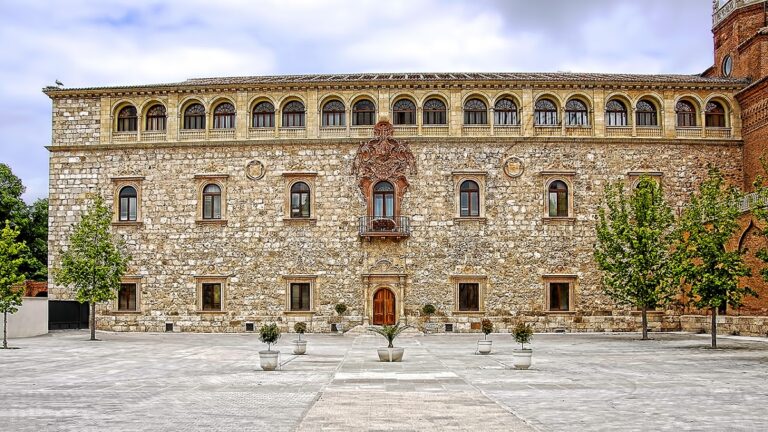
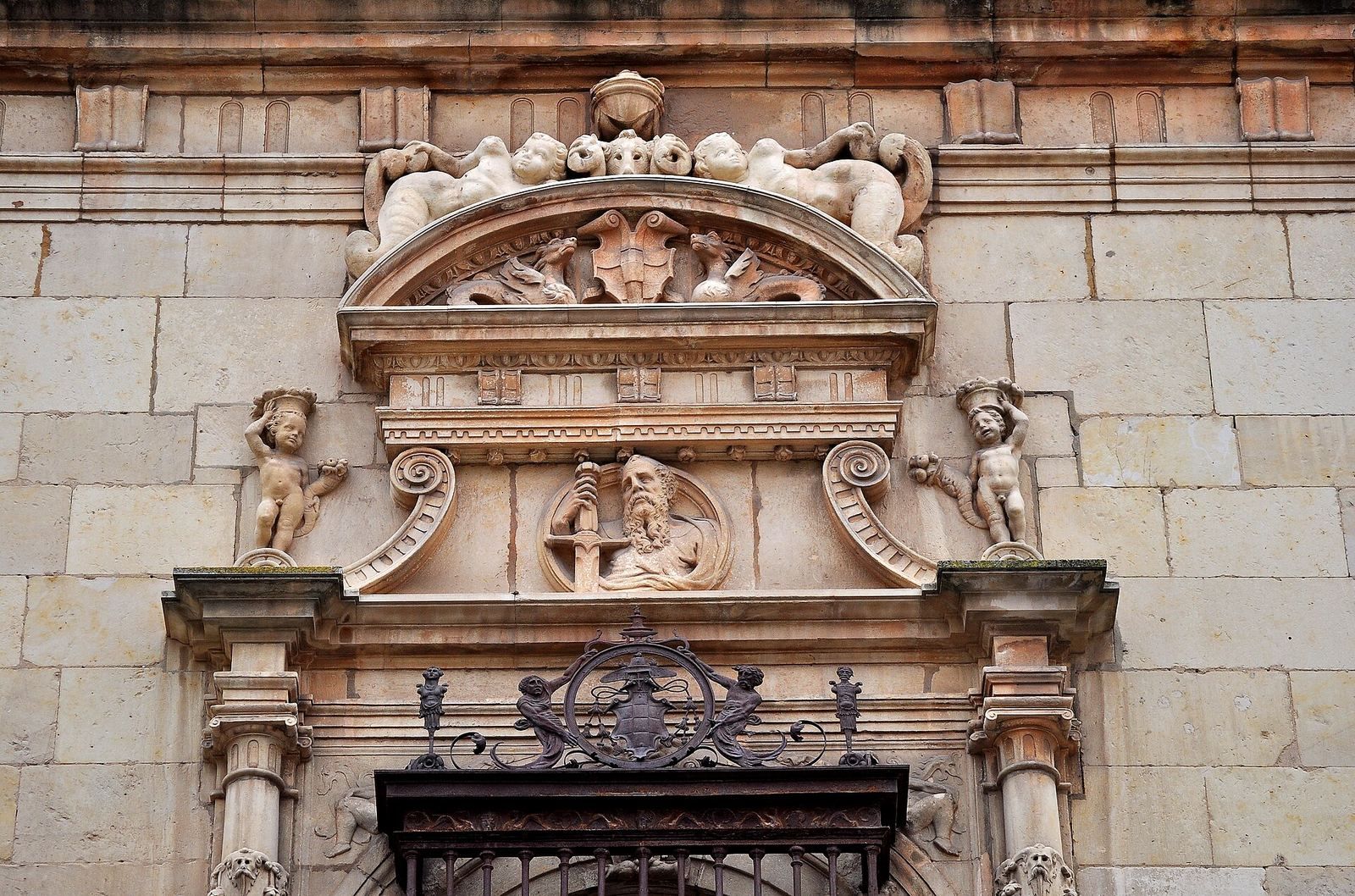
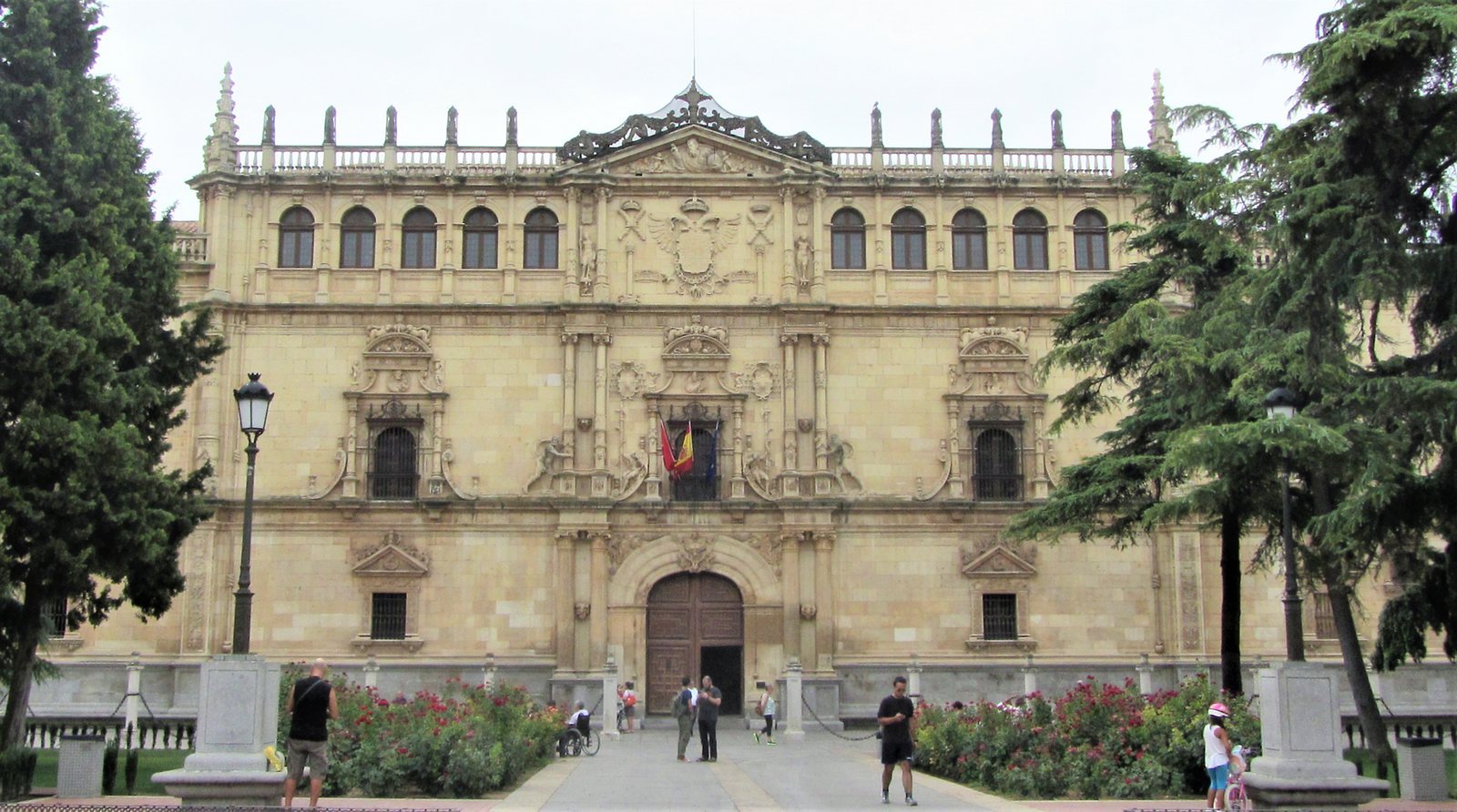
Designed by Rodrigo Gil de Hontañón, the limestone facade was begun in 1537 and completed in 1553. Its three unequal-height sections are arranged like an altarpiece, with a monumental entrance and classical column systems stacked one above another. The carved program presents stages of knowledge, with theology at its center. Four medallions above the lower windows portray the early Christian theologians Augustine, Jerome, Ambrose, and Gregory. From 1542 to 1548, Claudio de Arciniega added these works, sculpted male supports, halberdiers, and the upper window gallery.
At the center, an image of Christ as ruler of all crowns the facade, with a monogram for Christ above it and a large imperial coat of arms below. Juan Guerra sculpted the arms in 1552 to mark Charles V’s patronage of the university. They include the Pillars of Hercules, two heraldic figures, and the motto meaning “Further Beyond.”
Chapel and ceremonial hall
Chapel of San Ildefonso
Completed in 1510, the Chapel of San Ildefonso served as the college church. Francisco Vallés de Covarrubias and Elio Antonio de Nebrija are buried there. The chapel also contains the elaborate tomb made for Cisneros by Domenico Fancelli and Bartolomé Ordóñez. The monument is empty: Cisneros was buried in the Magistral Cathedral of Saints Justus and Pastor.
Paraninfo
Construction of the Paraninfo, or ceremonial hall, began in 1516. Gutiérrez de Cárdenas and Pedro de Villarroel created its plasterwork, while Andrés de Zamora, Bartolomé Aguilar, Pedro Izquierdo, and Hernando de Sahagún carried out the carpentry.
Courtyards
Patio Mayor de Escuelas
The original main courtyard of brick was replaced by the Patio Mayor de Escuelas, also called the Patio of Saint Thomas of Villanova. Juan Gómez de Mora designed the new courtyard after the earlier one was demolished in 1617; José Sopeña completed it in 1662. It has three storeys, a frieze, and a balustrade. A traditional inscription attributed to Cisneros recalls Ferdinand the Catholic’s mockery of the former courtyard’s plain appearance: “What was once built of clay is now celebrated in stone.”
Patio de Filósofos
The old Patio de Filósofos was put to industrial use in the nineteenth century after the university closed.
Patio Trilingüe
The Patio Trilingüe belonged to the College of San Jerónimo and was built by Pedro de la Cotera between 1564 and 1570. This two-level Renaissance courtyard bounds the complex on its southern side and lies beside the Paraninfo and the Hostería del Estudiante.