Paisley Abbey: A Medieval Cluniac Monastery and Parish Church in Scotland
Site at a Glance
- Rating
- 4.7
- Popularity
- Low
- Country
- United Kingdom
- Primary era
- Medieval
- External website
- Open
- Eras represented
- Medieval
- Civilizations
- Kingdom of Scotland
- Site type
- Religious
- Remains
- Monastery
On this page15 sections
History
Paisley Abbey is a medieval church in Paisley, United Kingdom, founded in 1163 as a Cluniac monastery under the patronage of Walter fitz Alan, the first High Steward of Scotland. The church developed through the Gothic period and later reconstruction, becoming an important religious foundation, a burial place for members of the Stewart dynasty, and an active parish church of the Church of Scotland.
Origins and Cluniac Foundation
An early Christian community associated with Saint Mirin, also called Saint Mirren, is traditionally placed at Paisley in the early medieval period. A shrine to the saint later attracted pilgrimage and veneration. The name Paisley may derive from the Brythonic term Passeleg, meaning “basilica” or “major church,” although this interpretation is not established.
In 1163, Walter fitz Alan established a Cluniac priory on his land at Paisley. A Cluniac priory belonged to the network of monasteries dependent on the Abbey of Cluny in Burgundy. About thirteen monks arrived from Much Wenlock Priory in Shropshire, and the new house was dedicated to the Virgin Mary, Saint James, Saint Mirin, and Saint Milburga.
The priory acquired important endowments during the thirteenth century. Alan fitz Walter, the second High Steward, granted it custody and revenues connected with the parish of Kingarth on the Isle of Bute shortly before his death in 1204. Around 1213, Walter Stewart, the third High Steward, granted timber from the forest of Sanquhar, while Gille Chriosd, lord of Tarbet, provided access to woods beside Loch Lomond for further building.
Growth, Patronage, and Medieval Conflict
Paisley monks founded Crossraguel Abbey in Carrick, Ayrshire, in 1244. The following year Paisley was raised from priory to abbey status, supported by Stewart patronage and its connection with Cluny. In 1334, the abbot received permission to wear a mitre and gained episcopal authority over churches dependent on the abbey.
The abbey suffered during the Scottish Wars of Independence, the conflict between Scotland and England over Scotland’s political independence. Edward I of England burned it in 1307. Rebuilding followed during the fourteenth century. William Wallace, who was born at nearby Elderslie, is traditionally believed to have received part of his education at Paisley.
Paisley also became associated with the Stewart succession. In 1316, Marjorie Bruce, daughter of Robert I of Scotland, also known as Robert the Bruce, and wife of Walter Stewart, the sixth High Steward, was brought to the abbey after falling from her horse while heavily pregnant. Robert II was born there by Caesarean section. Marjorie later died and was buried at the abbey. A cairn about 1 mile, or 2 kilometres, north of Paisley Abbey traditionally marks the place of her fall. Her connection with Robert II helped establish the abbey’s later reputation as a birthplace of the Stewart dynasty, which became Scotland’s ruling family.
Late Medieval Changes and Dissolution
In 1491, Abbot George Shaw granted absolution to James IV of Scotland and others implicated in the death of James III at the Battle of Sauchieburn, in the presence of relics. By 1499, Shaw had built a larger chapel for pilgrims and installed a carved stone frieze showing scenes from the life of Saint Mirin.
Fires and structural failure damaged the abbey during the fifteenth and early sixteenth centuries. A fire in 1498 affected the north walls and central tower. The weakened tower collapsed onto the choir in 1533. The eastern parts were later plundered for building stone, while the surviving western section continued to serve as a place of worship.
The Scottish Reformation, which transformed Scotland’s religious institutions in the sixteenth century, dissolved the abbey in 1560. The surviving church became a parish church of the Church of Scotland. Other buildings were converted into residences, including the building later known as the Place of Paisley. The former abbey buildings passed through the control of Claud Hamilton, commendator of the abbey, Lord Dundonald, and the Hamilton family, later Dukes of Abercorn. Parts deteriorated, and a tavern was established in the former abbey kitchen.
Restoration and Continuing Use
The church interior was renewed in 1788–1789, when a plaster ceiling was installed. That ceiling was removed in 1982. Restoration campaigns from the nineteenth into the twentieth century repaired or reconstructed the north transept, north porch, tower, choir, cloister, and other damaged areas. The principal architects included James Salmon, Sir Robert Rowand Anderson, Peter MacGregor Chalmers, and Sir Robert Lorimer. Work on the choir continued under Lorimer after Chalmers died.
The Kirk Session of Paisley Abbey acquired the buildings in 1904 and arranged their restoration. Archaeological investigations connected with the abbey drain took place in 1996, 2009, 2011, 2013, 2015, 2017, and 2019, and some recovered material is displayed in the abbey. Paisley Abbey is a Category A listed building, designated in 1971, while the abbey drain is protected as a Scheduled Ancient Monument.
The abbey remains an active parish church, with worship held each Sunday. It is the burial place of all six High Stewards of Scotland, Marjorie Bruce, Robert II’s wives Elizabeth Mure and Euphemia de Ross, and Robert III. Other burials include Beatrix nic Gille Crist-Stewart, Countess of Angus; Isabella of Mar, the first wife of Robert the Bruce; James Stewart of Cardonald; James Hamilton, first Earl of Abercorn; Claud Hamilton, first Lord Paisley; James Hamilton, eighth Earl of Abercorn; and William Cathcart, first Earl Cathcart.
Remains
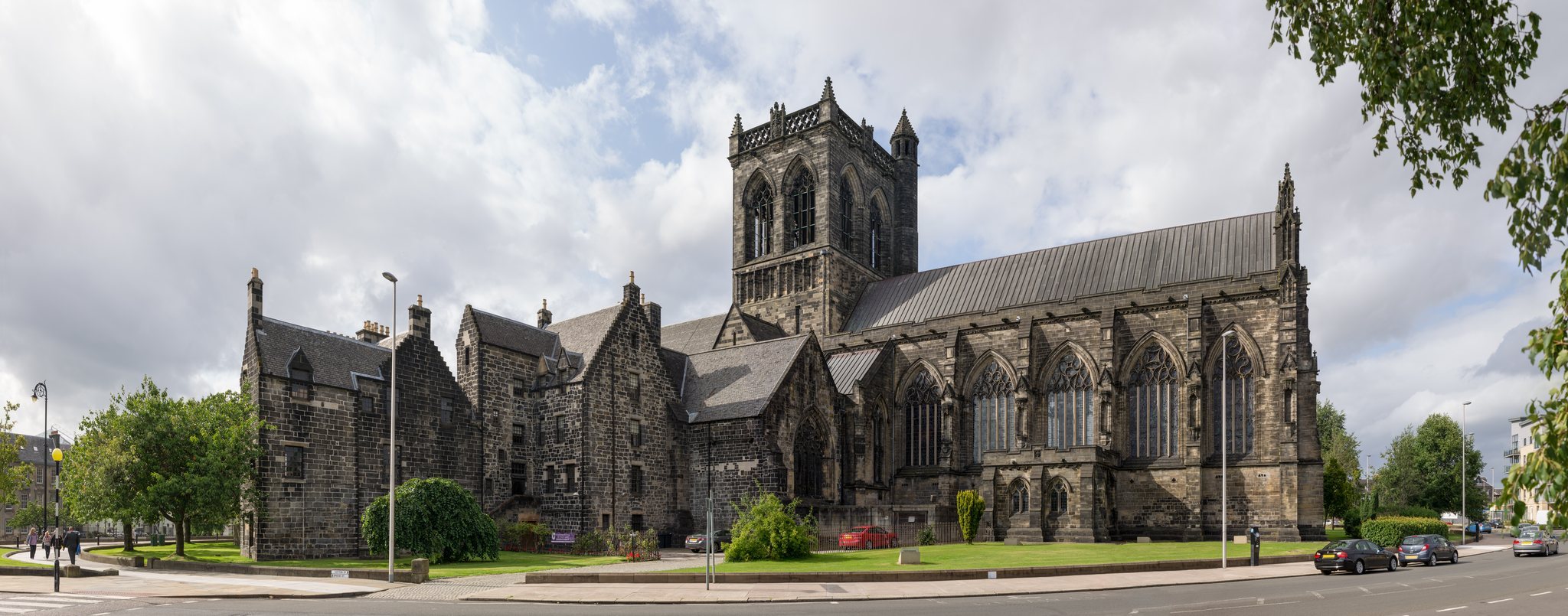
The abbey church has a cruciform plan, with its principal axis running from east to west. Its fabric combines Gothic work from the thirteenth, fourteenth, and fifteenth centuries with extensive rebuilding during the nineteenth and twentieth centuries. The surviving complex includes the church, former monastic buildings, a cloister and garden, memorials, stained glass, furnishings, an organ, and the underground abbey drain.
Church Structure
Nave and Western Entrance
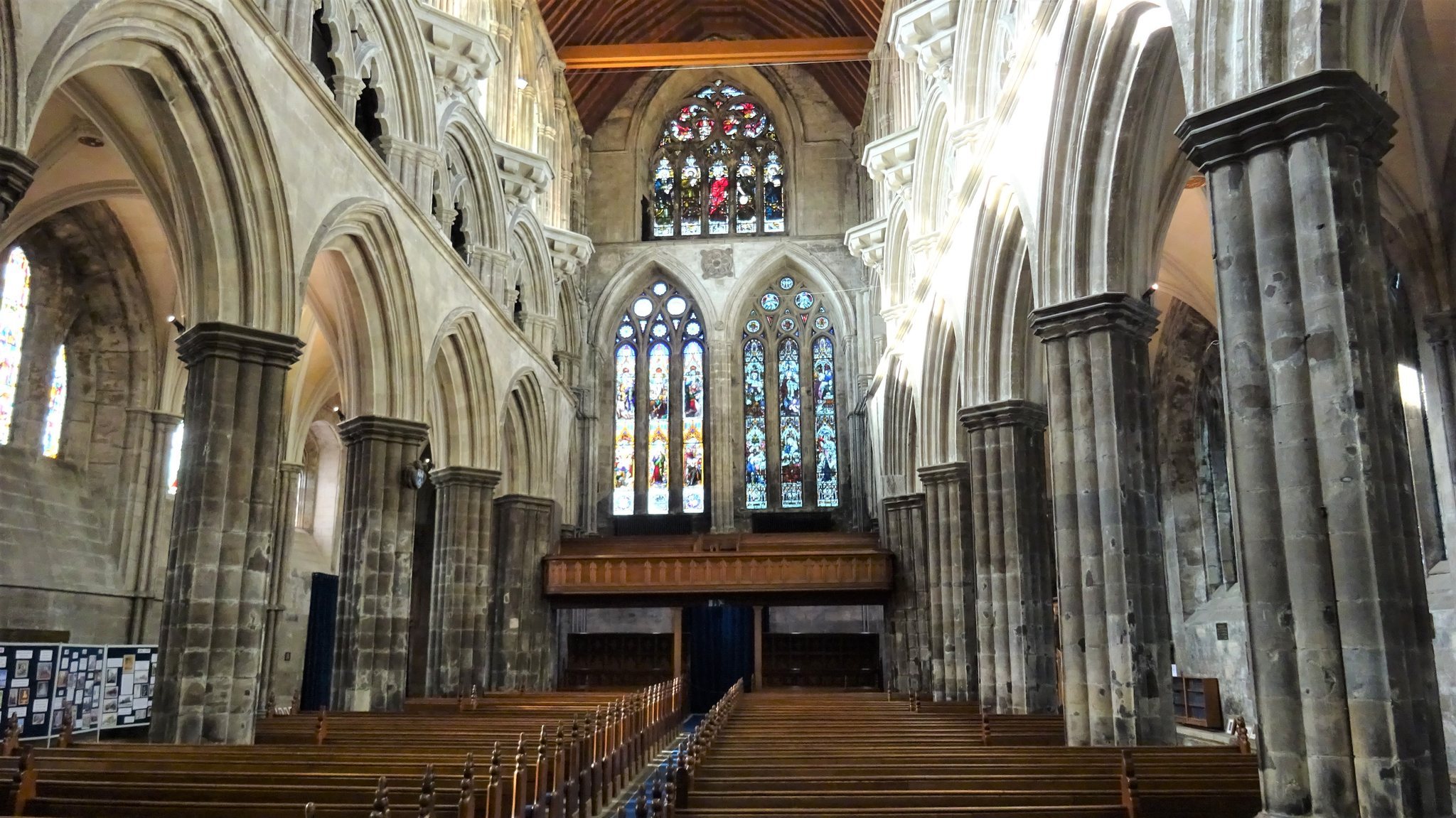
The nave is mainly fifteenth-century, although its westernmost portion and the inner part of the north porch date from the thirteenth or fourteenth century. Inside, an upper gallery or passage called a triforium runs above the main arcade, and the clerestory forms the upper wall zone containing windows. The clerestory passage runs around the supporting pillars rather than through them. The western processional entrance and its three adjoining bays are identified as the principal parts of the church to survive the fire of 1307.
Transepts, Tower, and Choir
The transepts, tower, and choir are largely products of twentieth-century rebuilding and restoration. The choir is about one and a half times the length of the nave. Fourteenth-century sedilia, or seats for clergy beside an altar, and a piscina, a basin used in Christian worship, survive in its eastern wall. The sacristy lies approximately midway along the south side of the choir.
The south transept extends about one and a half times as far from west to east as the north transept. It contains the fifteenth-century Saint Mirin’s Chapel, memorial plaques connected with members of the Hamilton family, and an incomplete frieze showing scenes from Saint Mirin’s life. The former monastic buildings stand against its south wall. West of those buildings are the cloister and cloister garden, bounded on the north by the south wall of the nave.
Tombs and Memorials
The choir contains a much-restored female effigy traditionally identified as Marjorie Bruce. Her remains are believed to lie within the abbey, although there is no evidence that they occupy the exact position of the tomb. The monument was reconstructed from fragments of different origins, and its base probably formed part of the former pulpitum, the stone screen separating the nave from the choir. Tombs opposite it commemorate Robert III and Simon fitz Alan.
A Latin inscription commemorates Margaret, Henry, and Alexander, the infant children of Margaret Seton and Claud Hamilton, first Lord Paisley. They died in 1577, 1585, and 1587 respectively. A marble gravestone donated by Queen Victoria commemorates members of the Stewart family buried at the abbey, including Robert III.
Art, Glass, and Furnishings
Cross and Saint Mirin Frieze
The abbey houses the Barochan Cross, an early medieval stone cross formerly located near Houston in Renfrewshire. Weathered but preserved inside the church, it is among the surviving early medieval objects associated with the site. The incomplete Saint Mirin frieze was originally brightly painted. It may first have formed part of the rear panel of an altar before being installed as a wall frieze.
Stained Glass and Choir Furnishings
The stained glass includes the Wallace Memorial Window of 1873, which depicts Samson; a window by Edward Burne-Jones; the Saint Margaret Window; and the Te Deum Window, showing prophets, apostles, and martyrs. Saint Mirin’s Chapel contains the War Memorial Window. The choir’s East Window, designed by Douglas Strachan, depicts Christ enthroned with Saint Mirin holding a model of the abbey. Strachan also designed the Peace Window in the south choir wall. The James D. D. Shaw Memorial Window, designed by John Clark, dates from 1989.
Twelve angel corbels survive in the choir, together with a stone communion table carved by Pilkington Jackson. Sir Robert Lorimer designed the ceiling bosses, which James A. Young carved. William and Alexander Clow carved the choir stalls, whose decoration includes numerous animal forms.
Organ
The abbey organ was built in Paris by Aristide Cavaillé-Coll in 1874. It has been rebuilt and enlarged several times. A 1968 reconstruction by Walker provided four manuals, 65 stops, and 5,448 pipes. Harrison and Harrison carried out major restoration in 2009, including cleaning and servicing, a new wind system, and the addition of a 32-foot contre bombarde.
Abbey Drain and Archaeological Finds
A surviving section of the Paisley Abbey Drain runs for about 90 metres from the abbey towards the White Cart Water. Probably dating from about 1350–1400, it is up to 2 metres wide and 2.2 metres high. Stonemasons’ marks and evidence of former gates survive within it, and water must be pumped out before entry.
Excavations in the drain produced a slate marked with music, believed to be the oldest example of polyphonic music found in Scotland. Polyphonic music combines two or more independent melodic lines. Other finds include imported cloth seals, chamber pots dating from about 1500, tweezers, carved bone handles, pottery fragments, and slate fragments. Some of these objects are displayed in the abbey.
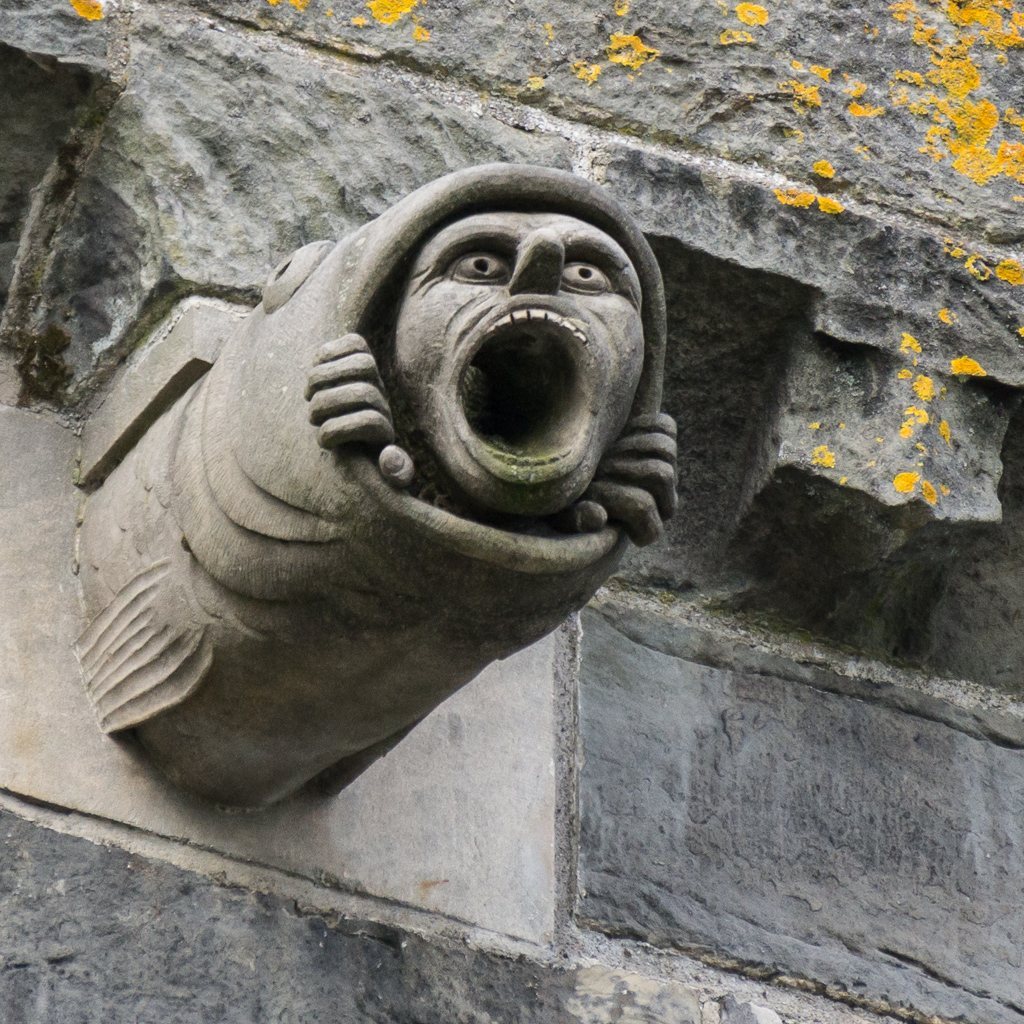
During restoration in the 1990s, twelve deteriorating stone gargoyles were replaced. One replacement was carved as a creature resembling the space creature from the 1979 film Alien.