Padmanabhaswamy Temple: A Vaishnava Temple in Thiruvananthapuram
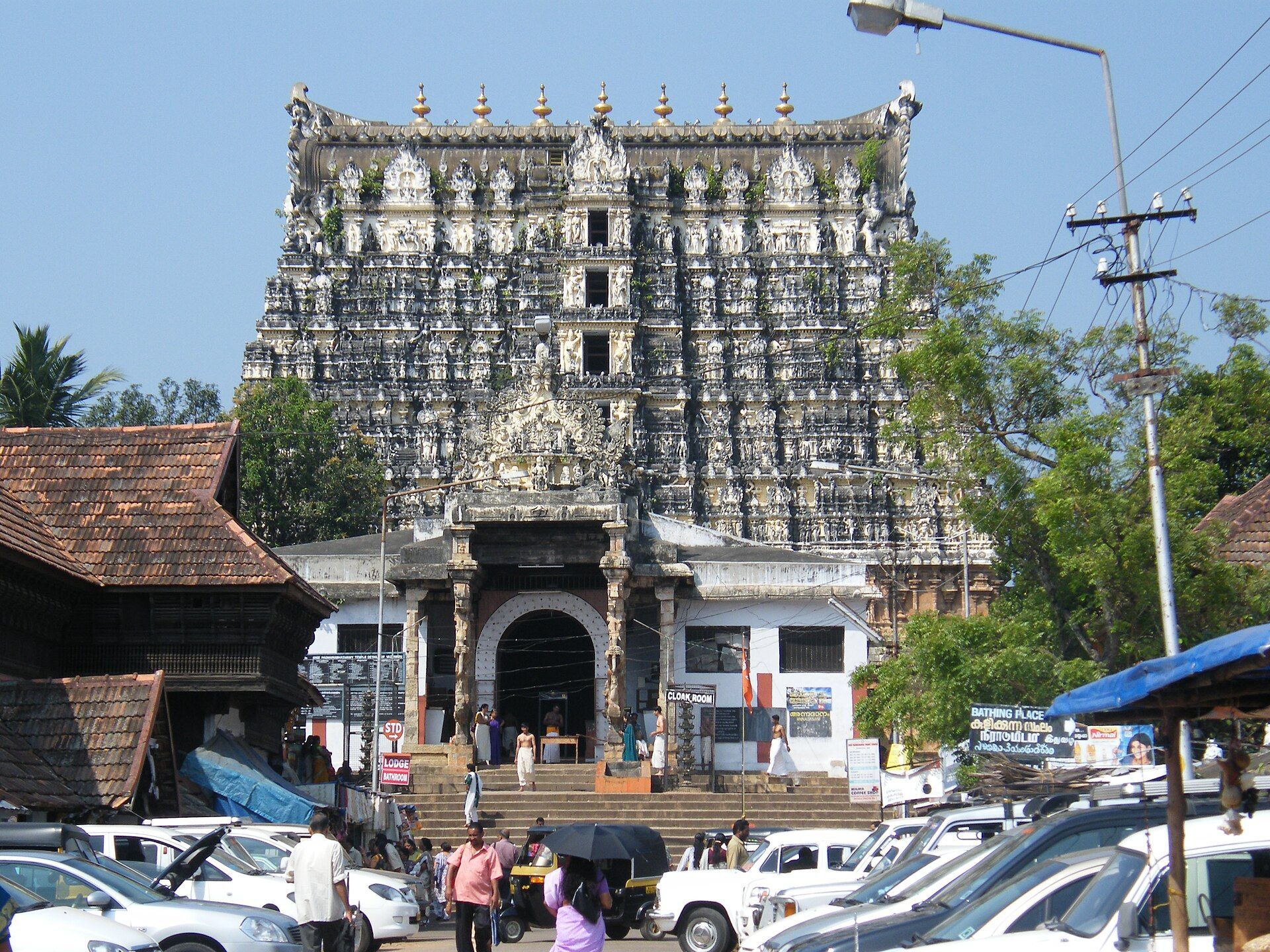
Site at a Glance
- Rating
- 4.7
- Popularity
- Very High
- Country
- India
- Primary era
- Early Modern
- External website
- Open
- Eras represented
- Medieval, Early Modern
- Civilizations
- Unclassified
- Site type
- Religious
- Remains
- Temple
On this page20 sections
History
Padmanabhaswamy Temple is a Hindu temple dedicated to Vishnu in Thiruvananthapuram, Kerala, India, and it combines Kerala and Tamil architectural traditions. The present complex was shaped especially by reconstruction in the eighteenth century, while the shrine was already an important Vaishnava pilgrimage centre by the early medieval period. Padmanabhaswamy, a form of Vishnu whose name refers to the lotus rising from his navel, is the tutelary deity of the Travancore royal family.
Sacred traditions and early history
Temple traditions identify the site with the ancient sacred settlement of Anantankadu. They differ over whether the deity appeared to the sage Divakara Muni or to Vilwamangalam Swamiyar. Another tradition attributes the original consecration to Parashurama in the Dvapara Yuga and assigns administrative authority to seven Potti families. It associates protection of the shrine with the Venad king Adithya Vikrama and ritual authority with the Tharananallur Namboothiripad family.
A related foundation story concerns Perumattukali, a Pulaya woman who directed the sage towards Anantankadu. She is associated with the first offering to Padmanabha, described in different versions as rice or mango presented in a coconut shell. The temple offering is now made in a golden shell. The deity and shrine are also connected with the Vishnu Purana, Brahma Purana, Matsya Purana, Varaha Purana, Skanda Purana, Padma Purana, Vayu Purana, Bhagavata Purana, Mahabharata, Sangam literature, and the devotional poems of Nammalwar. Interpretations linking references to a wealthy “Golden Temple” with this shrine remain uncertain.
In Tamil devotional tradition, the temple is one of the 13 Divya Desams of Malai Nadu, a historical region corresponding broadly to present-day Kerala and Kanyakumari. A Divya Desam is a sacred Vishnu shrine praised in the hymns of the Alvars, Tamil poet-saints devoted to Vishnu. This association places Padmanabhaswamy Temple within the established sacred geography of Vaishnavism, the Hindu tradition centred on Vishnu and his principal manifestations.
Records, conflict, and fire
Venad ruler Veera Iravi Iravi Varma built a temple record room, or record repository, within the compound around 1425. It preserved the Mathilakam records, which dealt with administration, revenues, expenditure, treasury management, ritual activity, and the proceedings of the Ettara Yogam, the body that historically administered the temple. More than 3,000 palm-leaf records were transferred to the Archives Department when it was established in 1867, while the remaining material was organized under 70 headings.
In 1680, the Muslim raider Mukilan invaded parts of Venad and destroyed the Budhapuram Bhaktadasa Perumal Temple. He planned to plunder Padmanabhaswamy Temple, but local Muslims loyal to the Venad royal family persuaded him not to do so. Mukilan was later killed at the Battle of Manacaud.
Temple records describe fires before and during the period immediately preceding the major reconstruction. A severe fire on 28 January 1686 damaged or destroyed the Abhisravana Mandapa, Mukhamandapa, Srivimana, Narasimha shrine, Thiruvollakka Mandapa, Karuvamandapa, circumambulatory halls, and sanctum. The main image survived, although the fingers of its left hand and the toes of its left foot were damaged and subsequently repaired or remade. Another fire occurred in 1932, after which Chithira Thirunal Balarama Varma ordered restoration the following month.
Travancore reconstruction and royal dedication
Reconstruction began after the 1686 fire. Anizham Thirunal Marthanda Varma completed five levels of the eastern gateway tower and undertook major work on the sanctum, the four-sided enclosure, the Padma Theertham tank, the Sreeveli structures, and the Ottakkal Mandapam. He also installed a golden flagstaff. The main image was reconsecrated in 1731, and the Bhadradeepam and Murajapam observances became associated with his reign.
The sixth and seventh levels of the eastern gateway were completed during the reign of Dharma Raja, with the Diwan Raja Kesava Das associated with the continuation of the work. Further construction took place under Swathi Thirunal and Chithira Thirunal Balarama Varma. These successive phases gave the temple much of the form that survives today.
On 17 January 1750, Marthanda Varma dedicated the Kingdom of Travancore to Padmanabhaswamy in the ceremony known as Thrippadidanam. He surrendered the kingdom and its territories, placed his sword at the deity’s feet, and resumed rule as the deity’s servant. His successors adopted the title Padmanabha Dasa, meaning servant of Padmanabha, while female members of the royal family were styled Padmanabha Sevini.
Before this centralization, administration rested with the Ettara Yogam, comprising the Pushpanjali Swamiyar, the Thiruvananthapurathu Sabha, its secretary, and the Travancore ruler. The Sabha’s decisions required royal approval. Marthanda Varma reduced the authority of the Ettara Yogam to an advisory role and brought temple administration under more direct central control. The principal ritual authorities remain the Tharananallur Namboothiripads as Tantris, senior officials responsible for ceremonial observances, Pushpanjali Swamiyars from the Naduvil Madhom and Munchira Madhom, and four Nambis serving as chief priests for Padmanabha, Narasimha, and Krishna.
Ritual life and modern administration
The two principal annual festivals are the ten-day Panguni festival in March or April and the ten-day Aipasi festival in October or November. Their ceremonies include Pallivetta and the ritual immersion of festival images in the sea at Shankumugham. Every six years, Murajapam brings 56 days of Vedic recitation to a close with Laksha Deepam, when one hundred thousand oil lamps are lit.
During Navaratri, images of Saraswati, Parasakti from Suchindram, and Kumara Swami from Kumarakovil are brought in procession to the area near the temple. The festival is associated with the Swathi Sangeethotsavam.
In June 2011, following litigation by T. P. Sundararajan, the Supreme Court of India ordered selected temple vaults to be opened and inventoried by archaeological and fire-service authorities. A seven-member panel examined the underground chambers while observing established temple rituals and procedures. Vaults A, C, D, E, and F, together with some antechambers, were opened or inventoried. Work on Vaults C to F was completed in 2012, while formal work on Vault A began by the end of that year. More than 102,000 articles were recorded from Vault A and its antechambers and more than 2,000 from Vaults C to F at the reported stages of the inventory. The term article could refer either to an individual object or to a collection.
Vault B, traditionally called Mahabharata Kallara, remained closed. Its traditions connect it with Balarama, serpent deities, Kanjirottu Yakshi, Sreechakram, and Ugra Narasimha as its protector. An Ashtamangala Devaprasnam in August 2011 declared it a forbidden area. Although the antechamber was opened on some occasions, including by Supreme Court-appointed observers in 2011, the principal chamber remained closed. Religious authorities and members of the temple’s traditional institutions opposed opening it.
The proceedings produced disputes over administration, inventories, ritual practice, and the position of the Travancore royal family. A 2011 Kerala High Court decision favoured state control, but the Supreme Court overturned that decision on 13 July 2020 and restored the former Travancore royal family’s right to administer the temple. The court also required an administrative and advisory structure under judicial supervision, covering secular administration, security, conservation, finances, property, and the vaults.
Remains
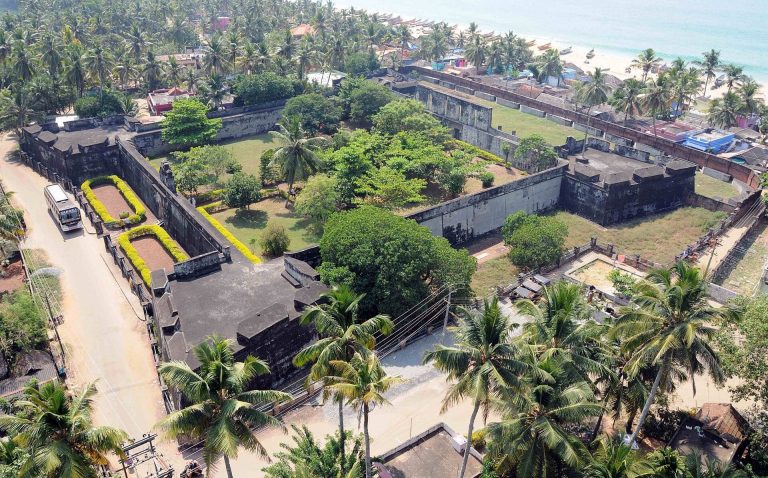
Padmanabhaswamy Temple occupies an enclosure of approximately seven acres, surrounded by substantial walls and approached by numerous granite steps. Facing east, it stands beside Padma Theertham, a large sacred tank to the northeast or east of the main complex. Mitranandapuram Theertham is another associated water feature, used by temple priests before worship and for drawing water during festival preparations. The main enclosure contains the broad circumambulatory complex, or enclosed passage around the shrine, with the principal sanctum at its centre.
Gateway and enclosure
Eastern gateway tower
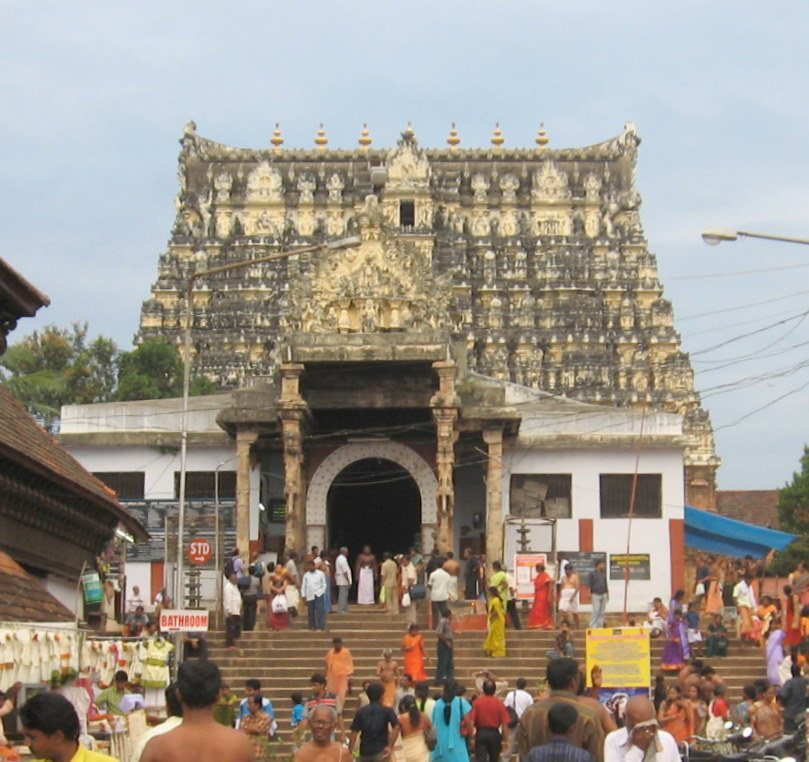
The principal eastern gateway tower has a foundation attributed to 1566. Approximately 100 feet high, it has seven tiers and follows a Pandyan or Dravidian-influenced form, using dark stone. Its upper section carries seven golden finials. The other temple gateways are generally two-storeyed and follow the Kerala style. Sculptures of the ten avatars of Vishnu appear on the first level of the eastern gateway: Matsya, Kurma, Varaha, Narasimha, Vamana, Parashurama, Rama, Balarama, Krishna, and Kalki.
Chuttambalam and Sreeveli corridor
The main enclosure, known as the Chuttambalam, contains the central sanctum, the Ottakkal Mandapam, lamp structures, a southeastern kitchen area, the Abhisravana Mandapa, and the large Sreeveli corridor. The Sreeveli structure measures approximately 400 feet by 200 feet and contains 365 single-piece granite pillars. The stone was brought from Tirumala through Poojappura, Karamana, and Jagathy. Tradition attributes its construction to 4,000 craftsmen, 6,000 workers, and 100 elephants working over six months, with Anantapadmanabhan Moothachary identified as its principal builder.
The corridor running from the eastern side towards the sanctum contains 365 and one-quarter carved granite pillars. Their elaborate ornament is associated with Vishvakarma temple builders. A flagstaff approximately 80 feet high stands before the main entrance.
Kulasekhara Mandapam
Outside the Nalambalam stands the Kulasekhara Mandapam, also called the Thousand-Pillared or Sapta-Swara Mandapam. Its pillars are described as producing the seven musical notes when struck and are protected with gold covering.
Sanctum and principal image
Sanctum and reclining Vishnu
The rectangular sanctum has three doors because of the extended reclining form of the principal image. Worshippers view the deity in three sections, comprising the head and upper body, the central portion, and the feet. Padmanabhaswamy lies in yogic sleep on Anantha or Adi Sesha, the cosmic serpent who serves as Vishnu’s couch. The serpent has five inward-facing hoods. Vishnu’s right hand rests above a Shiva linga, Lakshmi and Bhudevi appear beside him, and Brahma rises on a lotus from his navel. The image is approximately 18 feet long.
The principal image was made with 12,008 saligrams, sacred stones associated with Vishnu and traditionally obtained from the Gandaki River in Nepal. It is covered with Katusarkara Yogam, a special compound vulnerable to ritual bathing. Daily ablution is therefore performed on a separate ornamental image rather than on the principal one.
Ottakkal Mandapam
The Ottakkal Mandapam is formed from a single massive stone slab. Quarried at Tirumala, approximately four miles north of the temple, on the orders of Marthanda Varma, the slab measures about 20 square feet and is 2.5 feet thick. It was installed before the deity in 1731.
Sanctum sculptures and ritual images
The sanctum includes images of two chamara-bearing goddesses, Garuda, Narada, Tumburu, Vishnu’s personified weapons, Surya, Chandra, the Saptarshi, Madhu, and Kaitabha. Gold images of Padmanabha, Sridevi, and Bhudevi are used for abhisheka, or ritual bathing, and a silver festival image of Padmanabha is associated with the three-door arrangement.
Subsidiary shrines and decorative arts
Thekkedom and Thiruvambadi
Thekkedom is dedicated to Ugra Narasimha, while Thiruvambadi is dedicated to Krishna in the form of Parthasarathi. Thiruvambadi has an independent status within the complex, with its own namaskara mandapam, bali stones, and flagstaff. Its principal image is a standing, two-armed granite figure holding a whip and a conch. The main Padmanabha shrine also has a golden flagstaff. Both flagstaffs bear Garuda imagery because both principal images represent forms of Vishnu.
Other shrines and images are dedicated to Rama with Sita, Lakshmana, and Hanuman; Vishvaksena; Vyasa; Ashwatthama; Ganapati; Shasta; Kshetrapala; Garuda; and additional forms of Hanuman.
Paintings, carvings, and murals
The temple contains extensive wooden carvings, stone sculpture, and mural painting. Behind the sanctum is a large mural of Anantashayana, the depiction of Vishnu reclining on the cosmic serpent. It is approximately 18 feet long and is attributed to a Tamil Brahmin artist identified as Chalai Kalahasti.
Underground chambers and stored objects
Vaults and Mahabharata Konam
The southwest part of the Chuttambalam is known as Mahabharata Konam. Tradition associates this area with the place where Balarama donated cows. Vaults A and B lie beneath it, although this religious association does not provide an archaeological date for the chambers. Vault B is the largest reported underground chamber. Its door bears a serpent image, and its antechamber has been opened at certain times, while the principal chamber and several related chambers remain closed.
Inventoried treasures
The inventories included a solid-gold image of Mahavishnu approximately 3.5 feet high and encrusted with diamonds, rubies, and other precious stones. Other objects included an 18-foot-long gold chain, a 500-kilogram gold sheaf, a 36-kilogram gold covering, 1,200 stone-encrusted Sarappalli gold coin chains, and a nearly 30-kilogram, sixteen-part gold anki used as ritual attire. Gold coconut shells set with rubies and emeralds, jewellery, crowns, vessels, coins, and other ritual or valuable objects were also recorded.
The inventory included reports of gold coins dating to around 200 BC, Roman coins, and eighteenth-century Napoleonic-era coins. It also recorded a large gold throne intended for the principal deity, at least three jewelled gold crowns, and more than 60,000 precious stones incorporated into larger gold ornaments. Some gold vessels used in daily or occasional rituals were not inventoried because temple priests objected.
The accumulated wealth is traditionally attributed to offerings made over many centuries by the Cheras, Pandyas, Pallavas, Cholas, Kolathiris, the Travancore royal family, other South Indian rulers, and foreign rulers and merchants. Other interpretations connect portions of it with taxation, conquest, commercial exchange, or the temporary safekeeping of temple property belonging to royal families during the Mysore invasions.
In 1931, during severe economic difficulty, a group including the ruler and priests opened one vault or antechamber. They found a granary-sized chamber containing gold and silver coins, jewels, gold vessels, four boxes of gold coins, a large six-part chest of jewelled gold ornaments, and four additional chests of old coins. These were taken to the palace and state treasuries for counting.