Janardanaswamy Temple: A Vaishnavite Shrine in Varkala, India
Site at a Glance
- Rating
- 4.7
- Popularity
- Medium
- Country
- India
- Primary era
- Early Modern
- Eras represented
- Medieval, Early Modern
- Civilizations
- Unclassified
- Site type
- Religious
- Remains
- Temple
On this page17 sections
History
Janardanaswamy Temple is a Hindu Vaishnavite shrine dedicated to Vishnu in his Janardana form, located in Varkala, Kerala, India. Its stone foundation is attributed to the twelfth century, and the temple follows the Kerala architectural tradition with elements shared with Tamil styles. The shrine is also known as Varkala Temple and is traditionally called Dakshina Kashi, meaning “Kashi of the South.”
Origins and foundation traditions
Local tradition regards the sacred site as more than 2,000 years old and connects it with the Brahmanda Purana and Skanda Purana. The temple’s foundation legends associate its beginnings with Brahma, the Hindu creator deity, and the nine prajapatis, progenitor figures in Hindu cosmology. After offending Brahma, the prajapatis performed penance at the site. Narada, a divine sage associated with devotion, music, and religious teaching, directed them to the place where he had thrown his valkala, or bark garment. Vishnu was then worshipped there as Janardana.
A related tradition describes Brahma performing a yajna, a Vedic sacrificial rite, at Varkala while neglecting his responsibility as creator. Vishnu appeared as an old man and persuaded him to end the sacrifice and resume creation. The gods subsequently installed Vishnu at the sacrificial site. Another legend connects the temple’s pond and location with the penitent prajapatis. Vishnu is said to have created water for them with his Sudarshana Chakra, the discus weapon associated with him.
Rebuilding and royal patronage
The temple later fell into disrepair. One tradition attributes its condition to attacks by outsiders, while another connects it with flooding. A Pandya king suffering from spiritual afflictions encountered the ruins and prayed to Janardana for guidance. In the restoration legend, the king was told in a dream to search along the seashore where flowers were floating. He recovered the image of Janardana from the sea, attached a golden right hand to it, and rebuilt the temple at his own expense.
Inscriptions associate the reconstruction and much of the temple’s present appearance with the regency of Umayamma Rani, who ruled from 1677 to 1684. Other inscriptions connect aspects of the decoration with Marthanda Varma and the erection of the sacred flagstaff with Rama Varma I, whose reign lasted from 1758 to 1798. The complex consequently acquired much of its current form during the seventeenth and eighteenth centuries.
Two large bells on the southern side of the precinct are associated with another tradition. A Dutch ship’s captain and his assistant are said to have donated them after their vessel became stranded offshore and moved again following their offering to the temple. The bells bear the names Peter von Belson and Michael Edward, and one tradition dates the surviving bell to 1757.
Travancore administration and religious practice
The temple later came under the authority of the rulers of Travancore, a former princely state in southern Kerala. It formerly held extensive lands in Varkala and nearby areas. After Travancore joined the Indian Union, administration passed to the Travancore Devaswom Board, which administers many temples formerly associated with the state. Varkala functions under the board as a group and special-grade devaswom centre.
Janardanaswamy Temple is an important centre for rites commemorating deceased relatives and ancestors. Known as Kshetra Pindara Shraddham, the practice involves cooked-rice offerings for the dead. Offerings are made at the nearby seashore, particularly on new-moon days in the Malayalam months of Karkadakam, Thulam, and Kumbham. Karkadaka Vavu, observed in July or August, is especially associated with these ancestral rites. Varkala is traditionally regarded as a major South Indian pilgrimage centre for this purpose, alongside other prominent places connected with rites for the dead.
The temple is traditionally counted among the 108 Abhimana Kshethrams, an important group of Vaishnavite shrines. Tradition also connects it with Balarama, Krishna’s elder brother, during his pilgrimage through southern India. The shrine is believed to grant prosperity and liberation. A further legend holds that Janardana’s raised right hand slowly approaches his mouth. When it reaches the mouth and he consumes what it holds, the present cosmic age will end in pralaya, the dissolution of the world or cosmic cycle. Tradition connects periodic Ashtabandha Kalasam ceremonies, consecratory rites that reset or reinstall a temple image, with this belief.
Festivals and annual observances
The annual ten-day festival takes place in the Malayalam month of Meenam and ends with the ceremonial bathing of the deity in the Arabian Sea on the day of the Uthram star. The festival includes flag hoisting, a procession with decorated elephants, and traditional performances. Other important observances include Krishna Janmashtami, also called Ashtami Rohini, Vishu, Vaikuntha Ekadashi, Karkadaka Vavu, and monthly rites associated with the Thiruvonam or Shravana star.
Remains
Hilltop setting and outer precinct
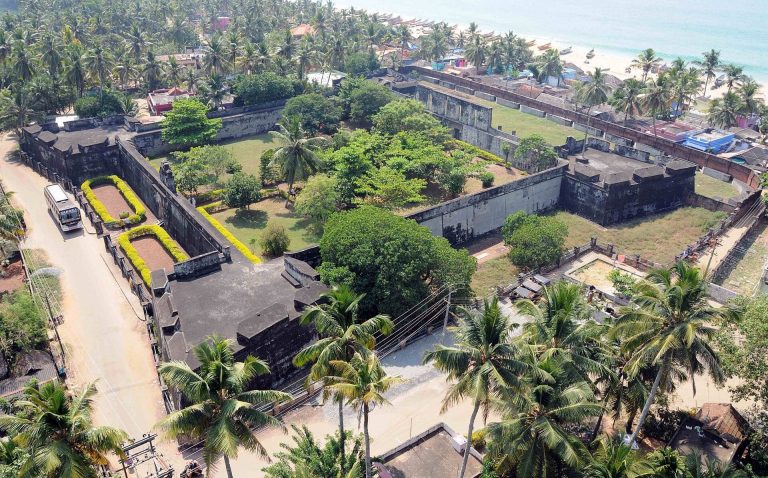
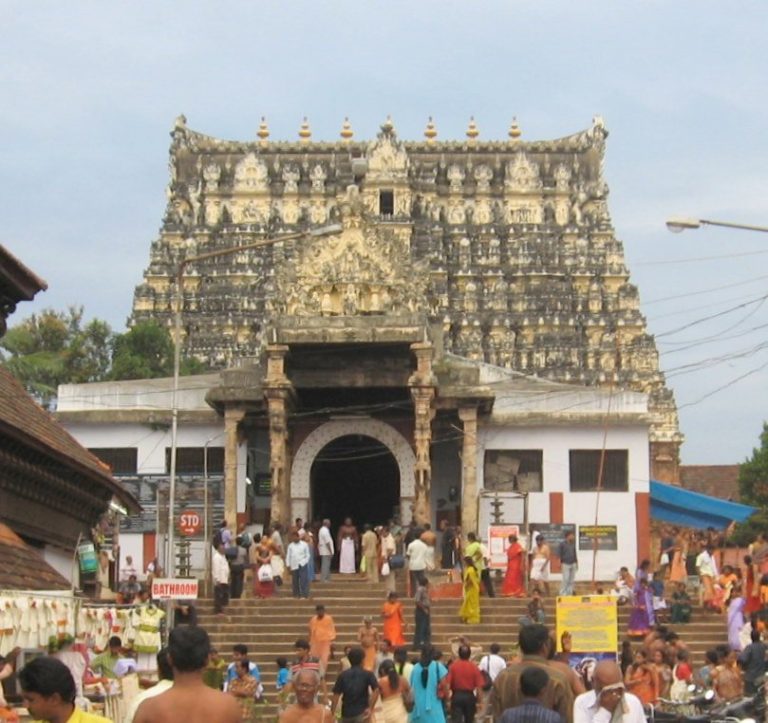
Janardanaswamy Temple stands on a hill or elevated tableland beside the Arabian Sea near Papanasam Beach. The hill rises approximately 53 metres above sea level, or about 175 to 200 feet. The main temple faces east. Its eastern entrance is approached by roughly fifty steps, while stepped entrances also rise from the northern and southern sides. The western side is higher and does not require comparable stairways.
Entrances and sacred water features
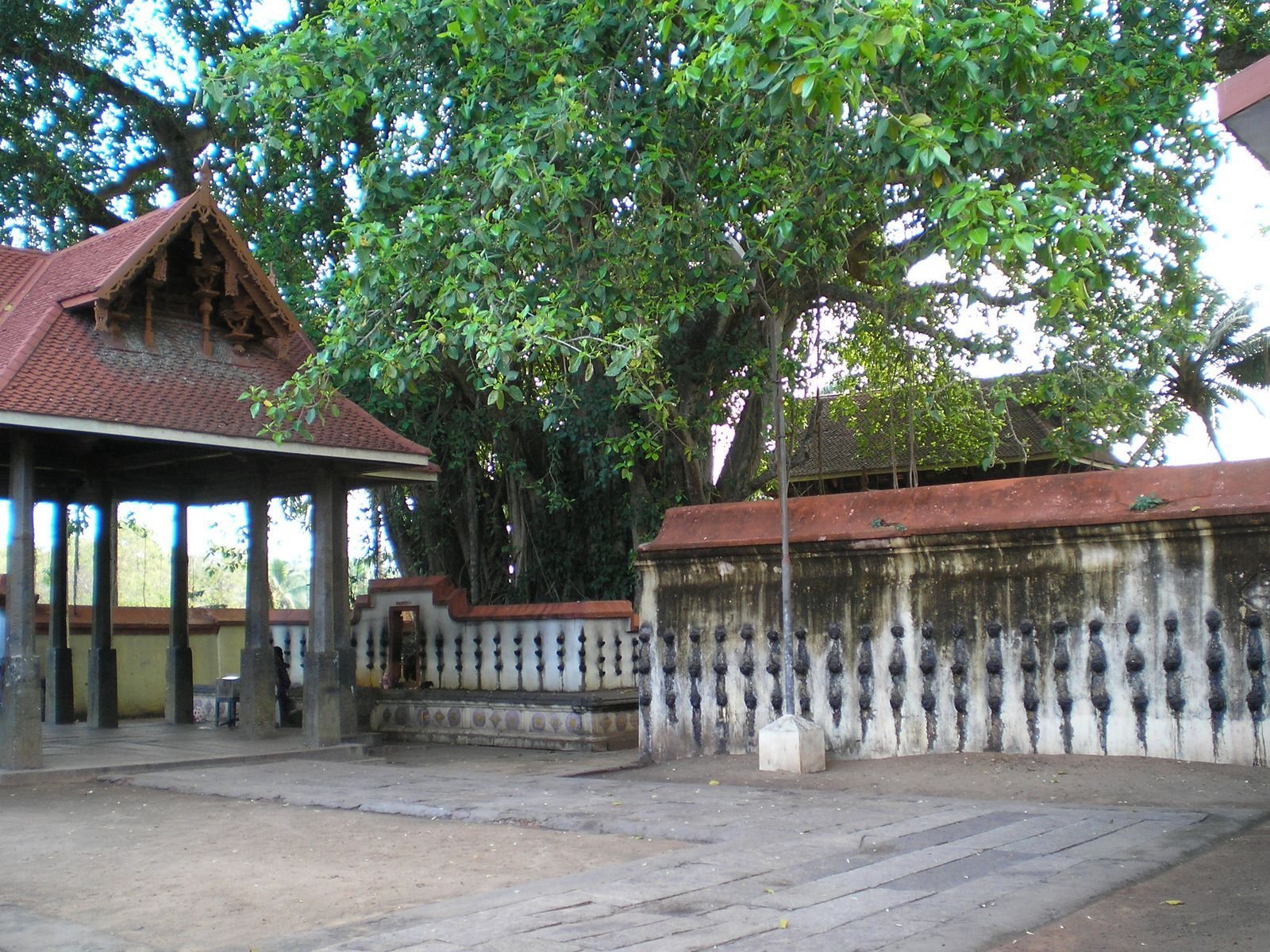
The complex is enclosed by a prakaram, a surrounding shrine enclosure, built from granite slabs. Its roofs are covered with copper sheets. A large banyan tree stands within the eastern gateway, with Naga deities, including Ananta and related serpent divinities, installed at its base. The tree is used for ritual circumambulation.
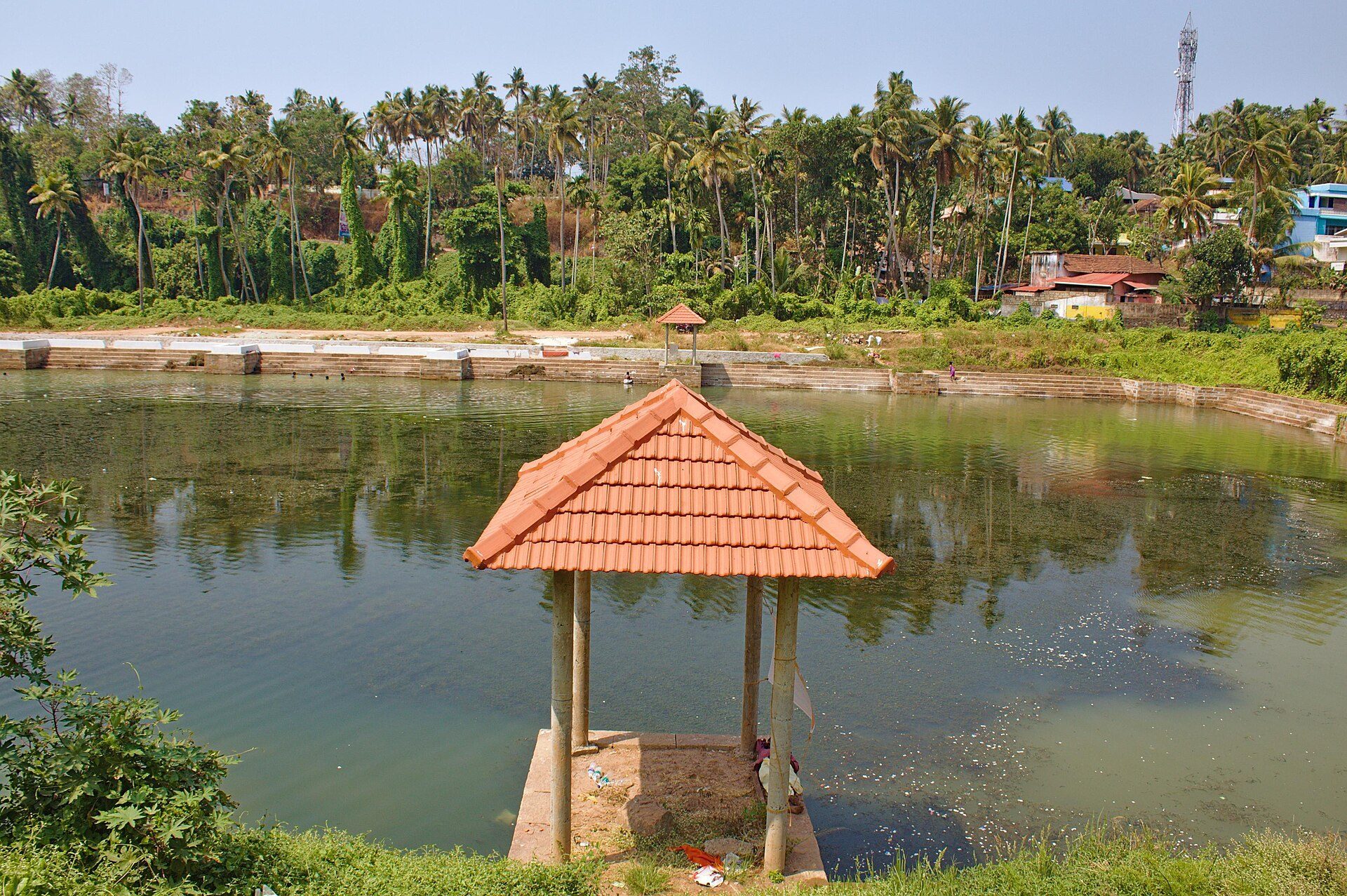
North of the temple is Chakratirtha, an elongated temple pond. A small shrine dedicated to Rama and Hanuman stands on its eastern bank and was renovated in 2021. Beneath the northern entrance, between the pond and the road, is a smaller pond regarded as the deity’s foot-water. A nearby shrine is dedicated to Shasta and is called the Cherukulatthupuzha Dharmashasta Temple.
Northern gateway and ceremonial structures
The northern entrance carries a carved image of Vishnu with Sridevi and Bhudevi, who represent Lakshmi and the earth goddess. Garuda, Vishnu’s eagle-like vehicle, and Hanuman appear beside them. A separate installation nearby is used for firecracker offerings.
An elephant shelter within the complex serves ceremonies and functions such as rice-feeding rites, weddings, and devotional singing. Beyond it stands a gilded flagstaff associated with Garuda and measuring about fifty feet in height. A large bali stone, a ritual offering stone, stands in the balikkalpura beyond the flagstaff. During the sheeveli, a temple procession in which offerings are made at designated points, the final offering is made there. The upper part of the structure carries carved figures of Janardana with Sridevi and Bhudevi, together with Garuda and Hanuman.
Southern auditorium and lamps
An open auditorium extends along the southern side of the temple. It contains offices for temple advisory bodies and is used for lectures, cultural performances, and teaching Hindu scriptures. Stone walls carry images of Dipalakshmi, represented as a woman holding oil lamps, and contain numerous niches for traditional lamps. The temple is described as being illuminated by copper oil lamps during twilight.
Subsidiary shrines
Ganapati, Ayyappa, and Ananta shrines
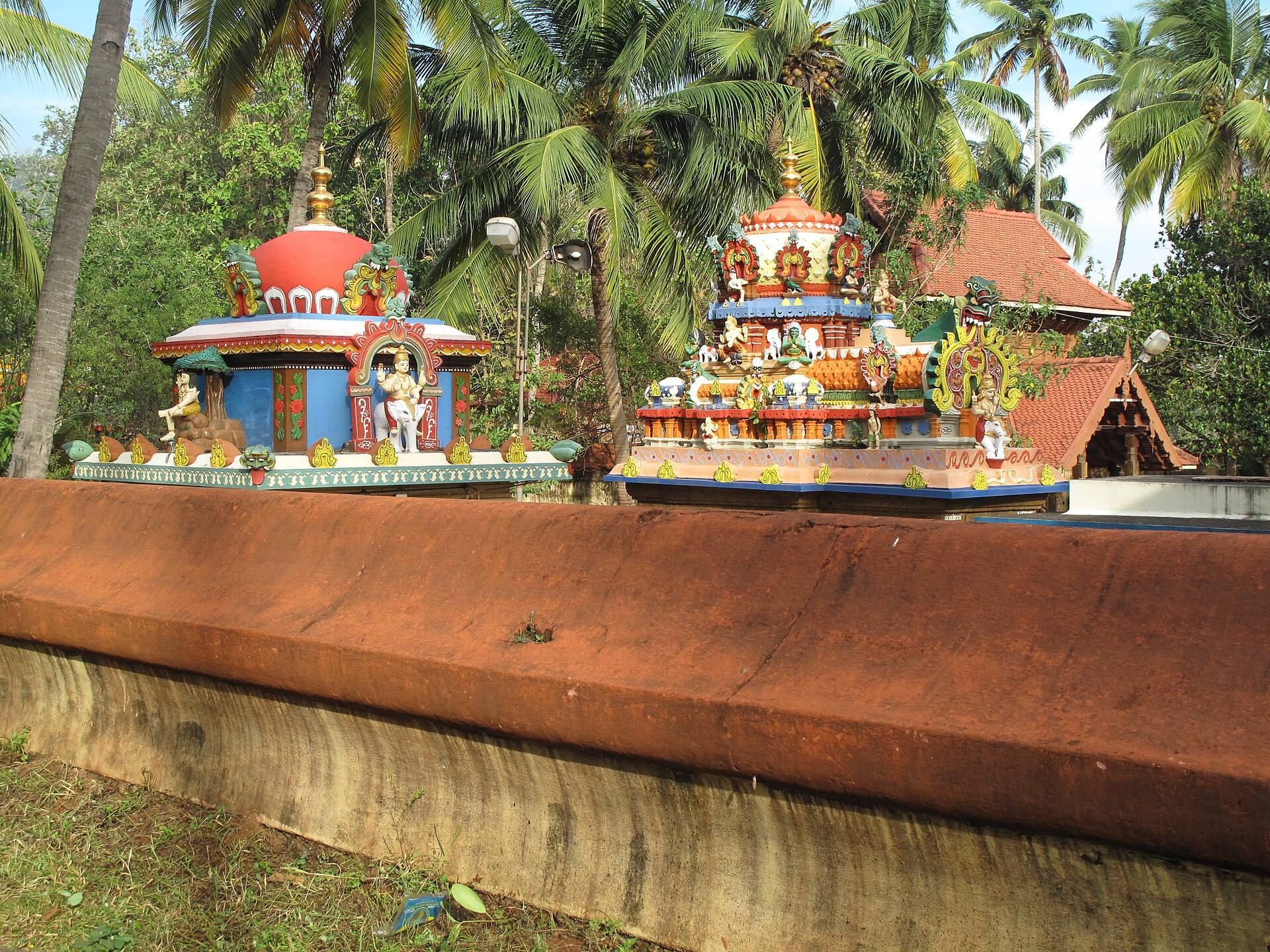
The southern and southwestern areas contain small shrines dedicated to Ganapati and Ayyappa, both facing east. The Ganapati shrine has a homa mandapa, a hall associated with fire ritual. The Ayyappa shrine has a mandapa, or pillared hall, and a stand for sesame-oil lamps. Both buildings combine Tamil and Kerala architectural features.
Near these shrines is a roofless platform dedicated to Ananta. A palmyra tree beside the Shiva shrine bears dolls nailed to it by childless couples as part of a devotional offering. An offering counter stands nearby.
Shiva shrine
The principal subsidiary shrine occupies the northeastern part of the complex and is dedicated to Shiva with Parvati. It faces west and contains a comparatively large Shiva linga, a mandapa, and an image of Nandi, Shiva’s bull mount. The shrine is the largest of the subsidiary buildings. Its sculpted upper level carries numerous deity figures, while the circumambulatory route is restricted to the northern drainage outlet, where Chandikeshvara is installed.
Main shrine and image
Circular sanctum
The principal sanctum is a moderately large circular granite structure with a circumference of approximately 100 feet. Its roof is covered with copper and topped by a gilded finial. The interior is divided into three rooms, with the western room serving as the garbhagriha, or innermost sanctum. A northern drainage channel carries away water from ritual ablutions.
The principal image is a standing Vishnu more than six feet high, carved from anjana stone and facing east. The four-armed figure holds the Sudarshana Chakra in the rear right hand, the Panchajanya conch in the rear left, and the inverted Kaumodaki mace in the front left. The front right hand holds a vessel associated with the offering of water. Made of gold, this hand is raised toward the deity’s mouth. Sridevi stands to the image’s left and Bhudevi to its right.
The image is presented at different times as Janardana, Narasimha, Venugopala, and Mohini. On some days a flute is placed in the hand. The image is also covered with sandalwood paste and decorated with flowers.
Nalambalam and carved pillars
A spacious granite-built nalambalam, the circumambulatory building around a sanctum, surrounds the principal shrine. Its entrance has door pavilions on both sides. The southern pavilion is used for special worship and daily fire rituals, while the northern pavilion accommodates musical performances and recitation.
The pillars carry carved scenes and figures including Vishnu’s ten avatars, episodes from the life of Krishna, stories of Shiva, salabhanjikas, and kneeling Brahmins. A kitchen occupies the southeastern corner and a well stands in the northeastern corner.
Ritual circuits and sacred images
The inner bali circuit contains stones representing the guardians of the eight directions, the seven mother goddesses, Virabhadra, Ganapati, Shasta, Subrahmanya, Brahma, Ananta, Durga, and Vishvaksena or Nirmalyadhari. Offerings are made at these stones during the sheeveli procession. The complex also recognizes seven northern mother goddesses: Bhageshwari, Kriya, Kirti, Lakshmi, Srishti, Vidya, and Shanti. Offerings are made to them during the procession.
The entrance to the principal shrine is flanked by images of Hanuman and Garuda. Janardana with Sridevi and Bhudevi occupies the main shrine, while subsidiary images and shrines represent Shiva, Ganapati, Ayyappa, Shasta, and serpent deities. Two large bells on the southern side preserve the names Peter von Belson and Michael Edward and remain associated with the tradition of the Dutch donation.
The temple’s physical and ritual setting extends to the nearby Papanasam seashore. The shore is used for ancestral offerings and for the annual arattu, the ceremonial bathing of the festival image in the Arabian Sea.