Santuário de Panóias: A Roman Ritual Sanctuary in Portugal
Site at a Glance
- Popularity
- Medium
- Country
- Portugal
- Primary era
- Classical
- Eras represented
- Classical
- Civilizations
- Roman
- Site type
- Religious
- Remains
- Sanctuary
On this page12 sections
History
Santuário de Panóias is a Roman sanctuary at Vale de Nogueiras, in Vila Real, Portugal, built in the late second or early third century CE. It stood within a religious landscape where a pre-Roman cult was already present.
Local worship and Roman construction
The sanctuary’s Roman-period cult was introduced at a place with existing indigenous worship. Gaius C. Calpurnius Rufinus, a Roman senator and member of the empire’s governing elite, is credited with establishing the cult at Panóias. He may have held a senior position in the province. His origins are thought likely to have been in Perge, in Pamphylia, a proposal supported in part by the Greek language and phrasing of an inscription.
Initiation and ritual
Historian and inscription specialist Géza Alföldy interpreted Panóias as the setting for a staged initiation. In his reconstruction, animals, not people, were sacrificed: their blood was offered, their entrails burned, and their remaining meat eaten. The initiate then received a revelation of the deity and underwent purification. A more advanced grade repeated the initiation at the second rock.
At the third rock, the highest grade involved symbolic death, burial, and rebirth. The initiate slept there overnight, dreamed of the divinities, and received oracles before symbolically returning to a new life. The ritual also involved incense, wine offerings, a sacrificial hatchet, round metal dishes, and a table used to skin and divide the animal. Priests wore white and crowns of branches chosen according to the deity. A herald cleared non-initiates from the sacred space before the rite.
After a period of neglect, the sanctuary was fenced in 2001 and infrastructure was installed at the site. It is designated a National Monument.
Remains
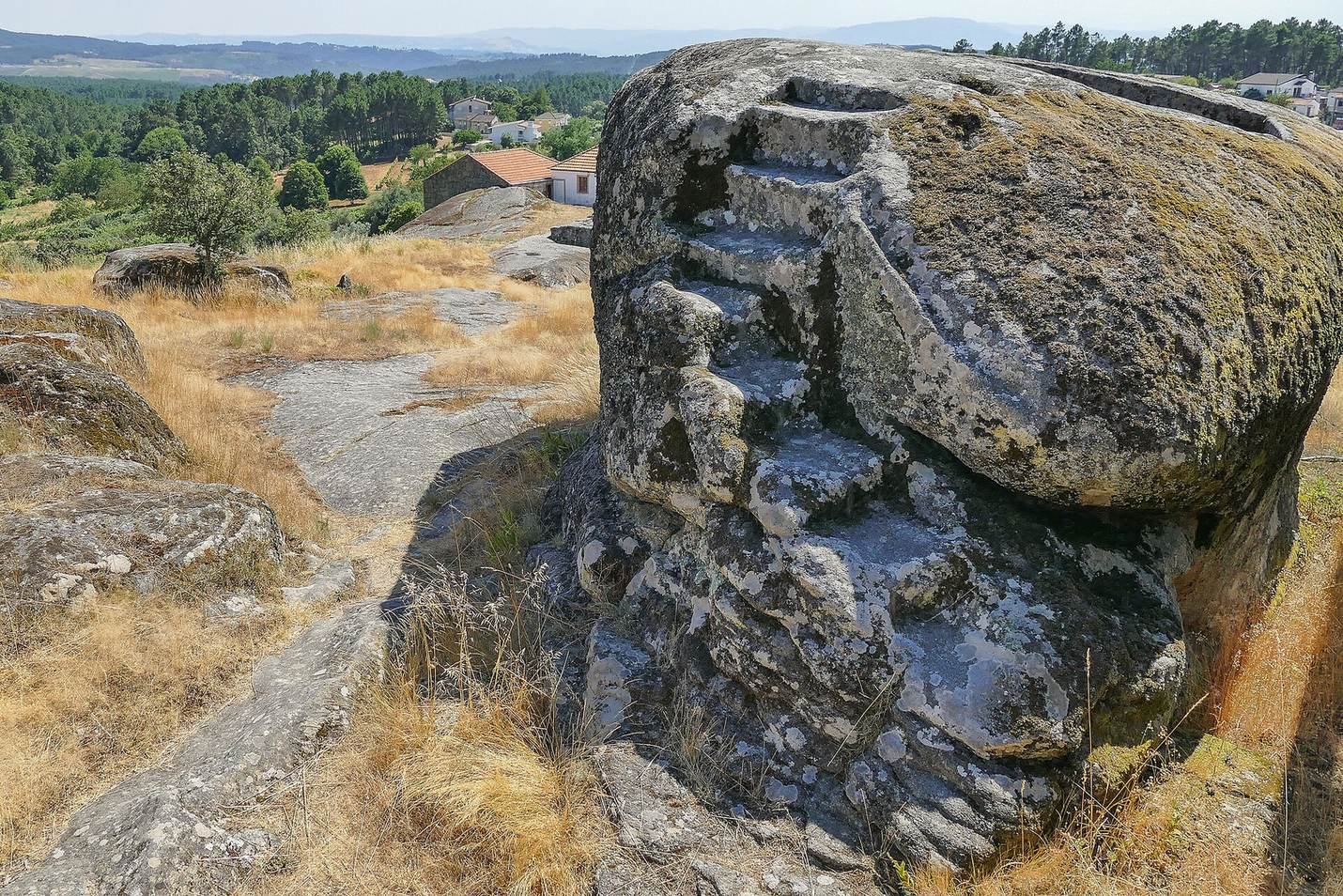
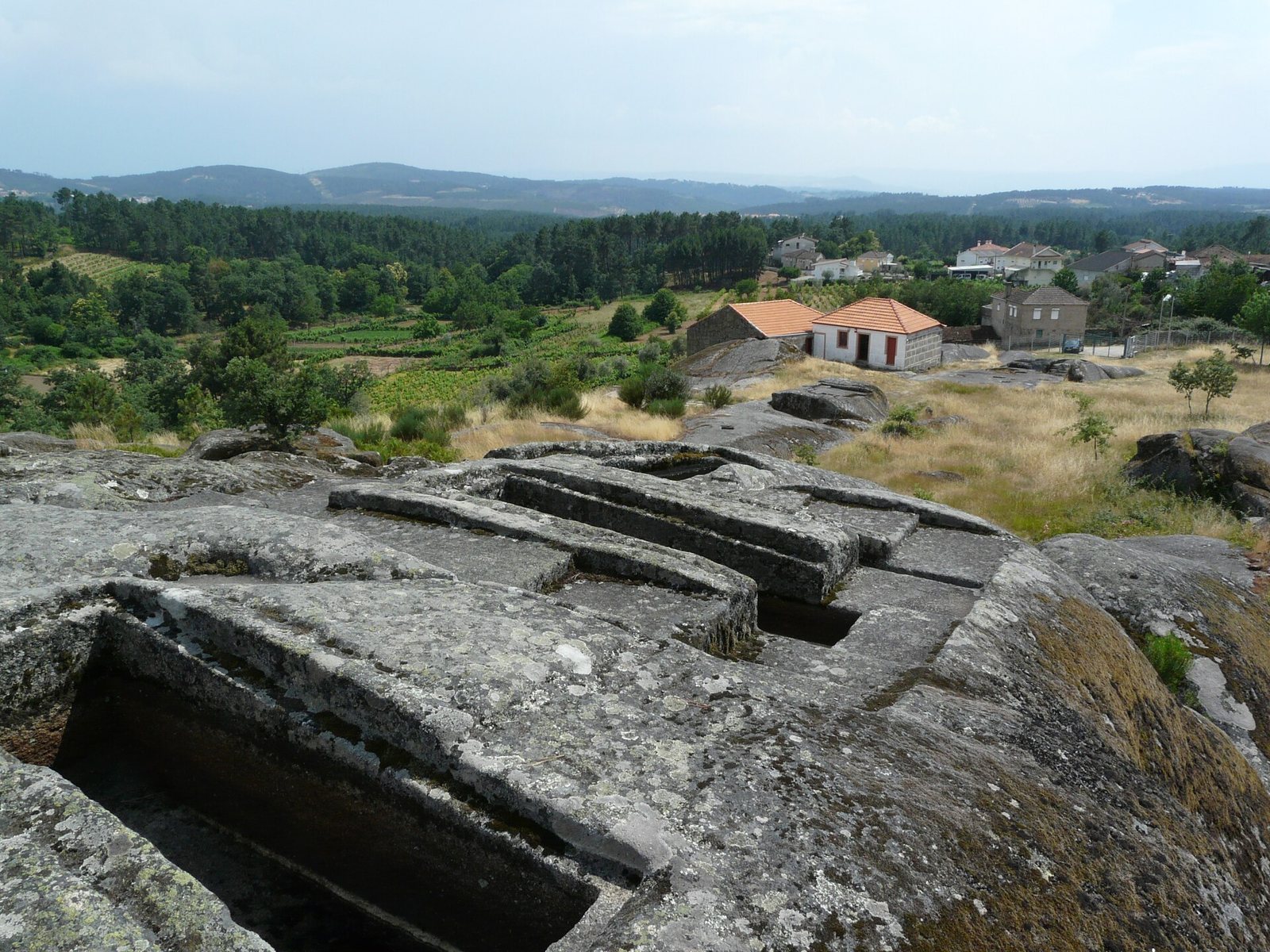
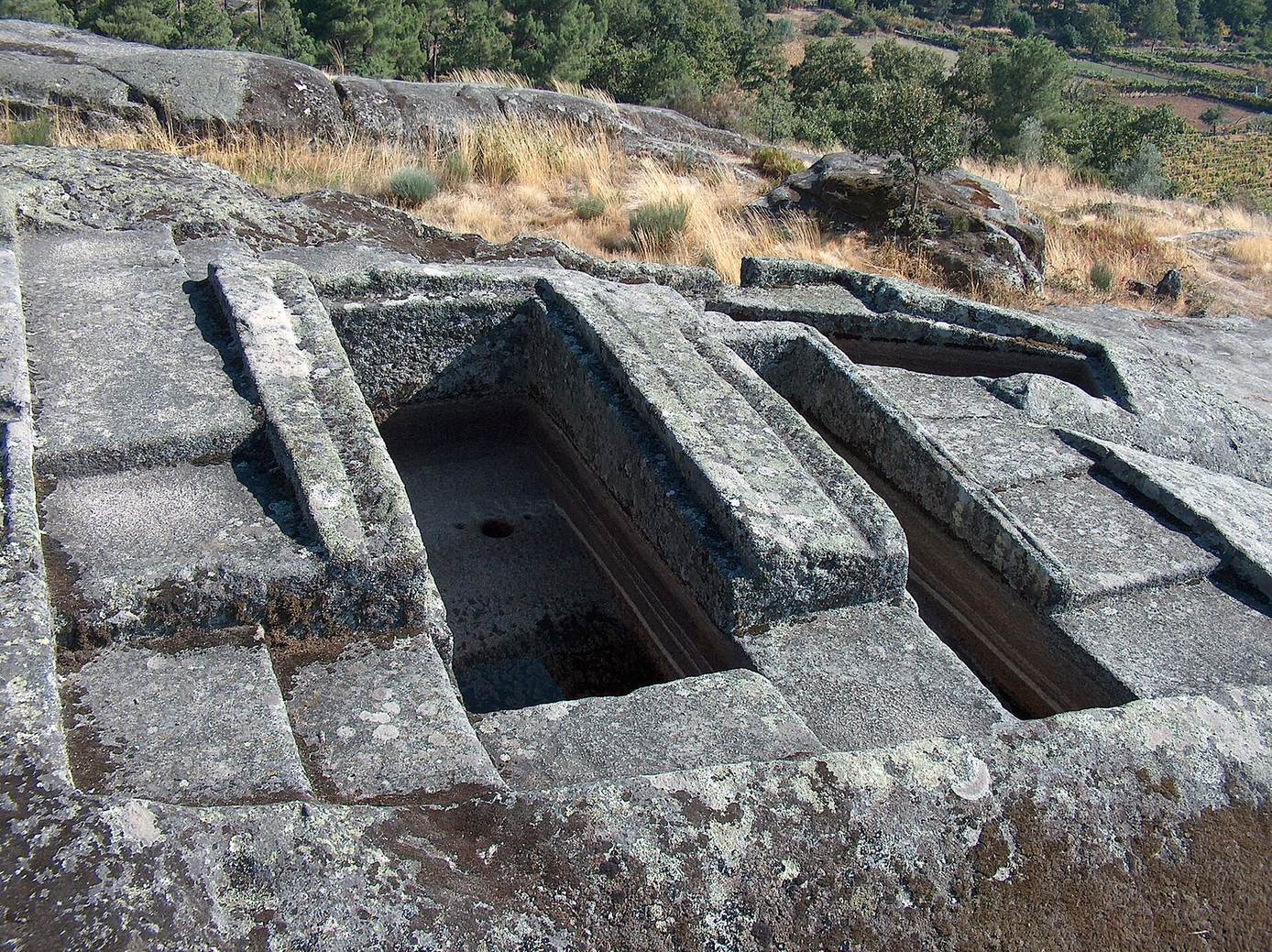
The sanctuary is an enclosure organized around three large rocks. Stairs and cavities were cut into the stone, while the arrangement and local topography formed part of the ritual setting. Traces of small temples are associated with all three rocks, alongside basins, altars, and other carved installations.
The rocks and temple remains
First rock
A granite recess cut into the first rock marks the position of a small temple. Stairs, washing basins, and cavities of different forms survive nearby. Rectangular cuttings were used to burn animal entrails, while a round cavity served for roasting meat. Another was used to remove blood, fat, and oil, and further cavities associated with the temple held ritual objects.
Second rock
The foundations of a second temple remain on this rock. Its dressed stone blocks were reused in buildings in the neighboring village, especially in the church floor. A hole may have held a metal post secured by two braces, where sacrificial animals could be tied. Nearby are several purification basins. Farther north, grooves in a basin held iron bars supporting a roasting grill, and a small cavity close by received blood.
Northern rock
The northernmost, third rock has stairs and a handrail leading to a broad upper platform. Rectangular cuttings described as graves and the foundations of a third temple are located there.
Inscriptions and altars
Texts at the entrance rock
The entrance rock bears three Latin inscriptions and one Greek inscription. The second Latin text lies to the left before the steps leading up to the rock. Rufinus is named as its dedicator, but its wording has received different readings, including references to a sanctuary or sacred precinct, a pool or underground passage, and a cavity for mixing. A third inscription, reached by climbing the steps and passing to the other side, dedicates an eternal pool and temple to gods and goddesses, including the divinities of the Lapitae. It also refers to victims being burned there.
The Greek inscription has been interpreted as a dedication of a temple to the highest Serapis, a Greco-Egyptian deity, together with a pool and the Mysteries, rites reserved for initiates. Other inscriptions connect the sanctuary with the Lapitae, described as a local indigenous community. It remains uncertain whether the name refers to a people or to cult figures, perhaps nymphs or matrons. The texts also refer to the Severe gods, understood as divinities associated with the underworld or earth.
Lost and worn inscriptions
A Latin inscription that stood six to seven metres east of the second text, on the right side of the path and facing the entrance rock, was destroyed in the twentieth century. Earlier readings and records allowed its text to be reconstructed. A separate, badly worn inscription was transcribed by the eighteenth-century scholar Jerónimo Contador de Argote, but its full wording can no longer be read. The fifth text has been interpreted as referring to Severe or angry gods; austere has also been proposed as a reading in place of infernal.
Eastern and northern altars
About twenty metres east of the main rocks, a smaller rock preserves a pre-Roman altar formed by cup-like hollows linked by grooves. It has been proposed as a place of worship for the Lapitae, including the deity Reva Marandiguius, associated with the heights of the Marão. Worship involving snakes and wild boars has also been suggested, but remains hypothetical. Farther north, a stairway cut into the rock leads to another altar, consisting of a hollow joined to a groove.