Our Lady of Sorrows Basilica in Jarosław: A Marian Sanctuary and Parish Church
Site at a Glance
- Popularity
- Medium
- Country
- Poland
- Primary era
- Early Modern
- Eras represented
- Medieval, Early Modern
- Civilizations
- Kingdom of Poland, Polish–Lithuanian Commonwealth
- Site type
- Religious
- Remains
- Basilica
On this page9 sections
History
Our Lady of Sorrows Basilica in Jarosław is a Roman Catholic Marian sanctuary and parish church in southeastern Poland. Its present church was built in stages from 1698 to 1713 in the Baroque style, a later ornate European style. The shrine’s history reaches back to a Marian image venerated from the late fourteenth century.
The shrine and medieval church
Tradition places the discovery of the wooden image on 20 August 1381. Shepherds are said to have found it in a pear tree some distance from Jarosław, then a small walled town, beside the road toward Kraków. The image showed Mary holding the dead Christ. According to the story, the shepherds carried it to the parish church, but it returned to the tree overnight. This was taken as a sign that the image should remain at the spot, where a wooden chapel was built. The shrine became a pilgrimage destination, and pilgrims were said to receive miracles through Mary’s intercession.
Queen Jadwiga is traditionally said to have prayed at the shrine before the legendary Battle of Stubno in 1387. A brick church in the Gothic style, associated with medieval European architecture, replaced the chapel in 1421; the church is first mentioned in a record from 1467. The image was declared miraculous by the Bishop of Przemyśl in 1636 and received papal-authorized crowns in 1755.
Jesuit and Dominican periods
The church passed to the Jesuits, members of the Society of Jesus, in 1629. They established a nearby college and novitiate, a period of formation for people entering the order, and moved music instruction there. The Jesuits remained until Pope Clement XIV suppressed their order in 1773. In 1777, Dominicans from Bochnia took over the monastery after a fire destroyed their own monastery and church there. The Dominicans, members of the Order of Preachers, have provided pastoral care at Jarosław since then.
The present church and modern status
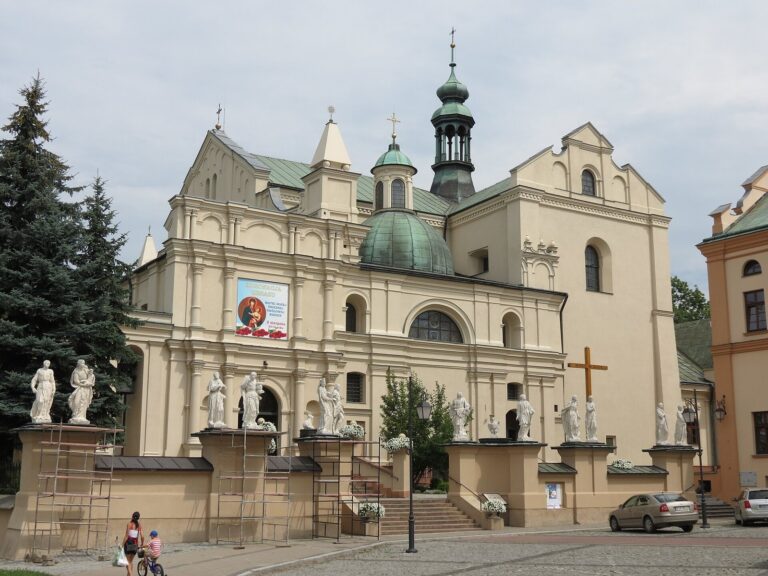
Construction of the present church began with the nave and chapels in 1698–1709. The choir, sacristy, and porches followed in 1709–1713, and Bishop Konstanty Dubrawski consecrated the church on 13 September 1713. The screen façade, a unified architectural front, and the passage around the choir were completed between 1743 and 1768 to a design by Jesuit architect Paweł Giżycki.
In 1966 Pope Paul VI granted the church the honorary title of minor basilica, which does not make it a cathedral. A parish was established there in 1970. The church and monastery complex entered Poland’s register of protected historic monuments on 24 November 1948. On 16 October 2010, Cardinal Stanisław Dziwisz formally installed relics of Saint John Paul II in the basilica. The feast of Our Lady of Sorrows is observed on 15 September.
Remains
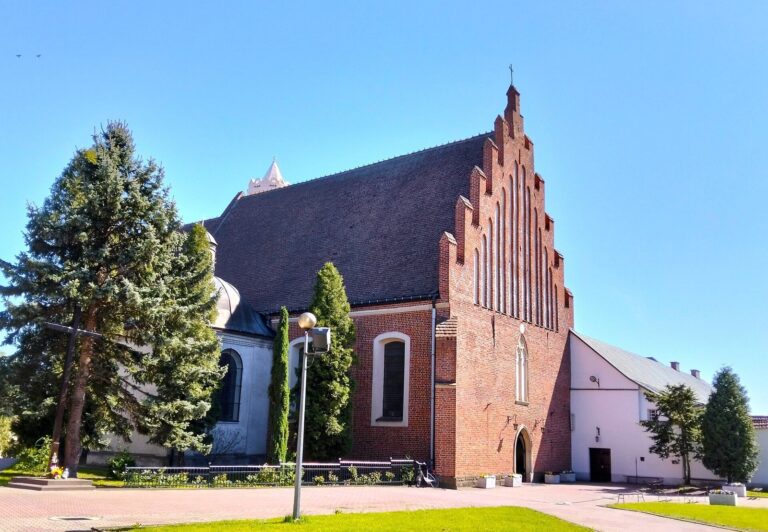
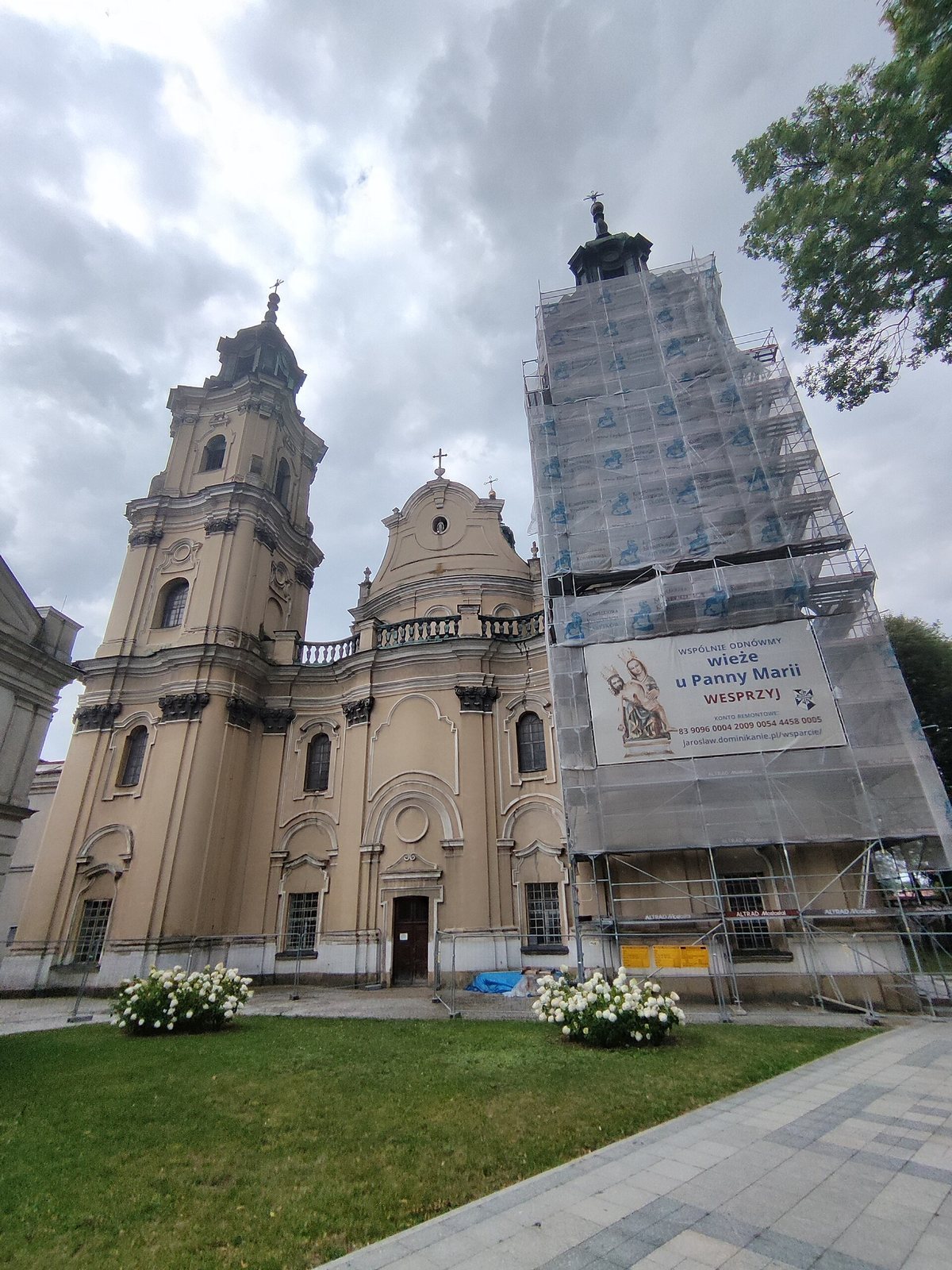
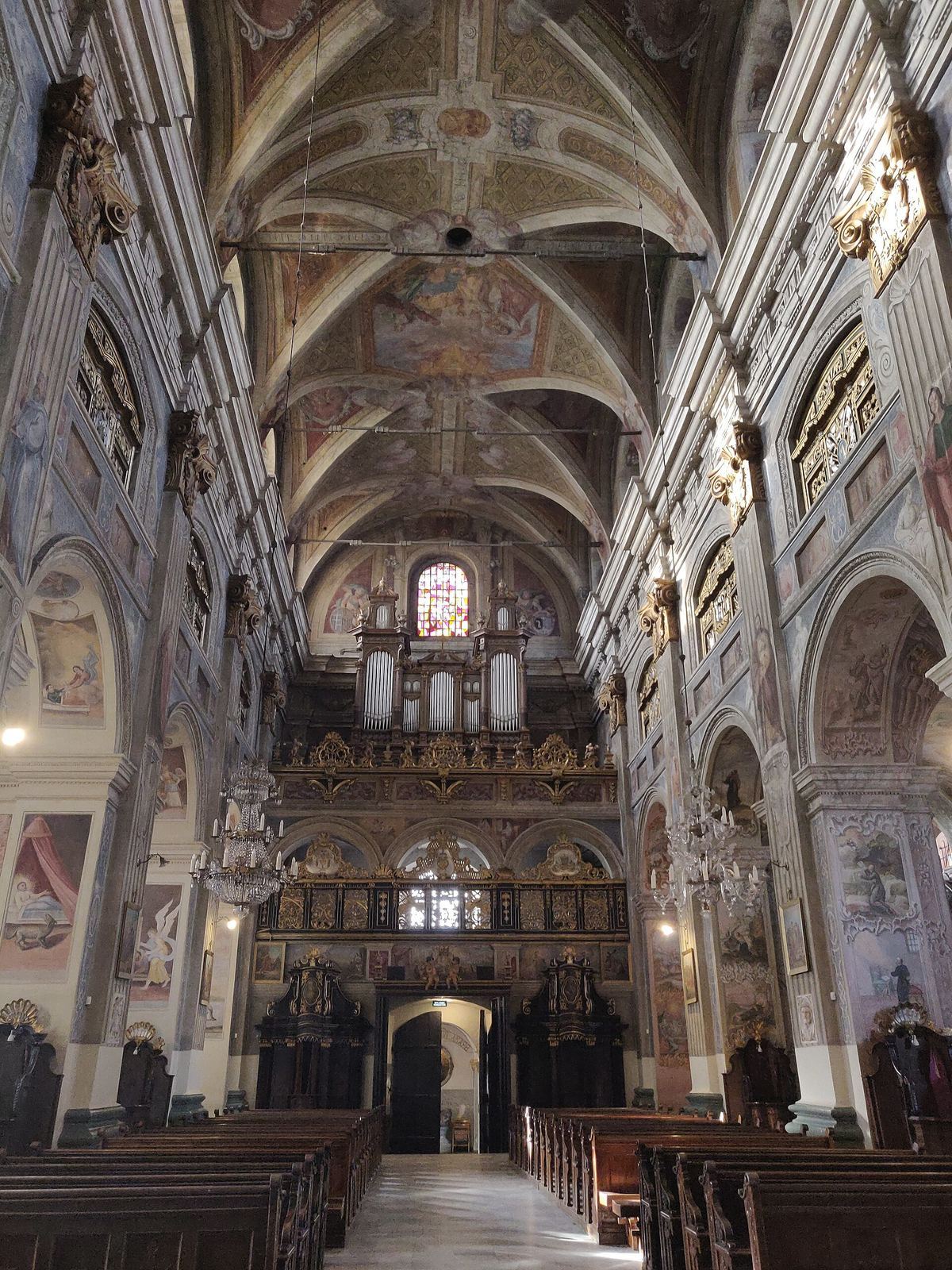
The brick basilica has a three-aisled plan, with a five-section nave leading to a two-section choir at the eastern end. Two chapels extend from the side aisles, suggesting a transept, the crosswise arm of a church.
Interior structure
In the nave, a continuous arched ceiling rests on shallow, column-like projections from the walls. The church contains ten altars and an organ with 21 stops and two manuals.
Façade and towers
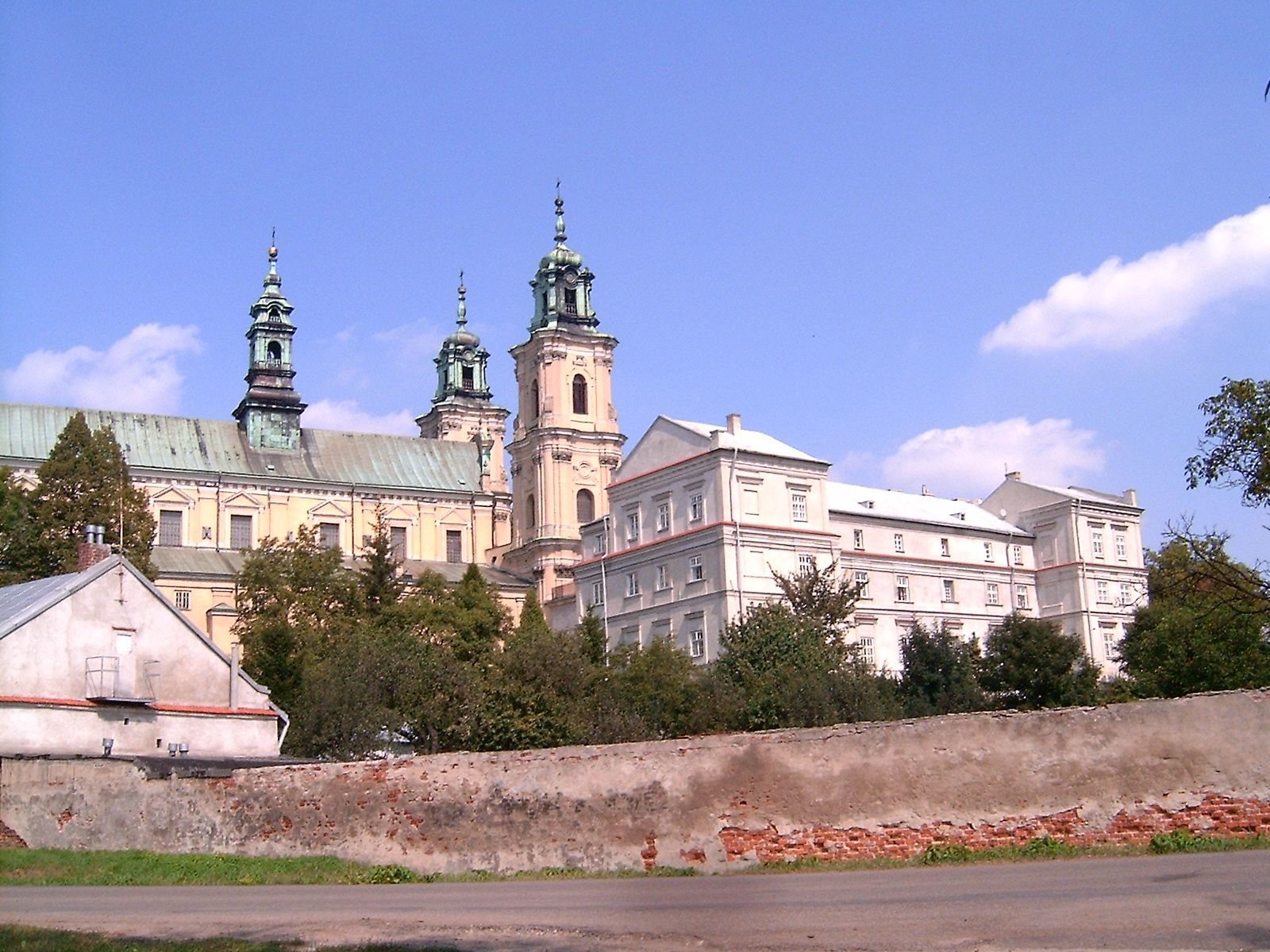
The choir’s screen façade has a front that curves inward and outward, flanked by two square towers of three storeys, each topped with an openwork spire. A small roof tower rises above the shared gabled roof over the nave and choir. The church has three towers in total, with the bells in the southern tower.
The venerated image and high altar
The wooden Gothic Pietà, an image of Mary holding the dead Christ, was carved from pear wood by an unknown maker. It is displayed in the Baroque high altar made by Jerzy Hankis in 1713.
Relics
The basilica’s venerated relics include those of Saint John Paul II, Saint Hyacinth, and Saint Dominic. The relics of John Paul II are kept in the relic altar.