Osterspai Castle: A Medieval Water Castle on the Rhine


Site at a Glance
- Rating
- 4.7
- Popularity
- Very Low
- Country
- Germany
- Primary era
- Medieval
- Eras represented
- Medieval, Modern
- Civilizations
- German, Holy Roman Empire
- Site type
- Military
- Remains
- Castle
On this page9 sections
History
Osterspai Castle is a medieval former water castle in Osterspai, Germany, built in 1302 on the bank of the Rhine. Heinrich I, Count of Sponheim of Tannenfels, is considered its likely builder. The castle was first recorded around 1400 and later became closely connected with the Liebenstein and Preuschen families.
Medieval Foundations and Liebenstein Ownership
For centuries, Osterspai was held under imperial immediacy, meaning that it answered directly to the emperor rather than to an intervening territorial prince. Local government was exercised by an imperial knight, a member of the lower nobility with this immediate status within the Holy Roman Empire.
In 1434, Philipp von Liebenstein received an assurance from the Liebenstein co-heirs that he alone could use the village and castle of Osterspai. These co-heirs were joint hereditary holders of Liebenstein property. Around 1500, the Liebenstein family also acquired parts of the former Eberbach wine estate west of the castle, including the chapel that now stands within the castle enclosure.
Changes in Lordship
The Lords von Waldenburg, also known as Schenker, assumed the local lordship of Osterspai in 1636. The castle and its buildings were still preserved in 1673, but most of the complex was lost afterward. In 1792, the imperial barons von Preuschen von und zu Liebenstein took over the lordship.
Nassau assumed control of Osterspai in 1806, during the political reorganization that accompanied the foundation of the Confederation of the Rhine. The surviving castle remains the family seat of the barons and baronesses von Preuschen, while the larger grounds are used as a vineyard.
Chapel History and Modern Preservation
St. James’s Chapel is the visible remnant of the former Eberbach monastic court at Osterspai. Eberbach Abbey was a major Cistercian monastery in the Middle Rhine region, and a monastic court served as an estate and administrative center for its agricultural and economic holdings. The chapel was first recorded in 1267, although its original patron saint is unknown.
The chapel is often confused with St. Peter’s Chapel at Spay on the opposite bank of the Rhine. That building was donated to Eberbach Abbey in 1237, and the confusion probably arose from Stramberg’s Rheinischer Antiquarius. The building within Osterspai Castle is now known as St. James’s Chapel.
Since 2002, Osterspai Castle has formed part of the UNESCO World Heritage Site Upper Middle Rhine Valley, a cultural landscape recognized for its historic river settlements, castles, fortifications, and associated countryside. The Burggarten Osterspai association was founded in 2011 and took on the lease of the castle garden, wine-press house, and adjoining open spaces from 1 May that year. Its income supports preservation of the Old Castle and cultural events such as concerts.
Remains
Surviving Castle Buildings
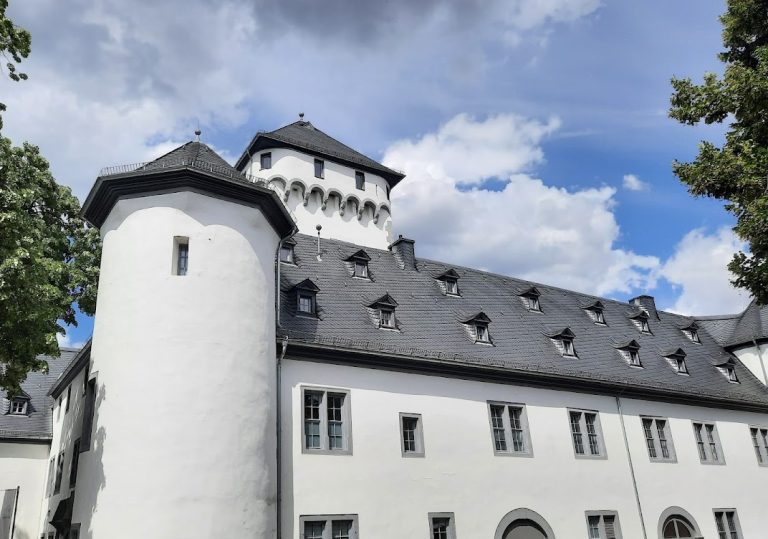
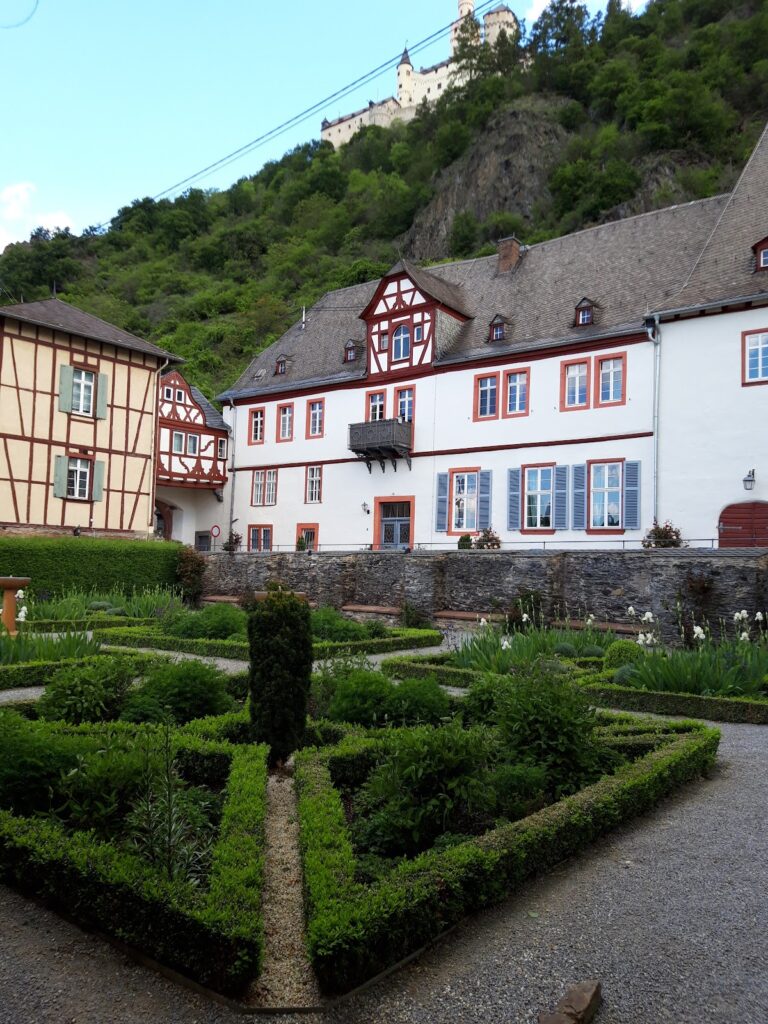
Osterspai Castle is a lowland castle that stands directly beside the Rhine. It was originally enclosed by a moat filled with water. The surviving complex is characterized by half-timbering and now consists of the massive residential tower and the chapel, while the broader grounds extend into vineyard land.
Old Castle Residential Tower
The residential tower, known as the Old Castle, was built in the mid-fourteenth century. Remnants of its corner towers remain visible, preserving evidence of the structure’s earlier defensive form. Around the beginning of the twentieth century, the tower was enlarged with a half-timbered addition. The tower remains part of the surviving family seat.
St. James’s Chapel
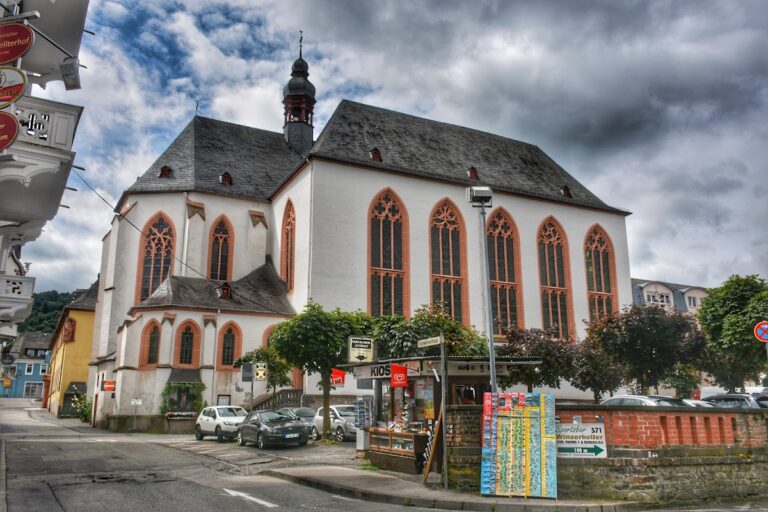
St. James’s Chapel is a rectangular hall arranged over two storeys. Remains of thirteenth-century wall paintings survive on the upper floor. Their artistic characteristics point toward the artistic milieu of Limburg Cathedral, linking the small building with the wider artistic culture of the medieval Middle Rhine.
Castle Garden and Wine-Press House
The extensive castle grounds are used as a vineyard. The Burggarten includes the wine-press house and adjoining open spaces, which form part of the area maintained for the preservation of the Old Castle and for cultural activities.