Orlová Monastery: A Benedictine Foundation in Czechia


Site at a Glance
- Rating
- 4.8
- Popularity
- Very Low
- Country
- Czechia
- Primary era
- Modern
- External website
- Open
- Eras represented
- Medieval, Modern
- Civilizations
- Habsburg, Holy Roman Empire
- Site type
- Religious
- Remains
- Monastery
On this page14 sections
History
Orlová Monastery is a Benedictine foundation in Czechia, established around 1268 during the medieval consolidation of the Teschen region. It was a dependent monastery of Tyniec Abbey near Kraków, whose monks followed the Rule of Saint Benedict, combining communal prayer with work and study. The monastery served religious, agricultural, and administrative purposes, while its position near the Ostravice River and Moravia also gave it value in strengthening the southern frontier of the Duchy of Opole and Racibórz.
Early records and foundation
Orlová appears in papal documents of 1227 and 1229, which confirmed Tyniec’s rights in Orlová and nearby settlements. A chapel may already have stood there at that time. The formal foundation followed in 1268, when Duke Władysław of Opole renewed earlier gifts to the church and established Orlová as a filial abbey of Tyniec. A filial abbey was a dependent monastery whose senior house retained authority over important appointments and institutional privileges.
Foundation traditions associate the transfer of Orlová to Tyniec with Duke Kazimierz I of Opole, who is said to have exchanged the area for New Teschen because Orlová had greater strategic value. The monks may also have been drawn to local salt springs and the possibility of making salt from brine. The endowment included Orlová, Solca with an inn, Doubrava, Chotěbuz, Vrbice without an inn, and Záblatí. The community also received, or claimed, tithes and other revenues from several further settlements. A tithe was an ecclesiastical levy on local income and did not necessarily mean that the monastery owned the village from which it was collected.
The surviving versions of the 1229 confirmation differ over the extent of Tyniec’s rights. One presents broad ownership of Orlová and its appurtenances, while the more credible version appears to concern tithe rights from a wider group of villages. This uncertainty continued into the interpretation of the monastery’s early estate. The charter of 12 May 1268 confirmed rights connected with Orlová, Solca, Doubrava, Chotěbuz, Vrbice, Záblatí, Žukov, Těrlicko, and Ostrava. It also granted judicial and economic immunities, exemption from castle construction and non-defensive military expeditions, and the right to retain judicial fines.
The charter required the abbot of Tyniec to establish the church at Orlová and gave him authority to appoint or approve the local abbot. The Orlová abbot was to enjoy the same ecclesiastical liberties as the head of Tyniec. On the Feast of the Nativity of the Virgin Mary, 8 September, visitors to the monastery received thirty days of protection from arrest and seizure of goods. The provision made the monastery a recognized refuge, including for people pursued for criminal offences.
Settlement and pastoral work
Father Jan, sent from Tyniec, became Orlová’s first abbot. He is associated with enlarging the earlier chapel or church and beginning the monastery buildings. The community probably consisted of several monks and may at times have reached about twenty members. An earlier chaplain, Martin, is known from before 1260 and witnessed a charter in that year.
From the late thirteenth century, the Benedictines helped clear forests, cultivate land, build agricultural structures, attract settlers, and encourage craft work and learning. Their activity contributed to the development of settlements including Lazy, Poruba, Rychvald, and Žermanice. The possible foundation of Horní Lutyně, Dolní Lutyně, and Cula remains uncertain. In the surrounding parishes, the monks exercised pastoral responsibility at Solca, Vrbice, and for a time Bohumín, as well as at a chapel in Těrlicko.
In 1291, Abbot Jan I, with the approval of Tyniec’s abbot Albert, attached Vrbice to the parish church at Bohumín. He also transferred it from the Teschen ecclesiastical district to the Ratibór district. This decision illustrates the monastery’s role in organizing religious administration as well as managing land and revenues.
Medieval expansion and financial decline
Monk Bohuško arrived from Tyniec in 1327 and became abbot after Jan I’s death. In 1345, Pope Clement VI accused him of forging documents and ordered the ecclesiastical authorities to annul acts based on the forgeries, punish those responsible, and remove or excommunicate people who knowingly supported them. Bohuško later left Orlová, lived outside religious life for a period, entered the Dominican monastery at Ratibór, and eventually returned to Tyniec. The historian Wojciech Kętrzyński later proposed that forged documents may have helped Bohuško recover the Orlová abbacy.
The monastery suffered financial difficulties during the fourteenth and early fifteenth centuries. It increasingly sold or pledged property, and by the middle of the fifteenth century it had lost rights in Těrlicko, Chotěbuz, and Solca, parts of Žukov, and revenues from three villages in the Ratibór castellany. A castellany was a medieval administrative district centered on a fortified settlement. The expense of constructing the church and later buildings deepened the debts, although Tyniec supplied three bells, two in 1453 and another in 1534.
Abbot Jan III nevertheless oversaw an important period of development. Before 1466 he commissioned a new masonry church, which was consecrated that year on the Feast of the Assumption of the Virgin Mary. The church was dedicated to the Assumption and the Holy Trinity. Indulgence privileges helped make it a pilgrimage destination. An indulgence was a formal remission of ecclesiastical penalties associated with sin, often connected with prayer, pilgrimage, or charitable giving. On 20 September 1473, Cardinal and papal legate Mark granted a hundred-day indulgence to visitors who came on specified feast days, including Good Friday and Marian feasts, and contributed to repairs and furnishings. Bishop Rudolf of Rüdesheim confirmed the privilege four days later. Records describe heavy attendance and many reported miracles associated with the church.
Property sales and secularization
Financial pressure continued after the medieval building campaign. Abbot Jan IV sold Vrbice and Heřmanice in 1491. In 1511, Abbot Ondřej Gniady of Zaběřov sold the monastery inn, together with a pond known as Podgórny, streams, six strips of land, and part of a field. New monastery buildings were erected or modernized in 1513 under the same abbot, increasing the community’s debt. A pond was added to the monastery’s property in 1514, with its income assigned to the needs of the church and monastery.
Záblatí was sold or pledged in stages between 1515 and 1532. The final sale, to Jan Sedlnický of Choltice in 1532, ended the monastery’s rights there and helped settle a debt of 200 florins owed to the Church of Our Lady in Ratibór. The monastery retained a tithe from Záblatí for part of this period and may briefly have recovered the village.
In 1545, Duke Václav III Adam of Teschen confiscated the monastery’s property during the spread of the Reformation, the sixteenth-century movement that challenged Catholic Church authority and institutions. Appeals by the monks, supported by King Sigismund I of Poland and King Ferdinand I, secured the return of part of the estate. The duke confiscated the remaining possessions in 1560 and 1561, however, and Orlová was secularized in 1561. Its villages, including Orlová, Lazy, Poruba, Rychvald, Polish Lutynia, and part of Žermanice, were incorporated into the princely estate of Fryštát.
A monk from Tyniec, Burziński, was appointed at Orlová in 1560. He preached forcefully against heresy and against Václav III Adam, who refused to recognize him, declared him a foreigner, and expelled him. After Burziński returned to Tyniec in 1561, Orlová’s Benedictine property passed permanently into princely administration. The monastery buildings were later dismantled, and their materials were reportedly reused in an Evangelical church and a Renaissance castle at Rychvald.
Later ecclesiastical administration
Protestants held Orlová’s church until 1631, when Benedictines from Tyniec returned. They recovered only the church and rectory, and a single monk served as parish priest. Tyniec continued to seek the restoration of the former estates throughout the seventeenth century.
In the early eighteenth century, the Orlová institution was separated from Tyniec and subordinated to the Benedictine congregation associated with Broumov and Břevnov. From that point, the abbot of Broumov appointed parish priests at Orlová. The parish entered the new deanery of Karviná in 1769. In 1770, after the Silesian Wars and the division between the Habsburg territories and the Prussian part of the Diocese of Wrocław, it came under the Austrian general vicariate of that diocese.
Remains
Orlová’s surviving remains combine the reconstructed monastery building with the church that replaced the medieval monastic church in the early twentieth century. The historic complex was connected with an estate of ponds, mills, fields, meadows, forests, inns, and villages. The monastery building underwent extensive reconstruction in the early twenty-first century and now accommodates a commercial company.
The church and medieval fabric
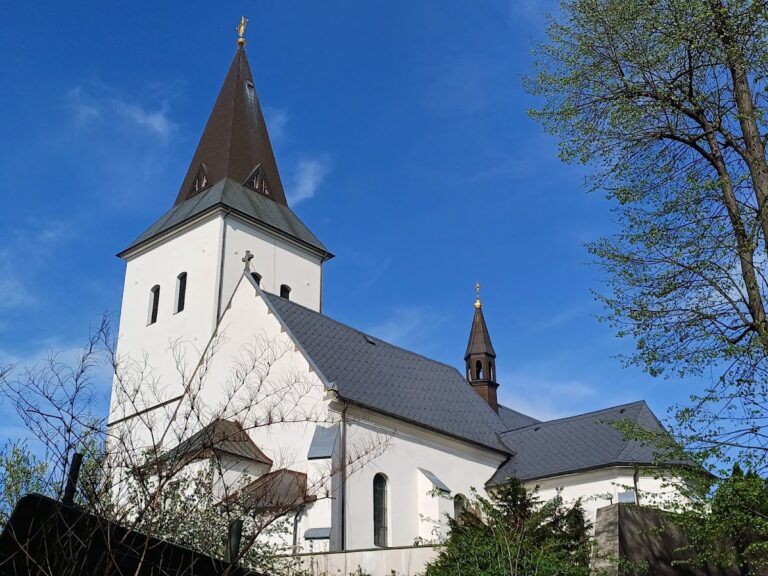
Neo-Gothic church
The medieval masonry church commissioned by Abbot Jan III survived until the beginning of the twentieth century. A new Neo-Gothic Church of the Nativity of the Virgin Mary was built in 1903 to 1905 on the remains of the earlier monastery church. The present church preserves two historic bells from the medieval building, linking the later structure with Orlová’s fifteenth- and sixteenth-century ecclesiastical history.
Medieval altar
The main Gothic altar of the Church of the Assumption of the Virgin Mary also survives from the medieval church. Its paintings date from around 1470. A reredos from the monastery is held in the collections of the National Gallery in Prague.
Historic bells
Tyniec supplied two bells in 1453, weighing 75 kilograms and 750 kilograms, and a third in 1534, weighing 900 kilograms. The larger surviving bell carries a Latin inscription invoking the King of Glory to come in peace and including a greeting to Mary. It is described as the sixth-oldest bell in the Czech Republic.
Monastic estate and boundary features
Inn and waterworks
The monastery inn stood below or beside the church and was sold in 1511 with the Podgórny pond, streams, six strips of land, and part of a field. Another monastery pond lay between a mill pond and the pond belonging to the innkeeper. The churchwarden and municipal council managed its stocking and fishing and kept records of the proceeds, which formed part of the economic landscape surrounding the religious institution.
Former monastery wall
A cross dated 1888 stands at the corner of the former monastery wall. It was dedicated by Francis and Barbara Szelig, although the date has become difficult to read. The cross preserves a visible association with the surviving boundary of the former monastic complex.