Old Town of Vrana: A Medieval Monastery and Frontier Fortress
Site at a Glance
- Popularity
- Medium
- Country
- Croatia
- Primary era
- Medieval
- Eras represented
- Medieval
- Civilizations
- Hungarian, Kingdom of Croatia, Knights Templar
- Site type
- Military
- Remains
- Fort
On this page10 sections
History
Monastery and papal presence
The Old Town of Vrana is a medieval and early-modern fortified complex in Vrana, Croatia, where a Benedictine monastery stood by 1076. Vrana was known by the ninth century. In 1076, King Zvonimir transferred the monastery and its estate to the papacy so papal envoys could maintain a lasting presence in Croatian lands. The monastery became part of the Patrimony of St Peter, the lands and rights held by the papacy as St Peter’s inheritance, and received papal privileges. Vrana became the earliest permanent base for papal representatives in the Slavic region.
The monastery also held two gold crowns set with precious stones, along with other valuables associated with the Croatian kingdom. The crowns were linked to King Coloman’s choice of nearby Biograd for his coronation in 1102.
Templar and Hospitaller rule
In 1136, the pope gave Vrana to the Templars, a Catholic military religious order. Papal privileges placed them beyond the authority of local bishops and nobles. King Andrew II confirmed these rights and granted the Templars further lands in 1209. King Béla IV spent Easter at Vrana in 1245.
The Hospitallers, another Catholic military religious order, took over administration in 1312. Their priory, a religious community and administrative center led by a prior, became one of the kingdom’s prominent institutions, with authority across the Croatian-Hungarian kingdom. During the fourteenth century, the prior also held the title of Croatian ban, a senior regional office with political and military duties.
Vrana was drawn into several conflicts. The Šubić family failed to capture it in 1328, and Venetian forces burned it in 1345. In 1383, supporters of Charles of Durazzo met there to advance his claim to the Hungarian throne against Queen Mary and her mother, Elizabeth. The two queens entered Vrana on November 4. Later in the century, John of Palisna, a Hospitaller prior and Croatian ban, controlled the fortress. In November 1389, his knights fought forces supporting Sigismund outside its walls. John was wounded and lost 120 men, but the fortress held; the opposing army withdrew to Zadar in December.
After John’s death, Sigismund installed Emerik Bubek as Croatian ban at Vrana. In 1402, forces backing Ladislaus of Naples besieged the fortress under Alojzije Aldemarisca, a Neapolitan duke, with 700 men from Zadar and Pag. Vrana fell on October 11, a turning point in the contest for the Hungarian throne.
Venetian frontier and Ottoman conquest
Ladislaus sold Dalmatia to Venice in 1409. Fighting over Vrana followed in 1411 between Venice and Croatian ban Karlo II Kurjaković. Under Venetian rule, the fortress guarded a frontier between Venetian territory and the Croatian-Hungarian kingdom, while disputes with the princes of Krbava affected the surrounding area. Venice strengthened both the fortress and the settlement below it in 1415–16.
Ottoman raids intensified after Bosnia fell in 1463. From 1499, repeated attacks on Vrana and its district brought livestock theft, burned villages, and the capture of people for enslavement. These assaults disrupted farming and cut local revenue below the cost of maintaining the garrison. The fortress was in poor condition by 1500 and underwent repairs in 1520. In 1524, the town and suburb had 561 residents and a garrison of 25 cavalrymen, soon reinforced by 36 infantrymen. By 1532, the drawbridge was broken and the fortress’s weapons were obsolete.
In May 1538, an Ottoman force of 6,000 infantry and 2,000 cavalry captured Vrana. The Venetian commander, Pietro Sorenco, fled, and the remaining defenders were overcome. Hereditary rights over the monastery and its property passed to the Zagreb Cathedral Chapter. Under Ottoman rule, Vrana became a strengthened frontier fortress, and the Ottomans organized a settlement below it.
Ottoman town and later decline
Vrana was the seat of an Ottoman district by 1574. The settlement was uninhabited during the first decades of Ottoman rule; later residents included soldiers and their families, as well as civilians, many of whom farmed. Most residents remained Christian, chiefly Orthodox. The garrison numbered 83 men in 1616 and 103 in 1643. By the middle of the seventeenth century, the town had about 500 houses, several mosques, a school for Muslim religious instruction, public baths, water facilities, and fountains.
Venetian forces temporarily retook Vrana in January 1647 during the Cretan War, a conflict between Venice and the Ottoman Empire that ended in 1669. To keep the fortress from being used by their opponents, they demolished it with cannon fire over four days. A peace settlement returned Vrana to Ottoman rule in 1669. In October 1683, local inhabitants freed the town, which then came under Venetian rule. The fortress no longer had a military role and was not restored for military or religious use.
Left to deteriorate, the fortress and the Vrana estate passed to the Borelli family in 1752. Austrian authorities assumed administration of the estate in 1868, while the fortress and nearby Mašković Han remained with the Borelli-Vranski family. Preventive conservation work in 2003 addressed the southern defensive wall, a tower, and the Church of St. Catherine, alongside clearance work; conservation and restoration of the church and other remains continued afterward. The Old Town is registered as a protected monument.
Remains
Fortress and defensive works
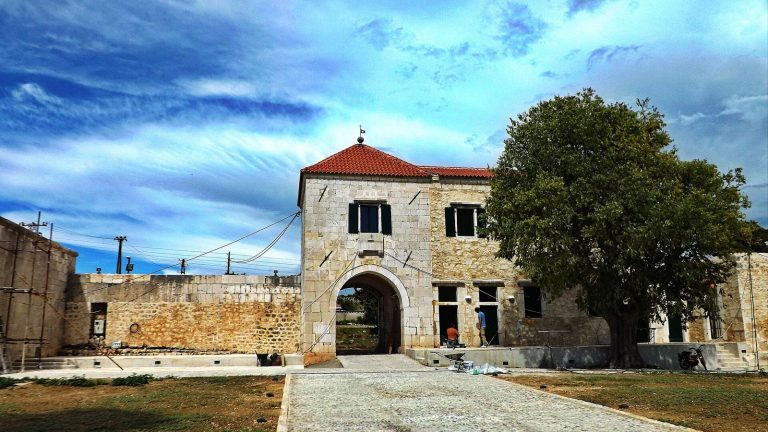
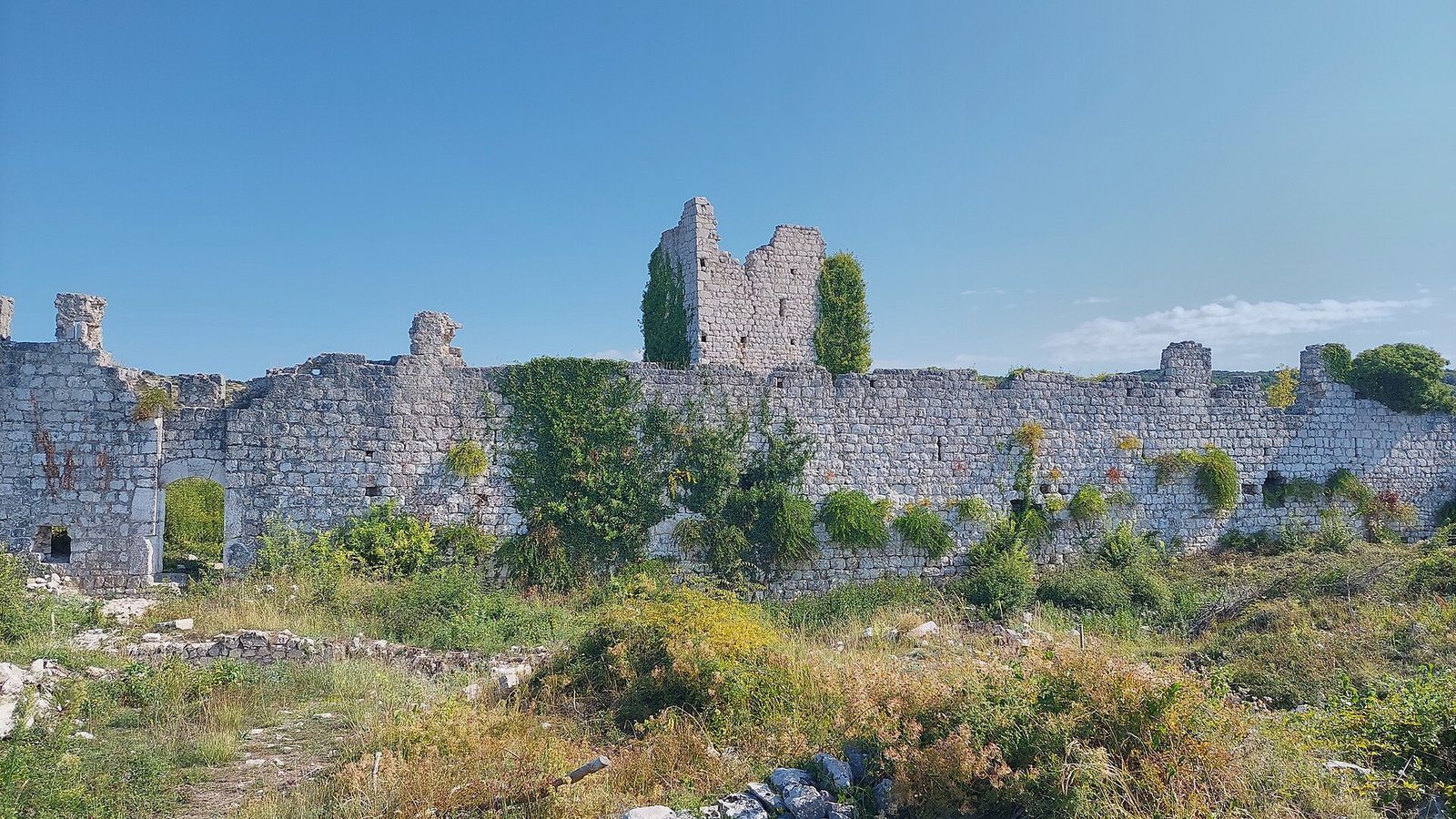
The stone fortress developed through medieval and early-modern phases. It occupies low ground at about 31 metres above sea level, below Nero Hill, at the northern edge of Vrana near the northern end and shore of Lake Vrana and the edge of its nature park. Mašković Han stands a few metres away. The defenses included three lines of walls, an outer enclosure, a drawbridge, and a ditch; the Templar fortress had four corner towers.
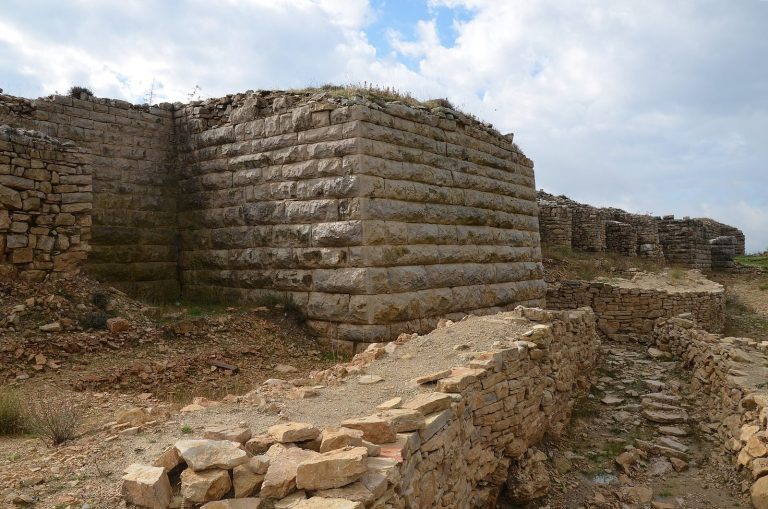
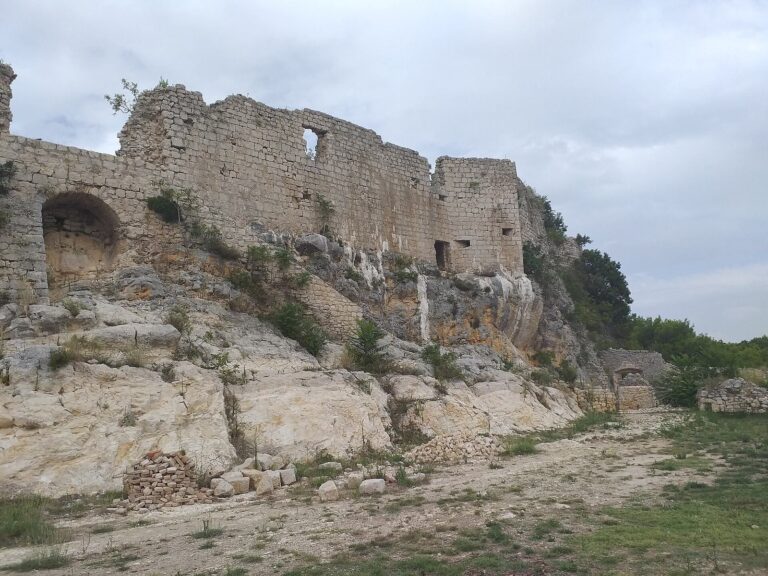
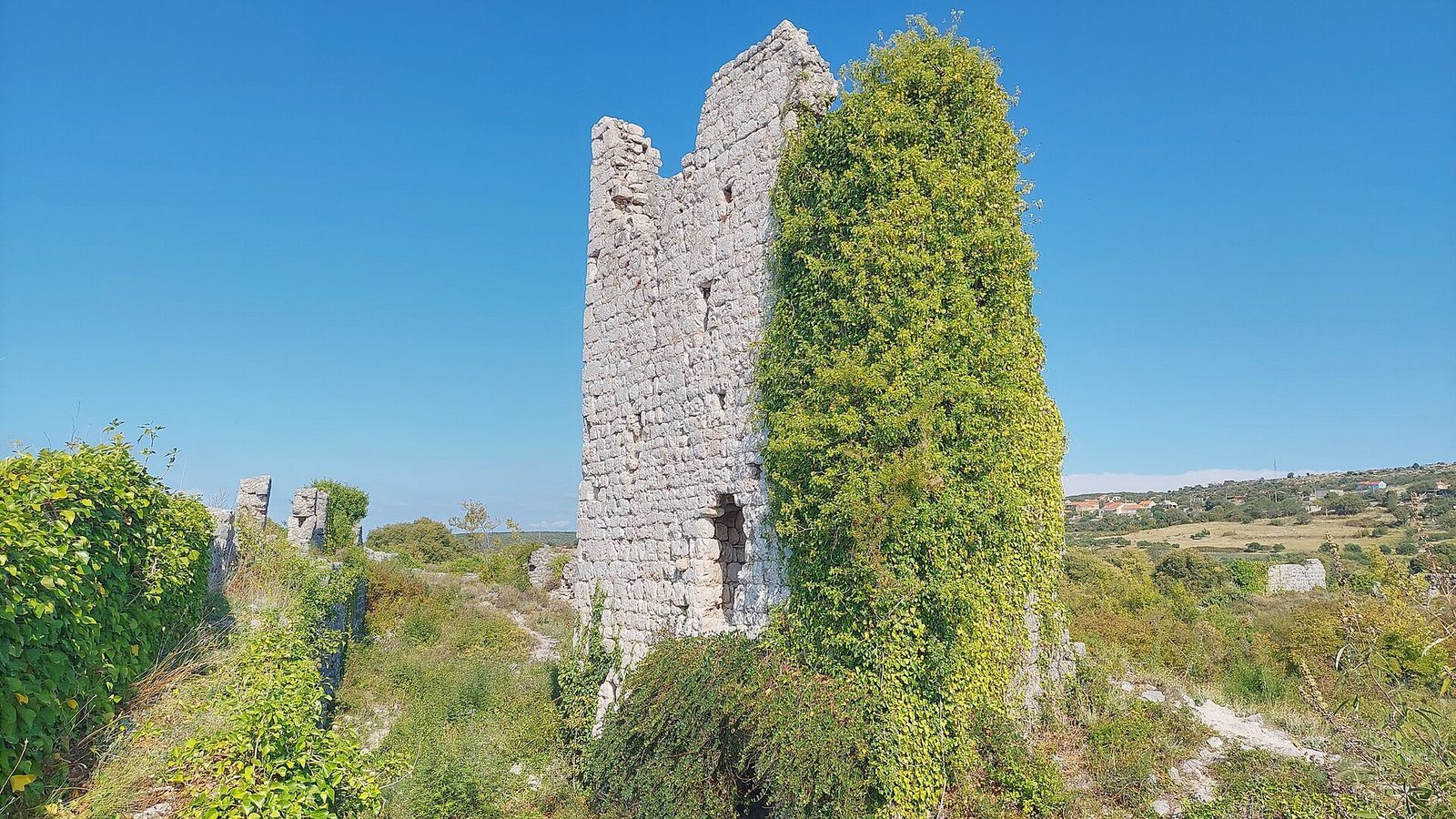
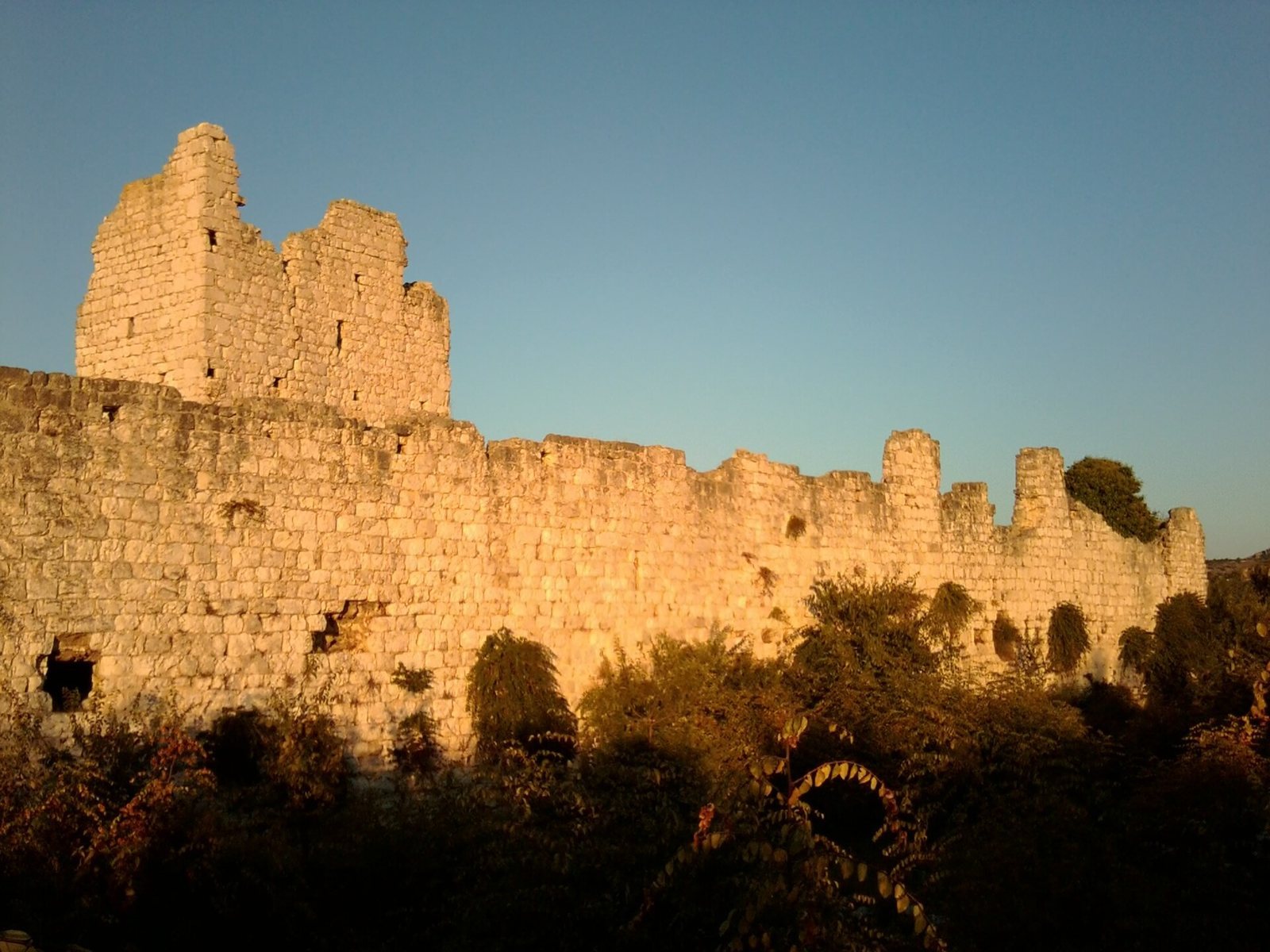
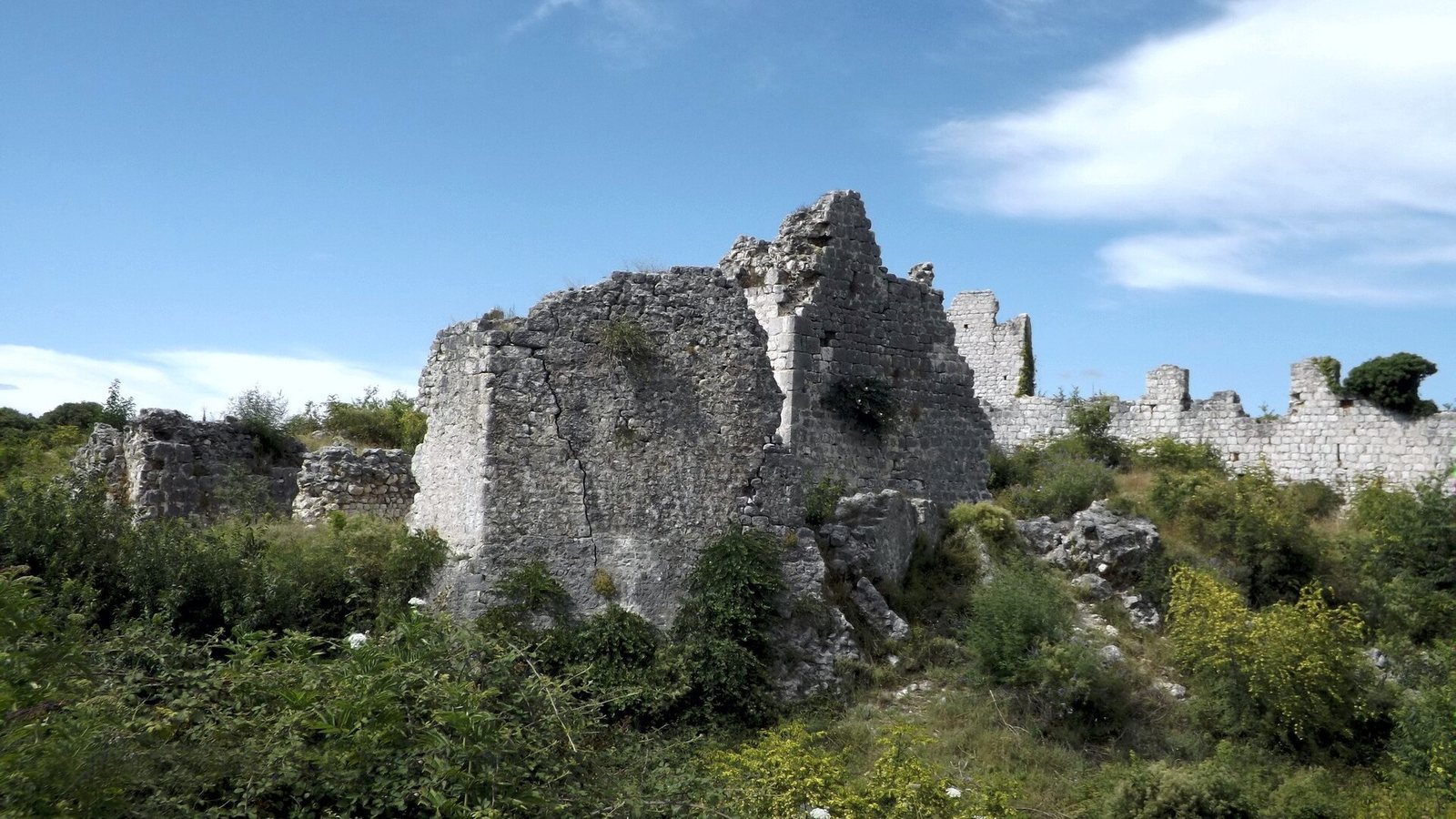
About one-fifth of the fortress’s original form survives. The southern and eastern wall faces are among the best-preserved sections, along with an entrance. Part of a square gate tower and the principal defensive tower remains, and stretches of wall still reach several metres in height. A projecting stone band at the top of the southern face could help guide reconstruction of the full defensive wall. The ditch, once about 30 metres wide, is still visible around much of the fortress. Stone from the ruins was reused in nearby settlements, reducing the surviving fabric.
Church and suburban remains
Church of St. Catherine
Ruins survive from the fourteenth-century Church of St. Catherine, built in the Gothic style, a medieval architectural tradition.
Fortress suburb
Traces of scattered buildings from the fortress suburb remain visible to the west.