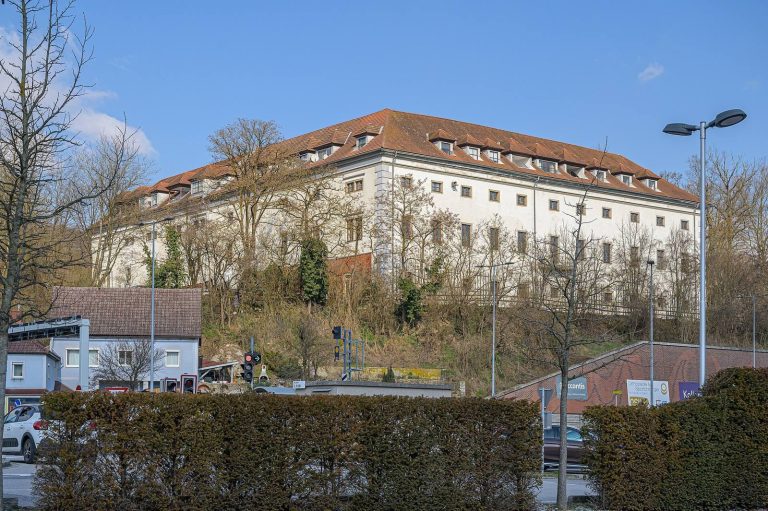
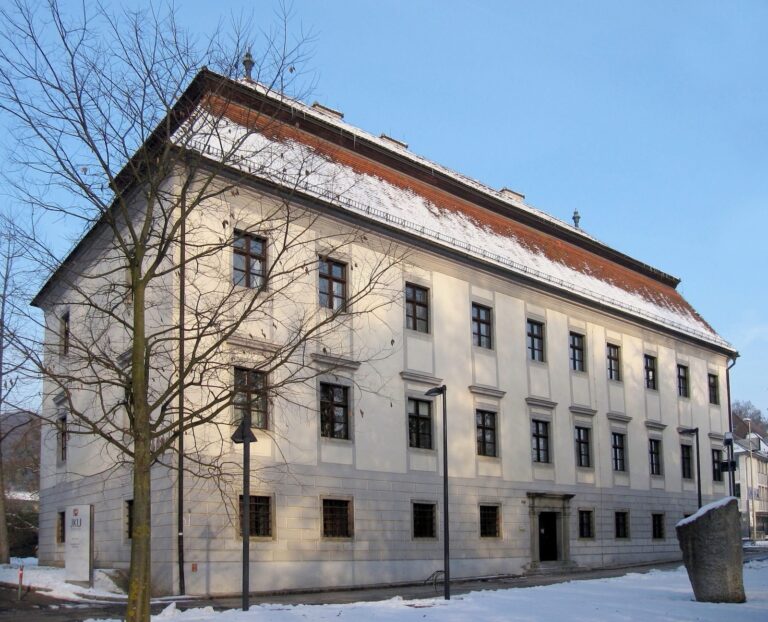
Old Cathedral, Linz: Former Cathedral of the Diocese of Linz
Site at a Glance
- Rating
- 4.6
- Popularity
- Medium
- Country
- Austria
- Primary era
- Early Modern
- Eras represented
- Early Modern, Modern
- Civilizations
- Austria-Hungary, Austrian Empire, Habsburg, Habsburg Austria, Holy Roman Empire
- Site type
- Religious
- Remains
- Cathedral
On this page12 sections
History
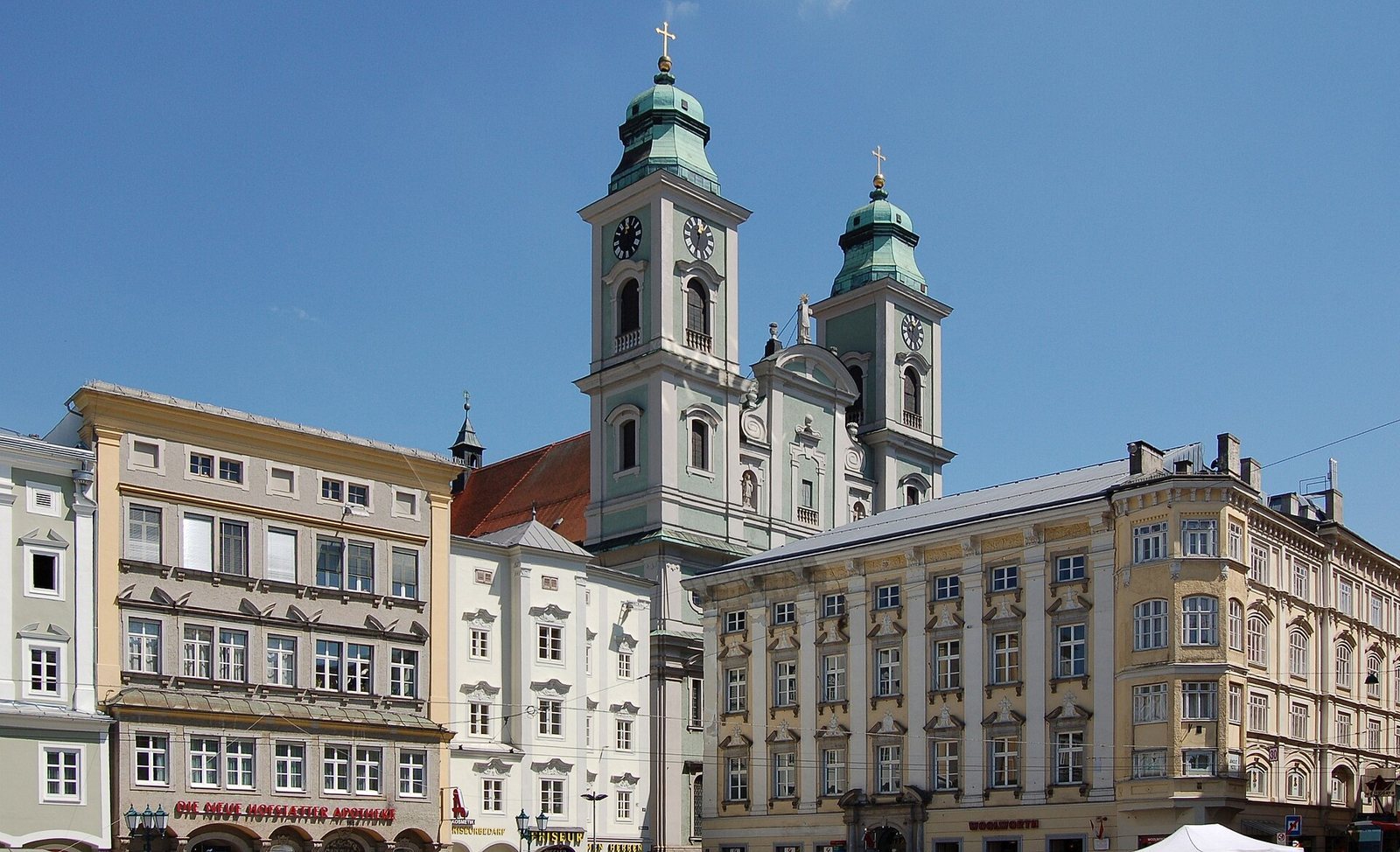
The Old Cathedral, Linz, is a Baroque church in Austria, founded by the Jesuits in 1669 and consecrated and opened for worship in 1678. Dedicated to Ignatius of Loyola, founder of the Jesuit Order, it was built for the Jesuit college in Linz, near the southern end of the Hauptplatz. The architect is unknown, but plans are attributed to Pietro Francesco Carlone, with Carlo Antonio Carlone also involved.
Jesuit church and cathedral
When Pope Clement XIV suppressed the Jesuit Order in 1773, the church was left without clergy. In 1784, Emperor Joseph II compelled the Diocese of Passau to give up its parishes in Upper Austria and began establishing the Diocese of Linz. Pope Pius VI confirmed the new diocese by papal bull, a formal document issued by a pope, on 28 January 1785.
Ernest Johann Nepomuk, Count von Herberstein, formerly an auxiliary bishop of Passau, became Linz’s first bishop. He selected the unused Jesuit church as his cathedral rather than the city parish church initially considered for the role. Herberstein was enthroned on 1 May 1785 and died in 1788. Joseph Anton Gall served as bishop from 1788 to 1807. The church remained the cathedral of the Diocese of Linz until 1909, and Rome confirmed its cathedral status in 1841. During the episcopate of Gregorius Thomas Ziegler, from 1827 to 1852, the church underwent restoration.
The church also became a setting for important musical performances. Beethoven wrote the Three Equali for four trombones for a performance there on All Souls’ Day, 2 November 1812. Anton Bruckner served as cathedral organist from 1856 to 1868. He studied with Simon Sechter and became conductor of the Frohsinn choral society in 1860. Frohsinn performed Bruckner’s seven-part Ave Maria in the church on 12 May 1861, a work he later regarded as a favorite. His Mass No. 1 received its first performance there on 21 November 1864. The original score has a small organ solo in the Credo but otherwise no organ part; the mass has been described as Bruckner’s first work as a fully mature composer. An annual Bruckner Festival is held in the church in his honor.
Maria Elisabeth, a daughter of Maria Theresa, is buried in the church. Jesuits who died before the order was suppressed in 1773 were also buried there, and the church again became a burial place for Jesuits associated with it and the Aloisianum college at Freinberg. Linz bishops who died between 1785 and 1924 were buried there, but their coffins were later transferred to the New Cathedral.
From cathedral to continuing place of worship
As Linz grew in the late nineteenth century, the old church could no longer accommodate the city’s needs. Bishop Franz-Joseph Rudigier began the project for a larger cathedral, laying its foundation stone in 1862. The New Cathedral took over the cathedral function in 1909, although its consecration followed on 29 April 1924. The former cathedral thereafter became known as the Old Cathedral. The Jesuits returned in 1909 and resumed pastoral care there.
The Jesuits left Linz and the Old Cathedral in 2023. Since autumn of that year, the church has been a rectorial church, placed under the care of a rector, within the Diocese of Linz. It is also a place of worship for Linz’s Ukrainian Greek Catholic community, an Eastern Catholic church in communion with Rome whose services follow the Byzantine rite. The church is protected under Austria’s Federal Monuments Office.
Remains
Exterior and interior plan
Exterior
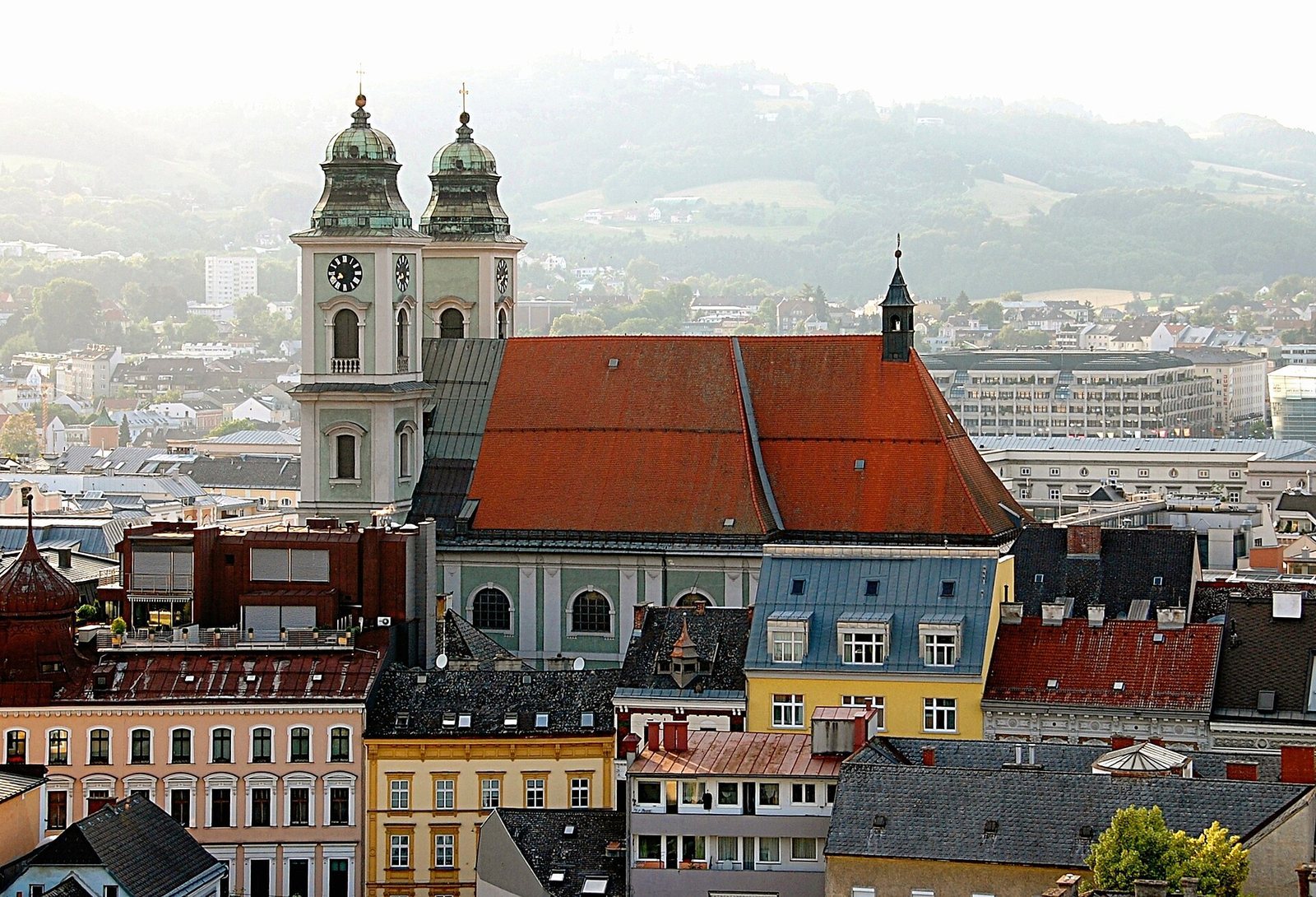
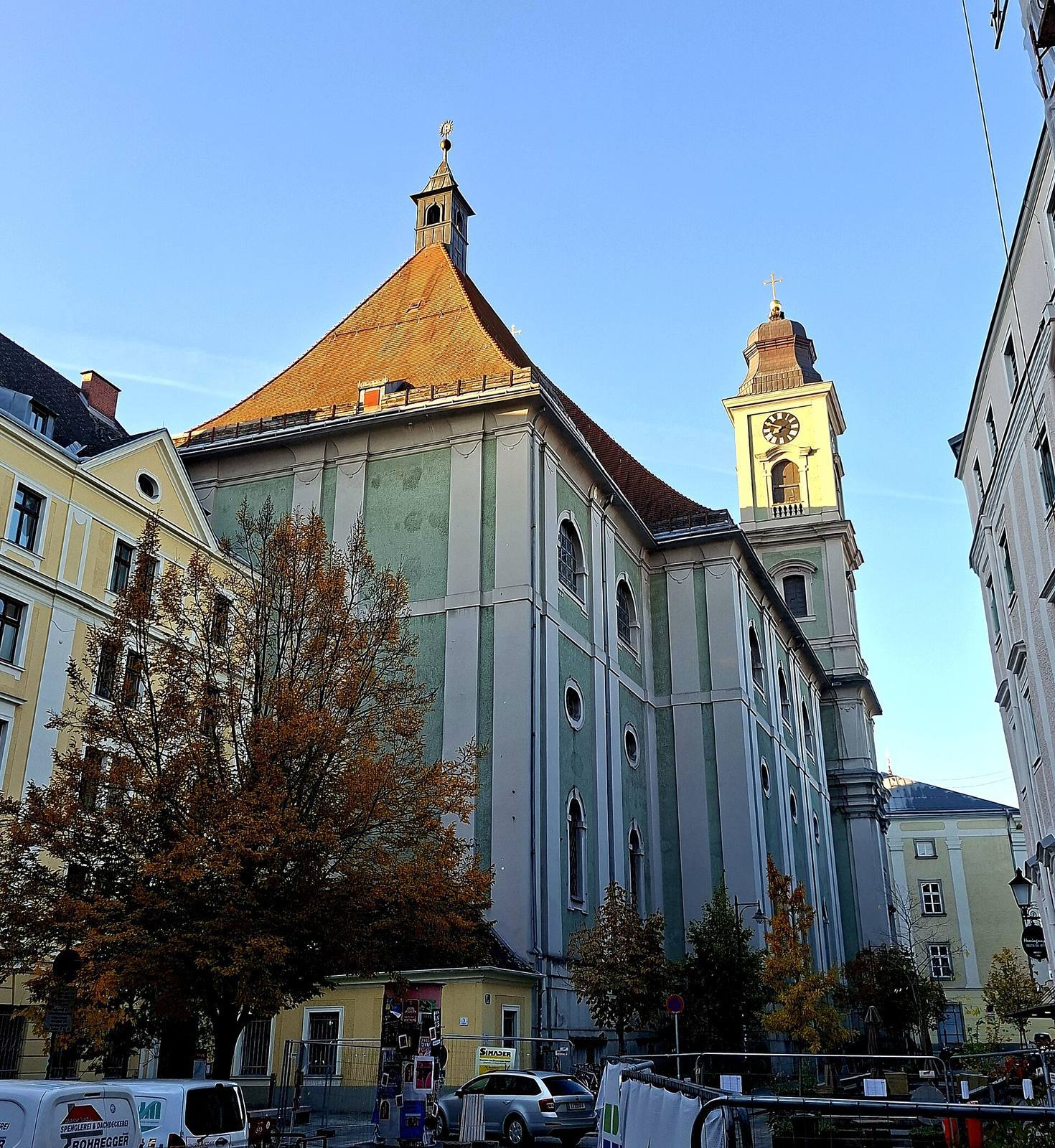
Set within the former Jesuit college complex in Linz’s Town Hall Quarter, the church has a relatively plain Baroque exterior. Two towers flank the main entrance, and each is topped by an onion-shaped dome. A plaque on the facade commemorates Anton Bruckner’s service as cathedral organist.
Nave and chapels
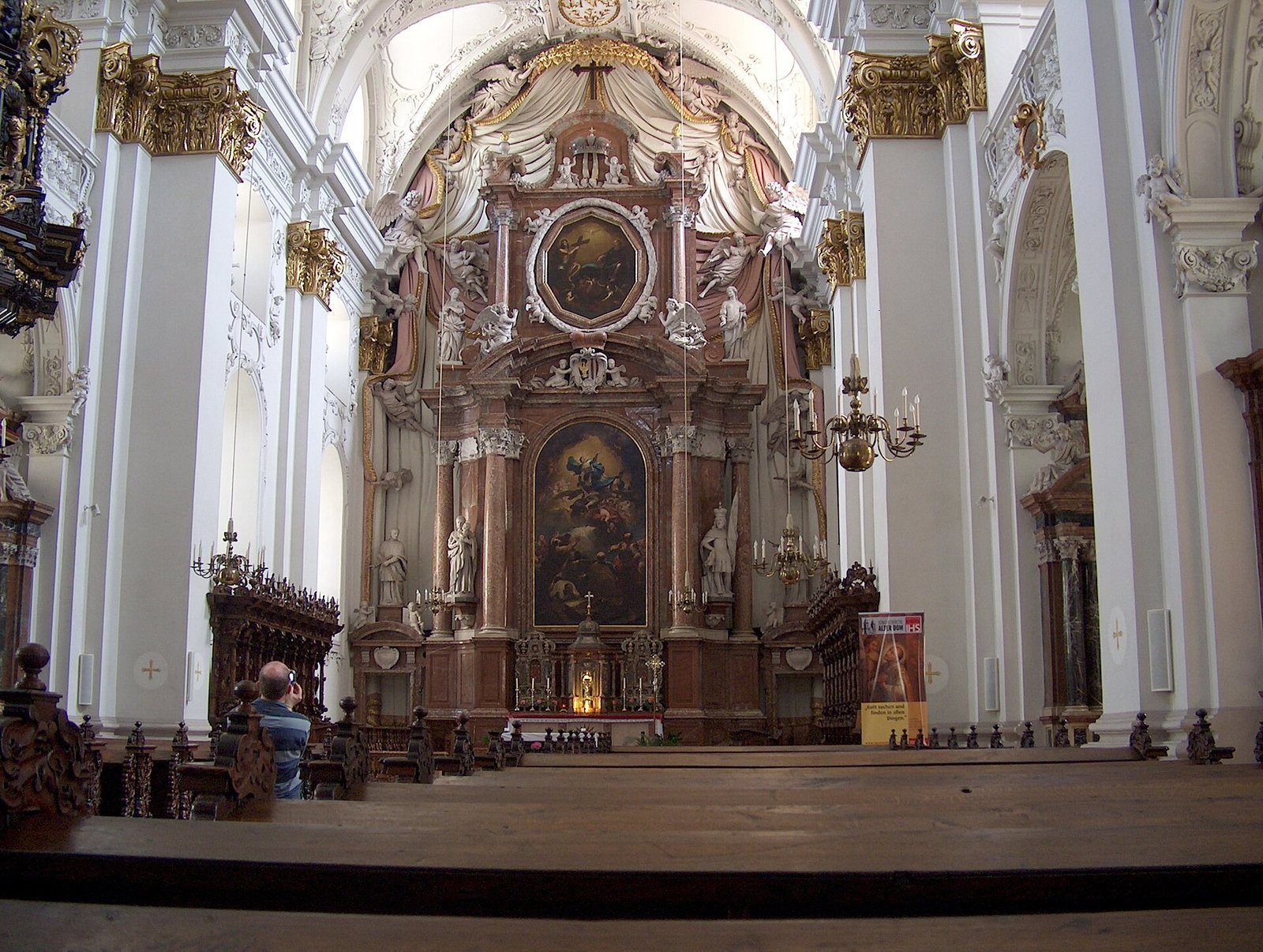
The interior is arranged around a single, broad nave, with three side chapels on each side. Niches in the chapels and pink-marble columns form part of the interior decoration. Above the entrance are the coats of arms of the Starhemberg, Weissenwolf, and Kuefstein countly families.
Furnishings
High altar
Giovanni Battista Colomba and Giovanni Battista Barberini made the high altar, which includes numerous marble statues. Its altarpiece depicts the Assumption of Mary, the Catholic belief that Mary was taken body and soul into heaven. The painting came from the Schwarzspanierkirche in Vienna and replaced an earlier image of Saint Ignatius. A painting of Saint Aloysius by Antonio Bellucci is also positioned above the altar.
Pulpit
The elaborately carved wooden pulpit has a detailed canopy above the speaker’s platform. Childlike angel figures occupy its four corners, and the four Evangelists appear among its sculpted figures. At the center, Jesus holds a globe; a statue of John the Baptist stands at the top.
Choir stalls
The seventeenth-century choir stalls came from Garsten Abbey and were carved by local artists. Their decoration includes faces of monsters and dwarfs.
Organ
Franz Xaver Chrismann built the organ between 1768 and 1770 for Engelszell Abbey. It was transferred to Linz after the monastery’s secularization and installed in a newly designed case. Alterations and installation work continued until 1795. The gallery was lowered, with that work completed in 1792. During renovations from 1853 to 1857, the organ was dismantled as the gallery floor was raised slightly.
While Bruckner was organist, he commissioned further changes from Josef Breinbauer, who carried out the work through 1867. The changes made the blockwork, groups of pipes that sound together, independently selectable through slider windchests, which direct air to chosen groups of pipes. They also extended half-stops, which serve only part of a keyboard, across its full range. The rear positive, a separate group of pipes traditionally placed behind the organist, was moved to the center of the case behind the console.
In 1979 and 1980, Rieger-Orgelbau renewed all the reed stops, pipe sets that sound through vibrating reeds, while retaining most of the organ’s underlying substance. Kuhn restored the instrument in 2016. It has three manuals, or hand keyboards, a pedal keyboard played by the feet, and 32 stops that control groups of pipes. Mechanical linkages transmit the movement of the keys and stops to the pipes.