Odenheim Abbey: A Benedictine Monastery and Later Collegiate Chapter
Site at a Glance
- Popularity
- Medium
- Country
- Germany
- Primary era
- Medieval
- Eras represented
- Medieval, Early Modern
- Civilizations
- Holy Roman Empire
- Site type
- Religious
- Remains
- Fortified Monastery
On this page13 sections
History
Foundation and growth
Odenheim Abbey was a Benedictine monastery in Germany, founded by the Counts of Lauffen around 1110–1118 as their family monastery. The Benedictines are a Catholic order whose members follow the Rule of Saint Benedict. Bruno von Bretten, Archbishop of Trier, and his brother Boppo III von Lauffen, a count, were associated with the foundation. Dedicated to Saints Peter and Paul, the monastery was endowed to the Diocese of Speyer. A royal charter first confirms its existence in 1122 or 1123, when Emperor Henry V confirmed the foundation and Boppo approved it. The first abbot, Eberhard, and the initial community came from Hirsau Abbey, a major Benedictine center of reform.
The monastery’s first site was Wigoldesberg. Before the mid-12th century, it moved to a valley roughly two kilometers away. The Lauffen family gave it property in Odenheim, Tiefenbach, Aglasterhausen, Großgartach, Hausen an der Zaber, Neckarwestheim, Poppenweiler, and Neckargartach, with further lands at Weiler an der Zaber added later. Under the foundation’s Hirsau-based charter, the counts held hereditary rights as secular protectors of the monastery, an office and jurisdiction known as a bailiwick. They had taken up the comital office in Kraichgau around 1103 and apparently shifted their residence away from Wigoldesberg. The monastery’s links to Hirsau may reflect the family’s affinity with its reform movement rather than the emperor-aligned circle around the Diocese of Würzburg.
In 1161, Emperor Frederick I confirmed a wide range of the abbey’s holdings, including lands in the Zabergau and along the Neckar, as well as at Elsenz, Ubstadt, Hambrücken, Bruchsal, Forst, Rettigheim, and Östringen. Some may have belonged to its original endowment and had only recently returned to cultivation. In 1184, Pope Lucius III allowed the monks to provide pastoral care at Odenheim’s parish church, bringing the church’s property and tithe rights into the monastery. Pope Celestine III placed Odenheim under papal protection in 1191 and made it independent of both Hirsau Abbey and the Bishop of Speyer. Odenheim also established a monastery at Kirchheim am Neckar and endowed it with property that included Häfnerhaslach.
Around 1200, the monastery prospered and contributed to Odenheim’s economic growth. After the male line of the Counts of Lauffen ended in 1216–1219, the Hohenstaufen kings retained the monastic bailiwick. Odenheim thus became an imperial abbey, a religious institution directly subject to the Holy Roman Emperor in matters of law and protection, rather than to an intervening territorial lord. In 1225, the monks began turning vineyards on Eichelberg into a settlement, where peasants worked the land under hereditary leases. Frederick II confirmed further holdings in 1237. Financial strain followed by the mid-13th century, and the monastery sold property and rights between 1249 and 1261. Odenheim received market rights in 1273 and became a trading center for livestock and produce from the monastic estate.
Imperial status, economic change, and conflict
From the early 14th century, the monastery increasingly leased land that it had once farmed directly. Farms near Odenheim were assigned surrounding parcels, and leases to dependent tenants and other farmers helped sustain agricultural production. Two additional mills were built near the village alongside the old monastic mill, later known as the Upper Mill.
Odenheim’s status as an imperial abbey became a source of prolonged dispute. In 1330, the Empire pledged its bailiwick rights over the monastery to Albrecht Hofwart von Kirchheim. In 1338, Bishop Gerhard of Ehrenberg of Speyer acquired the bishopric’s protective bailiwick and revenues from Odenheim’s estate bailiwick. The pledge was linked in 1349 with Speyer’s pledges over Landau and Waibstadt, and in 1350 the emperor allowed some rights to be pledged onward. Speyer’s bishops thereafter sought to treat Odenheim as territory under their authority, prompting litigation in imperial courts that continued for centuries.
Political instability led Abbot Dieter von Helmstatt to fortify the monastery in 1377. His successor, Dietrich III von Venningen, extended defenses around the economic buildings around 1400. Abbot Dieter II von Angelach acquired Landshausen in 1427, but debts forced the monastery to pledge some lands. Amid the Hussite Wars, conflicts in central Europe linked to the religious reform movement associated with Jan Hus, Dieter II further expanded the defenses. The expense contributed to the sale of the monastery at Kirchheim to Frauenzimmern. In 1461, the fortified complex withstood an attack by Martin Werner von Haberschlöcht.
Reform and conversion to a collegiate chapter
During the later 15th century, monastic discipline weakened as the community’s material prosperity increased. Speyer bishops Matthias von Rammung and Ludwig von Helmstatt tried to reform the monastery in 1468 and 1472, without success. Abbot Johann Schenk von Winterstetten resigned in 1472. His successor, Ulrich von Finsterlohe, reorganized hereditary leases on the monastery’s lands. The community, initially reduced to two monks under Ulrich, grew to seven. An effort in 1491 to bring the remaining older monks into the Bursfeld Congregation, an association of Benedictine monasteries promoting reform, left only two in place; Benedictines from Gottesaue, Sponheim, and Hirsau then replenished the community.
At the request of noble monks and following appeals by Maximilian I, then King of the Romans and later emperor, Pope Alexander VI converted the monastery in 1494 into a secular collegiate chapter. Such a chapter was a body of clergy serving a church, whose members did not live under a monastic rule. It retained the monastery’s privileges, property, rights, and revenues. Its members included five senior officers: a provost, or head, a dean, a schoolmaster responsible for education, a cantor who led singing, and a custodian who cared for the church and its property. Twelve canons, mostly noblemen, and initially seven, later ten, subordinate clergy called vicars also served there. The former abbot Christoph von Angelach became the first provost.
The chapter remained directly subject to the Empire as a provostry, an ecclesiastical foundation headed by a provost. Its provost held a seat and vote in the Upper Rhenish Circle, a regional grouping of imperial estates, and represented it in the Imperial Diet, the Empire’s assembly of estates, through the Rhenish College of Imperial Prelates. In 1507, amid regional unrest and disputes between Odenheim, an imperial village directly subject to the emperor, and the noble chapter, the canons pressed to move. Bishop Philipp I von Rosenberg of Speyer ordered the chapter transferred to Bruchsal. It kept the name Odenheim and its property, rights, privileges, and revenues. The bishop assigned Bruchsal’s Church of Our Lady as its church. The Latin school moved there too, while Odenheim lost its market rights.
Destruction, later use, and dissolution
During the German Peasants’ War, a large central European uprising in 1524–1525, former Odenheim mayor and peasant leader Marx Hovwarth led insurgents to the abandoned monastery in 1525. They burned its buildings while seeking to destroy records of rents and dues, which had already been moved to Bruchsal. The fire nevertheless destroyed the monastery’s archive and library, including many old books and manuscripts. These losses may have included a copy of the Nibelungenlied and the monastery chronicle.
The chapter sold Rettigheim to Bishop Philipp II of Speyer in 1546 to raise money for building work. After an administrative building at Odenheim was completed in 1569, management of the monastery’s estates and agriculture passed to the village. New levies, including a tax on wine sold in taverns introduced in 1588, and Protestant activity contributed to unrest around 1600. The Electoral Palatinate occupied the Odenheim lordship from 1609 to 1615.
After the devastation of the Thirty Years’ War, a series of central European conflicts from 1618 to 1648, Provost Heinrich Hathard von Rollingen ordered a farm established in the old monastic yard in 1671. French destruction of Bruchsal in 1676 prompted the canons to return temporarily to Odenheim. By the late 18th century, the provostry’s territory included seven or eight villages and covered about one square mile. During secularization, the transfer of church property and institutions to secular authorities, the Electorate of Baden took possession of the chapter’s lands in 1802–1803, ending the institution. The church and prelate’s chapel at Odenheim were dismantled.
Remains
The abbey first occupied Wigoldesberg, now called Greifenberg, before moving to a valley about two kilometers from the hill and from Odenheim. The valley complex comprised a church, residential buildings, and service buildings. A Hirsau workshop also associated with the construction of Paulinzella Abbey built the complex, and the two monasteries were architecturally similar.
Defenses and archive
Defensive works
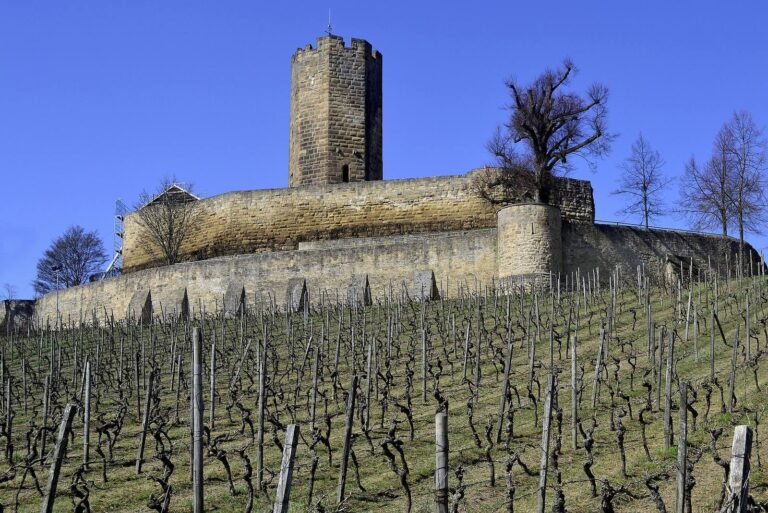
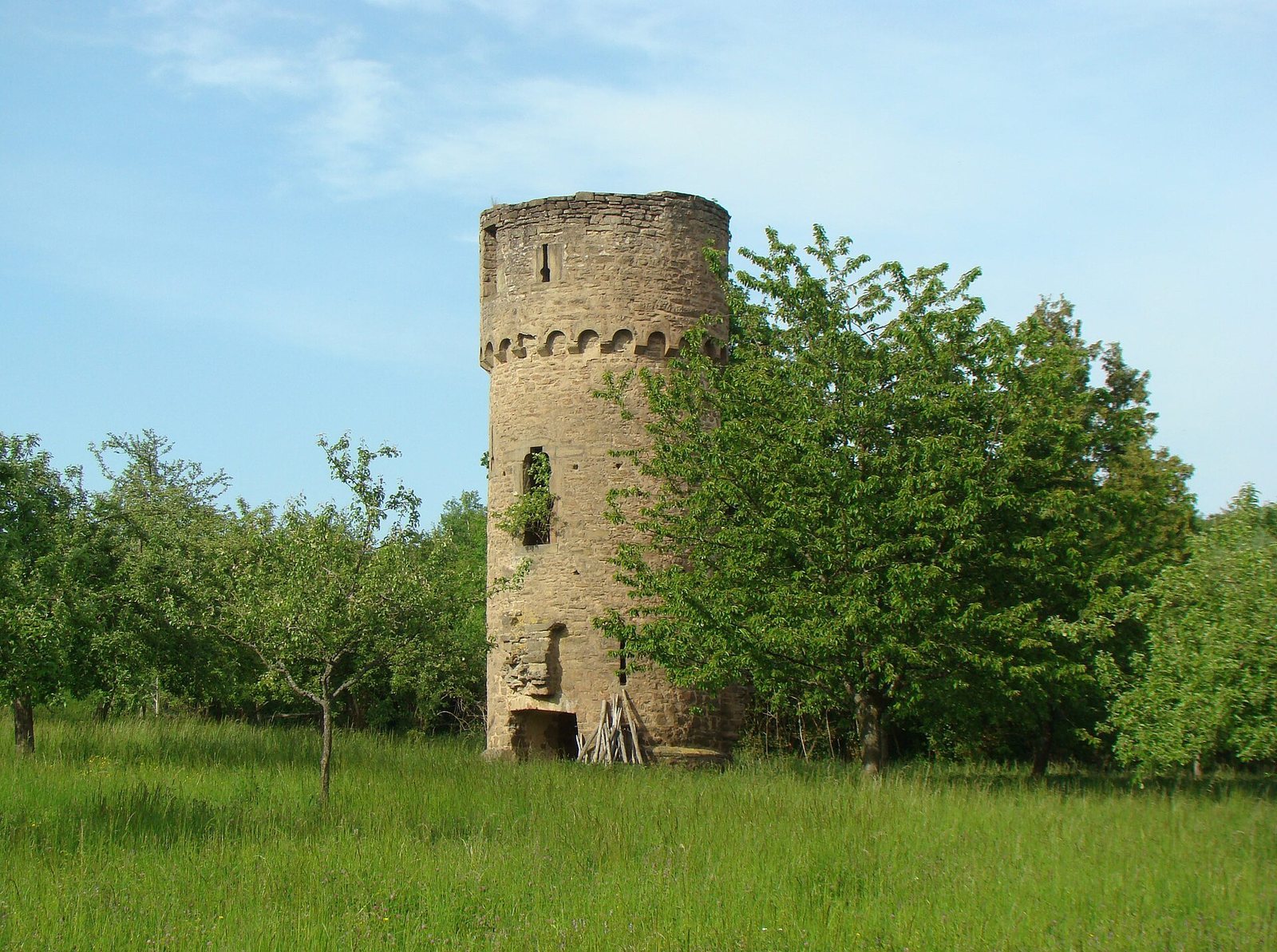
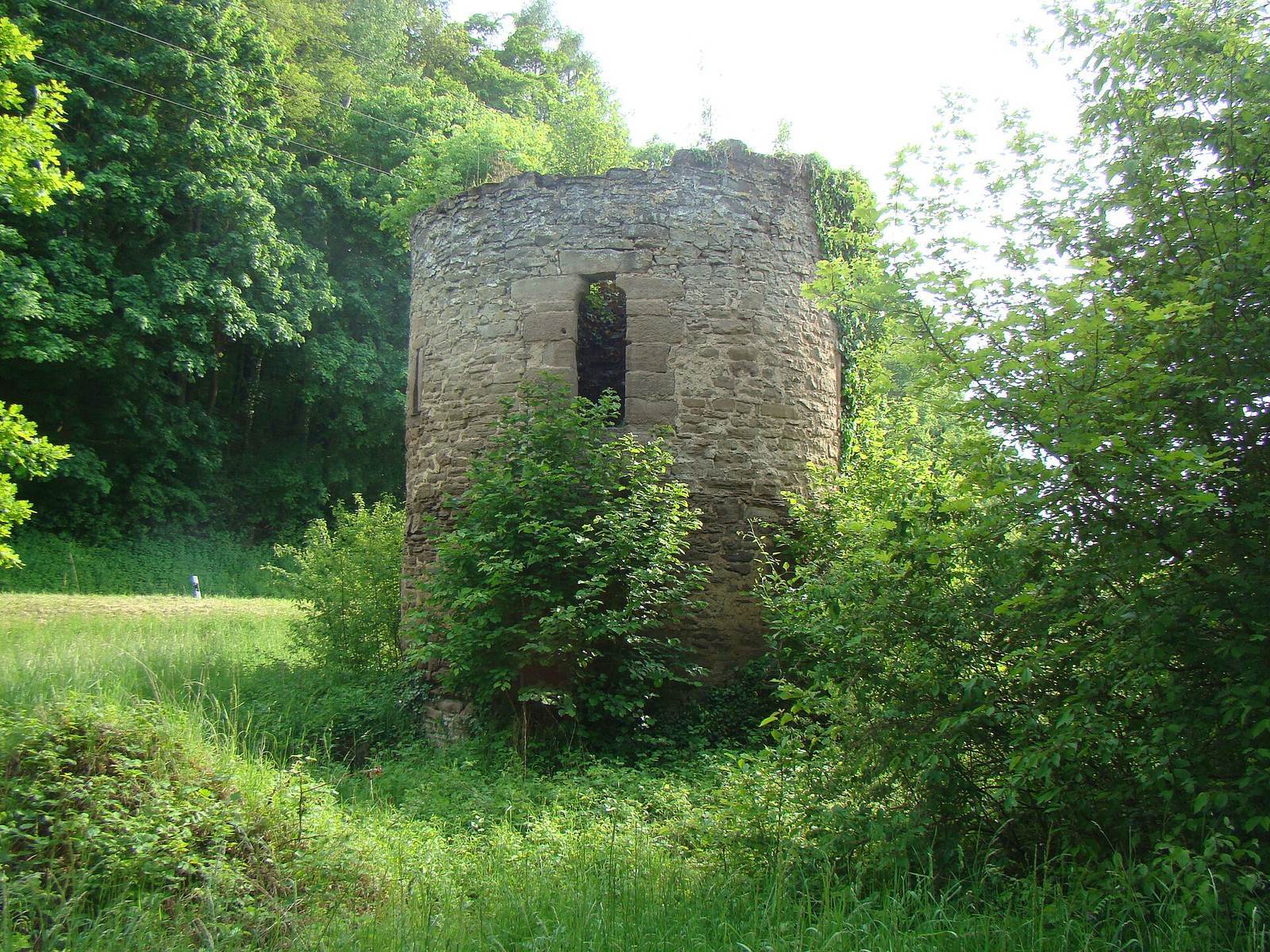
A moat enclosed the central monastic complex from 1377, and a fortified porch was added to the abbey church. Around 1400, a wall enclosed the economic buildings, with defensive towers incorporated into the defenses. Gate towers were added later. Two medieval defensive towers survive among the remains.
Archive building
An archive building was constructed within the monastery in 1486. When the canons returned temporarily in 1676, it was converted into a knights’ hall.
Reuse and surviving fabric
Farmstead in the former monastic yard
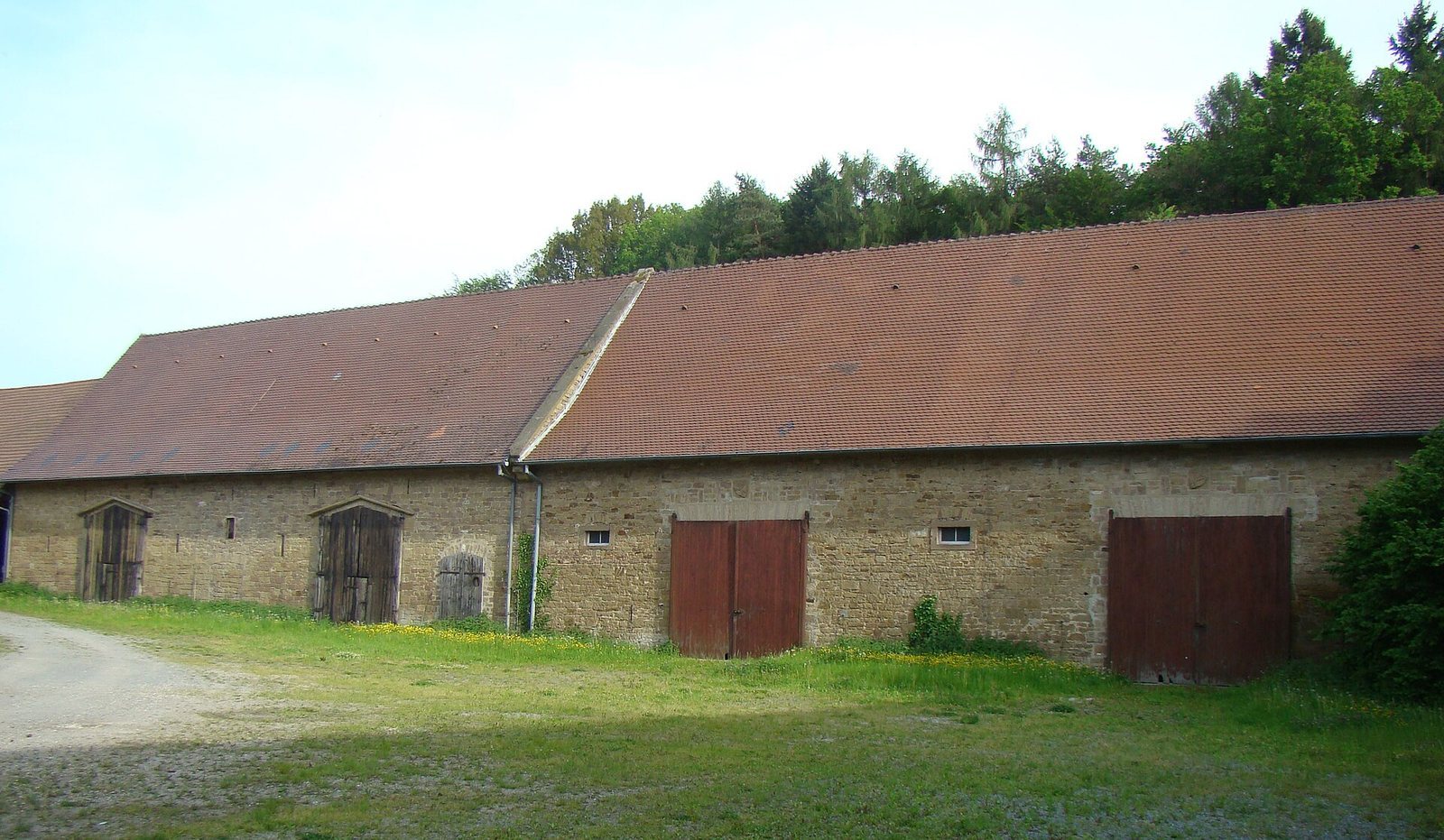
The farm established in 1671 incorporated surviving parts of the defensive walls and storehouses. Its new buildings included residential quarters and a single-nave Church of Saints Peter and Paul. After the canons returned in 1676, they added a prelate’s residence and a small Marian chapel.
Monastery stone reused in Odenheim
After the 1525 fire, people quarried the ruined buildings for stone. Material from the abbey was used in Odenheim’s church, renovated in 1543, and later in a parsonage and a hunting lodge. Entire cellar vaults were also dismantled and rebuilt in the village.
Surviving remains
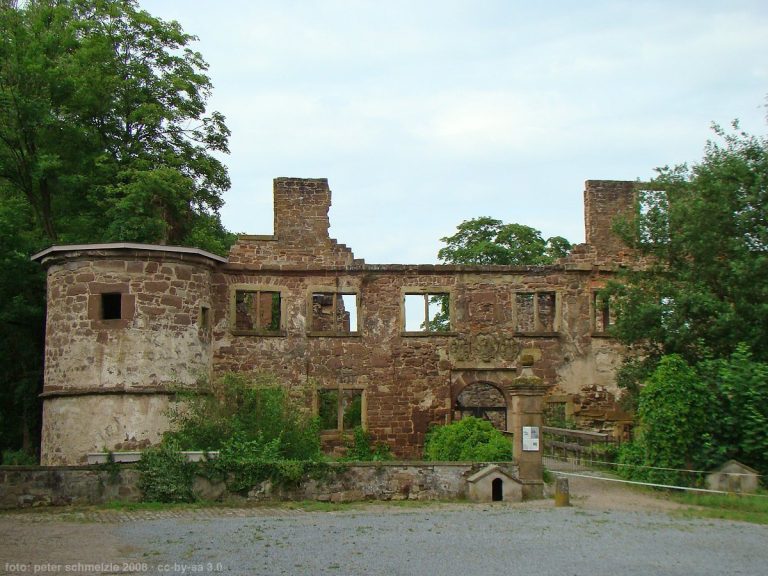
The abandoned monastic buildings were dismantled during the 19th century. The remains include a farmstead and two medieval defensive towers.