Nostra Signora di Loreto: A Baroque Marian Sanctuary in Tresivio
Site at a Glance
- Popularity
- Medium
- Country
- Italy
- Primary era
- Early Modern
- Eras represented
- Early Modern, Modern
- Civilizations
- Unclassified
- Site type
- Religious
- Remains
- Sanctuary
On this page10 sections
History
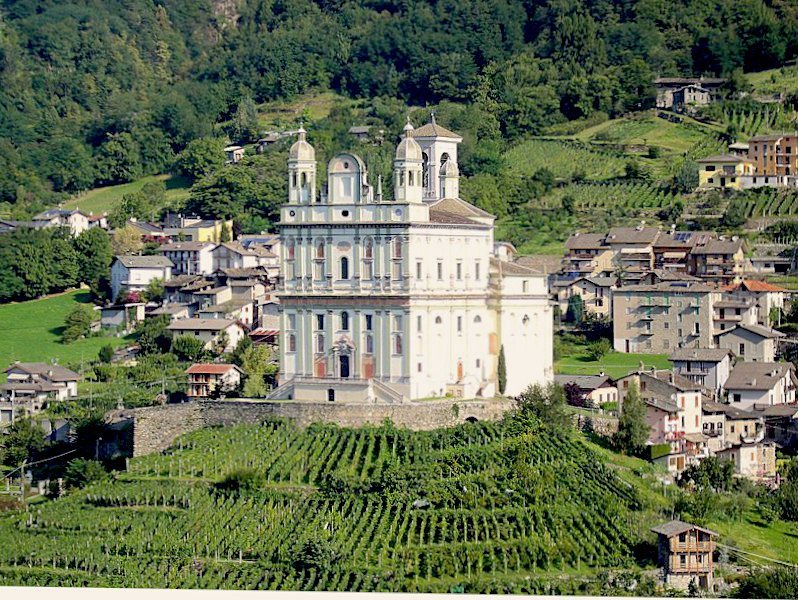
Nostra Signora di Loreto is a Roman Catholic sanctuary in Tresivio, Italy, whose Baroque construction began in 1646 and continued in stages until 1790. Baroque is an elaborate European style associated with the seventeenth and eighteenth centuries. The sanctuary belongs to the Diocese of Como, the territory administered by a bishop, and is dedicated to the Nativity of Mary, commemorated on 8 September. By size, it is identified as the largest church in Valtellina. The diocese includes it among its shrines and votive temples.
Early church and monastic administration
A church known as Santa Maria in Tronchedo stood at the site by 1016. From 1106, Benedictines, members of a Catholic monastic order whose communal life follows the Rule of Saint Benedict, administered it. They were connected with the monks of the Basilica of Sant’Abbondio in Como, and their oversight lasted for about a century and a half.
Creation of the Marian sanctuary
During the first half of the seventeenth century, local residents called for the church to become a Marian sanctuary. This desire arose in the context of the War of Valtellina, a struggle over control of the valley entangled with wider Catholic-Protestant conflicts. The new building campaign began with the laying of a foundation stone in 1646 and proceeded in stages through 1790.
The Guicciardi family of Tresivio made a substantial contribution. In a will dated 16 May 1656, Antonio Guicciardi left property, rents and capital worth 8,000 imperiali to the project. On 19 August that year, his nephew Giacinto reached an agreement with the Bishop of Como to establish an endowed church office and a perpetual right to nominate candidates to it. This right passed to Giacinto and his male descendants, who exercised it until the mid-nineteenth century.
Francesco Guicciardi, a senior administrative official, served as Chancellor of the Middle District, one of Valtellina’s three traditional divisions, in 1678, and as Supreme Chancellor of the Valley from 1707 to 1709. He urged the General Council of the Valley to direct the expected surplus from auctions of grain imported from the Duchy of Milan, a historical state in northern Italy, to the sanctuary’s construction.
Later development and modern history
Work on a replica of the Holy House of Nazareth began in the early eighteenth century. Its foundation stone was blessed in 1701 by Ignazio Lazzaroni, Tresivio’s senior priest. The bell tower was built between 1795 and 1833, while decorative work continued on the church. In 1913, the sanctuary entered Italy’s official list of monumental buildings.
The church closed in 1968 because of structural problems. In the late twentieth century, it was looted with the assistance of its then parish priest, Mario Simonetta. Major renovation work was completed in 2000.
Remains
Architecture and devotional furnishings
Setting and façade
The sanctuary stands in central Tresivio among vineyards, on the mountain slopes. Its Baroque façade includes a portal made of soapstone.
Holy House replica
Beneath the dome is an eighteenth-century replica of the Holy House associated in Christian tradition with Mary and the Holy Family at Nazareth, whose house is preserved at the Basilica of Loreto. A niche in the replica holds a statue known as a Black Madonna, a devotional image of the Virgin Mary represented with a dark complexion and an object of popular devotion.
Organ and bell tower
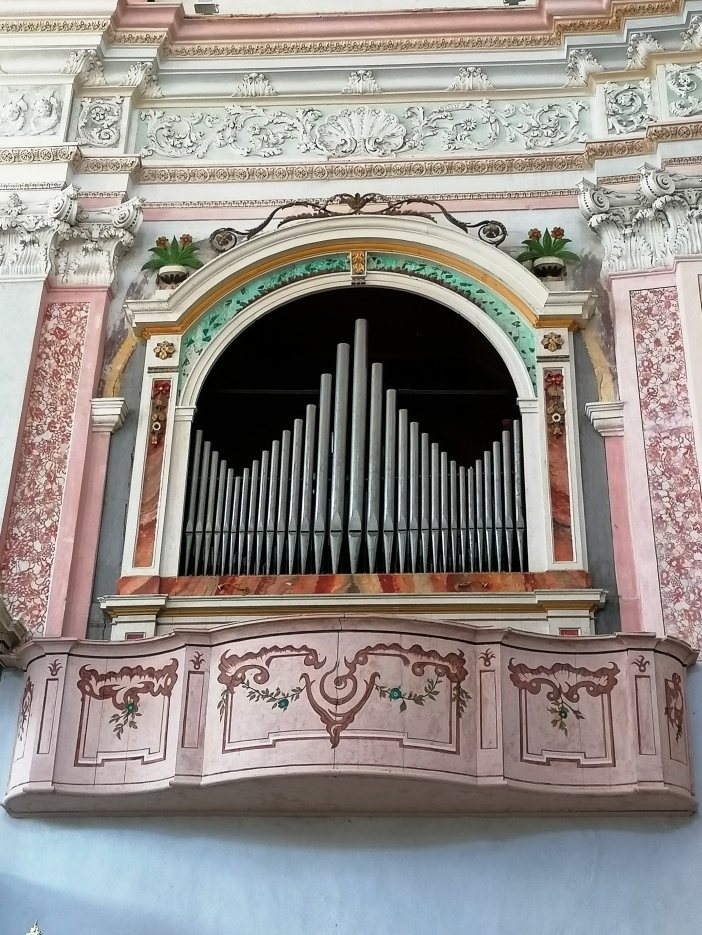
The presbytery, the altar area reserved for clergy, contains an organ gallery and organ case built around 1660, when organ builder Carlo Prati was commissioned to provide an instrument for the sanctuary. The sanctuary’s bell tower dates to 1795–1833, and one of its bells was cast in 1693.
Apostle sculptures
Since 2020, the sanctuary has housed a cycle of monumental wooden sculptures depicting the twelve apostles.