Nostra Signora della Neve: Parish Church of Veserxe, Italy
Site at a Glance
- Popularity
- Very Low
- Country
- Italy
- Primary era
- Early Modern
- Eras represented
- Early Modern, Modern
- Civilizations
- Genoese, Italian
- Site type
- Religious
- Remains
- Church
On this page14 sections
History
Origins and growth
Nostra Signora della Neve is the parish church of Veserxe, Italy. Its name means Our Lady of the Snows, a title of Mary associated with a traditional story of miraculous August snowfall in Rome. The church is first mentioned in the sixteenth century as a rural oratory, a small place of worship serving a local community. It appears to have been established for Veserxe’s residents, who had previously been required to attend Mass at Castelvecchio.
During a pastoral visit in 1585, Nicolò Mascardi, Bishop of Accia and Mariana, described the building as an oratory. In 1612, Domenico de Marini, Bishop of Albenga, considered an enlargement necessary because the growing population could no longer fit inside. He also judged the church favorably in comparison with other religious buildings in the commune, particularly for its image of Mary and the infant Jesus.
Endowment and parish life
From 1637, holy oil, blessed oil used in religious rites, was kept at Veserxe so that people unable to leave their beds could receive a blessing. Bishop Francesco Costa blessed the church on 8 October 1648. On 25 October, the rector of Zuccarello blessed the cemetery of the new parish according to the Roman rite, the liturgical tradition of the Roman Catholic Church.
The church’s independence from Castelvecchio developed gradually. Even after Veserxe had its own rector, a priest responsible for the church, he was still expected to attend certain services at Castelvecchio. These included Mass on Holy Saturday, the Saturday before Pentecost, and the Feast of the Assumption, which commemorates Mary’s being taken into heaven. At the Assumption observance, Veserxe’s residents also had to contribute a white candle valued at one lira.
While the church remained an oratory, rents from land provided 26 lire a year for repairs. Mass was celebrated twice each week for the local population, and bequests required five additional services annually. The community was also required to provide the church with an adequate endowment within six months. On 10 June 1649, it gave olive groves, chestnut groves, and vineyards valued at 4,020 Genoese lire, together with annual income of 200 lire. Chancellor Guglielmo Abbo recorded the arrangement.
Other gifts included olive groves at Cüràira from Guglielmo Moreno and property at Casanei from Andrea Moreno, recorded by the notary Angeretto Bassu of Erli in 1636. Laurentio Delfino also gave property. Giovanni Andrea Rosso’s testament required an annual payment of 40 soldi to a priest to celebrate Mass on the saint’s feast day.
The enlargement was completed in 1665, and Francesco Brusco became the church’s first rector on 26 September that year.
Repairs and later changes
Repairs continued over the following centuries. Don Carlo Mersenàru arranged for the paving to be repaired in 1927. From the late 1960s into the early 1970s, work addressed the plaster, bell tower, and roof. In 1969, a painted composition was begun at the priest Don Giannichedda’s request, in memory of his recently deceased mother. Flood damage to the churchyard was repaired in 1972, and further work took place in 2013.
In 1979, a simple marble altar table replaced the older seventeenth-century altar to bring the church into line with the norms of the Second Vatican Council, a gathering of Catholic bishops held from 1962 to 1965 that addressed church teaching and practice.
Remains
Setting and exterior
Churchyard and approach
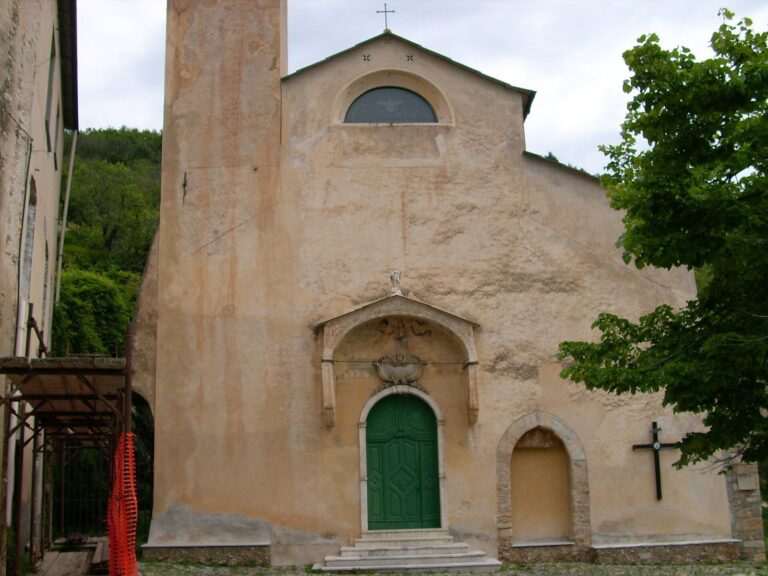
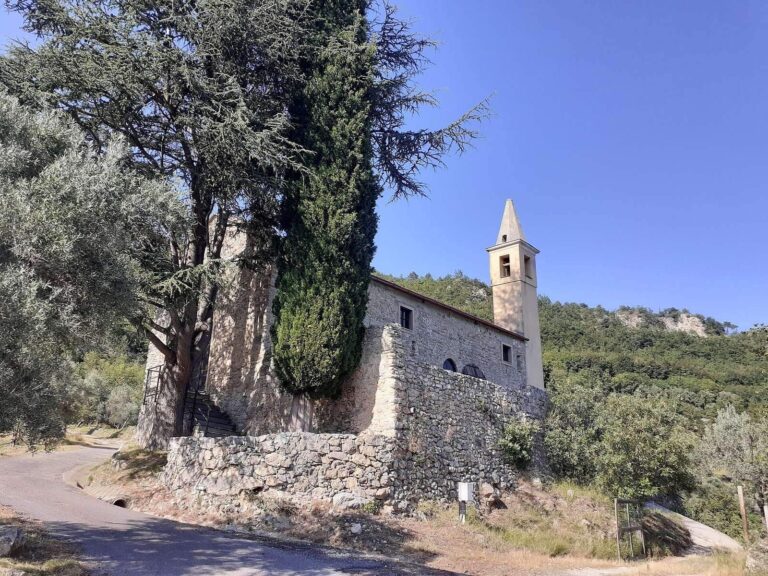
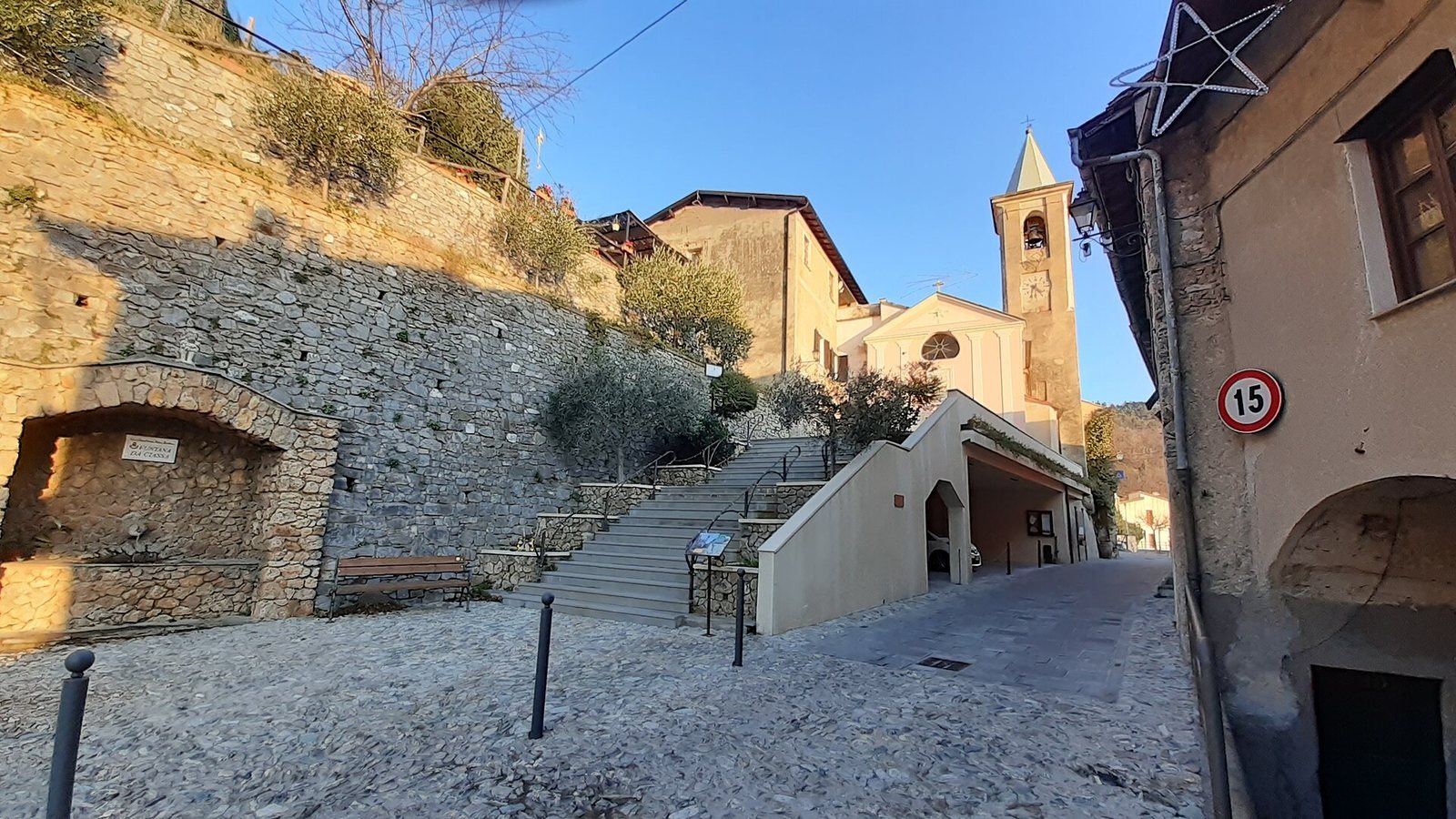
The church stands above road level at the entrance to Veserxe. A flight of steps, repaired in recent years, leads up to the churchyard, where pebbles form geometric patterns in the paving. The approach and churchyard reflect changes made over time, particularly during the 1960s.
Façade
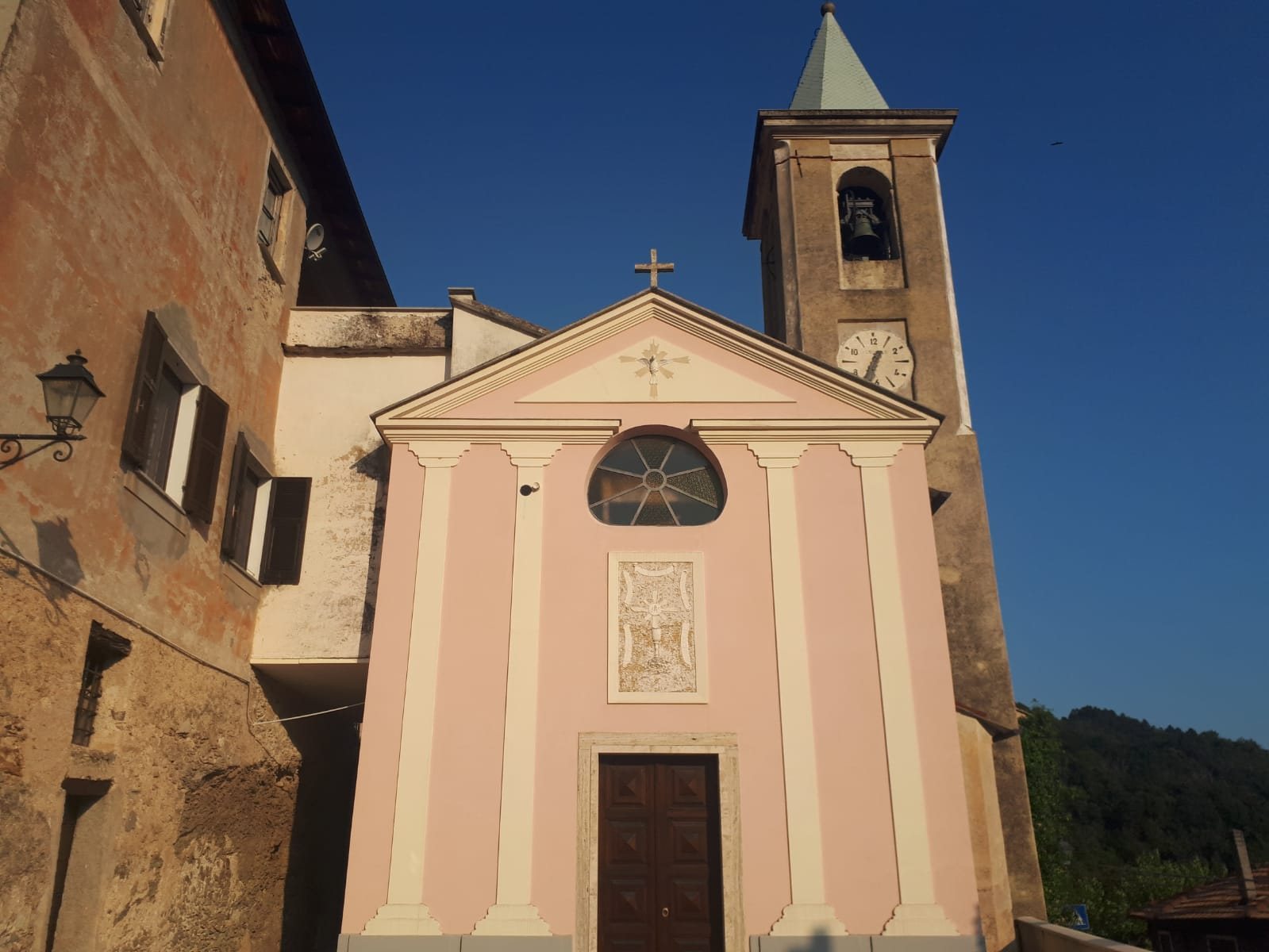
The façade is painted pink and has a gabled outline. Four slender ornamental columns, arranged in pairs beside the doorway, follow the Doric style, one of the classical architectural orders. They rise from slightly projecting bases of gray stone. The wooden door sits within a light-colored stone frame and has four projecting ornaments on each side. Above it, a framed panel shows a figure associated with Communion, the reception of the Eucharist; the image was once identified as Mary. An oval window with colored glass sits higher on the façade. Another figure at the lower edge of the triangular roof panel refers to the Holy Spirit, while a stone cross stands between the two roof slopes. The remaining exterior surfaces have a rough, unpainted finish, and the side and rear elevations have a plain appearance.
Bell tower
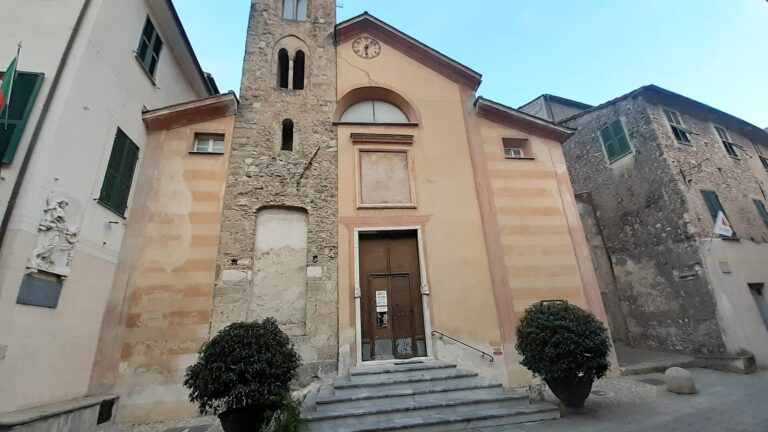
Attached to the church’s southwest side and facing Via Mazù, the bell tower has a square base with a rough plaster finish. Its profile narrows about halfway up, where a round clock is set within a rectangular frame, with the bell above. In 2005, the bell and its clapper were replaced, the mechanism was electrified, and the straps of the third bell were changed. The tower is capped by a pyramidal structure on a hexagonal base, covered with green slate tiles.
Interior and furnishings
Nave and presbytery
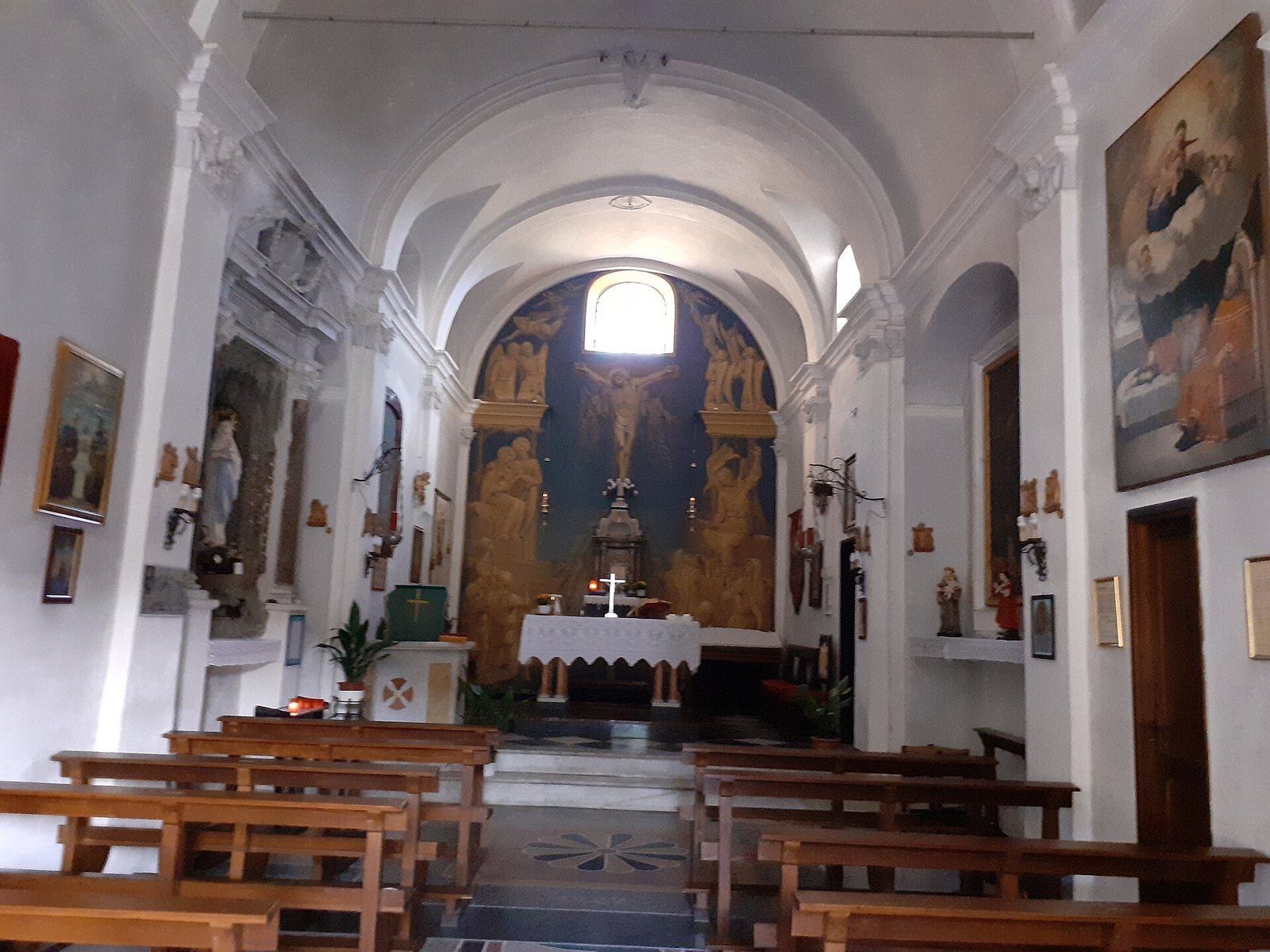
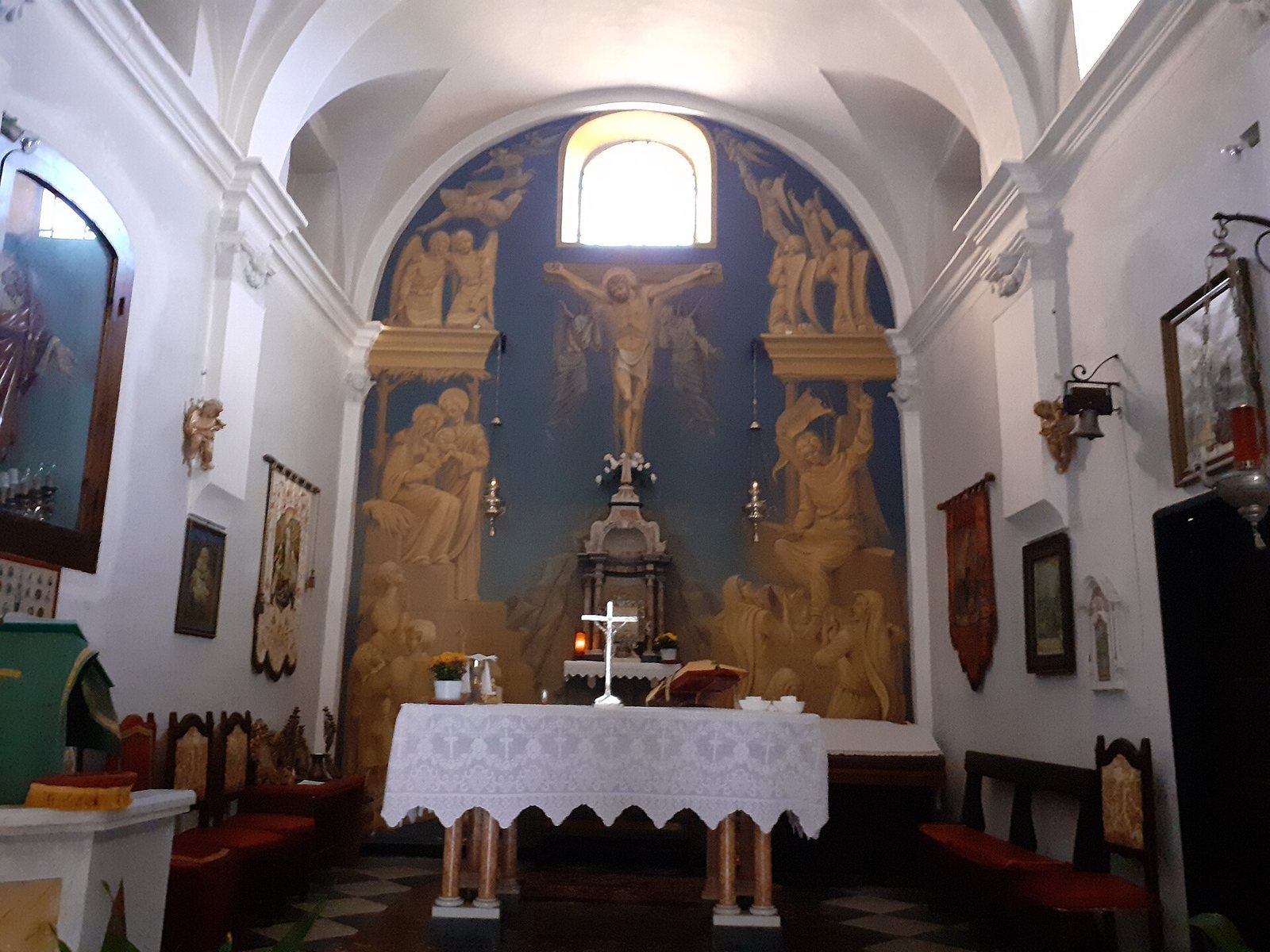
The church has a square plan and a single nave beneath a barrel vault, a long, arched ceiling pierced by window openings. Non-structural columns divide and emphasize the interior space, creating the appearance of a triumphal arch. Two steps separate the nave from the square presbytery, the area around the altar.
Side altars and niches
Two niches face one another across the nave. The niche on the right contains a statue of Mary and the infant Jesus, framed like a small temple by two ornamental columns painted to resemble colored marble. A triangular decorative top above them carries plant designs. Opposite stands a stucco altar inspired by the grotto of Our Lady of Lourdes, a title of Mary associated with reported apparitions at Lourdes in France. Dark-stone columns flank it, topped with molded capitals in the Corinthian style, a classical order known for leafy decoration. Its curved, broken top and cornice are interrupted by a central medallion with an angel’s head.
Rear-wall painting
Luciano Occelli, an artist from Savona, painted the composition on the rear wall. Its lower panel and curved upper outline include a curved central panel. Against a blue background, golden figures depict episodes from the life of Christ and evoke a cycle of water. Angels approach from the upper left; nearby, two others embrace and sing, appearing to lean on a side cornice. The cornice is a remnant of the earlier altar, when it stood against the wall, and also serves as a canopy above the Nativity. Mary holds the Child beside Joseph, and the three figures stand on a raised platform. Nearby, three praying figures represent a modern family.
In the lower right, three women pray: one kneels, another appears astonished, and the third listens to a guardian angel seated on an empty tomb. Behind the angel, a symmetrical cornice is shown with two columns. Above the left cornice, kneeling angels fly upward with their backs turned, becoming smaller to suggest their ascent to heaven. At the center, Christ hangs on the Cross between two weeping angels. A marble tabernacle, a receptacle for the consecrated Eucharist, stands at its foot. It has mixed linear decoration and four small columns, two on either side.
Madonna and Child painting
The church preserves an eighteenth-century oil painting on canvas of Mary and the infant Jesus. In its upper portion, the Virgin wears a blue and pink mantle and appears among clouds, with light behind her. Angels surround her, four on the left in two pairs and six on the right in two groups of three.
The painting refers to a tradition that Mary appeared in a dream on the night of 4–5 August 352 to Pope Liberius and a Roman patrician named Giovanni. She indicated where the church of Santa Maria Maggiore should be built in Rome. Below, Liberius sits on a throne in a brown robe while Giovanni sleeps in a bed. A snow-covered hill appears at the painting’s left edge, recalling the story of the miraculous snowfall associated with Our Lady of the Snows.