Nora Church: A Parish Church in Tärnsjö, Sweden
Site at a Glance
- Popularity
- Very Low
- Country
- Sweden
- Primary era
- Early Modern
- Eras represented
- Medieval, Early Modern, Modern
- Civilizations
- Swedish
- Site type
- Religious
- Remains
- Church
On this page12 sections
History
Nora Church is a Lutheran parish church of the Church of Sweden in Tärnsjö, western Uppland, Sweden. It serves Nora Parish in the Diocese of Uppsala, a territorial church administration. A medieval stone church stood on the site before a major rebuilding in the 1780s enlarged the building.
Medieval church and eighteenth-century rebuilding
Plans for rebuilding were prepared in 1772 by master mason Daniel Lundquist of Gävle. The Swedish Office of the Superintendent, which oversaw architecture and public building projects, approved revised plans in 1778. The revisions may have been made by the office’s superintendent, architect Carl Fredrik Adelcrantz. The work extended the church westward and widened it to the north, making it more than twice its former size. The old north and west walls, the north-side sacristy, and the south porch were removed.
Limited parish funds repeatedly held up the project. In November 1778, Olof Gabrielsson of Bondeborn pledged 50 riksdaler specie, a Swedish silver-based currency, on condition that a parish meeting approve the enlargement on the first Sunday of Advent. A contract auction for the work was set for 23 June 1783, and the church returned to use in 1786.
Repairs and twentieth-century alterations
In 1835, plans called for replacing shingles on one lower roof section and the sacristy roof with wrought-iron sheets, alongside repairs to the tower. Figurative paintings were found in the choir’s southeast corner in 1911 and conserved. The same kind of paintings elsewhere in the church was covered with whitewash. Work that year also added Art Nouveau plaster ornament to the ceiling vault and removed the upper gallery.
A 1966 restoration changed the choir furnishings and seating. The pulpit and its sounding board were moved to the north wall, and a new railing and stairway were installed. The altar painting was lowered and given an upper panel, while the pews were altered.
Organ history
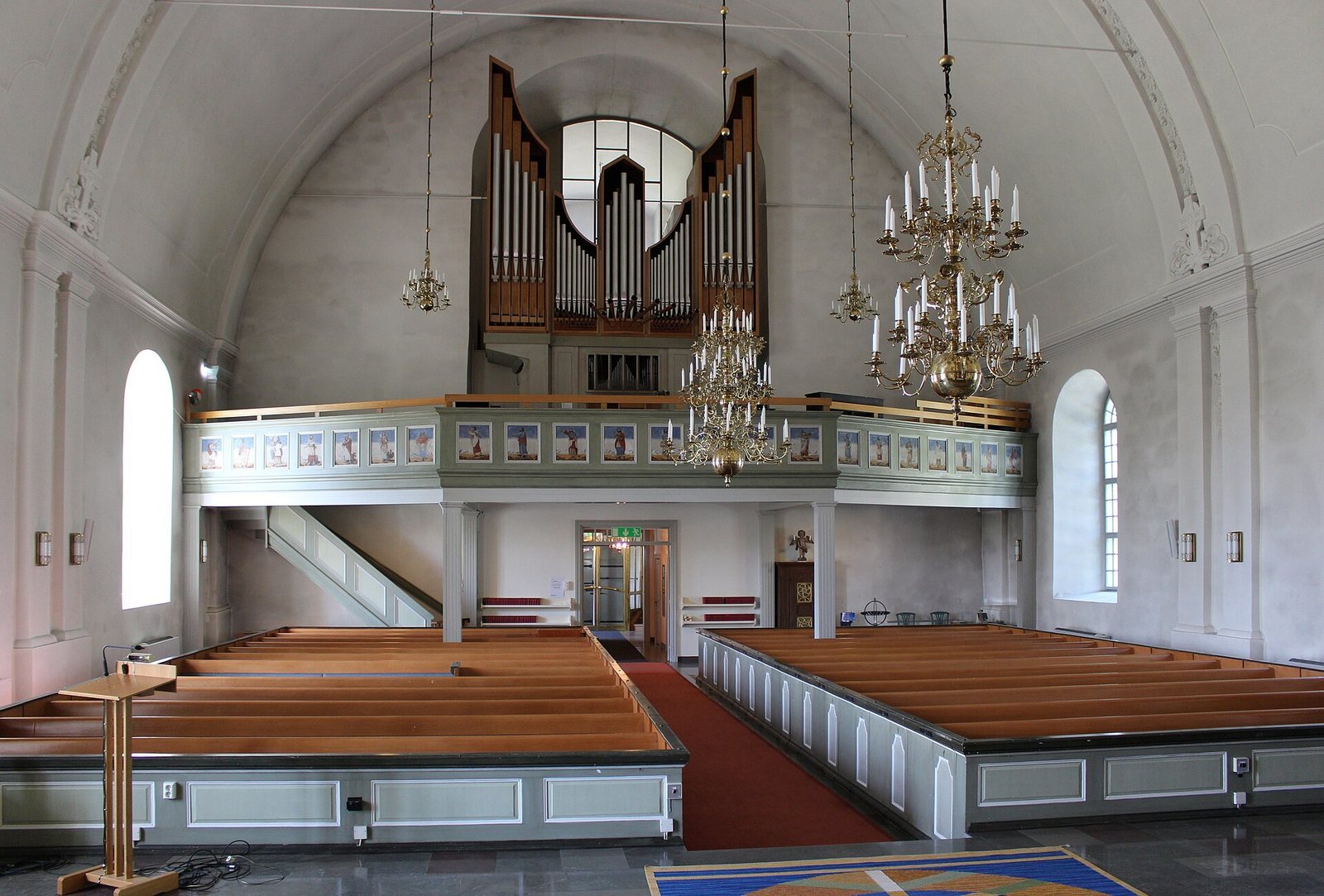
The church received a small positive organ, or small organ, in 1663. It was sold to Isac Risberg in 1706; that year Risberg built a six-stop instrument, later sold to Vidbo Church. Niclas Söderström and Eric Nordqvist built another organ in 1786. A Magnussons Orgelbyggeri of Gothenburg made a new instrument in 1932, and Grönlunds Orgelbyggeri of Gammelstad built the present organ in 1968.
Remains
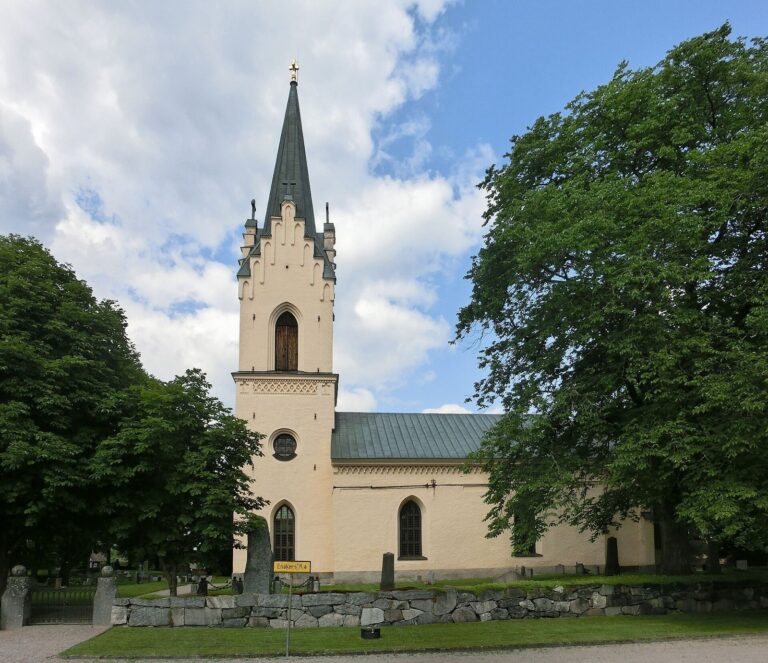
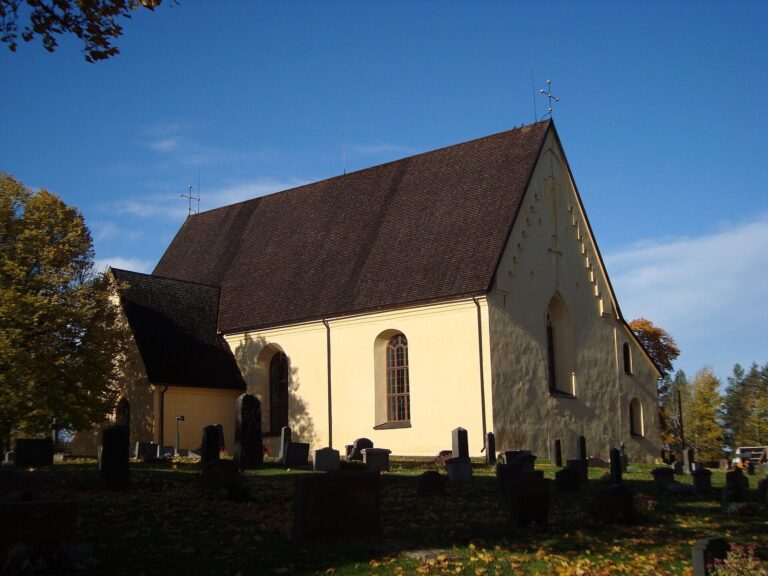
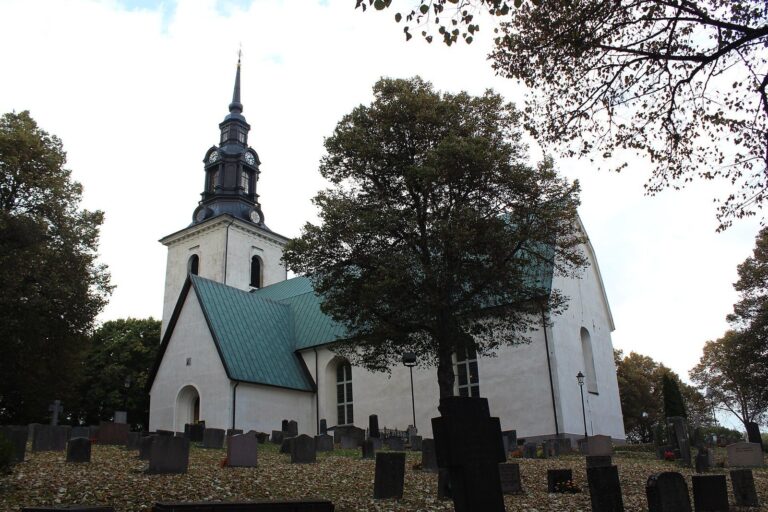
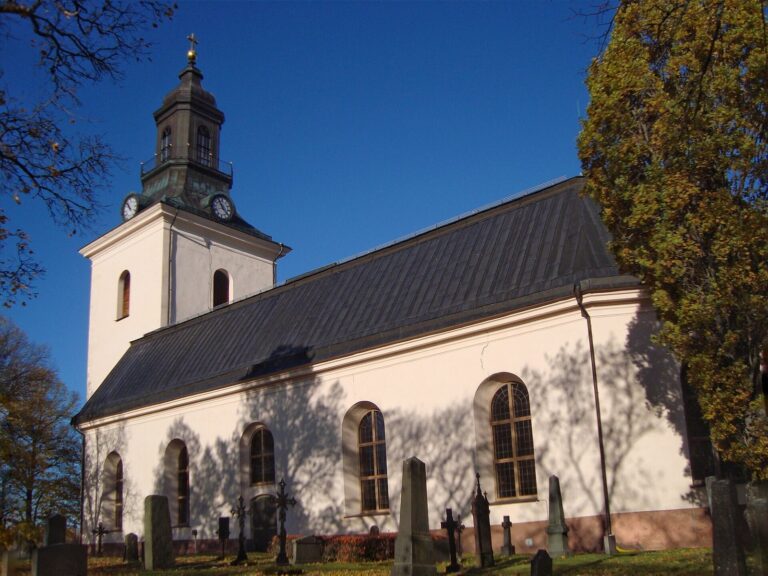
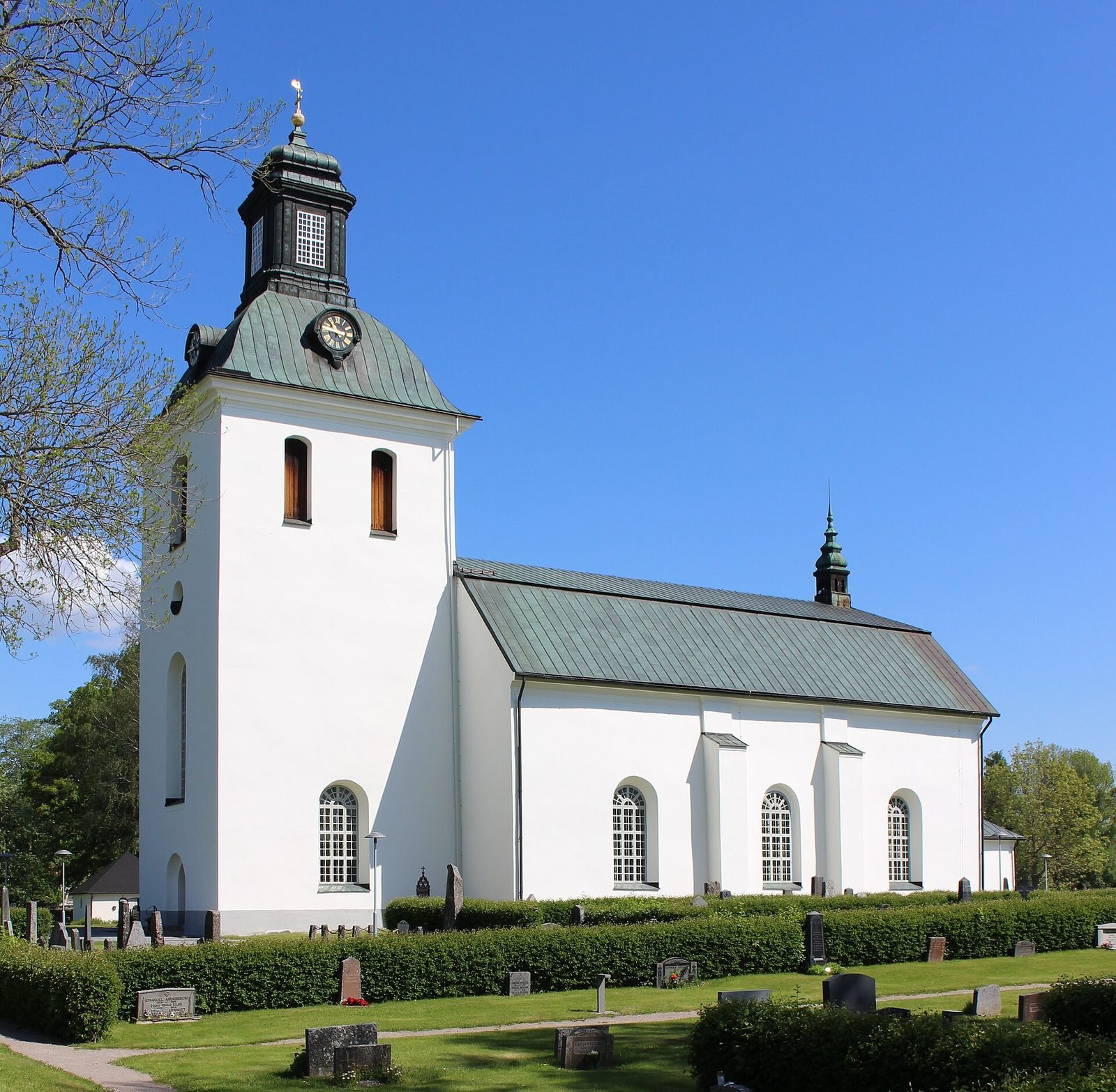
The nave, the main congregational space, and the choir, the area around the altar, are equal in height and width. They share a mansard roof, with steep lower slopes and shallower upper slopes. A small roof turret sits at the east end; a low sacristy is also on that side. At the west end, a substantial tower contains the main entrance. Its curved hood is topped by a lantern, a small raised roof structure.
Medieval fabric
The church incorporates the east and south walls of its medieval stone predecessor. These surviving walls are part of the present building’s fabric, alongside its later extensions.
Interior and furnishings
Vault and galleries
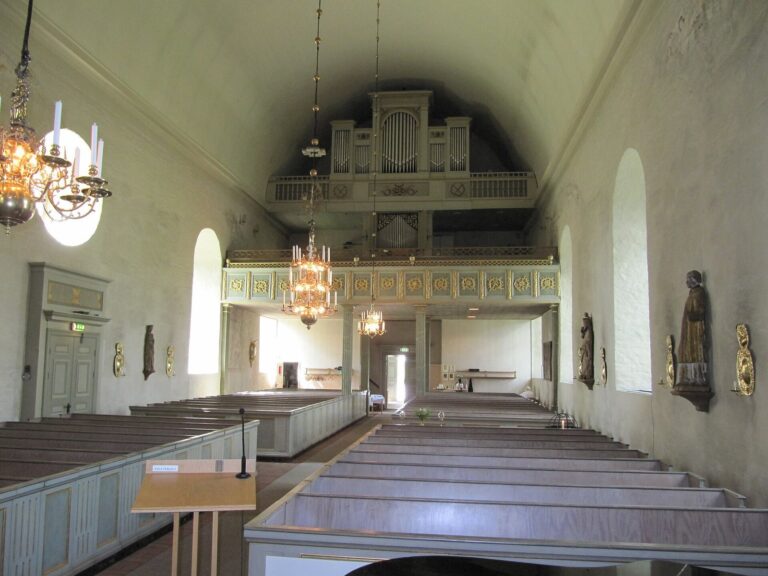
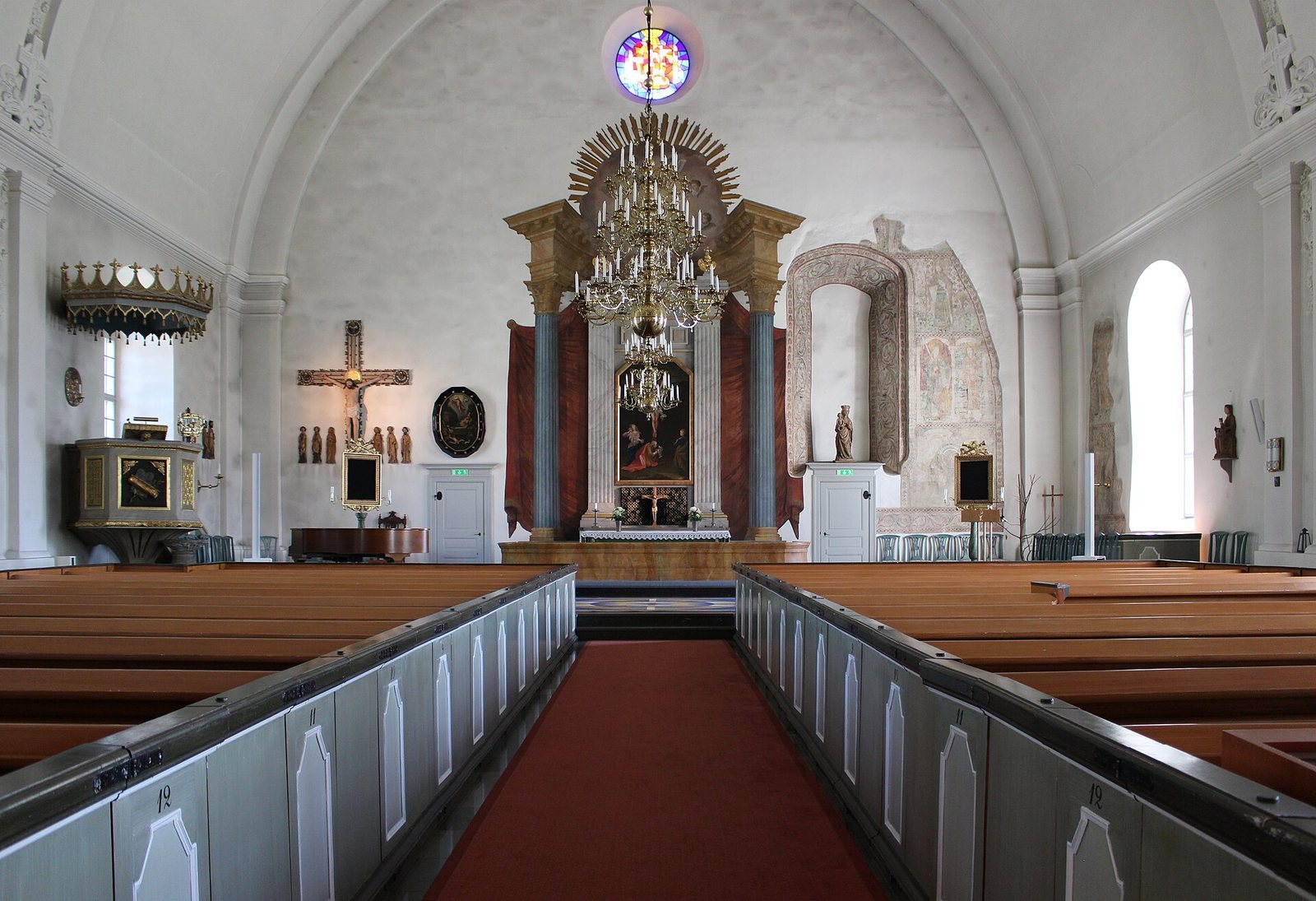
A brick barrel vault, a continuous arched ceiling, spans the church room and carries Art Nouveau plaster ornament. Double galleries once ran along the west wall, and the lower gallery remains. Parts of a gallery with paintings made in 1751 by Johan Winge of Gävle survive in poor condition beneath coverings.
Wall paintings
Figurative paintings by the Tierp School, a group of late-medieval church painters associated with Uppland, occupy the choir’s southeast corner. They date to the late fifteenth or early sixteenth century. Similar paintings in other parts of the church are covered with whitewash.
Altar and pulpit
The altar painting is an oil depiction of Golgotha, the place associated in Christian tradition with Jesus’s crucifixion. Olof Arenius painted it in 1729 for the earlier church’s altarpiece. Its frame, carved by Georg Svanström, has Neoclassical pilasters, shallow projections resembling columns. David Sundbäck painted the frame and the surrounding choir-wall scene, which uses painted perspective and drapery to suggest depth. Beneath the painting stands a pulpit probably made during the rebuilding; its sounding board was carved in 1806.
Choir window
A stained-glass window by Per Lindblad is set in the choir’s circular window.
Organs
Parts of the organ built in 1786 survive. That instrument had 18 stops, controls for selecting sets of pipes, two manuals, or hand-played keyboards, and an attached pedal played by the feet. The present organ has mechanical operation and slider chests, which regulate airflow to the pipes. Its facade dates from the same period as the instrument, and its keyboard and pedal ranges are 56 and 30 notes.