Nine Maidens Stone Circle: A Bronze Age Burial Monument
Site at a Glance
- Rating
- 4.6
- Popularity
- Medium
- Country
- United Kingdom
- Primary era
- Bronze Age
- Eras represented
- Bronze Age
- Civilizations
- Unclassified
- Site type
- Burial
- Remains
- Burial Mound
On this page4 sections
History
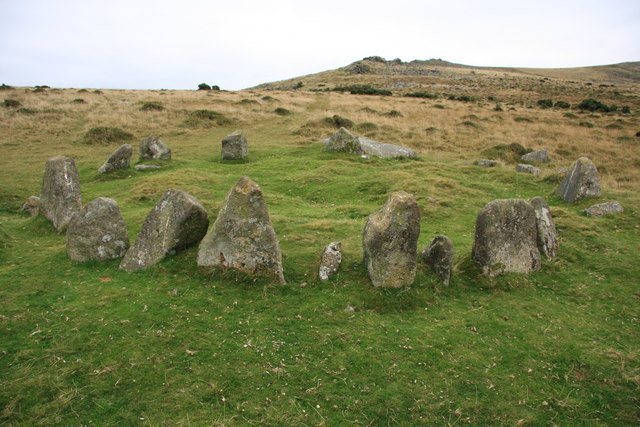
The Nine Maidens stone circle is a Bronze Age burial monument west of Belstone in the United Kingdom. It formed part of a funerary site, although the circle’s precise chronology is not given.
Damage and protection
Dora James recorded that four stones were deliberately defaced and broken in 1929. In 1971, the monument was scheduled under the official name “Nine Stones ring cairn on Belstone Common,” giving it legal protection in England as a nationally important historic site.
Folklore and proposed explanations
Local tradition says the stones dance at noon. One tale describes nine maidens turned to stone and condemned to dance forever for dancing on the Sabbath; another tells of seventeen brothers. The different numbers have been explained by the belief that dancing stones cannot be counted accurately. Nearby church bells are also said to bring the stones to life. A wider Dartmoor tradition imagines stone circles from a time when wolves roamed the hills and winged serpents the lowlands.
Some local people are said to fear that restoring the circle would bring a curse on anyone who disturbed it. According to one story, a film crew added a stone in 1985 while making The Circle of Doom. The later loss of the film’s only copy was treated as an example of the curse.
A purported ley line, an imagined alignment connecting places considered important, is said to cross the circle on a 350-mile route from Land’s End to Hopton-on-Sea in Norfolk. The claimed route passes other places associated with St Michael, the Christian archangel, including St Michael’s Tower on Glastonbury Tor. It is also said to align with sunrise on 8 May, a date when the Catholic Church celebrated St Michael’s apparition.
In 1892, John Chudleigh proposed that warm air rising from the ground might make the stones seem to move and could have inspired the dancing stories. Another speculative explanation links the name Belstone to Phoenician tin traders and “Baal’s settlement,” referring to Baal, a deity worshipped in parts of the ancient Near East. In this tale, traders hauled a bull-shaped sacred stone to the tor, and local people familiar with the story may have placed a stone there to fulfil it. The proposed connection is not evidence of Phoenician activity at the circle.
A different proposed origin derives Belstone from the Old English words belle, meaning “bell,” and stan, meaning “stone.” Sabine Baring-Gould suggested that this might refer to a rocking stone. Victorian-era archaeologists interpreted the circle as representing the full sun and full moon. A poem by Eden Phillpotts, written for his Book of Avis trilogy and recorded by Ruth St Leger-Gordon, may refer to another circle because of its inaccuracies, though these could have been poetic license.
Remains
The incomplete ring stands on the western slope of Belstone Tor, a rocky outcrop, amid clitter, or loose rock debris. Its diameter is about 21 feet (7 metres), and none of the upright stones is much higher than 3 feet (about 1 metre). The surrounding loose stone may have spared the circle from destruction by local masons.
Sixteen stones now stand upright. Samuel Rowe counted seventeen in an 1848 description and gave the tallest as no more than 2.5 feet high. The seventeenth may since have fallen among stones that no longer stand upright. The Book of Belstone suggests a possible total of twenty if smaller stones and five toppled or insecure stones are included. The burial cairn was robbed, and its cist, a stone-built burial chamber, was destroyed.