Nicolo-Peshnoshsky Monastery: A Russian Orthodox Monastic Complex in Russia


Site at a Glance
- Rating
- 5
- Popularity
- Very Low
- Country
- Russia
- Primary era
- Early Modern
- Eras represented
- Early Modern, Modern
- Civilizations
- Russian
- Site type
- Religious
- Remains
- Fortified Monastery
On this page19 sections
History
Nicolo-Peshnoshsky Monastery is a Russian Orthodox men’s monastery in Lugovoy, Russia, founded in 1361 by Methodius of Peshnosha, a disciple of Sergius of Radonezh. It stands at the historic meeting point of the Peshnosha River and the Yakhroma and serves as the center of the Monastic Deanery of the Sergiev Posad Diocese.
Foundation and medieval development
The monastery’s name is traditionally connected with Methodius carrying building materials across the river. This tradition is expressed as “carrying trees across the river” and links the community’s foundation to its position at the mouth of the Peshnosha, also called the Pestusha. Sergius of Radonezh was a fourteenth-century Russian monastic leader and saint whose disciples established or developed numerous monasteries, including Methodius’s community at Peshnosha.
The monastery’s first recorded land donations were made by Prince Peter Dmitrievich between the late fourteenth and early fifteenth centuries. They included Rogachyovo, Ivanovskoye, Bestuzhevo, Novoselki, Popovskoye, Aleksandrovskoye, Goveinovo, Nesterovskoye, and Belavino, together with neighboring villages. These gifts formed an early economic foundation for the monastery.
Expansion in the sixteenth century
Nicolo-Peshnoshsky Monastery prospered during the sixteenth-century development of the Dmitrov lands. Its income came from grain trade with Belozersk, extensive estates, and commerce with the Russian North. Salt, fish, and furs arrived from northern regions, while grain came mainly from the south. The Yakhroma connected the monastery with the Volga and Sheksna waterway, although this trade declined at the end of the sixteenth century after a direct overland route from Moscow to Arkhangelsk was established.
The monastery’s estates extended through the Moscow and Tver regions. Ivan IV, commonly known as Ivan the Terrible, donated the village of Sukhodol and twenty-five villages in Sukhodol Volost of Kashin Uyezd, Tver Governorate, in 1553. Ivan IV was the first ruler of Russia to be crowned tsar, and his reign lasted from 1533 to 1584.
Before 1764, the settlements around the monastery formed a monastery-controlled area known as Nikolshchina. Its Dmitrov holdings included Rogachyovo, Maloye Rogachyovo, Vasilyevo, Popovskoye, Alyoshino, Miklyayevo, Podvyaznovo-Myakotino, Kopylovo, Ignatovo, Aleksandrovo, Pozdnyakovo, Olisovo, Lutkovo, Murdasovo, Kochargino, Bezborodovo, Sofrygino, Zhirkovo, Cheshkovo, Bogdanovo, Abramtsevo, Nesterevo, Nechayevo, Trekhedenevo, and Ivanovskoye with its associated settlements. The monastery also owned Goveinovo, Kostyunino, Aladino, Demyanovo, and Terekhovo. Stone construction began during this period, and by the seventeenth century the monastery no longer had wooden buildings.
Several influential churchmen were associated with the monastery. In 1542, Vassian Toporkov, formerly Bishop of Kolomna, retired there. In 1544, Metropolitan Macarius of Moscow appointed Barsanuphius as abbot. Barsanuphius later became Bishop of Tver and, in 1555, was sent to Kazan as an archimandrite to establish the Transfiguration Monastery.
Ivan IV visited Nicolo-Peshnoshsky Monastery in 1553 while traveling to Kirillo-Belozersky Monastery. A tradition holds that he consulted Vassian Toporkov about governing the state. The visit was followed by the donation of Sukhodol and the twenty-five villages. In 1547, Ivan IV had also endowed the stone Church of the Nativity of the Virgin at Medvedeva Hermitage, which became a dependency of Nicolo-Peshnoshsky Monastery in 2009.
War, decline, and restoration
Polish forces occupied the monastery during the Time of Troubles, a period of political crisis, dynastic conflict, foreign intervention, and warfare in Russia during the early seventeenth century. In 1700, the monastery was assigned to Trinity-Sergius Monastery, after which its condition declined.
Catherine II’s secularization reform dissolved Nicolo-Peshnoshsky Monastery in 1764 and transferred its lands and settlements to state administration. Secularization was the transfer of church lands and institutions into state control. The monastery was restored in 1766 through the efforts of Dmitrov merchants Ivan Sychev and Ivan Tolchyonov and the petition of Mikhail Veryovkin.
Under Archimandrite Macarius Bryushkov, who led the monastery from 1788 to 1811, the community regained prosperity. Metropolitan Platon of Moscow called it the “Second Lavra.” The monastery also escaped destruction during the French invasion of 1812. French forces were stationed about eighteen versts away, but they avoided the road leading to the complex because of the surrounding marshes.
Revolutionary transformation and revival
After the October Revolution, several monastery buildings were transferred to a branch of the Dmitrov local-history museum. The monastery and museum closed in 1927 or 1928, and the buildings became a home for disabled people operated by the Moscow regional social-welfare administration. A labor collective on the grounds in 1926 included ninety-five men and twenty-three women. Hieromonk Aristarchus Zaglodin-Kokorev was later repressed and executed.
From 1966, the complex housed Psychoneurological Boarding Facility No. 3. Some churches and parts of the fortifications were restored under N. I. Ivanov during the 1960s and early 1970s. The proposal to remove the boarding facility from the historic complex was first made in 1975.
The revival of monastic life began in 2007. On 21 August that year, the Holy Synod of the Russian Orthodox Church converted the parish of the Sergius Church into the Nicolo-Peshnoshsky men’s monastery. Its formal reopening took place on 2 September 2007, when Metropolitan Juvenaly of Krutitsy and Kolomna celebrated the first service in the Sergius Church for eighty years. Hegumen Nikon Golovko became abbot, and Hegumen Gregory Klimenko replaced him in 2008.
The Epiphany Church was cleared of its use as a storage facility, and regular services resumed there on 19 August. It closed for restoration during Lent in 2008 and reopened by Easter. On 17 June 2008, the restored Sergius Church was consecrated, regular Divine Liturgy resumed, and the monastery began accepting candidates for monastic obedience.
On 12 June 2008, excavation machinery removed soil around the Sergius Church despite objections from regional architectural and conservation specialists and the abbot. The work disturbed the cultural layer, the archaeologically accumulated soil containing traces of past activity, and part of the monastery cemetery. Monastic remains from the seventeenth to nineteenth centuries were removed with the soil. In July 2009, a penitential cross was erected near the former skete after cemetery soil containing monastic remains had been dumped there with construction waste.
In March 2009, an order authorized the return of four buildings to the monastery: the Sergius Church, bell tower, hotel complex, and Sretensky Church. The boarding facility completed new buildings near Lugovoy and vacated the historic premises by December 2013. Repair and restoration continued, and the entire territory reopened on 24 August 2014 before the complex was transferred to the Russian Orthodox Church.
Nicolo-Peshnoshsky Monastery is a federally significant cultural-heritage property of the Russian Federation. Its continuing functions include worship, a library, a pilgrims’ hotel with a refectory, a museum, and an exhibition in the chapel associated with the eighteenth-century holy fool Ionushka. As of 2026, seven monks live there. Hieromonk Anthony serves as acting head of the community, while Hegumen Alexei Gorlychev, abbot since 2019, administers four monasteries in the Dmitrov and Taldom districts.
Remains
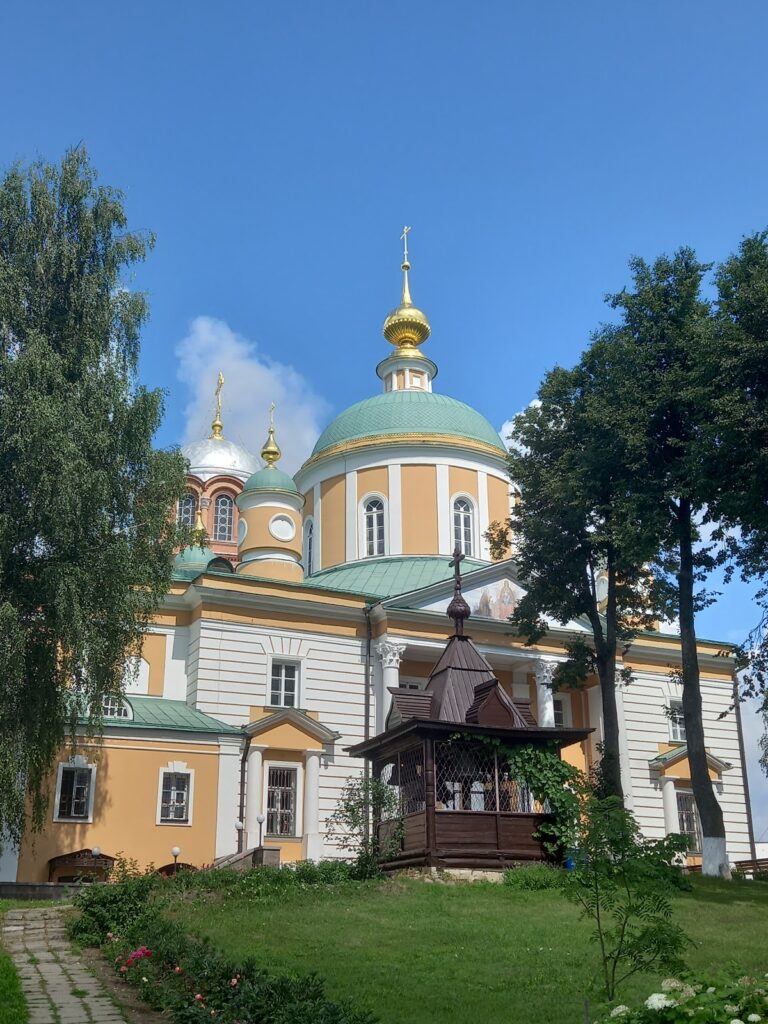
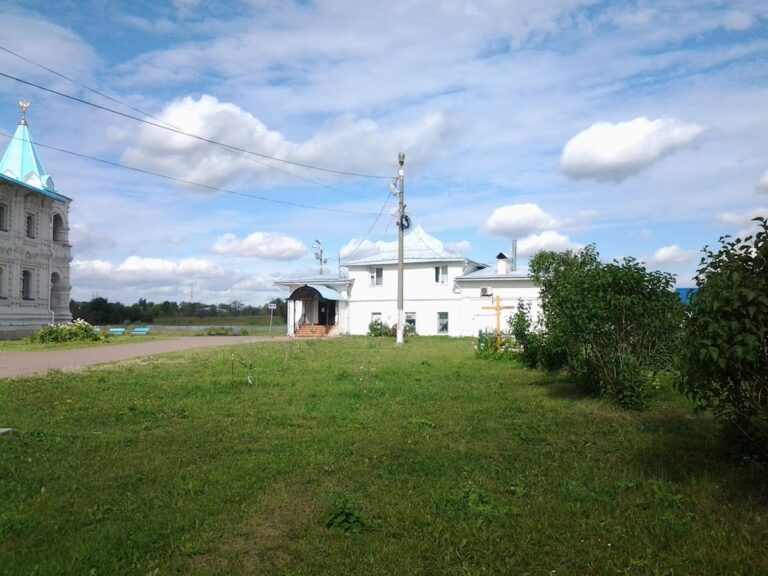
The monastery occupies the former riverside setting where the Peshnosha entered the Yakhroma. Land-reclamation work in the Yakhroma floodplain during the 1960s shifted the river’s main channel west of the complex, while a reclamation canal now runs nearby. The ensemble combines churches, monastic buildings, gates, a bell tower, and defensive walls with faceted towers. The restored interior courtyard places the Sergius Church at the center, with St Nicholas Cathedral on its left and the bell tower on its right.
Churches and central buildings
St Nicholas Cathedral
The white-stone St Nicholas Cathedral is a cross-domed church, meaning that a central dome is combined with intersecting barrel vaults to create a cross-shaped structural plan. Its date remains uncertain. The cathedral originally had two domes. Four smaller domes were added between 1683 and 1691, then removed in 1782, leaving the building single-domed. A small western vestibule was added in the seventeenth century, and a pseudo-Gothic refectory was attached in the nineteenth century.
Sergius Church
The Sergius Church was built in 1732 over the grave of Methodius of Peshnosha, replacing an earlier church. It contains the relics of the founder and occupies the central position in the restored courtyard. The church’s return to liturgical use formed a central part of the monastery’s revival in the twenty-first century.
Sretensky Church and refectory
The refectory, a communal dining building, incorporates the Church of the Presentation of the Lord. The complex was built in the first half of the sixteenth century and later reconstructed. Its return to the monastery was included in the 2009 order that transferred four buildings back to ecclesiastical use.
Bell-tower church
The church incorporated into the monastery bell tower dates from the beginning of the sixteenth century. It is identified as the Epiphany Church and is also described as dedicated to Methodius, Abbot of Peshnosha. The bell tower and its associated liturgical furnishings form part of the restored monastery complex.
Gates, fortifications, and other structures
Holy Gates and Transfiguration Church
The Holy Gates facing the Yakhroma date from 1623. The Transfiguration Church above them was built in 1689 and was described as a new structure in an inventory made in 1700. Together, the gate and upper church form one of the monastery’s principal architectural groupings.
Hospital church
The Church of Dmitry of Rostov is incorporated into the monastery hospital. It was built between 1811 and 1829, during the period when the monastery was regaining prosperity under Macarius Bryushkov. The hospital stands within the wider group of buildings that also includes the Treasury, Fraternal, and Abbot’s buildings.
Defensive enclosure
The defensive enclosure includes the Spassky passage gate and faceted towers. Sections of the fortifications were restored during the 1960s and early 1970s. By 2022, the northwestern and western towers and the hospital between them had undergone restoration.
Relics and icons
Objects associated with Methodius
The monastery formerly held the relics of Methodius, his staff, and a wooden chalice used by him in worship. The relics are associated with the Sergius Church, while the chalice is displayed in the Dmitrov museum.
Virgin Before and After the Nativity
The icon known as “Virgin Before and After the Nativity” entered the monastery after its former owner, the Moscow merchant Alexei Makeev, became a monk there. It passed to the monastery after his death in 1792. Prayers before the icon were traditionally associated with the end of a cholera epidemic in Dmitrov district in 1848. It was then moved to the Sergius Church, and an annual procession was established for 17/30 October. The icon is now considered lost.
Icon of John the Baptist
The monastery’s celebrated icon of John the Baptist was painted between 1408 and 1427 by Andrei Rublev, his pupil, or a follower, and the attribution remains qualified. The icon is now in the main collection of the Andrei Rublev Central Museum of Ancient Russian Art and Culture. A tradition holds that Roman Polyaninov, cupbearer to Prince Andrei Kurbsky, was healed before it in 1569.