Mor Yakup Monastery: A Syriac Orthodox Monastic Center


Site at a Glance
- Rating
- 4.7
- Popularity
- Low
- Country
- Turkey
- Primary era
- Medieval
- External website
- Open
- Eras represented
- Classical, Medieval
- Civilizations
- Byzantine
- Site type
- Religious
- Remains
- Monastery
On this page9 sections
History
Mor Yakup Monastery is a Syriac Orthodox monastery in Turkey, built between AD 400 and 600 in the late antique period. It stands in the Tur Abdin region of southeastern Turkey, on a fertile plain below the village of Saleh, known in Turkish as Barıştepe. The monastery is regarded as one of the oldest Christian monasteries in the world and belongs to the Syriac Orthodox Church of Antioch, an Oriental Orthodox church whose religious and scholarly traditions developed in Syriac-speaking communities of the Middle East.
Foundation and Early Centuries
The monastery is dedicated to Saint Jacob Hbischoyo, whose name means “the Recluse.” In Syriac Christian usage, “Mor” is an honorific meaning “lord,” used before the names of saints and senior clergy. Mor Yakup, a monk from Alexandria in Egypt, is identified as the founder who laid the monastery’s foundation stone. A construction date around AD 600 has also been proposed because the complex resembles Mor Gabriel Monastery.
The monastery was established at the place where Mor Barschabo and his disciples were martyred. A pious tradition relates that Mor Yakup left Alexandria with many disciples to pursue asceticism, a life of rigorous religious self-denial. He reached Amida and became associated with Mor Barschabo and his students. When Persian soldiers under General Shamir conquered the region around AD 400, they executed Mor Barschabo and his disciples at Saleh as an offering to the gods. Mor Yakup survived because the soldiers considered him filthy and unworthy. The tradition says that the monastery was later built at the martyrdom site and that the people of Saleh abandoned pagan cults and became Christians.
Mor Yakup died in AD 421. The monastery later flourished and served for a long period as the seat of a bishop during the seventh and eighth centuries. A bishop is a senior Christian cleric responsible for a diocese or comparable area.
Patriarchal Seat and Monastic Reform
From 1364 to 1839, Mor Yakup Monastery served as the seat of the patriarchs of Tur Abdin. These patriarchs were in schism with the patriarchs of Deyrulzafaran, meaning that the two ecclesiastical lines were separated by a dispute within the church. This relationship contributed to an important reform of monasticism, the religious practice of withdrawing from ordinary society for a disciplined spiritual life.
The last schismatic patriarch was Mas’ud II of Zaz, a West Syriac patriarch and mystic associated with the renewal of monastic life. He was regarded as the last major West Syriac mystic and as a renewer of monasticism.
Abandonment and Restoration
Following the genocide of the Syriac Christians, the monastery was abandoned from 1916 to 1965. It fell into decay and suffered severe damage, including damage caused by fire. Books, church furnishings, and manuscripts were looted or irretrievably destroyed.
After the monastery reopened, the entire complex underwent thorough restoration, although only part of the original building fabric survives. The community now includes the monk Daniel, originally from Beth-Kustan, and five nuns: Khazme, Nisane, Lishba’, Meryem, and Shmuni. The residents prepare foods such as bulgur from wheat, while the monastery’s agricultural holdings include vineyards.
Remains
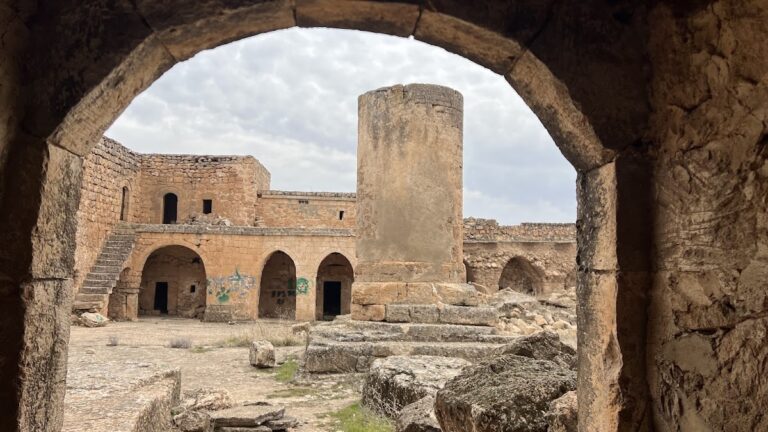
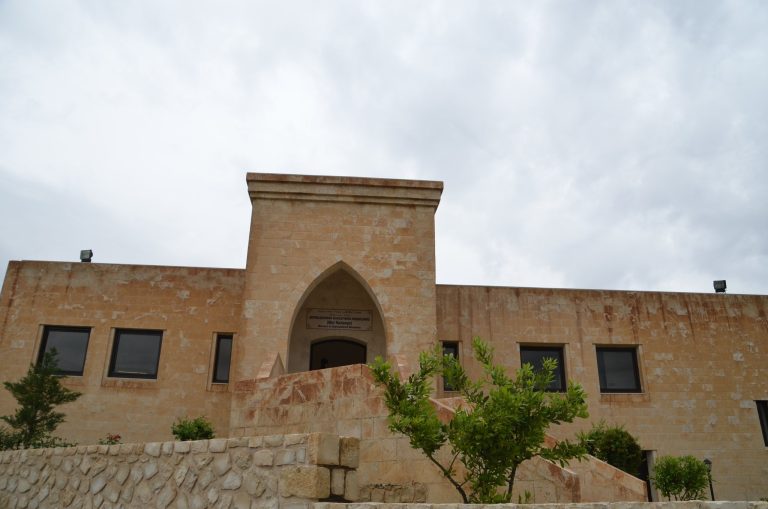
Mor Yakup Monastery is a stone-built complex whose surviving churches combine substantial masonry with restrained decoration. The remains include the main church, the attached Church of Mor Barschabo, and a separate stone-block complex to the north that is associated with an earlier pagan cult.
Earlier Cult Complex
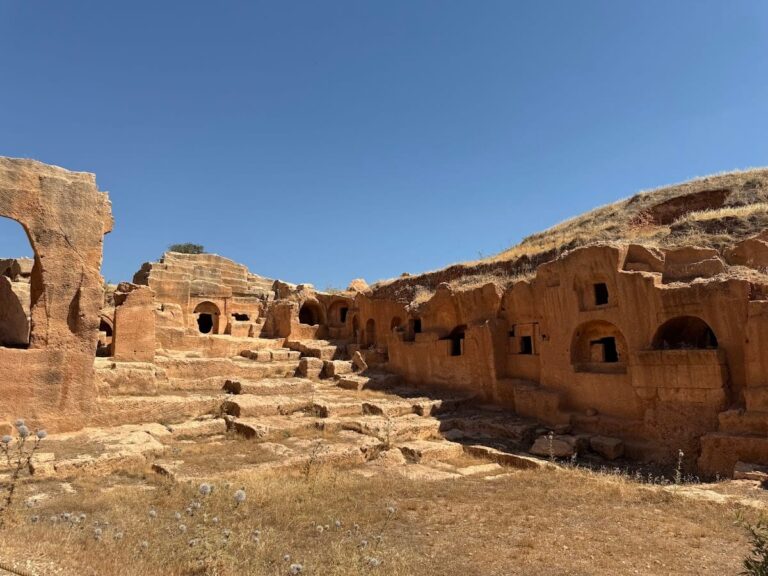
North of the monastery, a complex built from stone blocks is believed to preserve the remains of a pagan cult building. It may have formed part of an ancient temple complex dedicated to Heraklius and other deities. Two arches remain recognizable within this group of remains.
Monastic Churches
Main Church
The projecting main portal leading toward the apse, the semicircular or polygonal end of the church, is formed by two stone pilasters. Each pilaster is topped by a capital, the uppermost part of the support. A stone arch above the entrance carries carvings of doves and vine tendrils. The doves are interpreted as the sevenfold gifts of the Holy Spirit, while the vine represents Jesus Christ and Christians as branches connected to him.
Four windows light the south wall of the main church, and another window opens in the north wall. Two painted stone arches divide the church’s vault, a curved structural ceiling, into three areas. The bricks are arranged in concentric patterns, while herringbone framing, a repeated V-shaped arrangement of materials, appears on the eastern and western sides. Crosses and bands in restrained colors add to the church’s ornamental character.
Church of Mor Barschabo
The Church of Mor Barschabo is attached to the south side of the main church. Its construction resembles that of the main church and uses similarly simple decoration. Its position within the complex preserves the architectural association between the church dedicated to Mor Barschabo and the monastery founded at the site linked with his martyrdom.