Church of St. John at Kaneo: A Medieval Orthodox Church in North Macedonia


Site at a Glance
- Rating
- 4.9
- Popularity
- Medium
- Country
- North Macedonia
- Primary era
- Medieval
- Eras represented
- Medieval
- Civilizations
- Byzantine
- Site type
- Religious
- Remains
- Church
On this page6 sections
History
The Church of St. John at Kaneo is a medieval Byzantine Christian church in North Macedonia, dedicated to John the Theologian, the traditional Christian name for the apostle John. Its exact construction date is unknown, but archaeological and architectural evidence places it in the thirteenth century, while its architecture and paintings point more specifically to the late thirteenth or early fourteenth century. Church-property records confirm that it existed by 1447.
Medieval origins
The church may have served as the katholikon, or principal church, of a monastery that was later destroyed during the Ottoman conquest. It stood near the Church of Saints Constantine and Helena. A local tradition connects the building with the Bulgarian tsar Ivan Asen II, who was said to have married there. The same tradition explains the later blocking of the northern door as the result of its association with the tsar’s departure.
The church belongs to the religious and artistic world of medieval Ohrid. Its surviving paintings and architectural form preserve evidence of connections between Byzantine and Armenian Christian traditions. The frescoes also include representations of important church figures associated with the Ohrid region.
Ottoman and modern transformations
During Ottoman rule, the church declined progressively. It was abandoned and neglected from the seventeenth century, and the building deteriorated through that period and into the first half of the nineteenth century.
Around 1850, local Bulgarians restored the church. The work altered parts of its architecture and painted decoration, added a wooden iconostasis, and involved repainting the walls and dome. Several saints and the Virgin Mary were painted in the main apse in the early twentieth century.
Restoration in 1964 uncovered older medieval frescoes, including paintings associated with the period of the Byzantine Komnenian dynasty, which ruled the empire from 1057 to 1185. These discoveries contributed to the study of medieval art in North Macedonia. Later ventilation equipment was installed to help preserve the historic paintings and improve the building’s durability. The Church of St. John at Kaneo remains an active church of the Macedonian Orthodox Church within the Debar–Kicevo Diocese and the Ohrid Archbishopric. It is also a protected cultural monument within a UNESCO World Heritage property.
Remains
Setting and architectural form
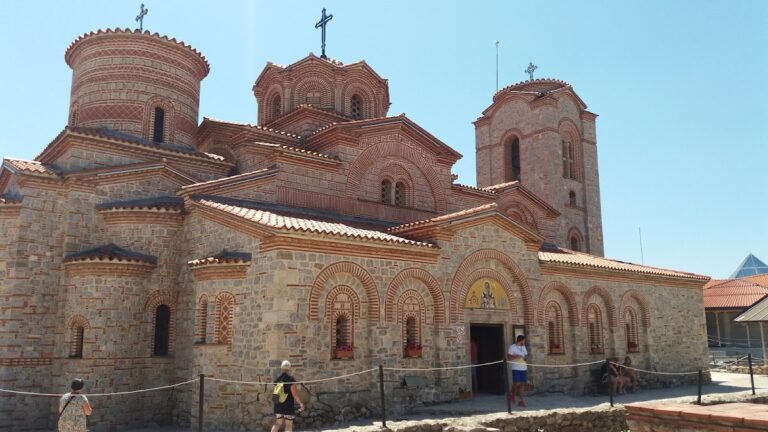
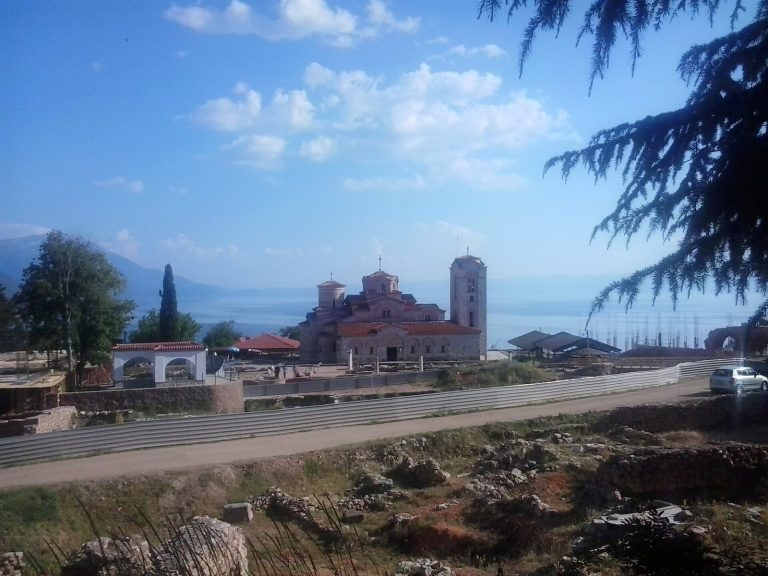
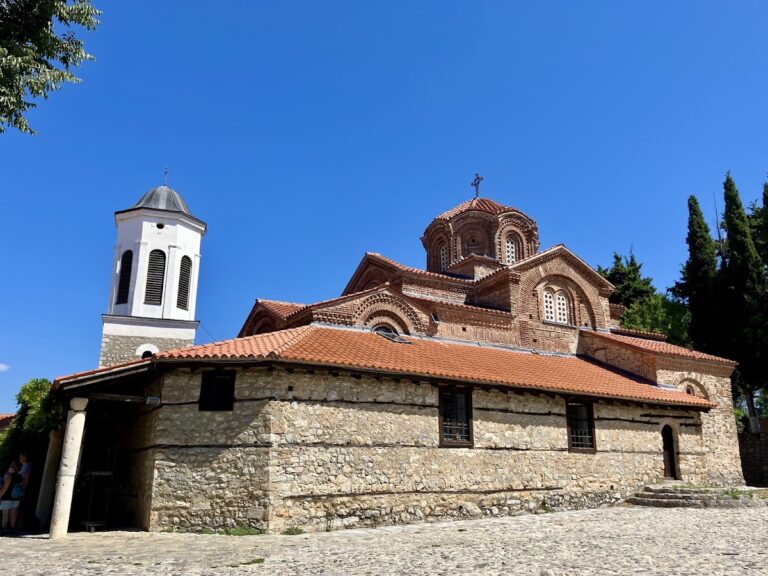
The church stands on a cliff above the shore and beach of Lake Ohrid, in the Kaneo fishing quarter from which it takes its name. Its plan is a three-aisled, cross-domed design with an inscribed cross and three apses. The building has a rectangular base, with the apses arranged on the eastern side. The side aisles are lower than the central aisle, producing distinct levels across the structure.
An octagonal dome rises above the church on four rectangular columns and curved pendentives, the architectural surfaces that support a circular or polygonal dome over a square or rectangular space. Its eight-sided gabled termination is unusual in regional church architecture and reflects Armenian architectural treatment. The dome therefore combines features associated with Byzantine and Armenian Christian traditions. Stepped window niches, a toothed brick frieze, and angular or triangular gables decorate the dome and date from the thirteenth to fourteenth centuries.
The lower sections are built of stone, while the higher walls use alternating horizontal courses of brick and porous tuff. Rich ceramic-brick decoration enriches the upper exterior, and the roof is covered with tiles.
Frescoes and interior decoration
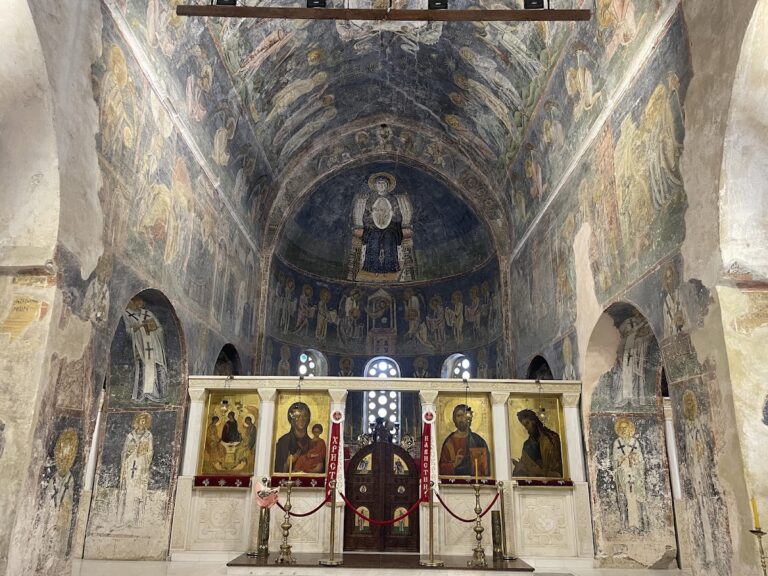
The original fresco cycle survives in fragments, some visible and others uncovered during restoration. Beneath the dome, a fourteenth-century image shows Christ Pantocrator, the almighty ruler, surrounded by eight flying angels. The spaces between the drum windows contain full-length figures of eight biblical prophets.
Other paintings show Jesus Christ on the southern column and John the Theologian in full length on the northern column. The cycle also includes Clement of Ohrid, a medieval Christian missionary and scholar associated with the region, together with Erasmus of Ohrid and the Ohrid archbishop Constantine Kavasila. The upper altar area contains a depiction of the Communion of the Apostles.
The angels in this scene wear royal clothing, an unusual feature in Byzantine painting. The backgrounds of the compositions are characteristic of the work associated with the Byzantine painters Michael and Eutychius. A wooden iconostasis from the nineteenth-century restoration carries images of several saints, while the Virgin Mary was painted in the main apse during the early twentieth century. Ventilation equipment now supports the preservation of the surviving historic frescoes.