Monastero di San Filippo di Fragalà: An Italo-Greek Monastery in Sicily


Site at a Glance
- Rating
- 4.7
- Popularity
- Low
- Country
- Italy
- Primary era
- Medieval
- Eras represented
- Medieval, Early Modern
- Civilizations
- Byzantine, Norman
- Site type
- Religious
- Remains
- Monastery
On this page12 sections
History
Monastero di San Filippo di Fragalà is an Italo-Greek religious foundation in Italy, on Mount Castro outside Frazzanò, whose surviving church belongs to the late eleventh century. Dedicated to Saint Philip of Agira, the monastery followed the Byzantine Greek rite while recognizing papal authority and is now Catholic. It developed into a religious, cultural, economic, and administrative center in the Val Demone, overlooking the valleys of the Nebrodi Mountains along the route known as the Via Francigena or Regia Trazzera.
Origins and the Arab period
The monastery’s beginnings are associated with several traditions. One places a religious institution here as early as 495, possibly under the dedication of Saint Nicholas of Myra. Another tradition places the first monastery in the early eleventh century or before the Arab conquest of Sicily. The institution certainly existed during the period of Arab rule, when it declined, although it did not experience severe persecution.
The foundation is also known as San Filippo di Demenna and San Filippo di Melitiro. Its dedication to Saint Philip of Agira reflects the religious identity that it retained through later changes in administration and ritual practice. The community belonged to the Basilian tradition, a form of Byzantine monastic life associated with Saint Basil, whose houses in medieval Sicily often used Greek liturgy while remaining within the Roman Church.
Norman refoundation and expansion
In 1090, the abbey was constructed under Gregorio, its hegumen, or Byzantine-rite abbot, with support and privileges granted by Count Roger I of Sicily and Adelaide. A diploma issued in 1145 restated these provisions, while Gregorio’s wills of 1096 and 1105 provide further evidence of the early institution. The monastery’s typikon, its rule governing worship, discipline, property, and succession, included provisions for choosing a successor. A nephew initially designated for that role had gone on pilgrimage to the Holy Land and apparently did not return.
Under Norman rule, San Filippo di Fragalà became an important Italo-Greek religious and cultural center and one of the major institutions of Norman southern Italy. Greek officials at the Norman court supported it, and the monastery remained under the direct authority of the Norman rulers. Adelaide and later sovereigns continued to provide patronage.
Around 1131, Roger II placed San Filippo, together with Sicily’s other Greek-rite monasteries, under the spiritual supervision of the Archimandrite of the Monastery of the Most Holy Savior in Messina. An archimandrite was a senior monastic authority responsible for supervising several monasteries. San Filippo nevertheless remained self-governing under its own hegumenos while accepting this wider spiritual oversight.
The monastery’s resources included extensive lands and a network of dependent properties, known as metochia, meaning monastic lands, churches, cells, or smaller religious establishments administered by a larger house. These possessions extended from the area around Messina to the northern slopes of Mount Etna, with further holdings in the Madonie and around Centuripe. Associated institutions lay at Alcara li Fusi, Bronte, Castell’Umberto-Castania, Frazzanò, Galati Mamertino, Longi, Maniace, Mirto, Mistretta, Naso, San Fratello, San Marco d’Alunzio, Torrenova, Troina, Oliveri, Piraino, and Raccuja. Their dedications included Saint Barbara, Saint Mary, Saint Nicholas, Saint Mark, Saint Marina, Saint George, Saint Peter, Saint Theodore, Saint Anastasia, Saint Basil, Saint Andrew, Saint Michael the Archangel, Saint Elijah, Saint Talleleo, Saint Filochio, the Holy Trinity, All Saints, and Saint John the Baptist.
Abbots, saints, and royal privileges
San Filippo was associated with a circle of religious figures that included Lorenzo of Frazzanò, Luca of Demenna, Leoluca of Corleone, Vitale and Elia of Castronovo, Saint Cono of Naso, Saint Christopher of Collesano, Saba the Younger, Macario of Collesano, and Kalì. Lorenzo of Frazzanò is commemorated inside the church.
On 27 November 1171, Margaret of Navarre, queen and regent, confirmed to Abbot Bonifacio the rights and privileges that Count Roger had previously granted. The succession of abbots includes Gregorio, Blasio, Bonifacio in 1171, Melezio in 1305, and Agnato between 1400 and 1409. Gaps in the surviving record do not necessarily mean that the office was vacant.
Decline, suppression, and rediscovery
The monastery declined under the Aragonese dynasty, and alterations in the seventeenth century changed its original architectural organization. On 12 April 1491, Ferdinand II of Aragon and Pope Innocent VIII attached the abbey, together with Santa Maria di Maniace and their dependencies, properties, and revenues, to Palermo’s Grande Ospedale e Nuovo.
In 1497, Pope Alexander VI authorized the hospital’s rectors to replace Basilian monks with Benedictines because suitable religious personnel remained difficult to find. In 1559, the hospital was permitted to replace members of those orders with members of other religious communities, including mendicant orders. Rodrigo Borgia, later Alexander VI, had earlier served as a commendatory administrator of the monastery while cardinal-bishop of Ostia. The hospital was required to preserve the monastery’s Greek rite.
The monastery was suppressed in 1866 during the confiscation and secularization of its property. Its library was moved to Frazzanò. The Greek and Latin parchments of its documentary archive, the Tabulario, passed through the Palermo hospital archive and are now held mainly in the State Archive of Palermo, with other documents in the State Archive of Messina. The archive included two wills of Hegumen Gregorio, one written on parchment, and an Adelaide diploma of 1109 described as its first paper document.
Antonio Salinas rediscovered the site during archaeological excursions in 1887. Restoration between 1903 and 1921 removed Baroque ornament from the church. Study of the monastery using the surviving documentation began in 1929, followed by another restoration campaign from 2000 and Franco-Italian university research in 2010 and 2012. The present complex therefore combines medieval survivals with fabric shaped by interventions from the fifteenth through the eighteenth centuries.
Remains
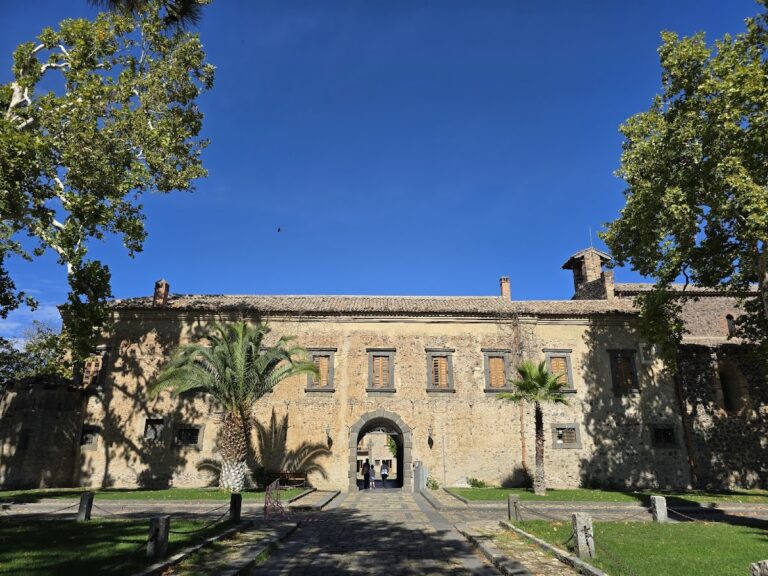
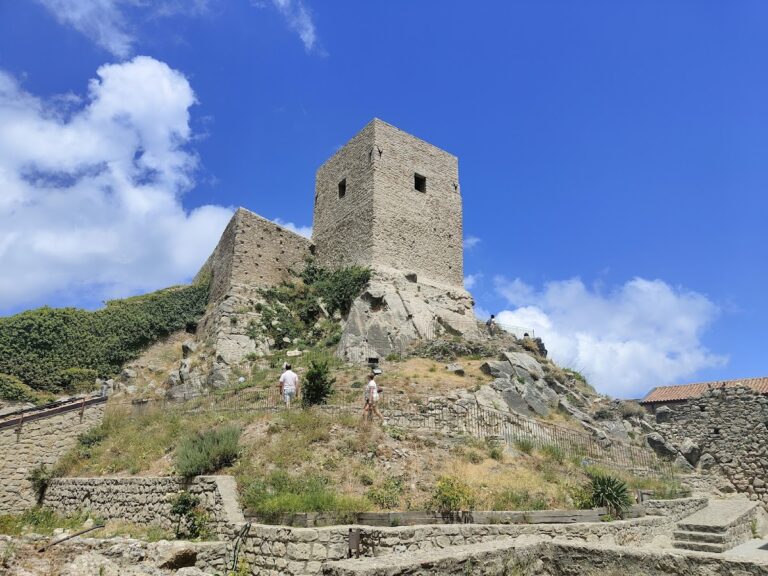
The surviving monastery forms an irregular square on Mount Castro. The church occupies the middle of the northeastern side, while the principal monastic wings extend along the northwestern and southeastern sides. The entrance lies near the northern end of the southwestern side. Inside, a rectangular courtyard has its longer axis running northwest to southeast. Different levels organized the complex, with service and guest spaces below, the church and cloister at an intermediate height, and the monks’ living quarters above.
Entrance and monastic wings
Portals and courtyard
A small Mannerist portal leads into the quadrangular courtyard. Another entrance has a Norman-style arch formed by two brick archivolts, or ornamental arch bands, with an outer strip decorated by lozenges. Verses of a blessing addressed to the religious community and the local inhabitants appear on the inner faces of the jambs, with the words arranged across the individual brick blocks.
Service rooms and living quarters
The lower level contained storerooms for grain, wine, and oil, together with guest quarters for pilgrims, stables for the monastery’s animals and travelers’ livestock, a refectory, kitchens, and workshops. The church and cloister occupied the intermediate level. A stone staircase led upward to monks’ cells, dormitories, and apartments.
The southern wing, currently under restoration, contains the abbot’s cells and alcove. At the top of the staircase are the remains of a Baroque fountain shaped like a shell, whose marble facing was stolen. A terrace leads to a large restored hall that formerly served as the chapter house. Some rooms and the small courtyard are used for exhibitions and theatrical and musical activities.
Church and painted decoration
Exterior and plan
The church stands on the eastern side of the complex. Its marble entrance portal dates to 1613 and has side bands divided into panels, including two that personify Good and Evil. The building is a simple single-nave church with a T-shaped plan. A strongly projecting transept forms the crossbar, while one large central apse and two smaller lateral apses complete the eastern end. The lateral spaces are the prothesis and diaconicon, the traditional service rooms beside the sanctuary in Byzantine church architecture.
Brick pilasters articulate the exterior, and an octagonal drum rises above the crossing. A small dome covers the left lateral apse, while a smaller portal on the left side is decorated with terracotta elements.
Frescoes and interior furnishings
The wall paintings date no later than the first years of the twelfth century and combine Byzantine, Italo-Greek, and Sicilian-Norman traditions. Their subjects include Christ within a mandorla, an almond-shaped frame, together with the Virgin, angels, bishops, apostles, monks, and Abbot Gregorio. Scenes from both the Old and New Testaments appear among the poorly preserved frescoes. A separate cycle in the upper parts of the nave presents episodes from the life of Saint Philip of Agira.
Inside the church, a simple aedicule, or small shrine-like structure, is dedicated to Lorenzo of Frazzanò. The nave is paved with sixteenth-century maiolica tiles from Naso. Together with the medieval painted decoration and the late-eleventh-century church fabric, these later elements show how the building remained in use while its furnishings and surfaces changed over time.
Nearby sites