Mizpe Yammim: A Phoenician Sanctuary in Israel
Site at a Glance
- Popularity
- Medium
- Country
- Israel
- Primary era
- Classical
- Eras represented
- Classical
- Civilizations
- Achaemenid, Phoenician
- Site type
- Religious
- Remains
- Sanctuary
On this page18 sections
History
Persian-period sanctuary
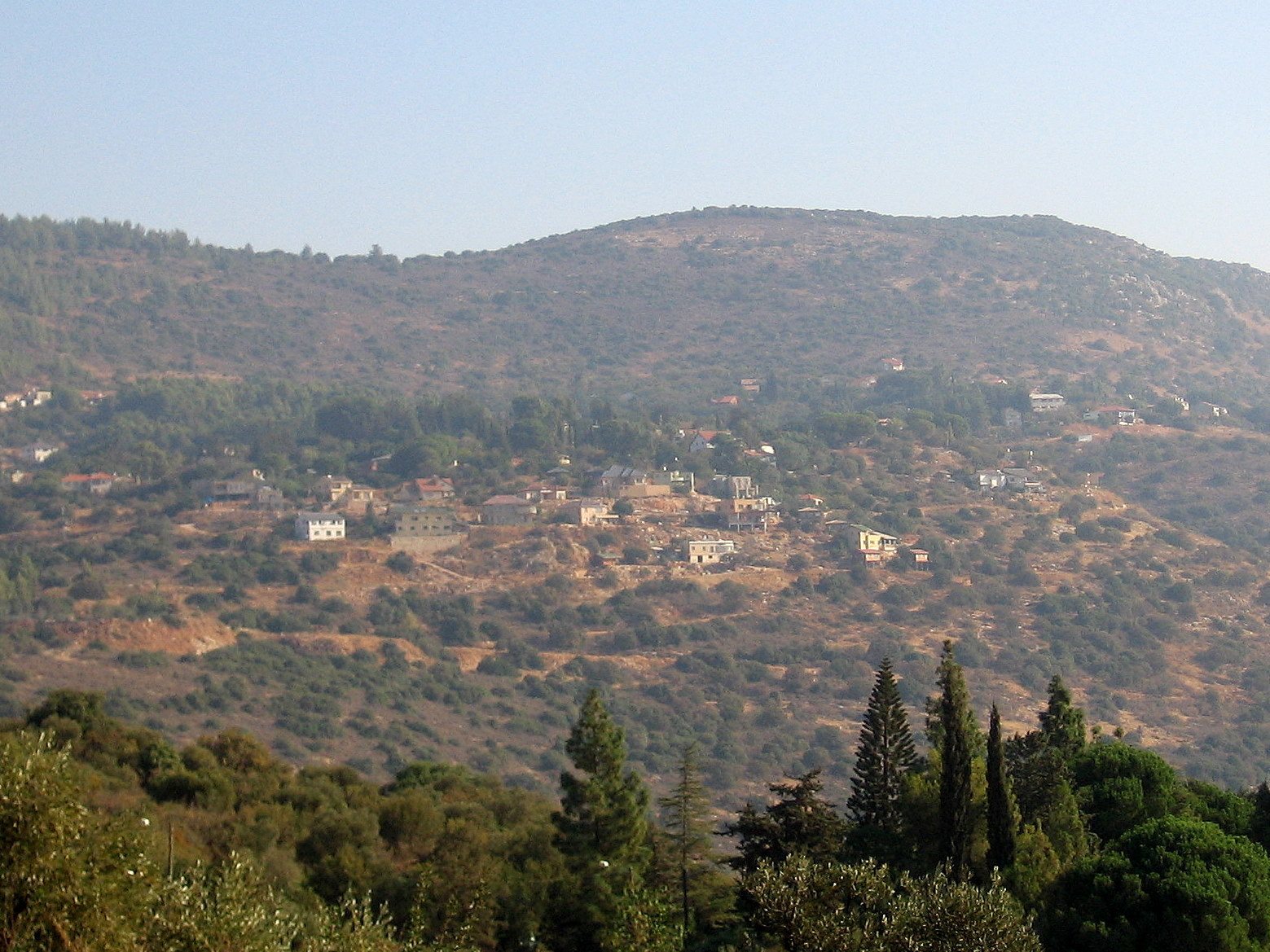
Mizpe Yammim is a Phoenician sacred precinct on a southern spur of Mount Meron in Israel, built during the Persian period (539–332 BC). Its remains are understood as a complete sacred complex, rather than a fortress with a temple inside it. The Phoenicians were peoples of the eastern Mediterranean coast, and the sanctuary reflects their religious culture.
The surrounding area probably lay within the sphere of Tyre and Sidon, prominent Phoenician cities that held a distinctive position in the Achaemenid Empire, the Persian realm ruled by the Achaemenid dynasty. An inscription suggests that the sanctuary may have been associated with Astarte, a major Phoenician goddess connected with fertility and warfare. Its fortified character may relate to her martial aspect, which had particular prominence in Bronze Age traditions.
Use, end, and archaeological interpretation
Activity continued at least until the middle of the second century BC, by which time the sanctuary had become an open-air complex. Worship probably ended around that time or later. One possibility is that it followed the Hasmonean conquest of Galilee. The Hasmoneans were a Jewish ruling dynasty whose expansion brought parts of the region under their control.
Mizpe Yammim was first reported in 1965 as an Israelite fortress, a classification based on an incorrect dating. A later survey recovered four bronze objects, prompting further investigation and excavation. The resulting interpretation identified the remains as a sacred precinct rather than a fortress containing a temple.
Remains
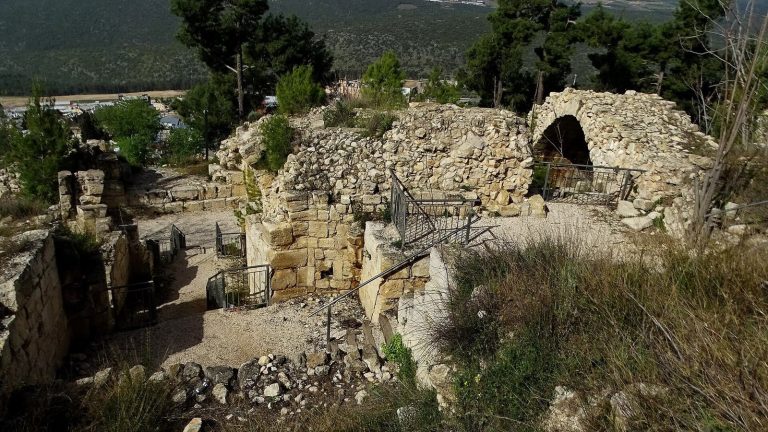
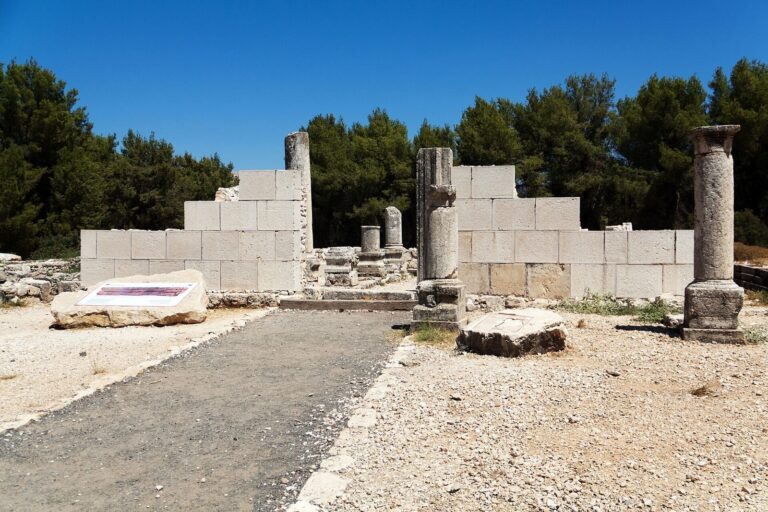
The precinct stands 734 metres above sea level. An enclosing wall defines its roughly rectangular plan, with a courtyard-and-building complex in the west and a temple at the western end of the southern boundary. The surviving remains also include ritual objects, pottery, animal bones, and evidence of activity from other periods.
Enclosure and western complex
Perimeter wall
The perimeter wall enclosed an area measuring about 30 by 90 metres. Its rectangular outline contained the sanctuary’s principal structures and open spaces.
Western complex
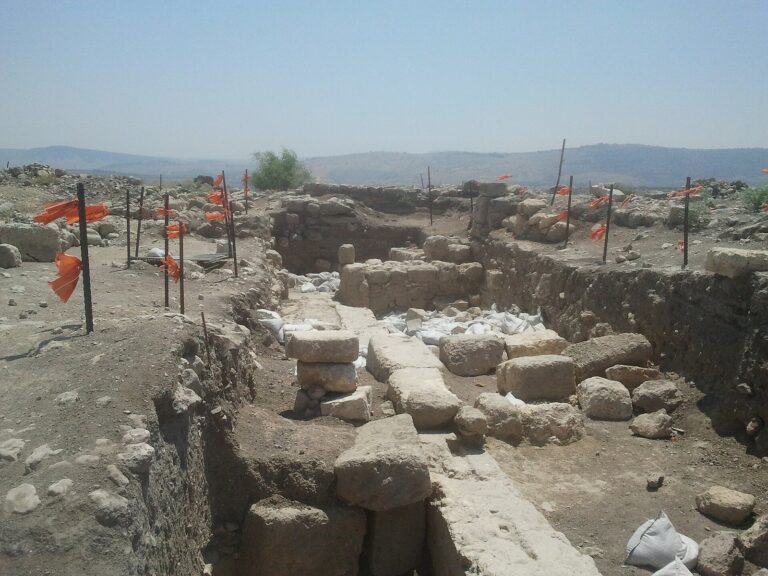
A square complex measuring 28 by 27 metres occupied the western part of the site. It consisted of an eastern courtyard, a western building, and a passage extending east and south of that building. A feature beside the courtyard’s western wall was probably a platform. The complex may have formed the sanctuary entrance and provided a base for the courtyard.
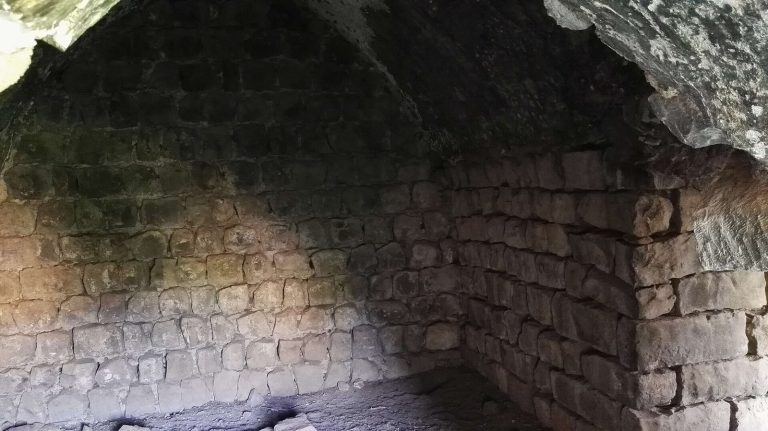
The western building was symmetrical and was probably filled with earth to support a structure raised above it, although no remains of that upper structure survive. One space was left unfilled and served as a cellar.
Temple
Main rooms and furnishings
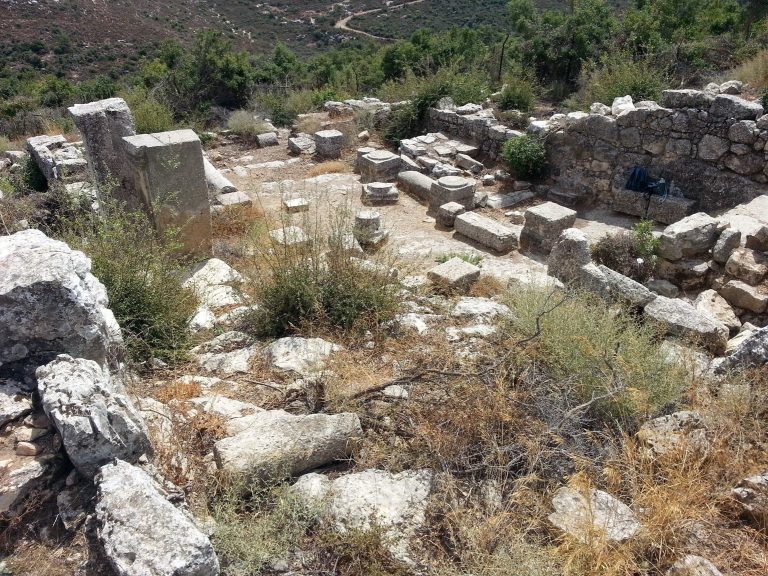
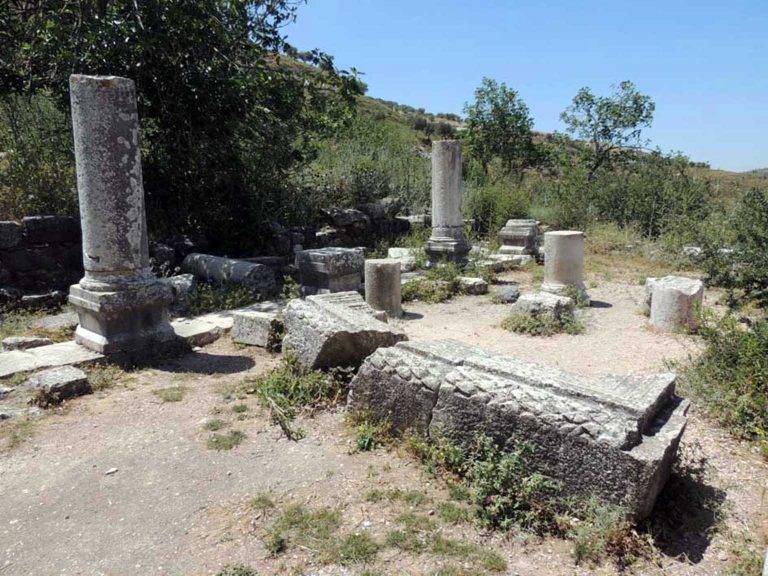
The temple stood in the western part of the southern boundary wall. Its main hall measured 14 by 6 metres, with its longer side against the outer wall. A second room, measuring 5 by 4 metres, lay to the east. The main hall was entered from the north and had three column bases along its central line, spaced 3.5 metres apart. Stone benches ran along all but the western wall. Platforms stood between the southern bench and the gap between the two western columns, and in the north-west corner.
Changes in use
Differences in the construction of the walls indicate two phases: an enclosed temple followed by an unroofed one. The north-west platform was rebuilt. It may have supported the presentation of offerings during the first phase and animal sacrifice during the second. The western complex and courtyard have been compared with the inner and outer courts described in Ezekiel 40, a biblical account of a temple, and with the divisions into courts at the two Jerusalem temples. The comparison concerns the arrangement and does not establish direct influence.
Ritual objects and deposits
Inscribed bronze vessel
Near the temple’s north-west corner, excavators found a bronze vessel used for ritual pouring. A lotus design decorates its base, and three rows of figures cover its body. A Phoenician inscription begins above the upper row and continues vertically through the middle row. It is a shortened dedication and dates to the sixth or fifth century BC. Short inscriptions in ancient Egyptian on the vessel name several gods.
Animal figurines
Three other bronze figurines from the Persian period were found near the temple’s north-west corner: a bull, a lion cub, and a reclining deer. They were probably deposited during the sanctuary’s final phase of worship. The deer’s pose is known from ancient Mesopotamian art; since animal figures were used as weights in the Persian period, this one probably served that purpose.
The lion has no mane or visible sexual organs, though it is probably male. A diagonal hole through its back may have attached it to another object, perhaps as a vessel handle. Its appearance suggests a three-to-five-month-old animal, possibly modeled from life. The bull may have been deliberately smashed.
Egyptian figures and offerings
A bronze figure of Osiris, an Egyptian god associated with the afterlife, came from the passage in the western complex. A worn and broken slate group found east of the temple’s north-west platform shows Osiris between Horus, associated with the sky and kingship, and Hathor, associated with motherhood, music, and love. The group was deliberately smashed, and its fragments were found far apart. The Egyptian figures were probably offerings; their presence does not by itself show that Egyptian gods were worshipped at the sanctuary.
A ceramic ladle of ritual character and many offering vessels came from the temple. The vessels included dozens of small jugs, four bottles, and a cup. Most were found on the floor and benches, and many types have parallels at other sites, suggesting that they may have been brought from a distance.
Pottery, animal bones, and other finds
Pottery and regional connections
Everyday pottery included locally made cooking pots and vessels with raised rope patterns, nail-shaped projections, and triangular impressions. Other pottery came from elsewhere. The assemblage as a whole spans the Persian and Hellenistic periods, the latter following Alexander the Great’s conquests and the spread of Greek-influenced kingdoms; pottery from the temple area is mainly Persian. Finds from the Phoenician coast, the Jezreel Valley, and the coastal plain point to connections with those regions.
Animal bones
About 20,000 bone fragments, weighing just over 30 kilograms altogether, were recovered. Most were broken into very small pieces. Most came from rocky ground east of the temple, although that area made up only about a tenth of the excavated area. Sheep and goats account for 94 percent of the remains, with cattle making up the rest. Skulls of these animals also came from the temple area; only isolated pig and goose bones were found near the north-west platform.
Coins and small objects
Other finds included metal fasteners, jewelry, arrowheads of a type associated with Iranian and Scythian weapon traditions, and a domed weight corresponding to the shekel weight of the Iron Age Kingdom of Judah. A shekel here is a unit of weight, and the object may have been Phoenician in origin. Four coins were recovered. One Tyrian coin from the late Persian period came from fill used to repair the north-west platform. Another, found near the bronze objects, dates to the second century BC, during the reign of either Antiochus IV or Antiochus V, Seleucid kings. The other coins were Tyrian and Byzantine, the latter from the reign of Emperor Anastasius I (491–518). Other scattered traces include a few Iron Age II pottery sherds, a Roman-period pit beside the southern altar, and Mamluk-period pottery, from the medieval sultanate, found elsewhere at the site.