Kōsoku-ji Temple: A Jōdo Shinshū Temple in Akashi, Japan
Site at a Glance
- Rating
- 3.7
- Popularity
- Very Low
- Country
- Japan
- Primary era
- Early Modern
- External website
- Open
- Eras represented
- Early Modern
- Civilizations
- Unclassified
- Site type
- Religious
- Remains
- Temple
On this page12 sections
History
Kōsoku-ji Temple is a Kōshō-ha Jōdo Shinshū temple in Akashi, Japan, traditionally founded between 1177 and 1180 by Jushin, identified with Sasaki Yoshikiyo, ancestor of the Izumo Genji. Jōdo Shinshū is a major Japanese Buddhist tradition centered on reliance upon Amitabha Buddha’s vow for rebirth in the Pure Land. The temple’s formal name is Gedatsu-zan Kōsoku-ji, and it is affiliated with Kōshōji in Kyoto as a subordinate temple.
Traditional foundation and early lineage
The foundation tradition connects Yoshikiyo with the Jishō-Juei War, the late twelfth-century conflict between the Taira and Minamoto factions. He is said to have supported the Taira side, entered religious life at Enryakuji after the war, and then become a direct disciple of Shinran, the principal founder of Jōdo Shinshū. After converting to the tradition, he reportedly founded Kōsoku-ji while travelling through the region. The temple’s successive chief priests were traditionally drawn from the Sasaki family.
Ryōzen and the transmission of Jōdo Shinshū
The seventh chief priest, Ryōzen, studied under Rennyo, the eighth head of Ōtani Honganji and a later leader who greatly expanded Jōdo Shinshū’s organization and popular following. In 1471, Ryōzen accompanied Rennyo during missionary work in Hokuriku. Because of Ryōzen’s advanced age, he was given a wooden image said to have been made by Shinran and three woodblock volumes of the Shōshinge Wasan, published in 1473. Ryōzen brought them back to Kōsoku-ji, where the temple tradition calls the books “Rennyo’s well-thumbed Shōshinge Wasan.”
Kōsoku-ji is traditionally included among the Harima Six Religious Centers, a group of six temples associated with the propagation of Jōdo Shinshū in the Harima region. Historical records differ over the membership of this group. The temple’s role as lodging for Honganji religious leaders is also linked with the transmission of a palanquin.
Wartime traditions and later history
During the Miki Campaign of the Tenshō era, a sixteenth-century military campaign in Harima connected with Hideyoshi’s efforts to consolidate control over western Japan, Kōsoku-ji was traditionally said to have served as the headquarters of Hashiba Hideyoshi’s forces. This identification remains unverified. An alternative view places the headquarters at Ōkubo with Oda Nobutada’s forces and suggests that later tradition confused the two commanders. Hideyoshi’s grant of the temple precincts in perpetuity as a source of funds for Buddhist offerings is nevertheless recorded as recognition of the temple’s cooperation during the campaign.
A document dated April 13, 1585, records the donation of a bell by four men, including Yamada Dōsei and Hachijō Masatsugu, who are thought to have been retainers of Ikoma Chikamasa. The document identifies the temple at that time as Ōkubo Dōjō. During roof replacement at the main hall in 2017, an inscription dated 1857 was found. In 2018, the chief priest proposed that this date probably marked the temple’s relocation to its present precinct.
Remains
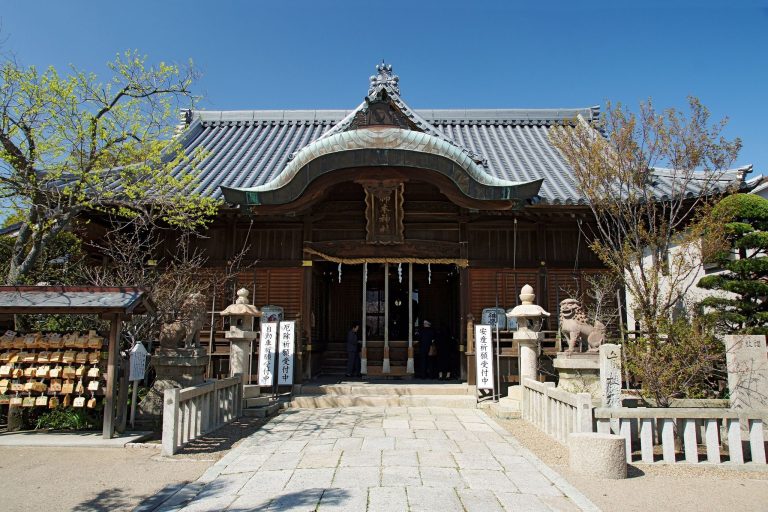
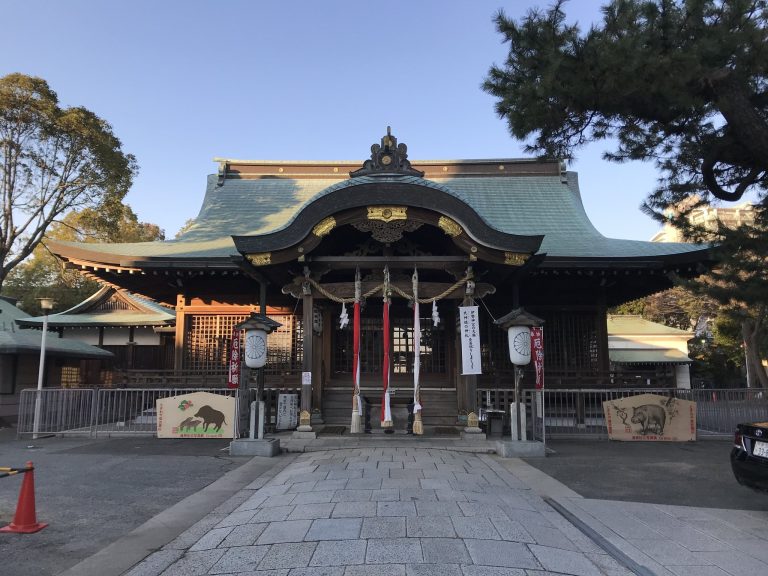
Kōsoku-ji preserves part of the arrangement recorded in an Edo-period geographical survey of Harima. The survey listed a yakui-mon gate, main hall, kitchen and living quarters, drum hall, guest hall, bell tower, tea-serving building, and lodging rooms. Four of those buildings remain: the gate, main hall, drum hall, and bell tower.
Surviving temple buildings
Yakui-mon gate
The yakui-mon is a roofed Japanese gate with distinctive supporting posts and framing. It was donated by Ikeda Terumasa, who became the first lord of Himeji Domain in 1600 after receiving recognition for his military service at the Battle of Sekigahara. Its kaerumata, a decorative structural bracket between a horizontal beam and the roof, is traditionally attributed to the carpenter and sculptor Hidari Jingorō.
Main hall, drum hall, and bell tower
The main hall, drum hall, and bell tower are the other three surviving buildings from the Edo-period arrangement. The main hall’s roof replacement in 2017 revealed the inscription dated 1857, which is associated with the proposed relocation of the temple to its current precinct.
Memorial and devotional features
Taikō Horse-Tethering Pine
A hall within the precinct houses the stump of a pine known as the “Taikō Horse-Tethering Pine.” Tradition identifies it as the tree beside which Hideyoshi sat during the Miki Campaign. This tradition is connected with the claim that Kōsoku-ji served as Hideyoshi’s headquarters, an identification that remains unverified.
Left-Twisting Jizō
In front of the temple gate stands a Jizō hall popularly called the “Left-Twisting Jizō.” Local tradition tells of a giant serpent that appeared in a nearby irrigation pond and threatened villagers. Jizō is said to have allowed itself to be wrapped around in their place before being pulled into the pond. The image was later recovered, worshipped on a nearby mountain, and moved to its present location when a housing development was built.
Religious objects and associated materials
The temple retains a wooden image said to have been made by Shinran and the three 1473 woodblock volumes of the Shōshinge Wasan brought back by Ryōzen. A palanquin associated with the lodging of Honganji religious leaders is also handed down at Kōsoku-ji. Together with the 1585 bell-donation document, these objects preserve the temple’s links with its religious lineage and regional history.