Methoni Castle: A Venetian Maritime Fortress in Greece

Site at a Glance
- Rating
- 4.7
- Popularity
- Medium
- Country
- Greece
- Primary era
- Medieval
- External website
- Open
- Eras represented
- Classical, Medieval, Early Modern, Modern
- Civilizations
- Byzantine, French, Ottoman, Roman, Venetian
- Site type
- Military
- Remains
- Castle
On this page12 sections
History
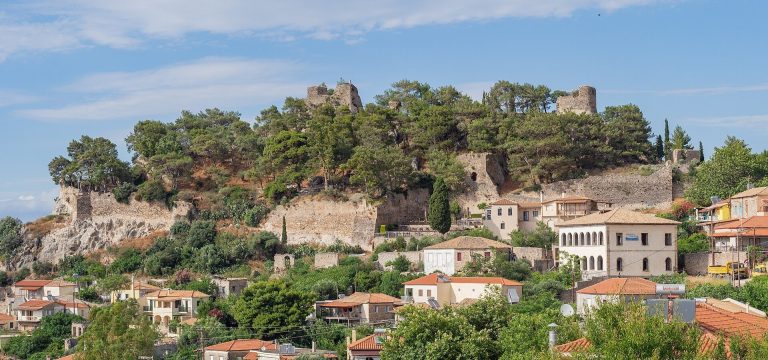
Methoni Castle is a medieval and early modern fortress in Greece, at Methoni on the southwestern Peloponnese. It occupies the Saint Nicholas Peninsula in Messenia, above the ancient acropolis of Methoni, traditionally dated to the seventh century BC. The site developed through Byzantine, Venetian, Ottoman, and later French phases, becoming a fortified maritime base that controlled important routes between the western and eastern Mediterranean.
Ancient and Byzantine Foundations
Methoni was already an important settlement in antiquity, and the later castle rose over its ancient acropolis. A Byzantine fortress was established on the site, although the date of its first fortification remains uncertain. Some city walls incorporated into the later defenses were attributed to the reign of the Roman emperor Trajan. During the medieval period, Methoni also served as an intermediate stop for Christian travelers journeying to the Holy Land.
Frankish and Venetian Control
In 1205, Methoni and its fortress came under the control of Frankish crusaders associated with the Principality of Achaea, a crusader state founded in the Peloponnese after the Fourth Crusade. They found the fortress ruined or partly ruined and repaired it or strengthened it hastily. The following year, a Venetian fleet commanded by Premarini and Renier Dandolo captured Methoni and the nearby port of Koroni. The Venetians destroyed the existing fortification before beginning their own reconstruction.
The Treaty of Sapienza in 1209 confirmed Venice’s rights to Methoni, which the Venetians called Modon, and to Koroni. Venice rebuilt both the fortress and its harbor as a fortified maritime base. Together, the two strongholds allowed the Republic of Venice, a major medieval and early modern maritime power, to control sea routes between the western and eastern Mediterranean. Venice called them the “principal eyes of the commune.”
Modon became a center of Venetian possessions in Greece, an anti-piracy base, and a repair station for Venetian military and commercial ships. Its castellan, the governor and military commander of the fortified town, also administered the settlement. In the fourteenth century, the castellan worked with the Council of Twelve to organize and provision naval escorts, determine which merchant ships needed convoys, and regulate their movement between Venice and Constantinople.
During the Venetian-Genoese War of 1350 to 1355, merchant ships could not continue beyond Modon until Venice’s Captain General of the Sea, its senior naval commander, had arrived to form and escort a convoy. The fortress faced pressure from Anatolian Turkish beyliks, Byzantine Monemvasia, and regional pirates. In 1337, attacks by the bey of Menteshe on Modon, Koroni, and the Aegean islands contributed to Venice’s agreement to pay tribute. One notable late-thirteenth-century castellan was Bartolomeo Zorzi, a Venetian patrician, merchant, and troubadour.
Artillery and Ottoman Conquest
The development of artillery during the fifteenth century transformed the fortress. High towers were replaced or supplemented by lower, massive bastions designed for cannon fire, while ditches and sloping defensive faces reshaped the fortifications. New Venetian works enclosed the settlement in 1499.
In 1500, during the Ottoman-Venetian War of 1499 to 1503, the fleet of Sultan Bayezid II defeated the Venetians in the Battle of Modon. The fortress was captured and sacked, and Methoni then remained under Ottoman rule for an extended period. The Ottoman authorities strengthened the defenses and sought to increase the garrison. Later work included the construction or completion of the fortified island of Bourtzi between 1500 and 1573, after earlier Venetian activity there.
Later Venetian and Ottoman Rule
Venetian forces commanded by Francesco Morosini recaptured Modon during the Morean War, the Venetian-Ottoman conflict of 1684 to 1699, in 1685 or possibly 1686. The Ottomans recovered it in 1715 during the Second Morean War, which brought the Venetian possessions in the region back under Ottoman control. Morosini restored a red-granite column within the fortress in 1686, adding a later Venetian association to an older monument.
In April 1770, during the Russo-Turkish War of 1768 to 1774, combined Russian and Greek forces under Count Alexei Orlov besieged the fortress as part of the Orlov Revolt, an unsuccessful Greek uprising against Ottoman rule supported by Russia. The attack failed in May, and Russian naval forces soon withdrew from the Peloponnese. Bombardment caused substantial damage to the fortifications.
Revolution, French Occupation, and Ruin
At the beginning of the Greek Revolution, Bishop Gregory of Methoni led an uprising at Methoni in March 1821 and besieged the Ottoman garrison. On 7 August 1821, the commander Mustafa Ali Basoglu surrendered the fortress and handed its keys to Gregory. In 1825, Ibrahim Pasha, commanding an Egyptian fleet and Ottoman-Egyptian forces, besieged and captured Methoni. Many defenders were killed, Gregory was imprisoned in the fortress dungeon, and Ibrahim made the castle his residence and the seat of the pasha of western Messenia.
After the Ottoman naval defeat at the Battle of Navarino in autumn 1827, a French expeditionary force under General Nicolas Maison occupied Methoni in 1828. The Ottoman garrison surrendered after negotiations and a small-scale attack. The French repaired the fortress and rebuilt the war-damaged town outside its walls, remaining in the area until 1833.
In 1833, Methoni and its fortress became part of the Kingdom of Greece. The settlement had previously been concentrated largely within the fortifications, but it was subsequently rebuilt outside the castle walls. The fortress itself then became ruins, preserving evidence of the successive Byzantine, Venetian, Ottoman, French, and Greek phases of the site.
Remains
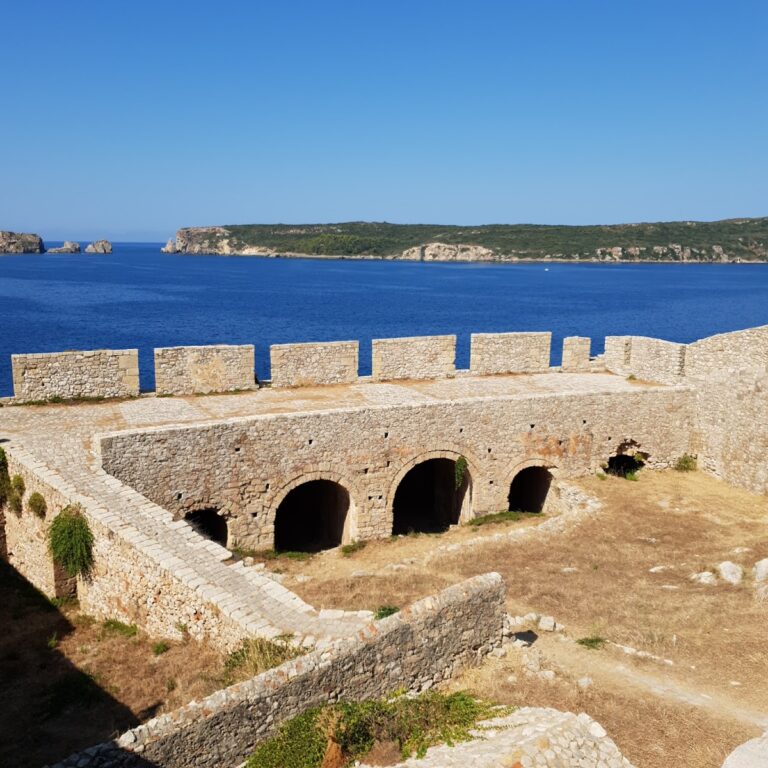
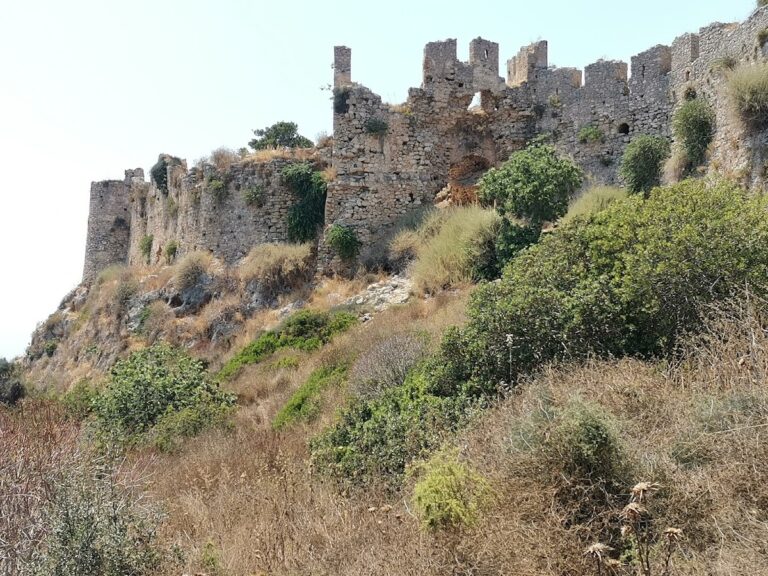
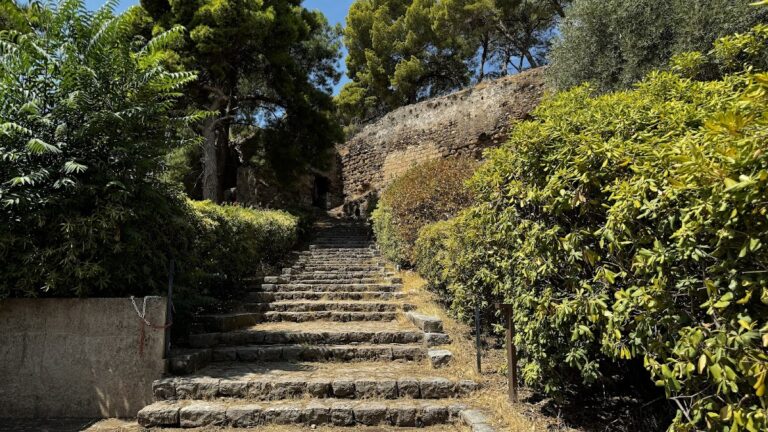
Methoni Castle occupies approximately 93,000 square metres and extends for about 700 metres along a narrow peninsula surrounded by the Ionian Sea on three sides. Its elongated plan is roughly elliptical or polygonal. The fortification is divided into a southern urban section and a northern citadel, separated by a low intermediate wall. The walls are built of roughly dressed stone bonded with mortar, with later defensive elements including towers, artillery bastions, crenellations, embrasures, parapets, scarps, and counterscarps.
Citadel and Landward Defenses
The southern section contained the principal civic and residential buildings, enclosed by walls strengthened with regularly spaced towers. The northern section formed the landward citadel, protecting the fortress from attacks coming from the mainland and often serving as the residence of the castellan or military commander. A wall about 6 metres high divided the two areas. It was strengthened by five towers, four square and one octagonal, attributed to the period after 1500, when the Ottoman authorities increased the garrison and reinforced the defenses.
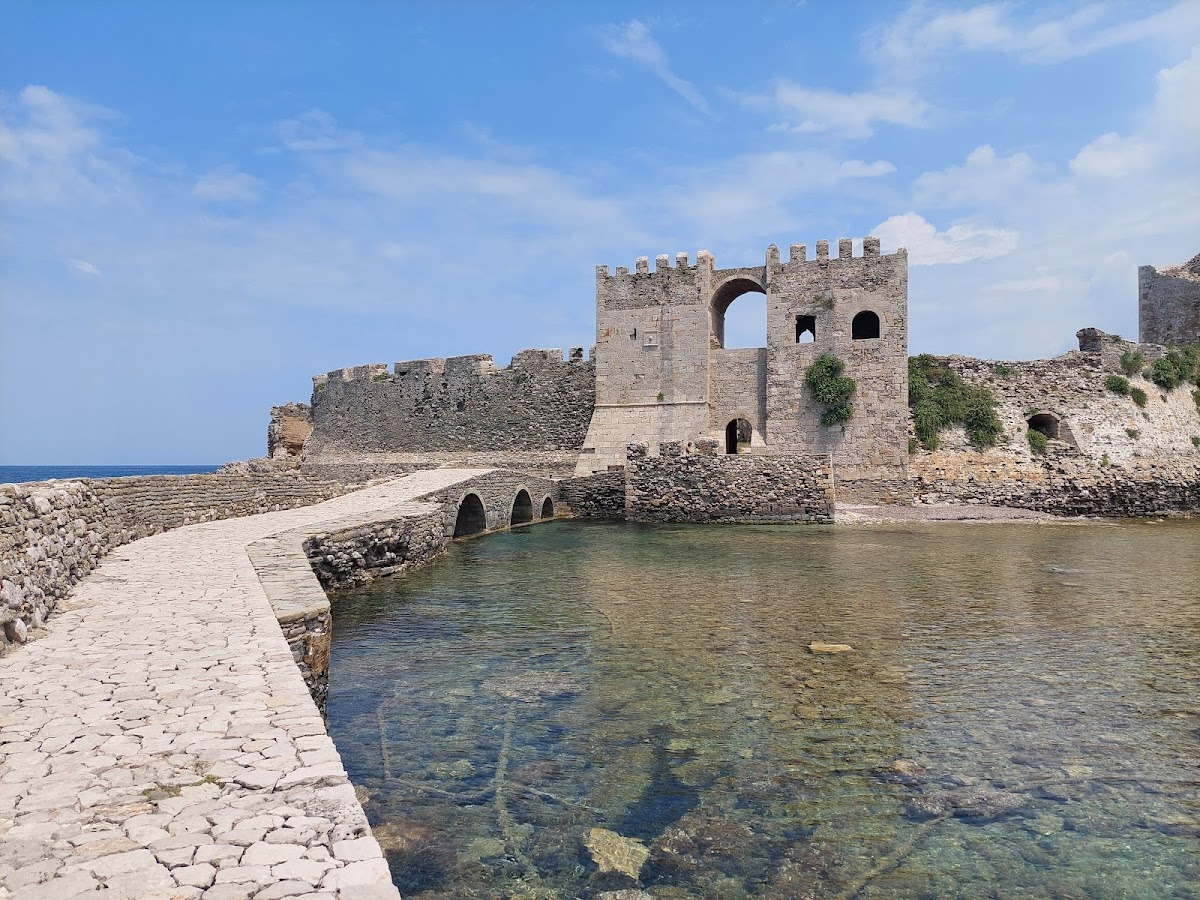
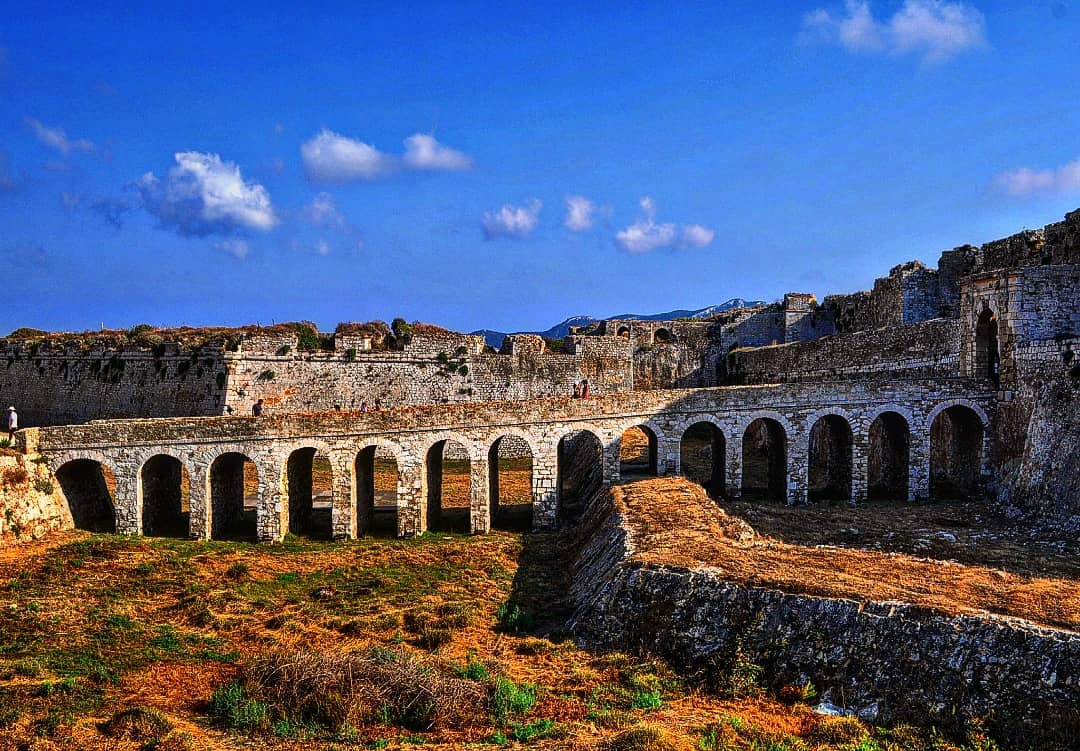
The northern side was protected by a broad dry ditch and a powerful wall with two bastions. A wide ditch was begun in the late fifteenth century and was originally crossed by a movable wooden bridge. The present approach is a stone bridge of fourteen arches, about 45 metres long, 3 metres wide, and 4 metres high. The French expeditionary force under General Maison built it in 1828 over the earlier ditch and masonry bridge supports. Two large walls with loopholes flank the entrance, including one constructed by General Antonio Loredan during the second Venetian occupation.
The main land gate stands at the center of the northern wall. Built from rectangular dressed limestone, it has pilasters and a monumental Renaissance entrance. The passage ends in an arch framed by pilasters with Corinthian capitals, ornate capitals decorated with stylized foliage, and this part of the gateway is attributed to Venetian work after 1700. The fortress had six entrances, three facing the harbor, with most placed at the ground floors of towers. The landward route passed through a vaulted passage and successive second and third gates into the inhabited interior.
Urban Buildings and Southern Gate
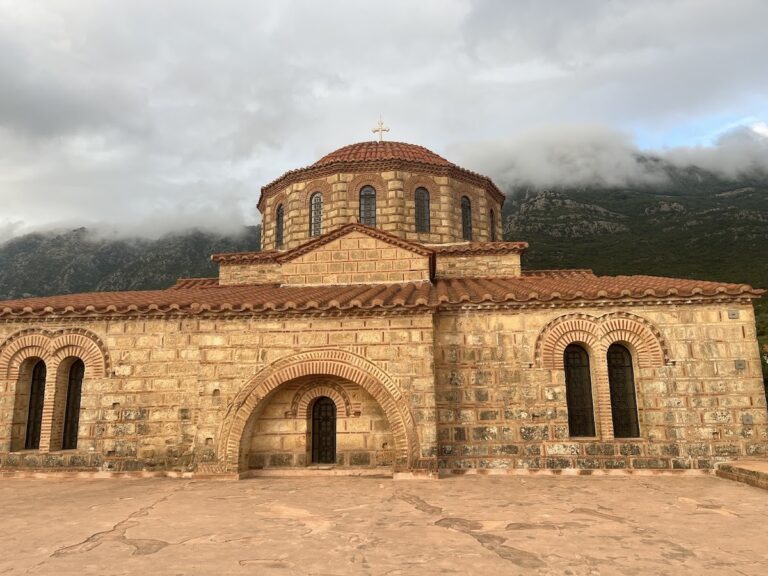
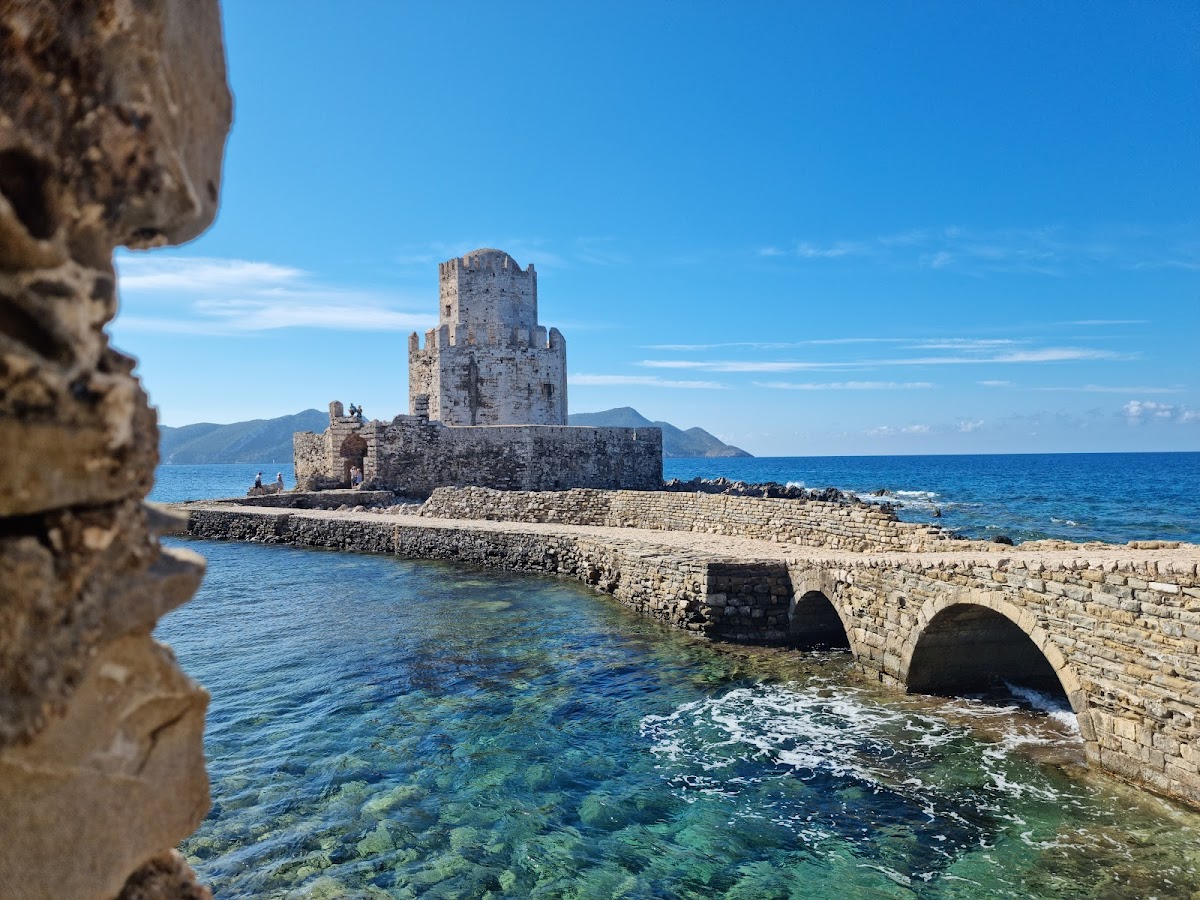
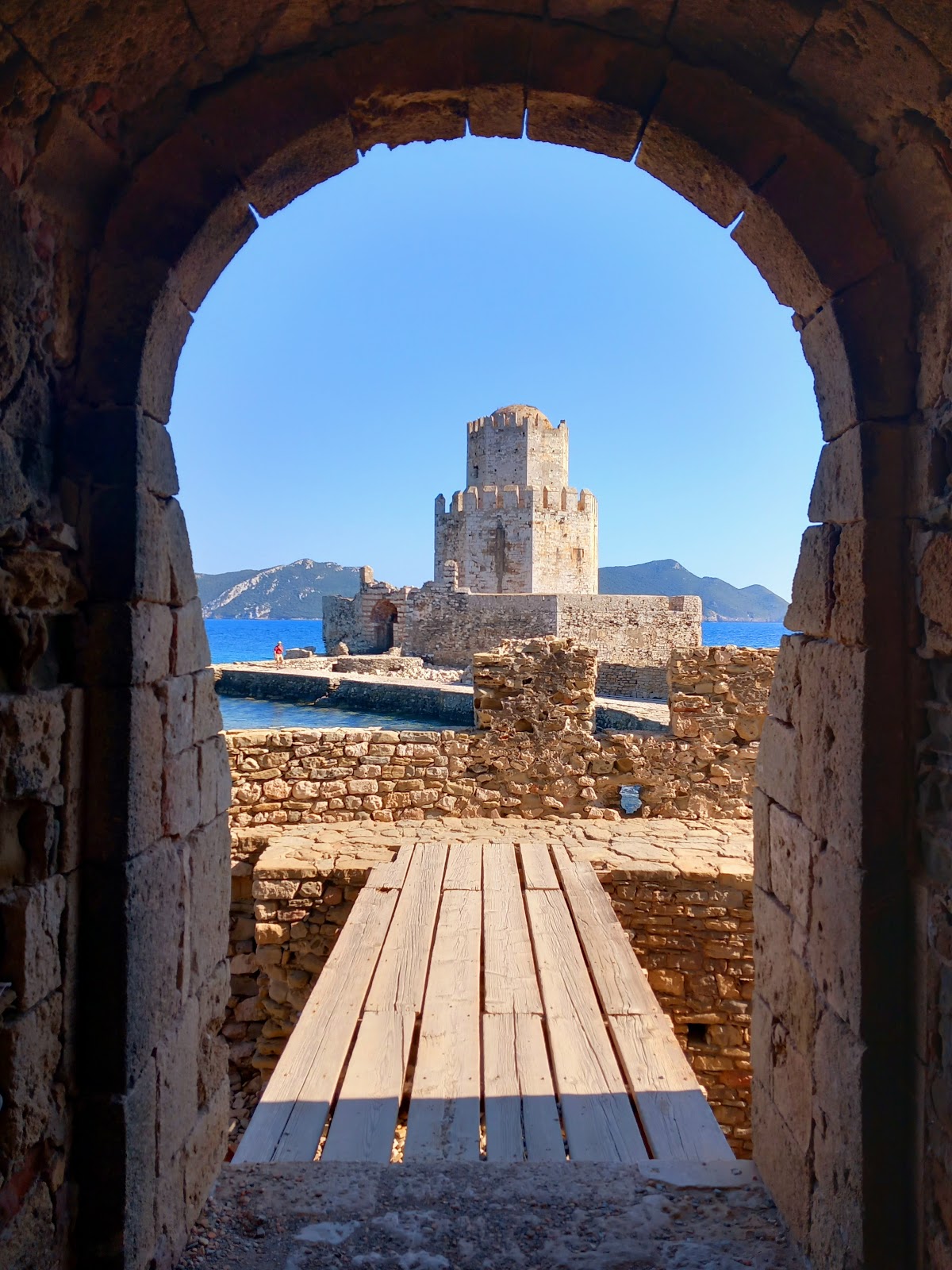
The southern section preserves ruins of Venetian residential buildings and a cobbled street leading toward the sea gate. Other surviving features include a Turkish bath, the Byzantine Church of Saint Sophia, parts of Doric columns, several cisterns, and the remains of a cemetery for British prisoners from the Second World War. The western wall is less carefully constructed in parts, while an eastern tower retains portions of Byzantine fortification. The southern sea gate has been restored, and a stone causeway crosses a small bridge from it to the fortified islet of Bourtzi.
To the left of the entrance are the ruins of a building first used by Ibrahim Pasha as a residence in 1826 and later occupied by General Maison. The French are also credited with constructing the Church of the Transfiguration in this area. Venetian coats of arms, winged lions of Saint Mark, and inscriptions remain on the fortress walls. A plaque built into the northern defenses dates from the period when Antonio Loredan commanded in the Peloponnese. Another plaque beside the main entrance bears the arms of the Foscarini, Foscolo, and Bembo families and records the construction of the Bembo fortification shortly before 1500.
Harbor and Waterfront
The eastern side of the fortress originally extended to the sea, although a beach now projects along that side. A quay once ran parallel to the eastern wall toward Bourtzi, forming a small protected harbor known as a mandraccio, or inner harbor for vessels beside a fortified waterfront. A larger harbor suitable for mooring ships lay to the northeast. The eastern wall underwent repeated repairs during both Venetian and Ottoman periods, including work associated with the second Venetian occupation.
Monumental Column
A monolithic red-granite column stands within the fortress. It was first erected in 1483 and restored by Morosini in 1686. Its capitals are Byzantine in style, and tradition holds that it was once surmounted either by Venice’s winged lion of Saint Mark or by a bust of Morosini, giving it the name “Morosini Stele.” The inscription has not survived. The origin of the granite and the column remains unknown because no ancient structures made from comparable granite have been found in Methoni or its vicinity.
Bourtzi
Bourtzi is a small fortified island south of the castle, linked to it by an artificial stone bridge. Its octagonal tower was built or completed under Ottoman rule between 1500 and 1573, following earlier Venetian work on the island. The two-story structure ends in a semicircular dome. Its lower floor contained a cistern and small defensive openings dating from the first Ottoman occupation. Beams set within the walls supported a wooden floor that no longer survives. Bourtzi successively served as a harbor defense, lighthouse, prison, torture chamber, and place of execution.