Tamgaly: A Sacred Petroglyph Complex in Kazakhstan
Site at a Glance
- Rating
- 4.5
- Popularity
- Very Low
- Country
- Kazakhstan
- Primary era
- Iron Age
- External website
- Open
- Eras represented
- Bronze Age, Iron Age, Medieval, Early Modern, Modern
- Civilizations
- Scythian
- Site type
- Civic
- Remains
- Rock Art
On this page10 sections
History
Tamgaly is a sacred petroglyph complex in Kazakhstan, created and used by Bronze Age communities associated with the Andronovo culture from the mid-fourteenth to thirteenth centuries BCE and revisited into the nineteenth and twentieth centuries. A petroglyph is an image made by removing or abrading part of a rock surface. The site lies in the southeastern Chu-Ili Mountains, within Zhetysu, and its archaeological landscape includes settlements, burial grounds, sacrificial places, rock-art galleries, and religious installations.
Bronze Age sanctuary
The canyon and its surrounding area served as a ceremonial and sacred zone for several millennia. People came there for ritual ceremonies, magical rites, the worship of deities and ancestral spirits, and other formal activities. Settlements and habitation areas were placed around the sanctuary’s periphery, while the central canyon retained its ritual role.
The oldest major series of carvings belongs to the Bronze Age. These compositions include solar deities, worshippers, warriors, supernatural beings, hunting scenes, sacrifices, and other imagery connected with the religious ideas of the communities that used Tamgaly. The solar, or “sun-headed,” figures are anthropomorphic forms with radiant heads or halos. Tamgaly is especially important in Kazakhstan because Bronze Age artists created an anthropomorphic visual representation of a deity there.
Iron Age and medieval additions
Petroglyphs continued to be made during the Late Bronze Age, the transitional or early Saka period, and the Early Iron Age. The Saka were Iron Age nomadic peoples of Central Asia associated with the wider Scythian cultural world. Their carvings include hunting scenes, predators pursuing deer and mountain goats, mounted warriors wearing pointed hats, herders, and clan or ownership marks. Later figures were often placed beside or over earlier ones, producing layered compositions. Early Iron Age petroglyphs are the most numerous at Tamgaly.
Medieval carvings show mounted standard-bearers, armed combatants, hunting, migration, and nomadic life. An elephant carrying a rider points to cultural exchange among societies connected by the Great Silk Road. Early Turkic runic writing from the ninth and tenth centuries appears among the rock inscriptions. Oirat prayers were carved on the sanctuary rocks from the late seventeenth to the mid-eighteenth century, followed by Kazakh graffiti and images in the nineteenth and early twentieth centuries.
Later history and protection
Tamgaly experienced roughly four centuries of reduced artistic visibility during the thirteenth to sixteenth centuries, in the context of the Mongol invasions, later wars, and population movements. Its religious importance nevertheless survived until the beginning of the twentieth century.
The rock-art gallery was discovered on 19 September 1957 by the Zhetysu detachment of the South Kazakhstan Archaeological Expedition of the Institute of History and Archaeology of the Academy of Sciences of the Kazakh SSR. The expedition was led by archaeologist Anna Georgievna Maximova. Geologists A. Medoev and B. Aubekerov and archaeologists A. Maryashev and A. Ermolaeva investigated the monuments during the 1970s and 1980s, while A. Rogozhinsky studied them from 1988 to 2005.
The Tamgaly State Historical, Cultural, and Natural Reserve was established in 2003. In 2004, the “Petroglyphs of the Archaeological Landscape of Tamgaly” were inscribed on the UNESCO World Heritage List under cultural criterion (iii), making Tamgaly the first Central Asian rock-art monument placed on that list. The site is also included in Kazakhstan’s state list of monuments of historical and cultural importance of republican significance and is protected by the state through the Tamgaly museum-reserve. The name Tamgaly means “painted” or “marked place” in Kazakh and other Turkic languages.
Remains
Canyon and rock-art galleries
The core of Tamgaly is a small canyon formed at the mouth of a gorge. In places, its curving slopes draw close together and create an almost enclosed space. The canyon and its narrow valley preserve the physical setting of the sanctuary. Petroglyphs are distributed among approximately 48 sites. Groups I to V form the principal concentrations in the small canyon, with about 3,000 images, while 22 further sites contain between 50 and 100 representations each. Other groups are dispersed across the wider landscape.
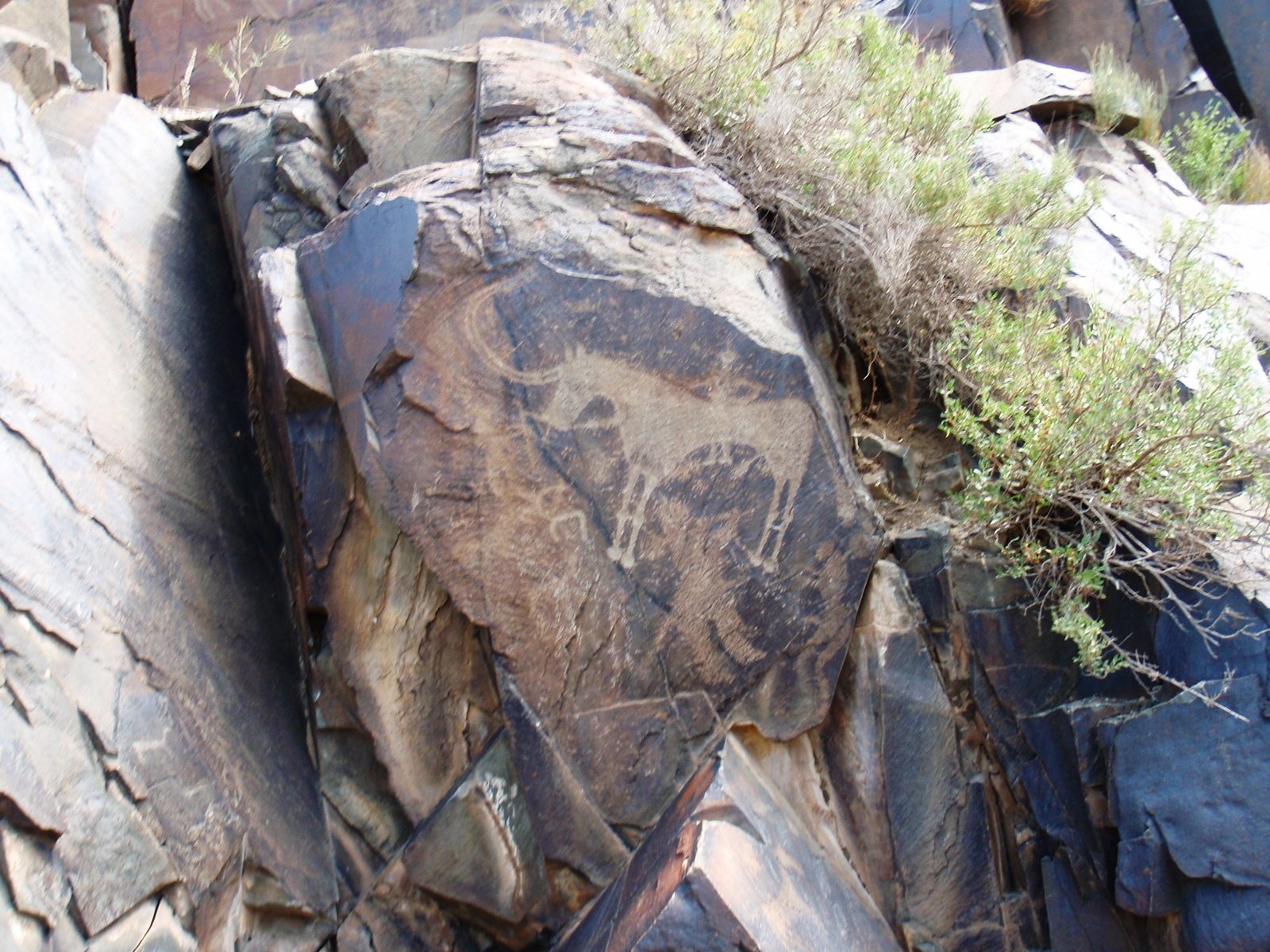
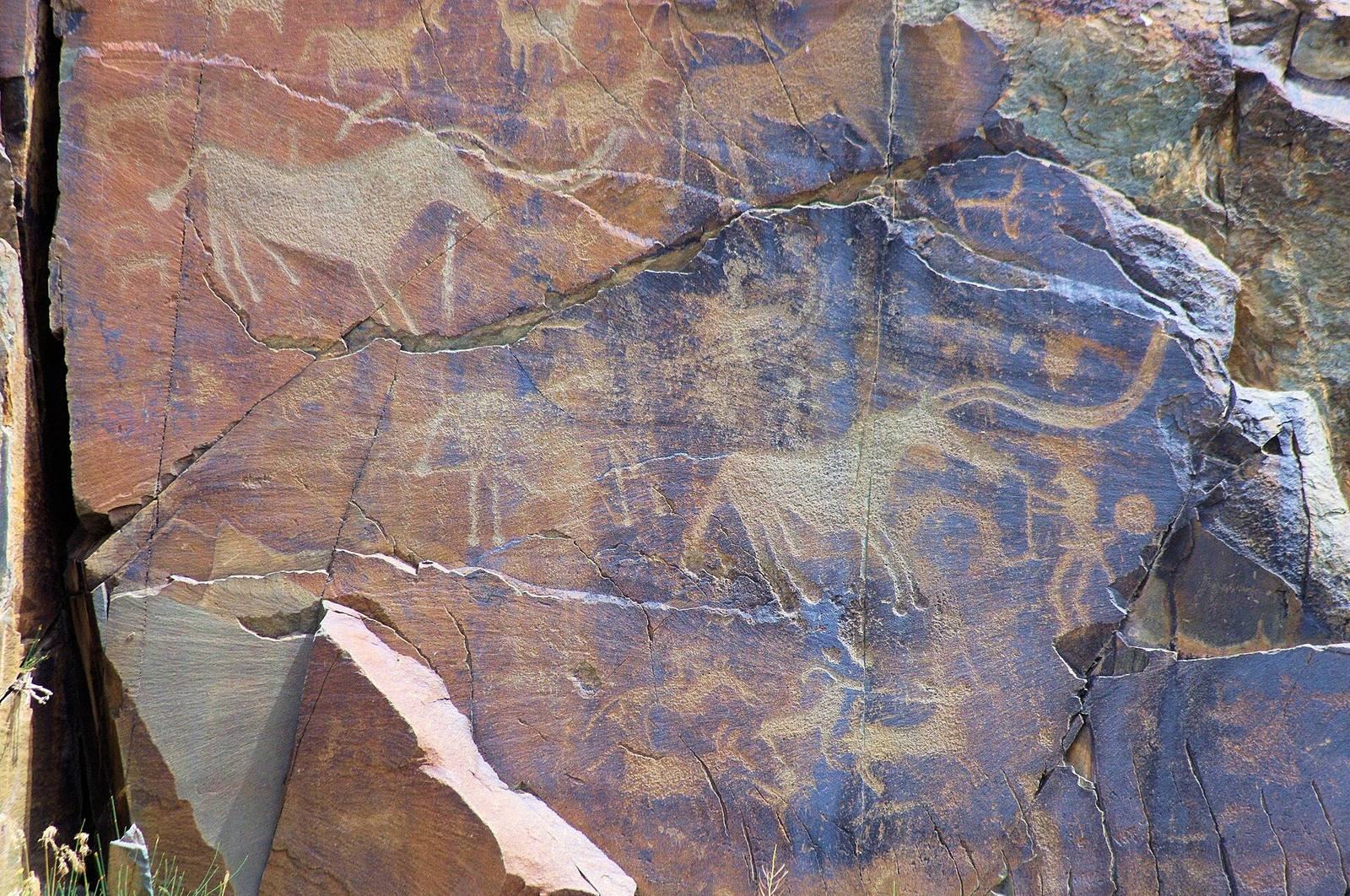
Large, smooth rock surfaces carry a dark desert patina, a natural surface layer formed through the oxidation of minerals and the action of microorganisms. Carvers created the images chiefly by repeatedly picking or pecking the rock, sometimes using an iron or stone implement. Middle Bronze Age figures were generally cut about 3 to 5 millimeters deep, while Late Bronze Age and transitional-period figures were usually 1 to 2 millimeters deep. Bronze Age figures commonly measure 25 to 30 centimeters in height, although exceptional examples reach 60 to 70 centimeters or about 1 meter. Later Bronze Age and transitional-period figures generally average less than 15 centimeters.
Bronze Age compositions
Bronze Age artists worked on broad, relatively level rock surfaces. Viewing places in the valley, generally 20 to 40 meters from the rocks, allow several compositions on opposing cliffs to be seen together. This arrangement creates increasingly complex visual groupings across the sanctuary.
Group IV contains a major vertical panel identified as panel 118. It shows six or seven solar figures, ten armed male warriors in dance-like poses, a woman giving birth, an erotic scene, and worshippers known as adorants. The wider Group IV composition is described as a pantheon arranged on the highest rock in the sanctuary, with divine figures above the warriors and a woman with raised arms below.
The Bronze Age imagery combines human, animal, and composite forms. Subjects include wild bulls, horses, kulan, deer, pigs or boars, wolves, camels, asses, chariots, club-bearing men, warriors with battle axes, wolf-masked archers, disguised figures, worshippers, sacrificial animals and humans, erotic scenes, and women giving birth. Some animal figures represent species that are now extinct.
Later carvings and inscriptions
Early Iron Age images vary more widely in style and technique than the Bronze Age works. Wild-animal hunts and predators chasing deer and goats are common, and some scenes overlap or obscure earlier carvings. Medieval and modern petroglyphs number about 300. They are generally shallower and often add mounted standard-bearers, dueling warriors, hunters, banners, weapons, horse equipment, and an elephant with a rider to earlier compositions.
Inscriptions include early Turkic writing from the ninth and tenth centuries, Oirat writing from the late seventeenth to the mid-eighteenth century, and Kazakh writing from the nineteenth century. Clan tamgas, distinctive clan, tribal, or ownership marks, were also carved into the rocks. The dark surface gradually reforms over exposed carvings, so differences in patina help establish relative dates. Some images were re-cut or had the patina removed again to make their outlines more visible. These layered surfaces are palimpsests, meaning rocks bearing imagery made at different times.
Settlements, burials, and ritual installations
Archaeological remains around the sanctuary include stone-built houses, animal enclosures, pottery fragments, and objects made from stone, iron, and bone. Occupation areas occur around the ritual core. Sacrificial places and other religious installations are associated with the rock-art galleries.
A large necropolis lies near the foot of one mountain, with earliest burials dating to the fourteenth and thirteenth centuries BCE. Separate groups of nomadic burial mounds on the piedmont plain date from the first millennium BCE to the first millennium CE. One mound has stone “mustache” ridges.
Archaeological landscape
The reserve and its buffer zone together cover about 3,800 hectares, while the inscribed area covers approximately 900 hectares. Across the archaeological landscape, about 5,000 petroglyphs survive, including the approximately 3,000 concentrated in the five principal groups of the small canyon. The landscape also supports rare plants such as Regel’s tulip and Kushakevich’s juno, both listed in Kazakhstan’s Red Book. Wolves, foxes, hares, tortoises, snakes, and numerous birds, including steppe eagles, kestrels, and saker falcons, occur in the Chu-Ili Mountain environment.