Tepe Narenj: A Buddhist Monastery near Kabul
Site at a Glance
- Rating
- 5
- Popularity
- Very Low
- Country
- Afghanistan
- Primary era
- Classical
- Eras represented
- Classical
- Civilizations
- Unclassified
- Site type
- Religious
- Remains
- Monastery
On this page8 sections
History
Tepe Narenj, also known as Narenj Hill, is an archaeological site containing a Buddhist monastery near Kabul, Afghanistan. The monastery was generally established in the fifth or sixth century, while activity at the site continued from the fifth through the tenth century. Its position along the commercial route linking Kabul with India connected the secluded monastic community to wider movements of people, ideas, and religious practice.
A Buddhist monastery on the Kabul–India route
The monastery provided a retreat for Buddhist monks away from the city. Its sculptures and religious imagery indicate the practice of Tantric Buddhism, a form associated with ritual, visualization, symbolic practices, and esoteric teachings. The site therefore contributes to the study of how Buddhist traditions developed and spread across the region.
In the seventh century, the Chinese Buddhist monk and pilgrim Xuanzang visited the monastery while returning from India. His travel record, Great Tang Records on the Western Regions, described the geography and culture of Central and South Asia and included observations connected with Buddhist sites.
Destruction, abandonment, and rediscovery
Muslim armies are believed to have destroyed the monastery in the ninth century. After the Muslim conquest, the site was abandoned. Later urban development caused further partial damage, and the remains eventually lay forgotten beneath a modern police station.
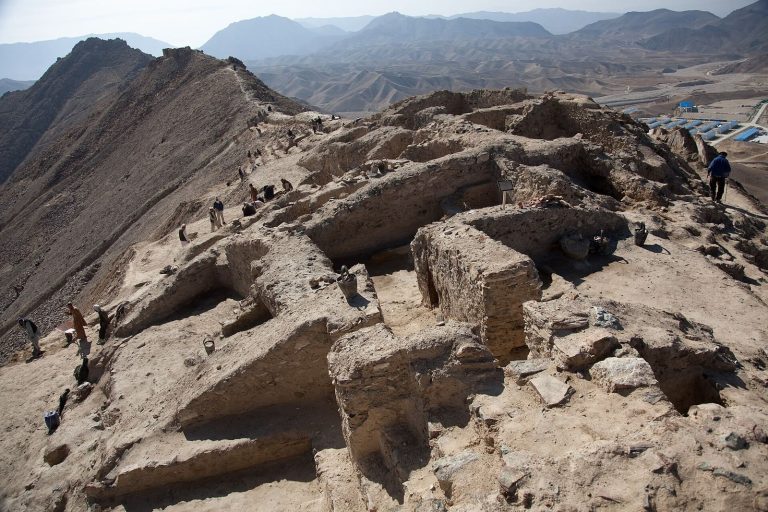
Post-conflict excavations following the Soviet–Afghan War brought Tepe Narenj back to archaeological attention. A joint study by Afghanistan’s Archaeological Research Institute and Japan’s National Research Institute for Cultural Properties identified the foundations. From 2004 to 2012, an Afghan team led by archaeologist Zafar Paiman carried out excavations, with two seasons each year. The Afghan Institute of Archaeology has also conducted one-month summer excavations since 2005, using the site as a training excavation for Afghan archaeologists.
The scale of the discoveries has made Tepe Narenj important for studying the expansion of Buddhism. The site was included among 100 sites at risk in 2008. Its exposed remains and archaeological materials continue to face threats from erosion, looting, armed conflict, recent political events, and inadequate administration.
Remains
Tepe Narenj lies on a hillside at the foot of Zamburak Shah Mountain, southeast of Kabul, near the historic citadel of Bala Hissar and Hashmat Khan Lake. The archaeological area extends for approximately 250 metres and was found beneath a modern police station. Its surviving remains include a Buddhist monastic complex with meditation monuments, small rooms, columns, sculptures, and coins spanning several historical periods.
Monastic layout and archaeological finds
Stupas and monastic rooms
The monastery contained five small stupas, Buddhist monuments associated with relics, commemoration, and meditation. Five small chapels or monastic rooms were also identified, together with columns. These features define the surviving architectural evidence for a secluded community organized around Buddhist religious practice.
Buddhist sculptures
Sculptural remains include representations of Buddhas and Bodhisattvas, Buddhist figures understood as beings who seek enlightenment while assisting others. The sculptures were formed from clay overlaid with fabric and then covered with stucco. The feet of one statue measure approximately 71 centimetres. Their size has been interpreted as indicating that the complete figure was intended to be visible from a considerable distance.
Coins and chronology
Coins found at the site range from the Kushan period to the era of the Hindu Shahis. The Kushans were an ancient ruling dynasty whose empire extended across parts of Central and South Asia, including present-day Afghanistan. The Hindu Shahis were a medieval Hindu dynasty that controlled parts of Afghanistan and northwestern South Asia after the decline of earlier regional powers. Together, the coins provide material evidence for activity at Tepe Narenj across successive political periods.