Melaten Cemetery: Cologne’s Municipal Burial Ground
Site at a Glance
- Popularity
- Very High
- Country
- Germany
- Primary era
- Modern
- Eras represented
- Modern
- Civilizations
- French, German, Kingdom of Prussia
- Site type
- Burial
- Remains
- Necropolis
On this page20 sections
History
Melaten Cemetery is a municipal cemetery in Lindenthal, Cologne, Germany, established in 1810. Its geometrically planned grounds were intended as a park-like burial place and public green, replacing the city’s earlier cemeteries after French reforms.
The Hospital and Execution Ground
A hospital for sick people and those with leprosy stood at Melaten by 1180. The institution, called the Court of Malaten, is first named in 1243. The place-name may derive from the French malade, meaning ‘sick’. The hospital lay beyond the Bischofsweg, the historical boundary between Cologne’s territory and the archbishop’s lands, and fell under archiepiscopal authority.
From the 16th through the 18th century, the open ground around the hospital served as a public execution site and included a tavern popular with poorer residents. People accused of heresy or witchcraft were burned there, including Protestant reformer Adolf Clarenbach in 1529 and Katharina Henot in 1627. Those executed were generally buried at the site, where executions continued until the end of the 18th century. The Rabenstein execution ground stood across Aachener Straße.
Establishing the Municipal Cemetery
During the French occupation, Napoleon I issued a decree on 12 June 1804 that prohibited burials inside cities, villages, and enclosed buildings, chiefly for public-health reasons. It also shifted responsibility for burials from the Catholic Church to municipal authorities. Cologne bought land on the former hospital grounds and demolished most of the buildings.
The city commissioned Cologne cleric and scholar Ferdinand Franz Wallraf to plan the new cemetery. His 1809 proposals drew on Père-Lachaise, a Paris cemetery known for its park-like setting, and envisioned a geometric layout with planting, public green space, and places for recreation. Cathedral priest Michael Joseph DuMont consecrated Melaten on 29 June 1810. The city’s cemeteries then closed, and the first burial took place on 1 July.
Officially called the God’s Acre of the City of Cologne, Melaten at first accepted only Catholic burials. Protestants continued to bury their dead at the old Geusen cemetery until 1829. Jewish burials continued elsewhere until a Jewish cemetery opened in Deutz in 1903. From the 20th century, Melaten also received burials of non-Christian faiths, including Muslim burials.
Expansion and Changing Burial Practices
The cemetery grounds expanded in 1833, 1850, 1868, and 1875. As Cologne’s population grew and Melaten became overcrowded, the city opened the North Cemetery in 1896, the South Cemetery in 1901, the West Cemetery in 1917, and the East Cemetery in 1946.
War Damage and Recovery
Air raids during the Second World War caused extensive damage. The former hospital chapel was destroyed in 1942 and restored in simplified form in 1952. The worst destruction came during bombing on 30 and 31 October 1944. A bomb struck a deep shelter beside the Aachener Straße entrance, killing more than 100 people gathered there for a wedding. After the war, people whose homes had been bombed temporarily lived in cemetery vaults.
Protection and Documentation
Melaten received monument protection in 1980. In 1981, following a proposal by Cologne art historian and monument-preservation official Hiltrud Kier, the cemetery introduced a grave-patronage scheme. Patrons maintain protected tombs whose burial rights have expired in exchange for the right to be buried there. Although earlier practice allowed original inscriptions to be moved or covered, current rules require them to remain visible in their original positions.
The growth of urn and anonymous burials created surplus burial space, and the cemetery opened to residents of all Cologne districts. Previously, eligibility also depended on parish residence or honorary citizenship. In 2025, a documentation project photographed 18,498 gravestones and checked information on 46,193 people. More than 31,000 images were processed for a gravestone database.
Remains
Plan and Landscape
Layout and Boundaries
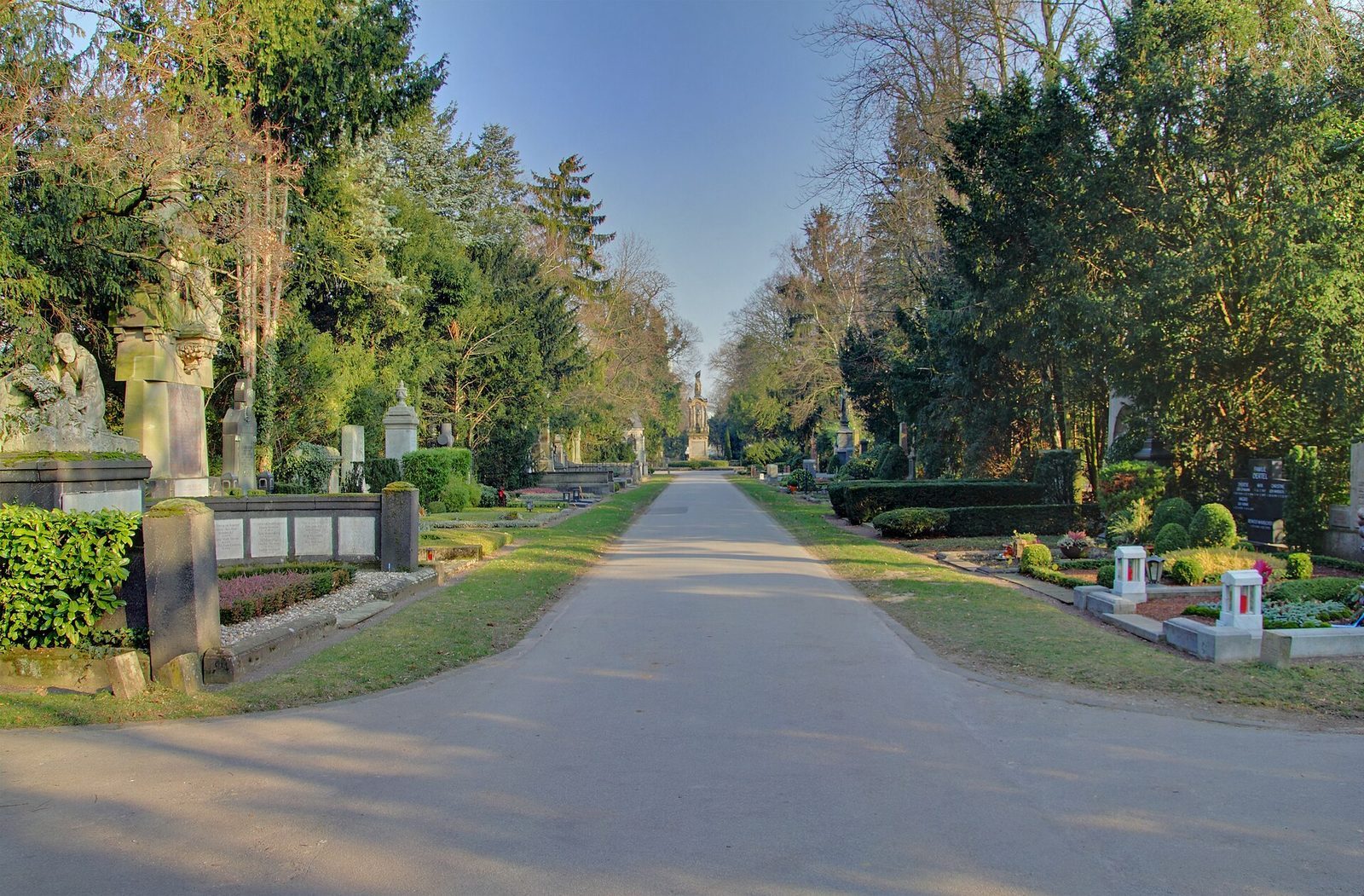
The 435,000-square-metre cemetery follows a grid of right-angled paths. Two main routes run north from Aachener Straße and meet an east-west path near the grounds’ midpoint. This central route is also called Millionaires’ Avenue, where the most expensive graves were placed. The grounds comprise the Old Ehrenfeld Cemetery in the north and Melaten Cemetery proper. They are bounded by Aachener Straße to the south, Piusstraße to the east, Oskar-Jäger-Straße and Melatengürtel to the west, and Weinsbergstraße to the north. Both sections border a separately administered Jewish cemetery toward Melatengürtel. The recorded total of 55,540 graves, counted in 2008 and 2010, was unchanged in early 2023.
Planting and Wildlife
The grounds were initially sparsely planted. Landscape gardener Maximilian Friedrich Weyhe’s 1826 planting plan was only partly carried out because of its cost. Tall, open rows of plane trees line the main paths and east-west axis, while medium-height lindens and rose bushes edge side paths. Later plantings included arborvitae, maples, birches, weeping elms, Japanese ornamental cherries, and trumpet trees; hedges enclose some plots.
More than 40 bird species live and breed in the cemetery, including greenfinches, blue tits, woodpeckers, blackbirds, starlings, jackdaws, robins, bullfinches, hawks, buzzards, and tawny owls. Collared and Alexandrine parakeets also live there. Collared parakeets released in the 1960s established breeding populations; their ancestors may have escaped from pet shops or the zoo. Bats, squirrels, feral cats, and foxes also inhabit the grounds.
Walls, Entrances, and Buildings
Walls and Entrances
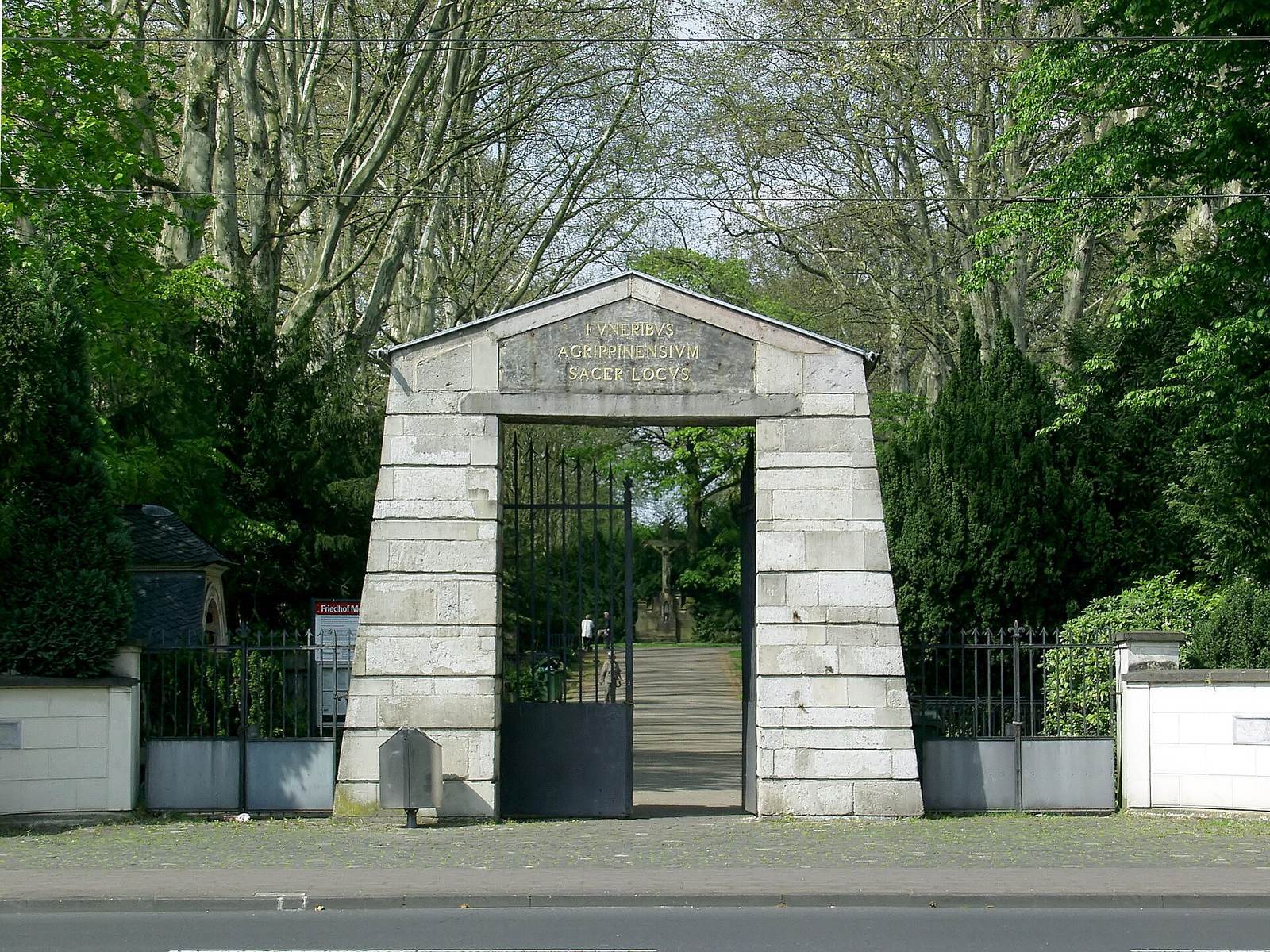
The oldest cemetery wall runs along Aachener Straße and dates to 1810. It incorporates the former main entrance, Gate II. Gates I and III were added to its east and west in 1874 and 1887. A new main entrance was built at Piusstraße in 1957. The cemetery has six public entrances: three on Aachener Straße and one each on Piusstraße, Weinsbergstraße, and Melatengürtel. Above the old Aachener Straße entrance, an inscription dedicates the place to Cologne’s dead. Two nearby inscriptions greet the dead as seed sown for a better future and urge passersby to pray, reminding them that they will soon join the dead.
Chapel
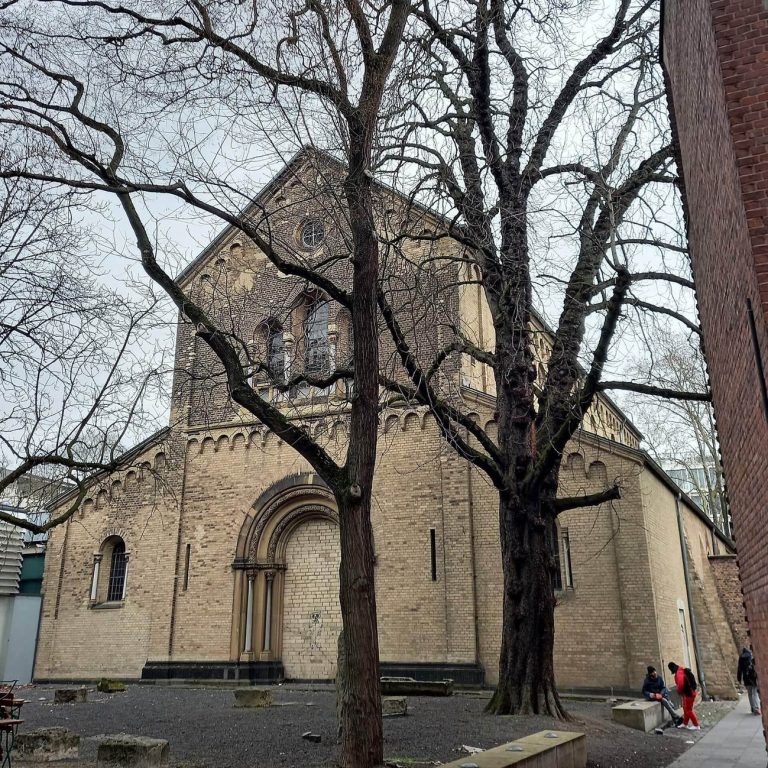
The Chapel of St Mary Magdalene and Lazarus stands on Aachener Straße. Archbishop Konrad von Hochstaden consecrated it in 1245. It was altered in 1475 and gained the dedication of St Mary Magdalene alongside that of St John. An electronic organ installed in 2019 was inaugurated on 1 November.
Mourning Halls
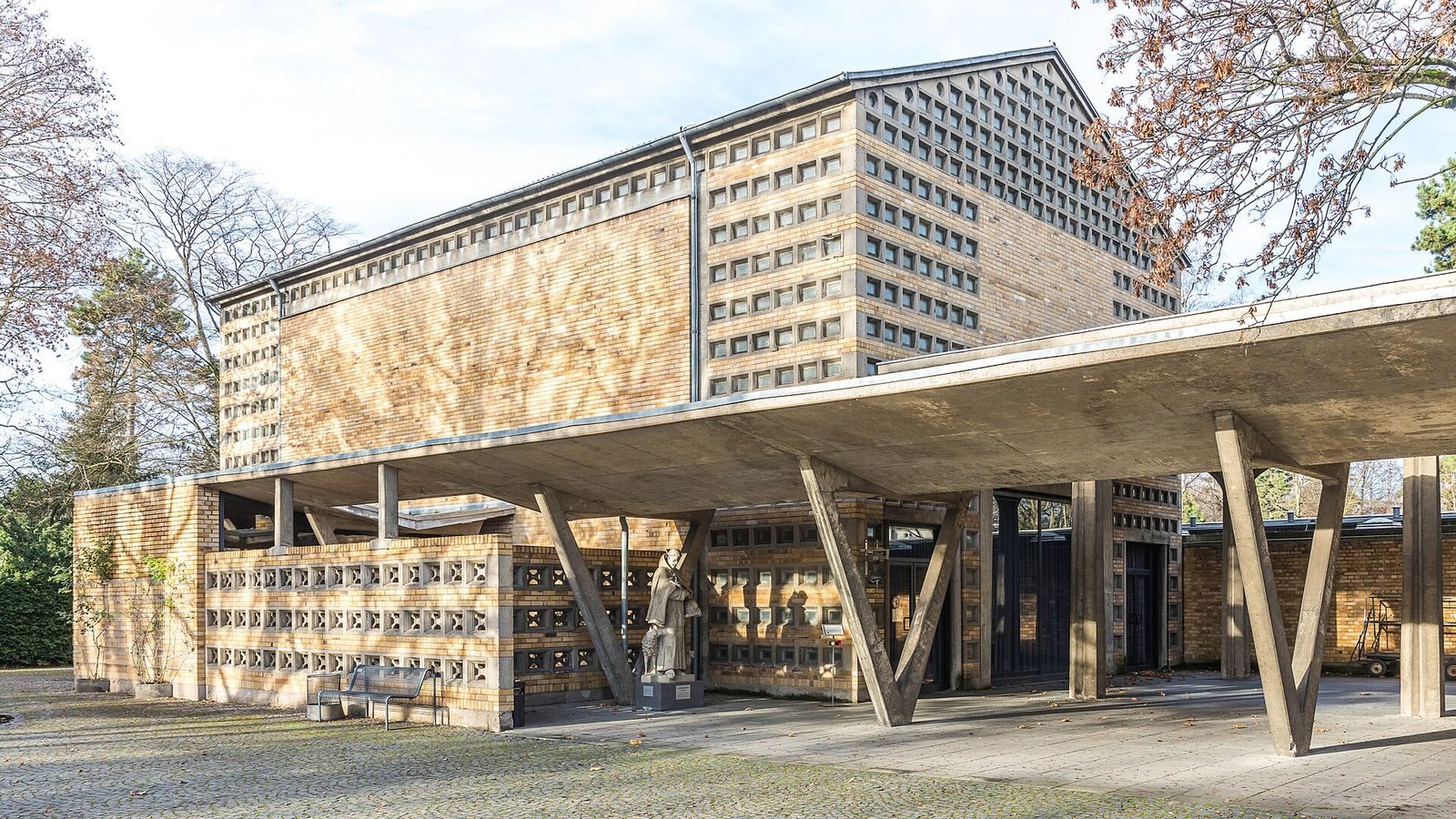
The old mourning hall was built in 1880–81 in neo-Romanesque forms to designs by Heinrich Wiethase. Around 1916 it was extended north along its main axis. Hans Verbeek and his colleague Klewitz designed the neoclassical addition, which included an open-sided porch. Wartime damage led to a temporary flat roof. A larger mourning hall, designed by Fritz Schaller, was built at the Piusstraße entrance in the 1950s. The older hall later served for storage before becoming Cologne’s first columbarium, an urn-niche building, which opened in 2024. It has about 500 chambers, each able to hold two urns.
Other Cemetery Buildings
Other buildings include an office from 1889, two gate lodges built in 1901–02, and a public toilet dating to 1896. Wartime bombing badly damaged these buildings and a number of older tombs; some buildings were later restored.
Tombs and Memorials
Family Tombs and Sculpture
Many 19th-century family graves are concentrated along Millionaires’ Avenue. Neo-Gothic monuments are prominent, alongside tombs in neo-Renaissance, neoclassical, and Art Nouveau styles. The cemetery also contains numerous original tomb sculptures.
War Memorials and Graves
Four war memorials and two war-grave fields commemorate soldiers killed in the First World War and people killed in a 1942 bombing, including a family of seven. Erected by veterans of the Napoleonic Wars, the 1853 Napoleon memorial was Melaten’s first war monument and honored soldiers regardless of rank. Its appearance amid Prussian anti-French sentiment seems to reflect a romanticized view of the French occupation in western German territories formerly occupied by France. The memorials to the 1866 and 1870–71 wars of German unification express the glorification of war. A Germania figure, representing Germany, remained on the latter memorial until the 1950s. A nearby French memorial commemorates French soldiers who died in Cologne. The memorials and graves show moderate upkeep, while wreaths are often placed before the 1870–71 monument, including wreaths from the city.
Other Memorial Markers
A memorial stone marks the location of the deep shelter beside the Aachener Straße entrance where people died in the 1944 bombing. A plain gravestone marks the graves of Ferdinand Franz Wallraf and merchant and benefactor Johann Heinrich Richartz, whose original monumental tomb was destroyed during the Second World War.
The Müllemeister Patronage Grave
A grave commissioned for merchant Johann Müllemeister features a grim reaper sculpture by Cologne sculptor August Schmiemann. The figure holds an hourglass in its right hand and a scythe in its left. The grave lies beside the western main path, between sections 82 and 76B. The Steinnus stonemason family later became its patrons, buried their young son Martin there, and added a frog sculpture recalling his nickname, ‘little frog’.