Hahnentorburg: Cologne’s Medieval Western Gate Castle
Site at a Glance
- Rating
- 4.5
- Popularity
- Medium
- Country
- Germany
- Primary era
- Medieval
- External website
- Open
- Eras represented
- Medieval
- Civilizations
- Holy Roman Empire
- Site type
- Military
- Remains
- Gate
On this page6 sections
History
Hahnentorburg is a medieval double-towered gate castle in Cologne, Germany, built by the city during the early thirteenth century as part of its fortified western entrance. It secured the roads leading to Aachen and Jülich and formed one of twelve gate castles in Cologne’s approximately eight-kilometre medieval city wall, constructed between 1180 and 1220. The gate was first recorded in 1264, although its construction is now dated to the beginning of the thirteenth century.
Medieval entrance to Cologne
Hahnentorburg had an important ceremonial role as well as a defensive one. In the Middle Ages, kings entered Cologne through the gate after their coronation ceremonies in Aachen. They then continued to Cologne Cathedral to venerate the relics of the Three Kings, traditionally associated with the Magi who visited the infant Jesus according to Christian tradition.
The gate also served as a prison. Adolf Clarenbach, Johann Klopreis, and Jodocus Schlappal were among those held there. Clarenbach and Klopreis were incarcerated on 3 April 1528. Klopreis escaped during New Year’s Eve in 1528, while Clarenbach and Peter Fliesteden were executed by burning at Melaten Cemetery on 28 September 1529.
The name and the changing city
The origin of the name Hahnentorburg remains uncertain. One explanation links it to Hageno von Anselm, a twelfth-century landowner, whose name may have produced earlier forms such as Hanenporcen and Hagenenporcen. Other explanations connect the name with words for a grove or woodland, referring to wooded areas along the road to Aachen. Historical forms include Hanenpforts, shown in Arnold Mercator’s 1570 view of Cologne, and Porte du Coq on the 1808 Tranchot map. Documents connected with the street renaming of December 1812 use Port des Coqs or Hahnen-Pforte.
The first section of Cologne’s horse-drawn tramway opened beside the gate on 18 May 1877. Soon afterward, the medieval fortifications became part of a major urban transformation. Cologne acquired the city wall and associated military land from the Prussian military administration in the early 1880s. Mayor Hermann Becker signed the purchase contract for 122.5 hectares, costing 11.74 million marks, on 28 February 1881. The agreement became legally effective on 5 May 1881 after confirmation by Chancellor Otto von Bismarck. The military administration transferred the central section from Weyertor to Gereonstor on 4 November 1881, the section from Weyertor to the Rhine on 5 June 1883, and the remaining northern section from Gereonstor to the Rhine on 5 July 1895.
Demolition of the medieval city wall began near Gereonstor on 11 June 1881. Cologne incorporated only four gate castles into the new urban plan: Hahnentorburg, Severinstorburg, Eigelsteintorburg, and the surviving part of Ulrepforte. Four short wall sections and Bayenturm were also retained. The area west of Hahnentorburg was named Hahnentorplatz on 4 May 1882 and became Rudolfplatz on 20 December 1883.
Restoration and later use
Josef Stübben, a German architect and urban planner known for his work on city planning and urban fortifications, restored Hahnentorburg in work carried out from 1888 to 1890. The gate was converted into a historical museum, a predecessor of the Cologne City Museum, and reconstructed medieval throwing machines were placed on the tower roofs.
Hahnentorburg was severely damaged during the Second World War. The left half-tower when viewed from the field side was largely destroyed, but the gate was subsequently restored. It later served as an exhibition building for a professional artists’ association. Since 1988, it has housed the Cologne carnival association EhrenGarde der Stadt Köln 1902, founded in 1902, as well as a rentable casino.
Remains
The surviving gate castle
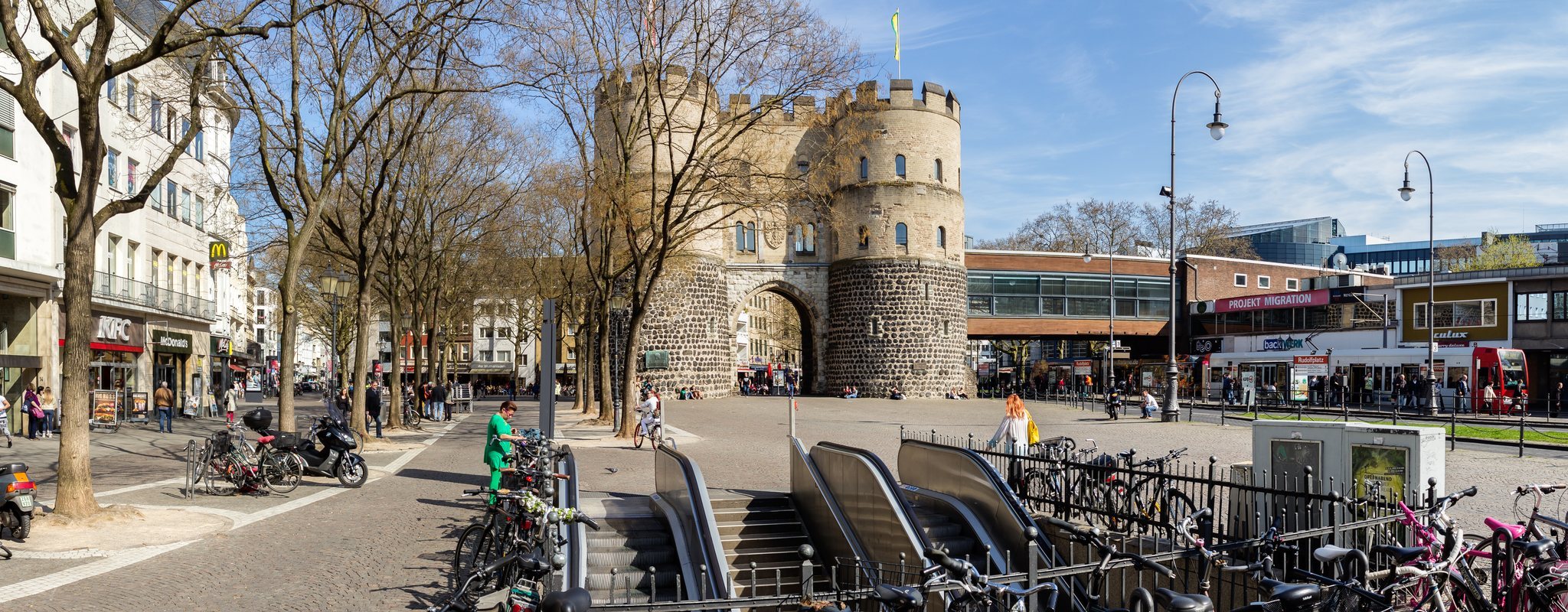
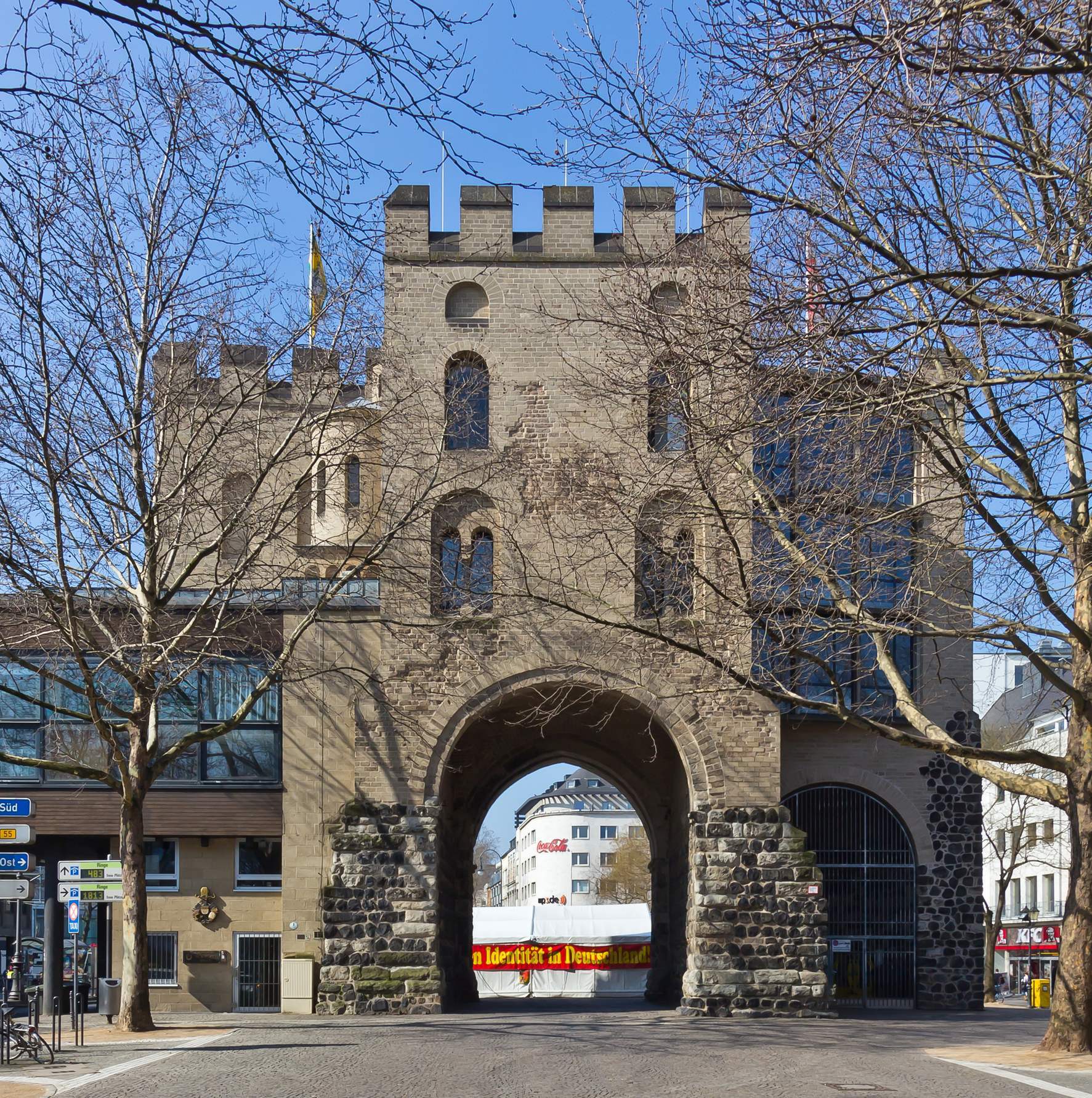
Hahnentorburg stands at present-day Rudolfplatz beside Hahnenstraße, in the southern part of Cologne’s old city. It is a double-towered medieval gate castle, meaning that the entrance is flanked by two towers so it could be defended from both sides. The structure formed the western passage through Cologne’s fortified city wall and was comparable in type to Eigelsteintorburg, which survives in the north of the former wall, and to the demolished Gereonstor.
The field-facing side carries an inscription reading “Erneuert 1888” beneath an eagle coat of arms. The left half-tower on this side was largely destroyed during the Second World War, and the restored gate preserves the results of the subsequent rebuilding. Together with Severinstorburg, Ulrepforte, Eigelsteintorburg, and Sachsenturm, Hahnentorburg remains among the best-preserved surviving evidence of Cologne’s extensively developed medieval fortifications.