Meir Necropolis: Rock-Cut Tombs of Ancient Cusae
Site at a Glance
- Popularity
- Medium
- Country
- Egypt
- Primary era
- Bronze Age
- Eras represented
- Bronze Age
- Civilizations
- Egyptian
- Site type
- Burial
- Remains
- Necropolis
On this page18 sections
History
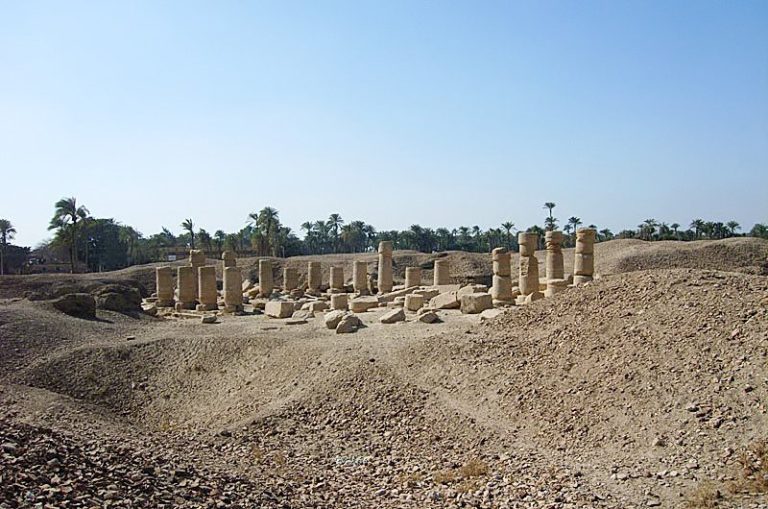
The Meir Necropolis is an ancient Egyptian burial ground in Egypt, on the west bank of the Nile about five kilometres southwest of the modern village of Meir. Used mainly from the Sixth through the Twelfth Dynasties, it served ancient Cusae, a center of Upper Egypt’s fourteenth nome, or administrative province. Local officials, their families, and attendants were buried here, and burials continued into the Greek and Roman periods.
Old Kingdom burials
The cemetery’s oldest identified tomb belongs to Ni-ankh-Pepi-Kem, also called Ni-ankh-Pepi the Black. His tomb dates to the reign of Pepi I, when he held senior offices including overseer of Upper Egypt, chancellor of the king of Lower Egypt, and overseer of prophets, a title for temple priests. His son Pepi-anch, whose tomb is A2, held the latter two offices and lived during the reign of Pepi II.
Pepyankh the Middle, also known as Heny the Middle, was buried in tomb D2 during Pepi II’s reign. He held titles including nomarch, or provincial governor, vizier, a senior state administrator, hereditary prince, and overseer of Upper Egypt. The hereditary-prince title marked elite status, not necessarily succession to the throne. Pepyankh was the son of Sebkhotpe, also called Hepi, and Pepkhernefert, also called Bebi. His wife was Hewetiaah, and they had six sons and three daughters.
Middle Kingdom officials and religious ties
Meir continued to receive burials during the Middle Kingdom. In group B, Senebi’s tomb dates to the reign of Amenemhat I. He was a nomarch, overseer of temple priests, and chancellor of the king of Lower Egypt. Another tomb owner, Ukh-hotep, held the offices of nomarch, chancellor, and overseer of Hathor’s priests during the reign of Senusret I. His son Senbi was a hereditary prince and overseer of priests; Senbi’s tomb dates across the reigns of Senusret I to Amenemhat II. A further tomb for a nomarch named Ukh-hotep, also an overseer of Hathor’s priests, dates to Amenemhat II.
Other tomb owners include Kha’kheperre-sonb, also known as Iy, a nomarch and overseer of priests during Senusret II. The date of a group C tomb belonging to an Ukh-hotep is uncertain, falling within either the reign of Senusret II or that of Senusret III. Group A also contains tombs from this period: A3 belonged to Ukh-hotep, a nomarch and overseer of sealers during Senusret I, while A4 belonged to Hepi-Kem, an overseer of Upper Egypt, chancellor, and overseer of priests under Merenre Nemtyemsaf II.
Cusae was a center of the cult of Hathor, a goddess associated with motherhood, music, and fertility. Titles held by priests buried at Meir link the cemetery’s officials and families to her worship. Other recorded owners include Pepi, a royal scribe and judge; Meni, an inspector of priests; Nenki and Pepy-anch, who were lectors, or priests who recited sacred texts in rituals; and Thetu, who held titles connected with the Thentet-cattle and the inspection of priests.
Later burials and archaeological work
Meir’s best-known cemetery use belongs to the Old and Middle Kingdoms. During the New Kingdom, burial grounds shifted to the Nile’s east bank, and tombs of that period have been suspected there. Coffins found at Meir show that burials nevertheless continued into the Greek and Roman periods.
During the nineteenth century, the necropolis was repeatedly plundered despite being guarded. Coffin wood was taken for farming tools and irrigation, and damaged or unwanted remains were burned. Around 1877, Muhammad Schehīn excavated for the Egyptian antiquities authority. Some coffins may have come from A4; better-preserved coffins were sent to Cairo, while others were burned. Émile Chassinat drew attention to the cemetery in 1890, but the tombs did not receive protection as a result. Georges Daressy led authorized excavations from 1892 to 1895, chiefly in group A. Work in group B in 1899 and 1900 included copying inscriptions by Chassinat, Daressy, and Jean Clédat. Alessandro Barsanti, Georges Legrain, Clédat, and Sha’ban also worked at Meir during this period.
In 1910, Sayd Bey Khashabeh received an excavation license for a broad area that included Meir. Ahmed Kamal directed work there through 1914, concentrating mainly on groups B, D, and E; many of the finds are now in the Metropolitan Museum of Art in New York. Aylward Manley Blackman examined decorated tombs across all five groups in campaigns from 1912 to 1914, in 1921, and in 1949 and 1950. He published the tombs in six volumes and established the group labels and numbering system still used to identify them. Howard Carter cleared tombs in group B in 1918, documenting work in eleven graves and publishing four. Sami Gabra excavated at Meir for the University of Alexandria in the 1940s. In 1989, Naguib Kanawati proposed a revised classification and chronology for senior priests buried at the site, seeking to clarify their dates and relationships.
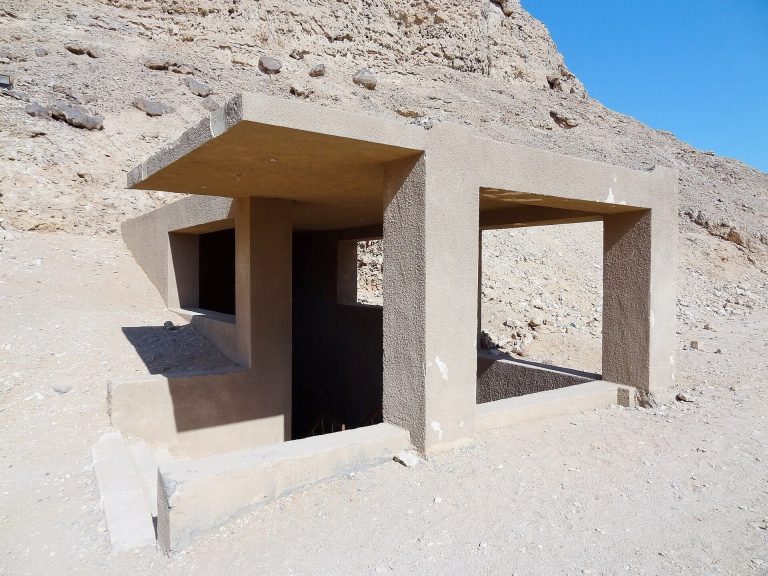
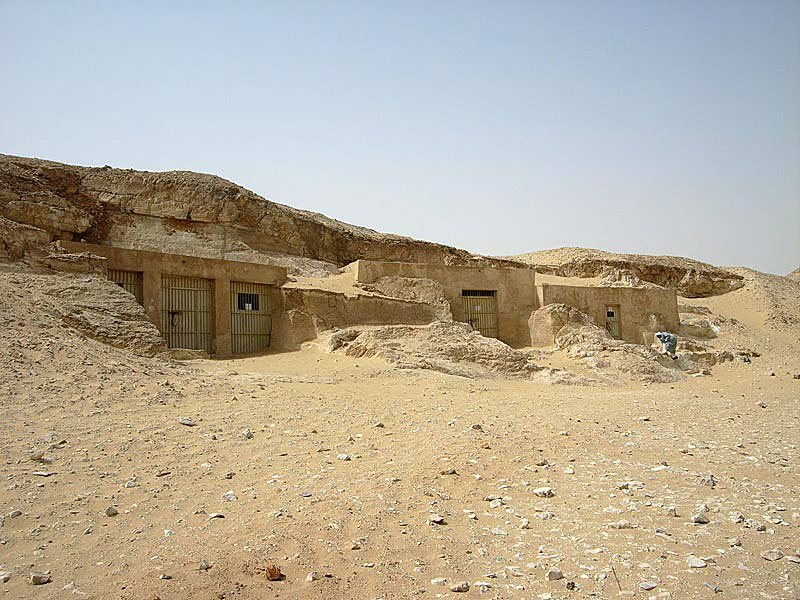
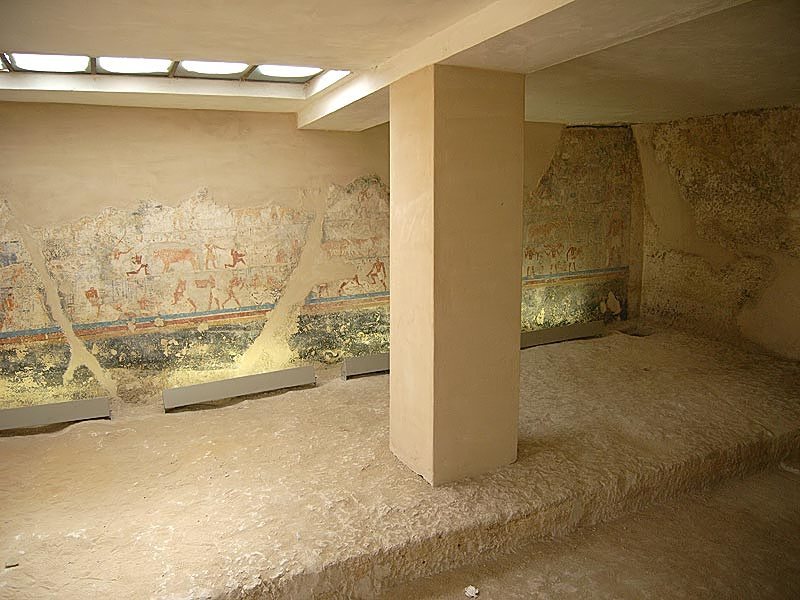
Egyptian authorities later roofed collapsed tombs, including some in group B, and installed electric lighting in A1 and A2. The cemetery has about 75 tombs with interior decoration, although the total number of tombs is uncertain.
Remains
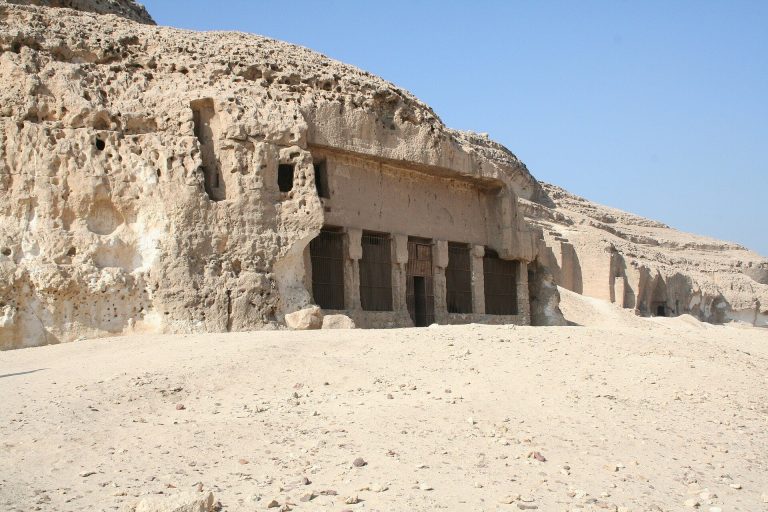
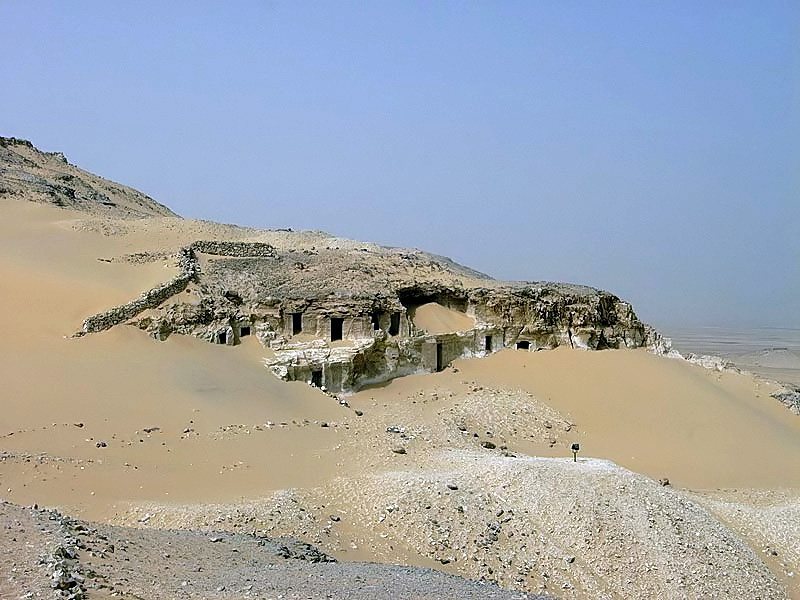
The rock-cut tombs occupy a hillside on the Nile’s west bank and extend roughly 1.5 kilometres from north to south. Five cemetery groups are arranged along this stretch. Group A contains tombs dating from the Sixth to Eleventh Dynasties, group B those of the Twelfth Dynasty, and group C those of the late Twelfth Dynasty. Groups D and E are mainly associated with the Sixth Dynasty. A separate cemetery for less prominent residents lies below the main tomb area, while attendants’ burial shafts are situated east of the elite tombs.
Carving and painted decoration
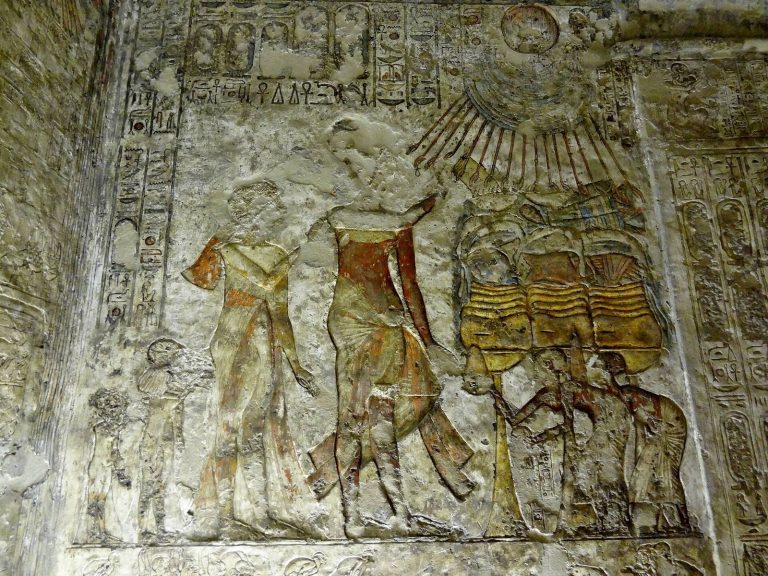
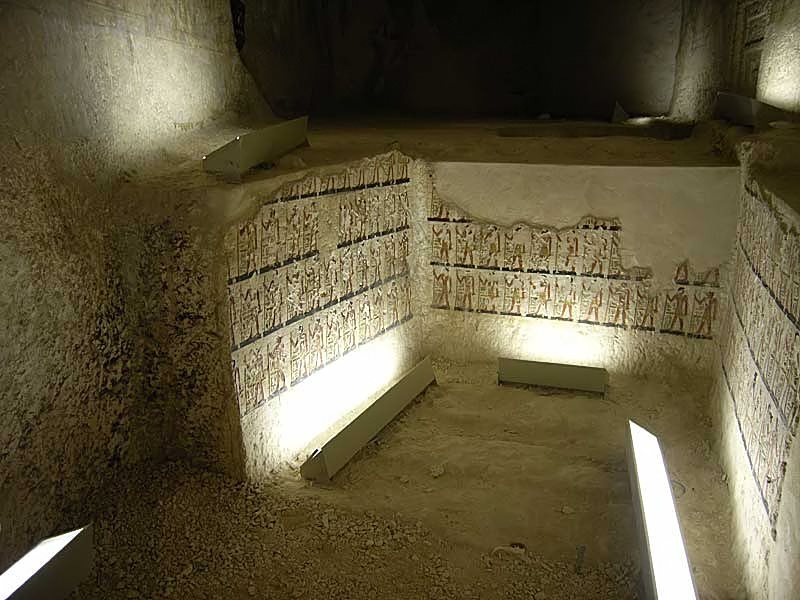
The tombs are cut into the hillside. Their scenes use very low relief, with figures standing only slightly proud of the stone. Carvers outlined figures in limestone and cut back the surrounding surface, which could itself be worked into the design. The scenes show daily work, festivals, sports, and occupations in detail, with figures painted in flat colors. The two central Sixth-Dynasty tombs in group A differ from the Twelfth-Dynasty examples: their figures are painted against blue backgrounds.
Group A tombs
A1, the tomb of Ni-ankh-Pepi-Kem
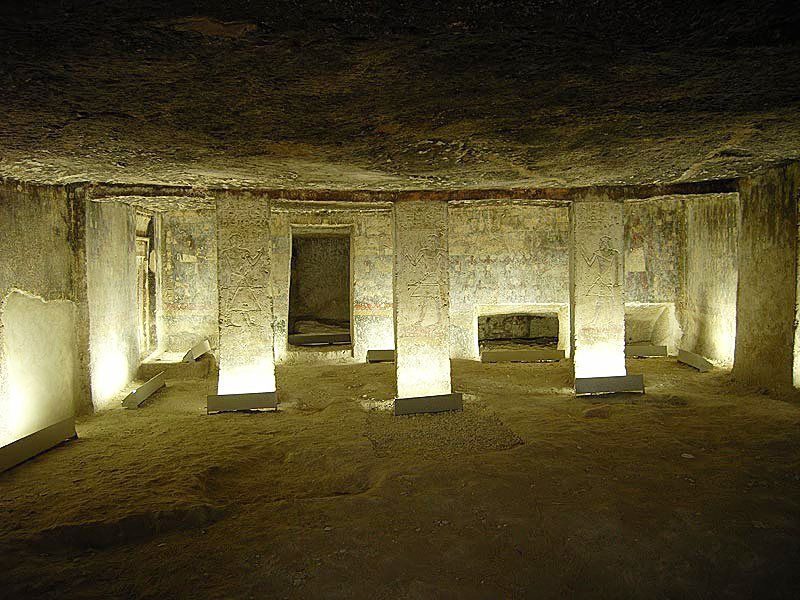
A1 has a decorated southern entrance that is partly covered by sand, and a passage connects it with A2. Its large vestibule has three pillars bearing images of the tomb owner. Stone stelae and offering tables stand along the west side. Scenes at the rear show the owner and offering bearers, fishing, and the capture of birds. Three inner chambers continue beyond the vestibule; the western chamber contains two unfinished niches for statues.
Two wooden statues of Ni-ankh-Pepi-Kem, servant figurines, and model boats were recovered from A1 in the late nineteenth century. The statues and figurines are held in the Egyptian Museum’s collection, as are the boats.
A2, the tomb of Pepi-anch
A2 contains eight rooms and has a southern entrance. Its first room shows the owner and his retinue, offering bearers, and craft and agricultural activities. An eastern chamber associated with a statue of the deceased has about 250 depictions of the owner and his titles across its lower part. Ink drawings above show a westward Nile crossing to a purification tent, as well as cattle, furniture, and food.
A large decorated hall lies west of the first room. Its walls depict boating, farming, fishing, bird-catching, and crafts, along with the owner hunting, receiving gifts, and riding in a sedan chair. Two rooms adjoin the north side of the hall, one containing a burial shaft; a passage on the west links the tomb with A1. A room at the hall’s northeast corner contains butchering scenes, an offering list, and images of the owner at a meal or receiving gifts.
Group B tombs
The group B tombs combine large halls, statue niches, and scenes of ritual and everyday activity. B1 and B2 both include an unusual image of slender Beja herders tending well-fed cattle. The interpretation is disputed; one reading takes the scene as an expression of the tomb owner’s care for Bedouins.
B1, the tomb of Senebi
B1 consists of a large hall with a statue niche at the rear. Two pillars were added during reconstruction. The southern entrance wall shows a desert hunt, while the south wall depicts the owner before herders, butchers, offering bearers, and priests. The same wall includes fighting bulls, men vaulting over bulls, and a calving cow. On the north wall, dancers and musicians appear alongside offering bearers, wrestlers, marsh fishing, bird presentation, and agricultural work. Craft scenes survive on the north entrance wall.
B2, the tomb of Ukh-hotep
B2 has a large hall supported by two pillars, with a statue niche at the rear. Two men with donkeys appear on the southern entrance wall. The south wall shows the owner hunting in the desert, alongside offering lists, bearers, and herders. Near the rear, the owner and his wife appear in festival, bull-fighting, and gift-bearing scenes, while the niche shows them with offering bearers.
The north wall depicts the couple with attendants, herders, and musicians, as well as papyrus harvesting, bird-catching, and boat-building. The north entrance wall shows the owner and his wife before attendants.
B3, the tomb of Senbi
B3 has a large forehall with four pillars leading to a chamber for the sarcophagus, or stone coffin. A stone stela on the south wall commemorates Senbi’s sister Mersi. At the rear, an inscribed doorway leads to the next hall.
B4, the tomb of Ukh-hotep
B4 is a large hall without pillars. Two projecting walls frame the rear statue niche as a shrine, and another hall lies at the northwest. The south entrance wall retains craft scenes. On the south wall, the owner and family fish and catch birds, while other figures use a dragnet. A list of 59 nomarchs appears on the rear south wall, probably as imagined ancestors of the owner.
The shrine contains butchering and offering scenes. In the niche, inscriptions accompany a painted false door, a representation of a doorway through which the deceased was believed to communicate symbolically with the living. On the north wall, the owner appears before musicians and scenes of tending, bringing, and counting livestock. Part of a hunting scene survives on the north entrance wall. The rear hall shows the owner and his wife with priests, offering bearers, butchers, cooks, and people carrying food trays; a false-door stela stands at the rear.
Group C and D2
Group C tombs
A wooden statue recovered from a group C tomb depicts Ukh-hotep with his two wives. It is now in the Museum of Fine Arts, Boston.
D2, the tomb of Pepyankh the Middle
Room C in D2 contains painted reliefs against a dark slate-gray to indigo background. The carving is comparatively rough. Workmen excavating for Ahmed Bey Kamal found the tomb undisturbed in March 1913, and it was described at the time as the largest tomb discovered in the cemetery.
Other excavated objects
Finds from excavations at Meir also include coffins, small statues, stelae, offering tables, a wooden palette bearing the name of the pharaoh Merikare, and another model boat. The precise tombs in which these objects were found are not established.