Attinghausen Castle: Medieval Fortress in Switzerland
Site at a Glance
- Popularity
- Medium
- Country
- Switzerland
- Primary era
- Medieval
- Eras represented
- Medieval
- Civilizations
- Holy Roman Empire
- Site type
- Military
- Remains
- Castle
On this page9 sections
History
Attinghausen Castle is a medieval fortress in the village of Attinghausen, Switzerland. Its first fortification was established before 1100, probably by knights serving the Counts of Zähringen, a medieval noble dynasty with lands in southwestern German-speaking Europe and parts of present-day Switzerland.
The early fortress and the von Schweinsbergs
By the 13th century, the original owners had been replaced by the von Schweinsberg family, perhaps after Ulrich von Schweinsberg married a daughter of the earlier family. The von Schweinsbergs sometimes used the name von Attinghausen. A branch of the family settled in Uri by the middle of the century and built Schweinsberg Castle a short distance north of Attinghausen. Around 1300, the family divided into a Uri branch led by Werner II and a Bernese Oberland branch led by Diethelm I.
The lords of Uri and regional alliances
By 1294, Werner II had become Landammann, Uri’s chief magistrate, probably succeeding Arnold von Silenen. The office then probably passed to Werner’s son Johann, and the family held it until 1358 or 1359. King Adolf of Nassau granted privileges in 1297, followed by Louis IV of Bavaria in 1316. These grants, together with Uri’s victory at Morgarten in 1315, were associated with efforts to secure the canton’s territory. Werner’s personal role in that battle is unknown.
Johann led Uri’s army at the Battle of Laupen in 1339, a major regional conflict. On 1 May 1351, he and Zurich’s Rudolf Brun signed an alliance that brought Zurich into the early Swiss Confederacy, a loose alliance of Swiss communities and cantons that preceded the modern state. In 1353, Johann received a fief, land or rights granted in return for service, which included the emperor’s customs post at Rudenz Castle in Flüelen, where tolls were collected on the emperor’s behalf. Emperor Louis also appointed him Rector of Valais, an official charged with administering a territory.
Destruction and abandonment
Johann died in 1358. A tradition connected his death with an uprising that destroyed the castle, though he may instead have died from disease or while campaigning with his army. His son Jacob was with the pope at Avignon and either did not return to Uri or died on the journey. In 1359, Jacob’s cousins Werner and Johann von Simpeln probably took control of the Attinghausen lands and castle. They died soon afterward, perhaps from disease or in the fire that destroyed the castle in 1360.
The Lords of Rudenz inherited the lands but could not afford to rebuild the castle. They settled at Rudenz Castle in Flüelen, and Attinghausen Castle was abandoned. The ruins were first excavated in 1894 and sold two years later to Uri’s historical association, now the Historical Society of Uri. An archaeological investigation followed in 1979. Safety concerns in 2007 prompted further investigation, recording, and repairs supported by donations. The castle is listed as a Swiss heritage site of national significance.
Remains
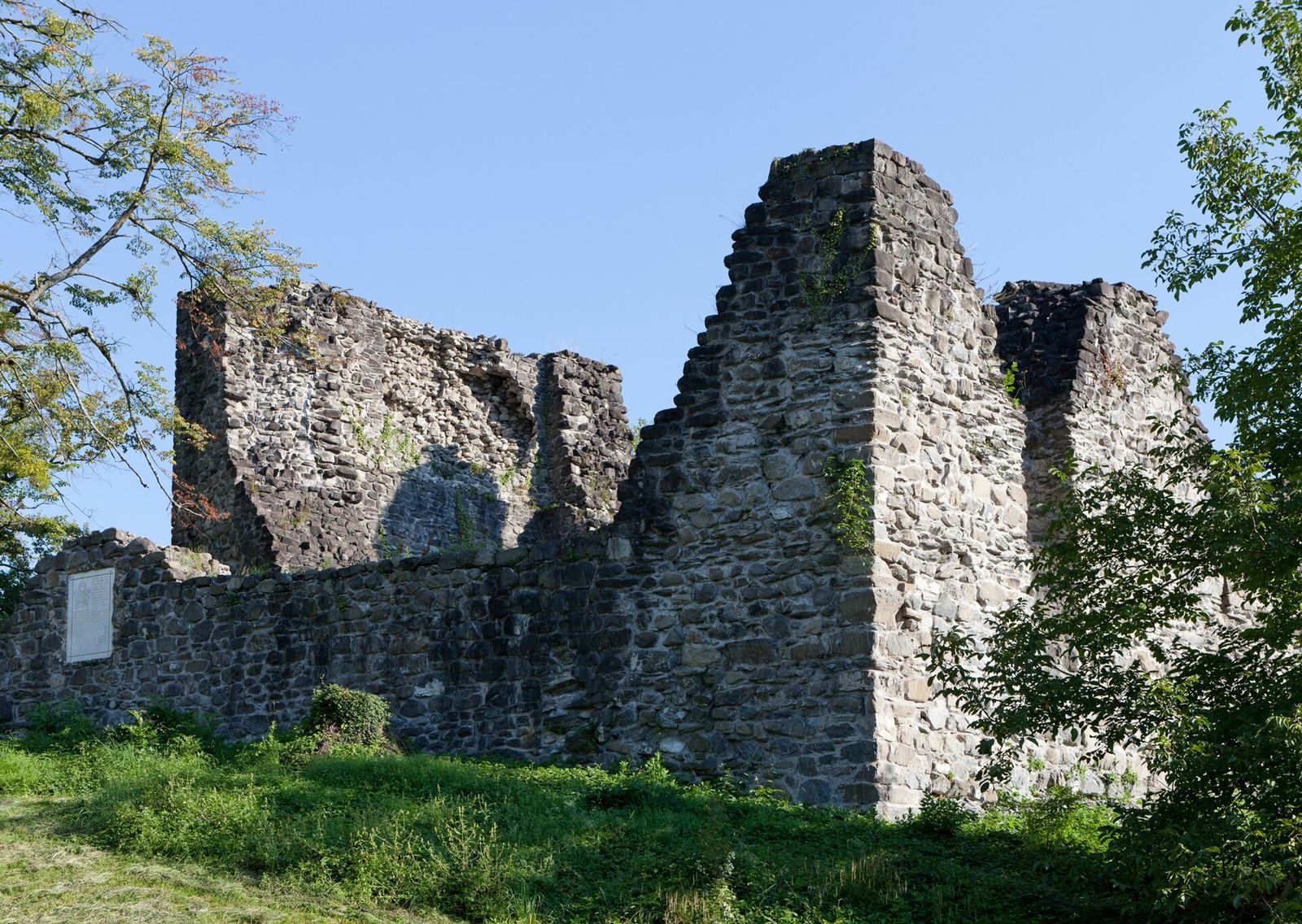
The ruins occupy a hill in the middle of Attinghausen village. The castle’s form developed from a probable hilltop motte-and-bailey, a raised mound with an enclosed courtyard, into a complex of defensive walls, a tower, and residential buildings.
Fortifications and buildings
Tower and ring wall
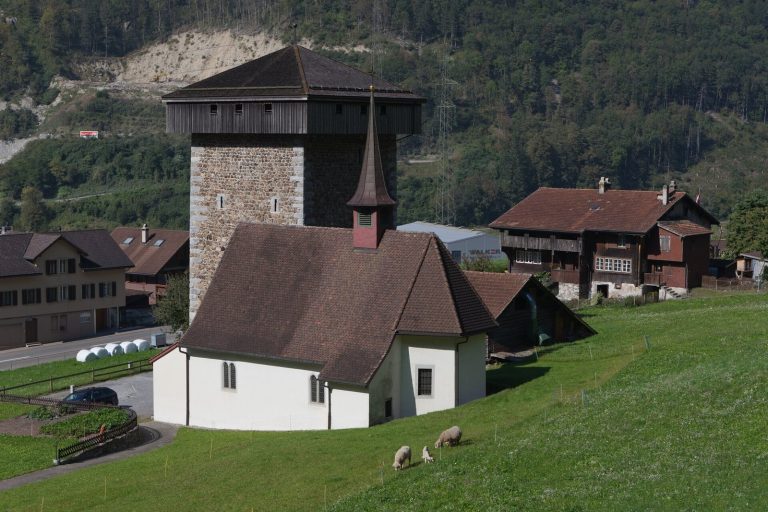
The later defences included a square tower measuring 11 by 11 metres and a ring wall, a defensive wall enclosing the castle area. A wooden staircase led to the tower’s main entrance at its second or third level. The gatehouse stood on the western side of the ring wall.
Residential building
A massive wooden building stood along the southern side of the ring wall. Around 1300, it was replaced by a large stone residence. Its ground floor may have been used for stables and agricultural storage, with living quarters above.
Archaeological finds
The 1979 investigation recovered numerous objects associated with the castle’s residents. The site survives as ruins.