Marsala Cathedral: Norman Mother Church in Sicily


Site at a Glance
- Rating
- 4.5
- Popularity
- Low
- Country
- Italy
- Primary era
- Medieval
- External website
- Open
- Eras represented
- Medieval, Early Modern, Modern
- Civilizations
- Crown of Aragon, Kingdom of Sicily, Norman, Spanish
- Site type
- Religious
- Remains
- Cathedral
On this page26 sections
History
Marsala Cathedral, also called the Mother Church of Saint Thomas of Canterbury, is a Norman-period cathedral in Marsala, Italy, begun around 1176 and later enlarged and remodelled in Renaissance and Baroque forms. It is the largest church in the city and serves as the parish church of Saint Thomas of Canterbury, the seat of the archpriest, and the centre of the local foranial vicariate, a church subdivision grouping parishes under delegated pastoral oversight.
From Lilybaeum to the Norman cathedral
The site has an early Christian history reaching back to the first half of the 2nd century, when a cathedral basilica and the Diocese of Lilybaeum were established. Lilybaeum was the ancient city corresponding to modern Marsala. The diocese continued until it was suppressed during the Arab period in the 9th century. Arab raids left the early basilica in poor condition, and archaeological discoveries indicate that the later Norman church occupied the same general location.
The diocese was not restored when Norman rule re-established dioceses in Sicily during the 11th century. Al-Idrisi, a 12th-century geographer at the court of Roger II of Sicily, described Mazara as having commercially eclipsed Marsala by the Norman conquest. This change was connected with the decision to retain Mazara as the diocesan seat. Since 1966, the ancient name has survived through the titular Diocese of Lilybaeum, a title preserving a former diocese without making it the ordinary residence of a bishop.
Tradition places the beginning of the Norman cathedral around 1176, during the tenure of Tutino of Marsala as governor of the Diocese of Val di Mazara. After Marsala lost its episcopal status to Mazara, Tutino raised the local church to the rank of archpriest church. The building was consecrated between the canonization of Thomas Becket in 1173 and the end of the reign of William II of Sicily and Joan of England in 1189. Becket, also known as Thomas of Canterbury, was the English archbishop murdered in Canterbury Cathedral in 1170. His canonization in 1173 helped spread his cult rapidly through Europe. William II was a Norman ruler of Sicily, while Joan was the daughter of Henry II of England, whose conflict with Becket formed part of the saint’s historical setting.
Renaissance expansion and artistic change
During the reign of Alfonso V of Aragon, Renaissance artistic influences reached Marsala through Tuscan-Carraran and Lombard-Ticinian traditions, as well as through northern marble workers active in Palermo. Despite difficult economic conditions, the Norman cathedral was enlarged three times between 1497 and 1590.
The first enlargement, in 1497, added a large chapel and two side chapels. One of these was dedicated to the Most Holy Sacrament and placed under the patronage of the Ministrali, a lay confraternity representing blacksmiths, tailors, shoemakers, and carpenters. Donations by Giulio Alazaro, Pietro di Anello, Antonio La Liotta, and artisan confraternities brought works by the Gagini, Berrettaro, Mancino, and Di Battista families and workshops into the church.
The Most Holy Sacrament Chapel was remodelled again in works recorded for 1590. Four figures were removed from the lower part of its altar structure and later installed on the side walls among stucco decoration. A silver frontal was added, and Orazio Ferrero of Giuliana is associated with the dismantling, reassembly, and stucco work. He also added a figure of God the Father to the vault. In the first half of the 18th century, Giovanni Biagio Amico carried out work on the church roofs.
Collapse, rebuilding, and continuing religious use
The cathedral dome collapsed in 1893, leading to the closure of the church for safety reasons. The building reopened in 1903 beneath a temporary covering. A permanent dome was constructed in 1950 and restored in 2016. Its present fabric therefore brings together an early Christian location, a Norman foundation, Renaissance sculpture and chapels, Baroque decoration, later repairs, and continuing Catholic use.
Remains
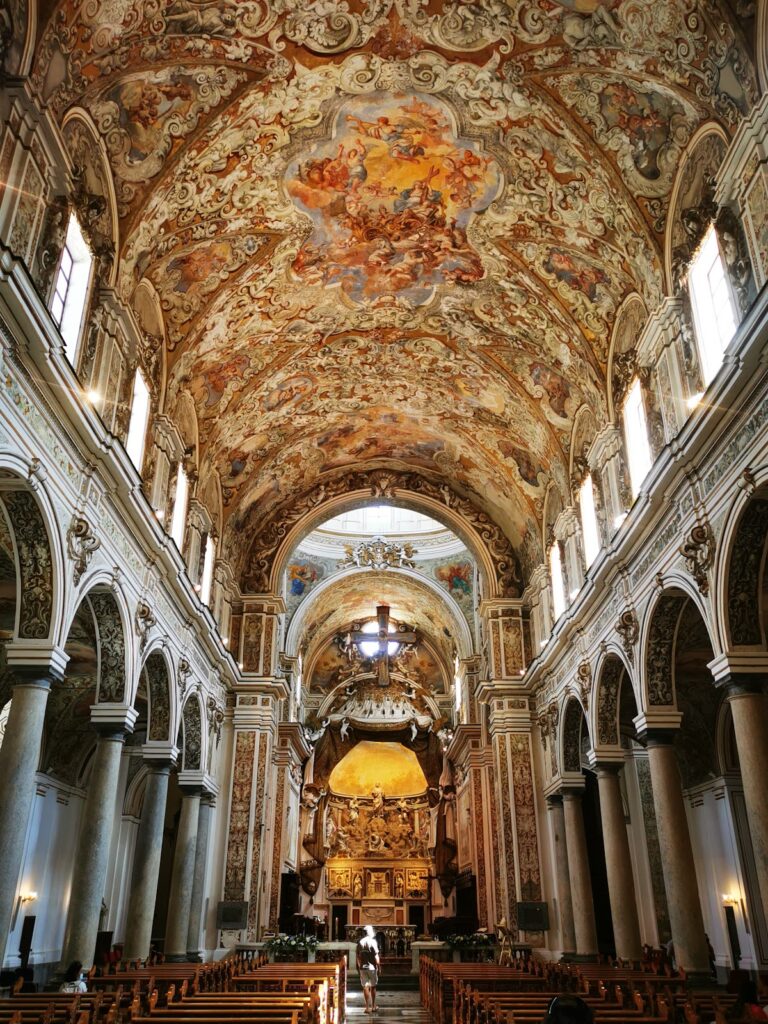
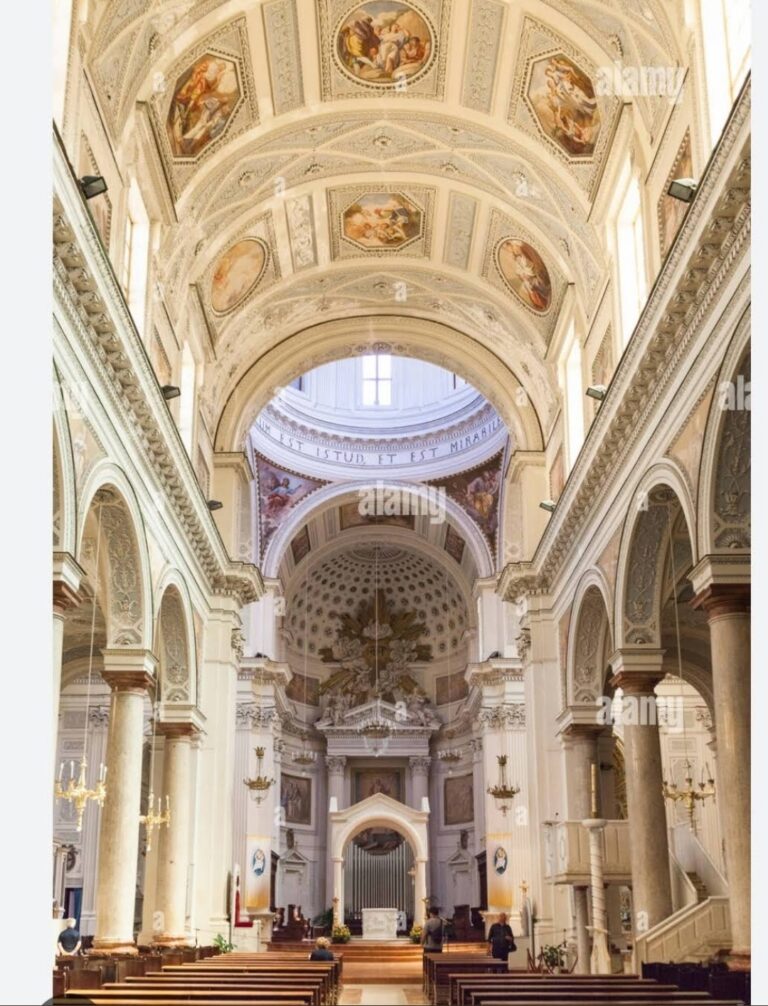
Marsala Cathedral faces Piazza della Repubblica and the adjoining Via Giuseppe Garibaldi. Its basilica plan is organized around a central nave with lower side aisles, transepts, and an apse, the rounded termination of the sanctuary. The lower part of the facade is Baroque, while the upper order and bell tower, completed about a century after the lower construction, belong to the restrained later Baroque style known as Barocchetto. The interior remains principally Norman in character, especially around the high altar, although several chapels received Baroque furnishings and paintings.
Earlier layout and right nave
The former Norman church was oriented differently from the present building. Its principal facade stood on what is now Piazza Maggio, at the position of the present side entrance. The building extended approximately 25 metres at right angles to the current church and occupied more than half of present-day Via Garibaldi. It probably had a basilica plan with apses, side chapels, a colonnaded portico, and a bell tower.
The right nave is divided into seven bays, each containing a chapel or entrance feature.
Baptistery Chapel
The first bay contains the Baptistery Chapel. Its 17th-century marble baptismal font stands beneath a 19th-century octagonal wooden canopy. An 18th-century canvas of the Baptism of Jesus, formerly associated with the chapel, is now in the sacristy.
Chapel of Saint Christopher
The second bay is the Chapel of Saint Christopher, formerly patronized by the massari, including laborers, agricultural workers, and people responsible for cleaning the church. Its altar contains an image of the Assumption of the Virgin with six cherubs, derived from a dismantled sculpted altarpiece by Antonino Gagini. Reliefs of the Presentation in the Temple and the Death of the Virgin also belonged to that work, with the latter attributed stylistically to Antonello Gagini. An 18th-century canvas of Saint Christopher is flanked by scenes of the Liberation of Saint Peter from Prison and the Beheading of Saint Paul. A tombstone for Barbara Grifeo, who died in 1552, is set into the right wall after being transferred from the Grifeo tomb in the Carmine church.
Chapel of Saint Rosalia
The third bay contains the Chapel of Saint Rosalia. Its altar painting, dated 1656, shows the saint writing under an angel’s dictation in a classical-Baroque composition. The chapel also contains the Madonna della Grotta, a 1490 statue by Gabriele di Battista and Giacomo Di Benedetto transferred from Santa Maria della Grotta. Two Gagini-school sarcophagi came from the Carmine church: that of Bernardo Requesens, who died in 1539, and that of Antonio Grignano, who died in 1475 and whose monument was made by Domenico Gagini.
Milazzo-Maggio entrance
The fourth bay contains the Milazzo-Maggio side entrance. Beside it is the sarcophagus of Ludovico Petrulla, a Carmelite philosopher and theologian from Marsala who died in 1504. The monument is bounded by an Annunciation and an Agnus Dei, or Lamb of God, attributed to Andrea Mancino’s workshop. The bay also contains the sarcophagus of Filippo Maria, procurator general of the Carmelite Order, who died in 1612, and a 1543 holy-water stoup, a basin for holding holy water, attributed to Giacomo Gagini. Both sarcophagi came from the Carmine church.
Chapel of Saint Matthias
The fifth bay is the Chapel of Saint Matthias. Its altar painting shows Saint Matthias evangelizing between scenes of the Massacre of the Innocents and the Deposition. These works came from Sant’Antonio Abate and were painted by the Trapani artist Domenico La Bruna. The chapel belonged to the patronage of the Lazzara family, which commissioned Antonino Gagini’s Madonna dell’Itria of 1564 and the 1566 sarcophagus of Giulio Lazaro, or Lazzara, Captain of Justice, and his wife Brigida Sanclemente. An 18th-century Sicilian polychrome-marble frontal carries the monogram I.H.S. between the arms of Francesco Maria Graffeo, bishop of Mazara.
Chapel of the Holy Family
The sixth bay contains the Chapel of the Holy Family. Its altar painting of the Holy Family is set within a painted-glass and wooden structure in Baroque style.
Chapel of the Crucifix
The seventh bay is the Chapel of the Crucifix. Its 18th-century Baroque altarpiece is faced with Sicilian polychrome marble. The chapel contains a 15th-century wooden Crucifix attributed to De Crescenzo and an 18th-century statue of the Addolorata, made of wood and canvas. From 1686, the chapel was patronized by a confraternity of agricultural workers.
Left nave chapels
The left nave also contains seven bays, with chapels and devotional monuments associated with local trades, confraternities, and religious communities.
Chapel of Saint John Nepomucene
The first bay is the Chapel of Saint John Nepomucene. It contains a painting of the saint in apotheosis, two frescoes concerning Confession, and an 18th-century wooden statue of Saint Eligius. Blacksmiths and farriers held its patronage.
Chapel of Saints Simon and Jude
The second bay is the Chapel of Saints Simon and Jude, patronized by coopers. It contains a late Gothic-style painting associated with the 1593 wooden Madonna of Portosalvo, protector of sailors, together with paintings of Saints Simon and Jude and a statue of the Archangel Michael. Two votive frescoes show the Virgin saving a ship in danger and the port of Marsala. The port view is placed above the sarcophagus of Giulia Ventimiglia, transferred from the church of Madonna della Cava.
Chapel of the Four Crowned Saints
The third bay contains the Chapel of the Four Crowned Saints, patron saints of masons and stonecutters. Its principal canvas depicts Severus, Severinus, Carpophorus, and Victorinus, who were martyred in Rome under Diocletian around AD 300. The chapel also contains a small painting of the Souls in Purgatory and the Virgin between two female saints, with wooden statues of the Ecce Homo and Saint Joseph in side niches. Wall-building craftsmen held its patronage from 1699.
Via Garibaldi entrance
The fourth bay contains the Via Garibaldi side entrance and a white Carrara-marble holy-water stoup dated 1474 and attributed to Domenico Gagini.
Chapel of the Fishermen
The fifth bay is the Chapel of the Fishermen, also called the Chapel of Pascasino. A mutilated plaster statue of the Madonna della Provvidenza, or Madonna of Good Counsel, formerly stood on the altar, and a canvas preserves its memory. In the 20th century the chapel was dedicated to Pascasino, bishop of Lilybaeum. Its marble-and-glass altar bears a 1979 fresco by Carlo Montarsolo depicting Pascasino. A wooden statue of Saint Blaise occupies a wall shrine on the left. The Fishermen’s Confraternity holds the chapel’s patronage.
Chapel of Our Lady of the Rosary
The sixth bay is the Chapel of Our Lady of the Rosary, formerly the Chapel of Pentecost. It contains a wooden group of the Madonna of the Rosary with Saint Dominic and Saint Catherine of Siena, transferred from San Domenico, and a 17th-century canvas of Pentecost reflecting the earlier dedication. The painted-glass and wooden altar was made by local craftsmen in the 19th century. Two panels depict Saints Pascasino and Gregory, bishops of Lilybaeum, while two marble angels made by Galleni of Viareggio in 1934 came from the high altar.
Chapel of the Holy Trinity
The seventh bay contains the Chapel of the Holy Trinity. Its 18th-century painting shows kneeling Carmelite saints before the Trinity and is accompanied by paintings of four Carmelites and the Virgin with Carmelite saints. Michele Giacalone and his pupils made the marble altar in 1959. Luigi Santifaller of Ortisei produced the statue of Our Lady of Mount Carmel in 1960.
Transepts and Renaissance sculpture
The transepts contain some of the cathedral’s most important Renaissance chapels and monuments. A transept is the crosswise part of a church that intersects the nave.
Chapel of Our Lady of Succour
The right transept contains the Chapel of Our Lady of Succour, also called the Liotta Chapel. Its altar holds a marble statue of the Madonna del Soccorso, or Madonna della Mazza, by Giuliano Mancino. Mancino and Bartolomeo Berrettaro created the original noble chapel between approximately 1490 and 1512. Its marble furnishings included the tomb of Antonio La Liotta, who died in 1512, showing the reclining deceased, a dog, and the Virtues of Faith, Justice, Temperance, Prudence, Fortitude, and Piety. Two further burials were also included. The chapel commemorates Girolamo La Liotta, who died in 1599, and a female relative who died in 1600. Paintings show Saint Anthony Abbot and Pascasino before the Trinity and Saint Anthony Abbot with the Christ Child.
Chapel of the Purification
The other chapel in the right transept contains Antonello Riccio’s 1593 canvas of the Purification of Mary in the Temple. The donor, Antonio Lombardo, archbishop of Messina and a citizen of Marsala, appears in prayer. The composition was inspired by a work by Girolamo Alibrandi. A 1490 statue of the Virgin and Child, also known as the Madonna del Popolo and made by Domenico Gagini, came from the Carmine church. To the right stands Lombardo’s sarcophagus, made in a Michelangelo-style form and dated to his death in 1595.
Chapel of the Most Holy Sacrament
The chapel in the left transept was built under the patronage of carpenters, tailors, blacksmiths, and shoemakers and is decorated with figures of their patron saints. Its first phase, from 1518 to 1530, produced a marble sacramental repository, an architectural structure for reserving the consecrated Eucharist. Bartolomeo Berrettaro commissioned the work with Giuliano Mancino. After their partnership ended, Berrettaro’s brothers continued it. Following Bartolomeo’s death in 1524, Antonino Berrettaro completed and delivered the repository.
The design included a relief of the Chalice and Host, representations of the Annunciation and the Crucifixion of Jesus, and God the Father above. A second phase, from 1530 to 1532, followed Antonino Berrettaro’s death. Antonello Gagini and his son Giandomenico completed the earlier work and made an altar with an arch. Its surrounding decoration includes twelve Passion panels, among them the Last Supper, the Garden of Gethsemane, the Kiss of Judas, and the Flagellation. Other elements include medallions of Daniel and Jeremiah, Christ and the twelve Apostles in the predella, and figures of the Four Evangelists, Saint Joseph, Saints Crispin and Crispinian, Saint John the Baptist, the Archangel Michael, Saint Eligius, Saint Olivia, seraphim, and angels.
The chapel’s mixed Sicilian-marble altar includes a silver frontal and a tabernacle, the enclosed container for the consecrated Eucharist, made by Sicilian silversmiths. The left transept also contains a statue of the Sacred Heart, a Baroque-style canvas of Saints Peter and Paul, and the burial of Isidoro Spanò, bishop of Nemesi.
Apse and high altar
The apse contains the presbytery, the area around the high altar reserved for the clergy, and the high altar itself. Against the piers stand a 1554 marble statue of Saint Vincent Ferrer by Giacomo Gagini and a 1516 marble statue of Saint Thomas the Apostle by Antonello Gagini. Pietro di Anello commissioned the latter, which includes reliefs of the donors and the family arms. The statue of Saint Vincent Ferrer had previously stood in San Domenico and then in Madonna della Cava, where it was defaced during the bombing of 11 May 1943.
Leonardo Milazzo’s 1656 canvas of the Martyrdom of Saint Thomas of Canterbury hangs in the apse. The area also contains a monumental organ built in 1915 by Michele Polizzi of Modica, a marble altar made in 1929 by the Marsala craftsman Michele Giacalone, and a liturgical altar created in 1981. The monumental inlaid wooden choir dates from the 19th century and has eight stalls on each side. An 18th-century Crucifix from Santo Stefano and two large 18th-century wooden candlesticks are also placed at the altar.
Nearby sites