Mars Gate Reims: Roman Monumental Arch and Northern City Entrance


Site at a Glance
- Rating
- 4.4
- Popularity
- Medium
- Country
- France
- Primary era
- Classical
- External website
- Open
- Eras represented
- Classical, Medieval
- Civilizations
- Roman
- Site type
- Military
- Remains
- Gate
On this page11 sections
History
Mars Gate is a Roman monumental arch in Reims, France, built by the Romans during the first quarter of the 3rd century AD. It stood in Durocortorum, the Roman and Gallo-Roman city that became the capital of the Remi, the local Gallic people incorporated into the Roman world. The arch was originally erected to express the grandeur of the city and later became its northern entrance.
The monumental entrances of Durocortorum
Mars Gate was one of four monumental arches placed at the cardinal entrances of Durocortorum. The other three were the eastern Ceres, or Trier, Gate, the southern Bazée Gate, and the western Venus, or Soissons, Gate. Mars Gate is the only one of the four that survives.
The name Mars Gate comes from a nearby temple dedicated to Mars, the Roman god associated with war and military power. Although the monument is sometimes called a triumphal arch, it is more accurately described as a monumental arch. Roman triumphs were ceremonies reserved for Rome itself.
A local tradition says that Reims was founded by Remus or his companions after they fled Rome. Another interpretation holds that the inhabitants raised the arch to thank Emperor Augustus after Roman roads were routed through the city. This connection with Augustus remains an interpretation rather than an established fact.
Incorporation into the city defenses
During the 4th century, the city was reorganized as a fortified settlement. The existing four arches were incorporated into the Late Roman defensive circuit, a period when cities across the later Roman Empire commonly strengthened or rearranged their defenses. The northern arch thereby became Mars Gate and served as an access point through the walls.
Around 1228, the arch became part of the Archbishops’ Castle and was incorporated into the episcopal fortifications. In the 14th century, the ramparts were reconstructed. The arcades of the ancient arch were blocked, while a new Mars Gate with a drawbridge was built about 100 metres farther east. That replacement disappeared when the city’s ramparts were dismantled in the mid-19th century.
Rediscovery and conservation
Henry IV, king of France, ordered the destruction of the Archbishops’ Castle in 1595. Mars Gate remained partly hidden within the walls, although the blocked openings could still be distinguished. It was rediscovered during the 17th century, when parts of the surrounding structure were cleared. Its decorative details were recorded at that time, but much of the carving later deteriorated.
Buildings around the arch were demolished during the 1810s. The monument was fully exposed during the dismantling of the ramparts between 1844 and 1854. It had been designated a French historic monument in 1840, and its survival was especially threatened by the removal of the fortifications. Prosper Mérimée, a French writer and heritage official, helped mobilize public support and funds for its protection.
In 1854, the architect Narcisse Brunette reconstructed the western pilaster on the side facing the promenade. Earlier repairs and consolidations carried out during the 19th and 20th centuries were later judged inadequate. Major restoration based on scientific study took place under the Historic Monuments authorities in 1983 and 1984.
A further campaign began in 2015. It replaced the unsuitable 19th-century concrete roof covering with lead and added rainwater drainage. The architrave, a horizontal architectural band above the columns, was also reinstated to continue the fragment reconstructed in the 19th century. A second phase, concentrating on the facings and decoration, began in January 2023.
Urban works connected with the Reims tramway in 2011 helped create a more open pedestrian setting around the gate. They also exposed the wheel ruts beneath the central passage and the aqueduct that ran alongside the monument. Renovation of the Hautes-Promenades between 2018 and 2020 created a broad space in front of the arch. During the First World War, a nearby tree and plaque commemorated soldiers who had served in the East and Alexander of Serbia, the Serbian king.
Remains
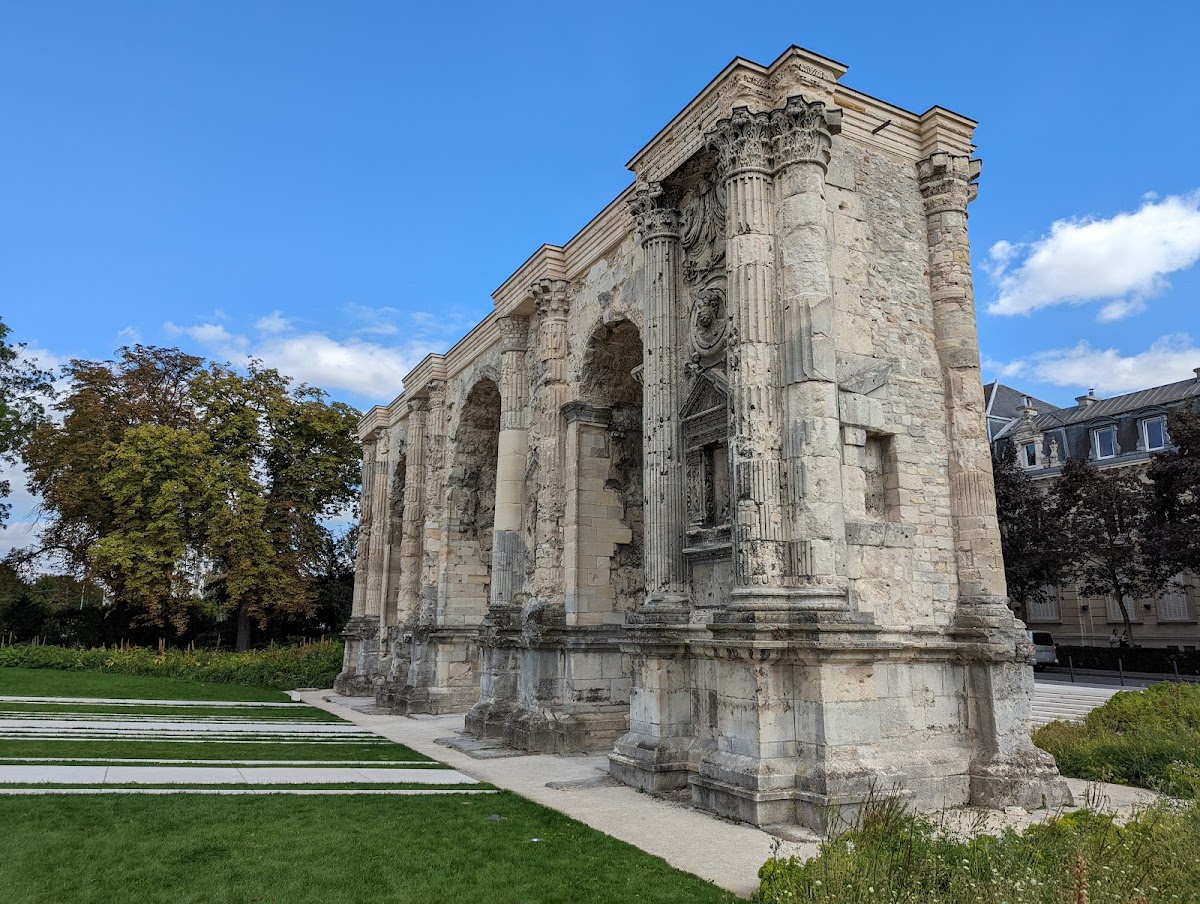
Mars Gate is a long, thick Roman arch with three semicircular passages, carved façades, and decorated vaults. It measures approximately 32 metres in length, 13 metres in height, and 6.4 metres in thickness. Its original summit probably carried an entablature, a horizontal upper structure above the columns, which has disappeared. The present height therefore does not represent the monument’s original total height.
Passages and architectural framework
Three arched openings
The central opening is broad enough for wheeled traffic, and its floor preserves wheel ruts made by vehicles passing through the northern entrance of Durocortorum. The two side openings are smaller and served pedestrians. Roads leaving the city from this entrance led toward Soissons, Bavay, Laon, and Boulogne. The aqueduct that ran beside the gate was exposed during modern urban works, together with the ruts beneath the central passage.
Columns and sculpted façades
Eight columns stand on the piers along the façades, with two additional columns on each side. Their Corinthian capitals, column tops decorated with elaborate foliage and acanthus leaves, support the architectural arrangement of the monument. The solid sections between the columns contain niches topped by triangular pediments. Above them are medallions with heads carved in high relief.
Most of this decoration is now severely degraded. The western section reconstructed in 1854 retains its decorative treatment more clearly. Sacrificial scenes appear above the archivolts, the carved bands that follow the curves of the arches. Carved decoration also covers the exterior and the ceilings of all three passageways.
Mythological and agricultural imagery
Scenes beneath the arches
The underside, or intrados, of the vaults contains a rare image of a Gallic harvesting machine within a calendar of agricultural activities. Other medallions show ploughmen, grape harvesters, reapers, and a miller. Together, these scenes portray rural work and production involving cereals, vines, and livestock.
The calendar includes activities associated with June through December. Its scenes show animal breeding, haymaking, the gathering of apples and other fruit, ploughing, mounted deer hunting, grape pressing, pig slaughter, and the distribution of provisions. Another image presents a man with four sons, representing the year and the four seasons.
Mythological medallions
Beneath the western arch, a square medallion depicts the Roman she-wolf nursing Romulus and Remus, the legendary founders of Rome. The shepherd Faustulus and Acca Larentia watch the scene. Beneath the eastern arch, a badly damaged image shows Leda and Zeus in the form of a swan. In Roman mythology, Zeus was identified with Jupiter.