Marienkirche: A Romanesque and Gothic Parish Church in Hürup, Germany


Site at a Glance
- Rating
- 4.2
- Popularity
- Very Low
- Country
- Germany
- Primary era
- Medieval
- External website
- Open
- Eras represented
- Medieval, Early Modern, Modern
- Civilizations
- Danish, German
- Site type
- Religious
- Remains
- Church
On this page17 sections
History
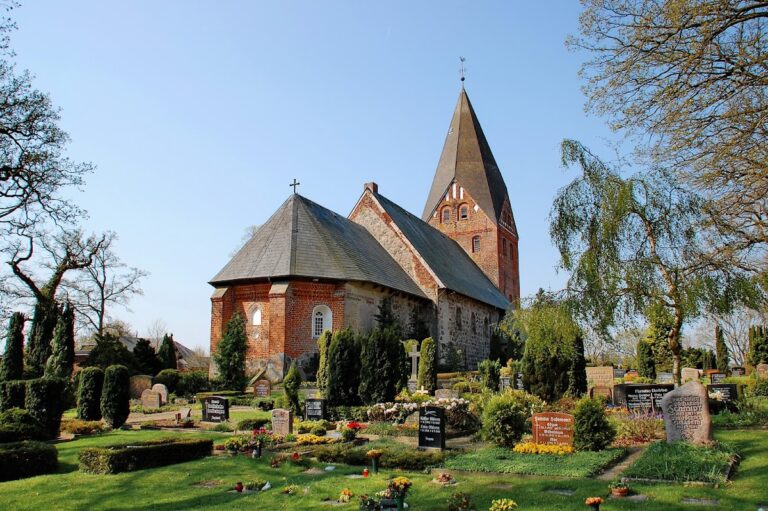
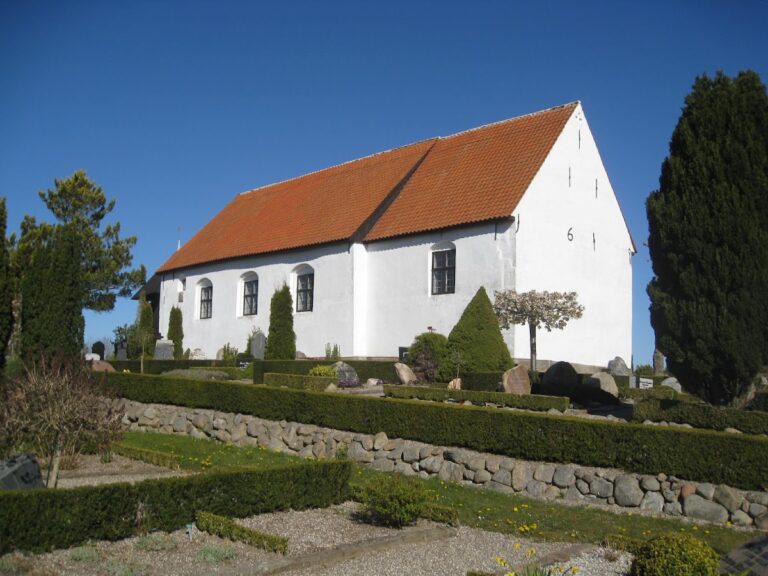
Marienkirche is a Romanesque brick church in Hürup, Germany, built by medieval Christian builders at the beginning of the thirteenth century. It belongs to the Hürup-Rüllschau parish in the Schleswig-Flensburg church district of the Evangelical Lutheran Church in Northern Germany. The church began as a simple single-nave building and was later enlarged and refashioned through several medieval and modern phases.
Romanesque foundation and Gothic enlargement
The original church was a small single-nave structure in the Romanesque style, a broad medieval tradition that generally preceded Gothic architecture. During the Gothic period, the recessed box choir was extended with a three-sided termination and covered by a vault. This change gave the eastern end a more elaborate form while retaining the earlier nave as the main body of the church.
The tower was extended during the sixteenth century. In 1892, its lower hall was connected with the nave, and the tower received a brown wood-grain imitation finish on the figures of the Triumphal cross group. A vestibule was added before the south portal in 1934. The shingled tower was renovated in 2014.
Medieval sculpture and changing arrangements
The church’s Passion relief may originally have been made for the rood screen of the Cistercian monastery church at Rüde. A rood screen was a partition carrying a crucifix that separated the choir from the nave. If this provenance is correct, the relief reached Hürup after the monastery was demolished in 1582.
For many years, the Passion sequence stood above the chancel arch, the arch marking the transition from nave to choir. Its position there resembled an arrangement at Nordhackstedt and may have placed it below a crucifix that is now lost. The suitability of this location as the relief’s original position has consequently been debated. At the end of the nineteenth century, the reliefs were taken down and the surviving traces of their original paint were stripped. In 2000, the sequence was restored, placed in a new frame with a gilded backing board, and installed on the north wall of the nave.
Later furnishings and parish use
The small fifteenth-century carved altarpiece was first made for a side altar. It was later found in an attic, restored at the Thaulow Museum, and repainted using traces of its original finish. It returned to its base in 1934, replacing a Neo-Gothic altar that had itself replaced a Baroque altar. The Triumphal cross group was moved from beneath the chancel arch to the south wall of the choir. Its figures were originally painted in color and were later given the brown wood-grain finish applied in 1892.
Two of the four apostle figures on the north wall of the choir date from the second quarter of the fifteenth century. The other two were probably added around 1900. They were probably restored when the Trinity altarpiece was treated, during work that exposed an earlier Baroque overpaint.
Hans Buchholz made the west gallery in 1643, and he carved the Baroque pulpit in Flensburg in 1666. The organ was built by Marcussen & Søn in 1880 and stood in the northeast corner of the nave beside the chancel arch until 1990. It is now placed on the west gallery inside the tower. A man from Koltschen named Hans von Gehlhorn bequeathed the gallery balustrade to the church.
Remains
Marienkirche survives as a single-nave brick building with a flat wooden ceiling, a Gothic choir with a three-sided termination and vault, and a shingled tower. The south entrance is preceded by the vestibule added in 1934. Medieval sculpture and later furnishings remain distributed through the nave, choir, tower, and gallery, preserving evidence of the church’s changing religious and artistic arrangements.
Medieval architectural and baptismal features
Romanesque baptismal font
The Romanesque granite baptismal font dates from the twelfth century and is attributed to the stonemason Horder. It came from Djursland and belongs to a group of granite fonts concentrated mainly in North Schleswig. Two encircling bands of foliage ornament the basin, with the foliage representing the Tree of Life, an ancient Christian symbol. Traces of earlier colored paint survive on the stone.
Gothic sculpture
Passion relief
A Passion relief, the sculptural presentation of Christ’s arrest, suffering, death, burial, and resurrection, extends for 6.3 meters along the north wall of the nave. Dendrochronology, the dating of timber through tree-ring analysis, places it at about 1265. The work is regarded as one of the most important examples of Early Gothic sculpture in northern Germany. Its seven panels show the Arrest of Christ, the Flagellation, the Descent from the Cross, the Entombment, the Resurrection, the Three Women at the Tomb, and Christ in Hell.
The relief’s artistic context has been compared with Gothic cathedral portals, especially the west portal of Amiens, the transept portals of Chartres, and sculpture from Sens and Laon. A similar work dating from about 1285 is found at St. Jürgen’s Church in Nordhackstedt. The sequence was restored in 2000 and now stands in a new frame against a gilded backing board.
Madonna and Child
A seated Madonna and Child may be older than the Passion relief and may have been made in the same workshop. The Madonna’s head was replaced in the fifteenth century, probably because its strict Romanesque form no longer suited contemporary taste. The replacement head is Gothic and has a gentle, maternal smile. The figure measures 72 centimeters in height. Extensive alterations make a more precise stylistic classification difficult.
Altarpiece and choir sculpture
Trinity altarpiece
The small carved altarpiece from the mid-fifteenth century stands on a masonry altar table built in 1934. Its central shrine presents the Trinity, the Christian doctrine of one God expressed as Father, Son, and Holy Spirit, in the form of three figures. God the Father holds a globe shaped as an imperial orb, Christ stands on the left, and the Holy Spirit appears on the right as a bearded young man holding a dove. The wings contain figures of the Archangel Michael and a holy bishop.
A Gothic crucifix dating from about 1330 has been attached to the altarpiece since 1934. Although Gothic in date, it imitates a more rigid Romanesque style. The altarpiece was repainted using surviving traces of its earlier finish, and its restoration also exposed a Baroque overpaint on the apostle figures.
Triumphal cross group
The Triumphal cross group, a prominent crucifixion group, dates from about 1500. Its lively, finely carved figures were originally polychrome, meaning painted in several colors. The crossboard is later than the figures and appears, from its form, to predate the major renovation of 1892. The group was originally installed beneath the chancel arch and later moved to the south wall of the choir.
Apostle figures
Four apostle figures are installed on the north wall of the choir. Two are fifteenth-century works, while the other two were probably added around 1900. Their restoration revealed an earlier Baroque overpaint, linking the figures to the church’s successive changes in decoration.
Baroque and nineteenth-century furnishings
Pulpit
Hans Buchholz carved the Baroque pulpit in Flensburg in 1666. Christ and the Evangelists, Matthew, Mark, Luke, and John, appear as fully three-dimensional figures holding their identifying attributes. They stand within fields framed by hollow-moulding strips and flanked by abundant fruit garlands. The pulpit also includes an octagonal sounding board, the canopy above the speaker that helps project the voice, and a staircase with a door.
Gallery and organ
The west gallery was made by Hans Buchholz in 1643. Its balustrade contains paintings in fourteen fields showing apostles, Christ, and Paul. Pilasters and strapwork ornament frame the strongly colored scenes, with strapwork consisting of interlacing bands resembling leather straps. The Neo-Gothic organ case stands on the gallery inside the tower. The organ itself was built by Marcussen & Søn in 1880 and remained beside the chancel arch until its relocation in 1990.