Marchtal Abbey: A Swabian Monastery and Former Imperial Abbey
Site at a Glance
- Popularity
- High
- Country
- Germany
- Primary era
- Early Modern
- Eras represented
- Medieval, Early Modern
- Civilizations
- Holy Roman Empire
- Site type
- Religious
- Remains
- Monastery
On this page11 sections
History
Marchtal Abbey is a former monastery and abbey in Obermarchtal, Germany. Halaholf and Hitta founded its earliest religious house, dedicated to St Peter, before its transfer to St Gall’s Abbey in 776. Re-established by 993, Marchtal later became a Premonstratensian abbey and an independent imperial territory. Its present church is a Baroque building, an ornate style of European art and architecture, consecrated in 1701.
Early monastery and community of canons
In 776, Halaholf and Hitta’s descendants made the monastery dependent on St Gall’s, a Benedictine abbey in what is now Switzerland. The Benedictine house was destroyed or fell into decay during the ninth or tenth century. By 993, Duke Hermann II of Swabia and his wife Gerberga had re-established Marchtal as a community of secular canons, clergy who were not members of a monastic order. Dedicated to the apostles Peter and Paul, it served as a burial place and family monastery for the dukes of Swabia. Bishop Gebhard II of Constance consecrated an enlarged church on 1 January 995. An earlier dating places the foundation of the canons’ community in 1011, under Duke Hermann III.
During the twelfth century, Marchtal passed between Swabian noble families, including the Staufen dynasty. Frederick I, Holy Roman Emperor, was among its proprietors. Repeated changes in ownership contributed to the community’s decline.
Premonstratensian abbey and imperial territory
In 1171, Hugo II, Count Palatine of Tübingen, refounded Marchtal as a Premonstratensian house. The Premonstratensians were a Catholic order whose members combined communal religious life with clerical ministry. Marchtal began as a double monastery, with communities for both men and women, and received additional property. Its canons came from Mönchroth Abbey at Rot an der Rot. Eberhard von Wolfegg became the first provost, or head of the community. Between 1204 and 1208, Provost Meinhardt had the monastery walls rebuilt. Provost Walther II later enlarged the church, which Bishop Henry I of Constance consecrated on 2 May 1239. In 1273, Provost Konrad barred the admission of additional women, and the house thereafter became a men’s community.
From the late thirteenth century until 1420, Marchtal belonged to the bishops of Constance. It became an independent abbey in 1440 and had its own abbot from the following year. In 1500, it joined the Swabian College of Imperial Prelates, which represented church territories in the Imperial Diet, the assembly of the Holy Roman Empire’s estates. Marchtal gained direct status under the emperor, known as imperial immediacy, and a vote in the Diet. Its jurisdiction extended over more than 30 villages and hamlets, including Obermarchtal, Uttenweiler, Dieterskirch, Hausen am Bussen, and Seekirch. The abbey also held property in Reutlingen, Ehingen, Munderkingen, and Riedlingen.
As a member of the Swabian Circle, a regional administrative and defense grouping of the empire, the abbey owed military and financial contributions. In 1521 its quota included one mounted soldier, four infantrymen, and 90 gulden, a historical currency. A later quota, set in 1663, was two mounted soldiers and five infantrymen, or 44 gulden; the same obligation was still stated for the eighteenth century. The abbey also owed 45 gulden to the Imperial Chamber Court, a high court of the empire. In 1803 its territory was described as covering three square miles and having between 6,500 and 7,000 inhabitants.
Conflict, persecution, and rebuilding
From the early sixteenth century, canons from Marchtal studied at the Catholic University of Dillingen, closely associated with the Jesuits, a Catholic religious order. Jesuit influence contributed to reforms at the abbey. In 1609, the abbot and his successors gained the right to wear a mitre, ceremonial headwear associated with bishops, during religious services.
Witchcraft prosecutions in the abbey’s territory came in three main waves, from 1586 to 1596, 1627 to 1628, and 1745 to 1757. Around 50 people were burned at the stake in 1586–1588, when the territory’s population was about 700. During the second wave, territorial governor Bernhart Bitterlin had seven people tortured and sentenced to death. Under torture, Waldburga Kepplerin and Ursula Bayer confessed to alleged dealings with the devil and named 19 others. Those people were then tortured and sentenced to death, with two avoiding both torture and a death sentence. Seven women were killed in the final wave. The surviving count reaches at least 60 death sentences for alleged witchcraft, and the total may have been higher.
During the Thirty Years’ War, a series of conflicts in central Europe from 1618 to 1648, the canons fled advancing Swedish forces in 1632. The buildings survived, but were left badly dilapidated. Under Abbot Konrad Kneer, the community unsuccessfully sought to establish a shared secondary school and college for Upper Swabian Premonstratensians at Munderkingen. The canons instead enlarged Marchtal’s school and admitted pupils from outside the community.
Abbot Nikolaus Wierith, who led the abbey from 1661 to 1691, directed its rebuilding. Plans for a new church began in 1674, its foundation stone was laid in 1686, and the church was consecrated on 11 September 1701. The wider monastery complex was also rebuilt in the Baroque style from 1686. Baroque music formed part of the community’s cultural life; composers associated with Marchtal included Sixtus Bachmann and the Premonstratensian monk Isfrid Kayser. Sebastian Sailer, a canon, was known as a preacher, writer, and poet in the local dialect. In 1770, Marie Antoinette stayed overnight at the abbey while travelling from Vienna to Paris for her marriage.
Dissolution and later uses
In 1802, Abbot Friedrich II and the community surrendered their rights and revenues to the House of Thurn and Taxis, a German princely family, which administered them within the Principality of Buchau in Upper Swabia. The canons had to leave in 1803, when the monastery was dissolved and its buildings became an administrative centre for the family’s Upper Swabian holdings. The complex was later used as an occasional summer and hunting residence and for princely events. Its library was transferred to the princely central library in Regensburg, with parts later entering the monastic libraries at Beuron and Neresheim. In 1806, the former abbey passed to the Kingdom of Württemberg, and its church became a parish church.
In 1919, Visitation sisters displaced from Chotieschau Abbey, in what is now the Czech Republic, settled in the north wing and founded a girls’ secondary school with a boarding school. The school continued until 1992, when a diocesan Catholic-school foundation took it over. The sisters moved to Untermarchtal in 1997. The Diocese of Rottenburg-Stuttgart bought the complex in 1972 and converted it into a teacher-training academy, which opened in 1978. In 2001, Bishop Gebhard Fürst raised the abbey church to the rank of minster, a title for a church that does not by itself mean it is a cathedral. The complex now houses the diocesan academy’s conference centre and schools in the north wing; the church is used for services and concerts.
Remains
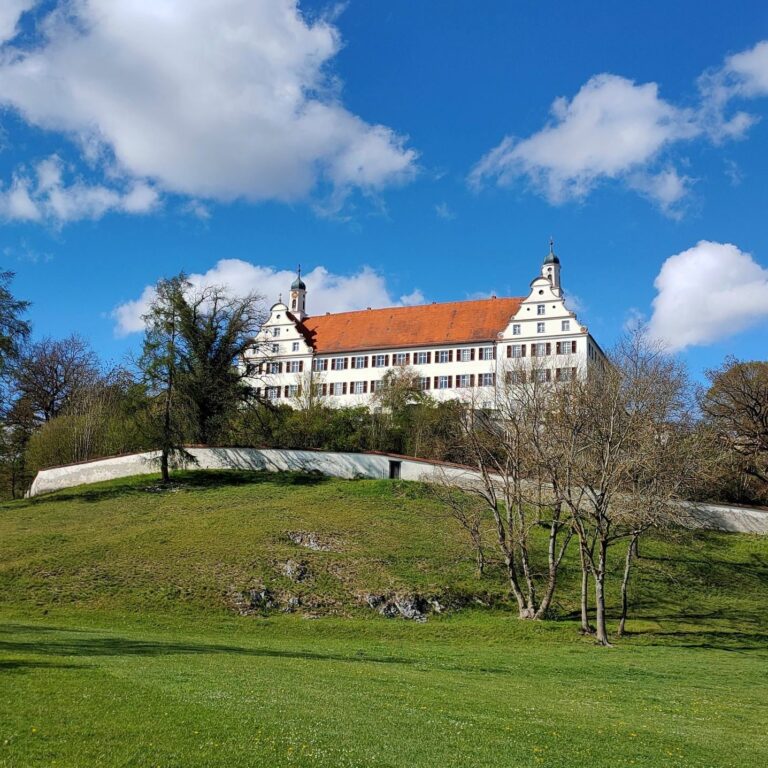
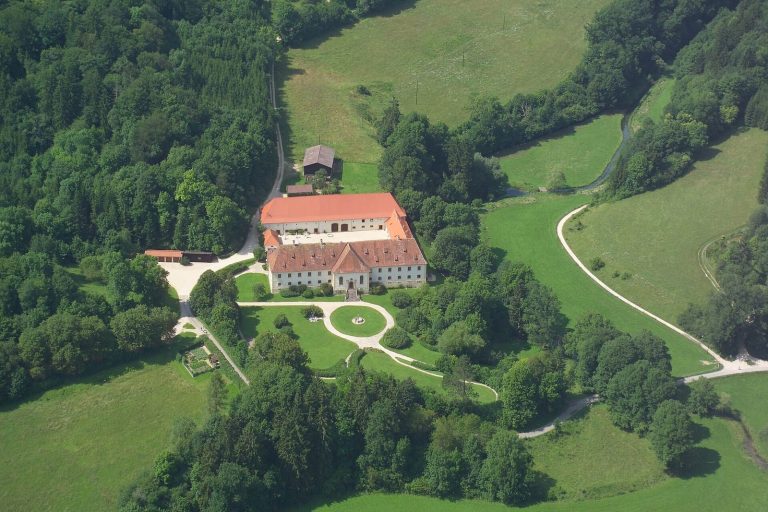
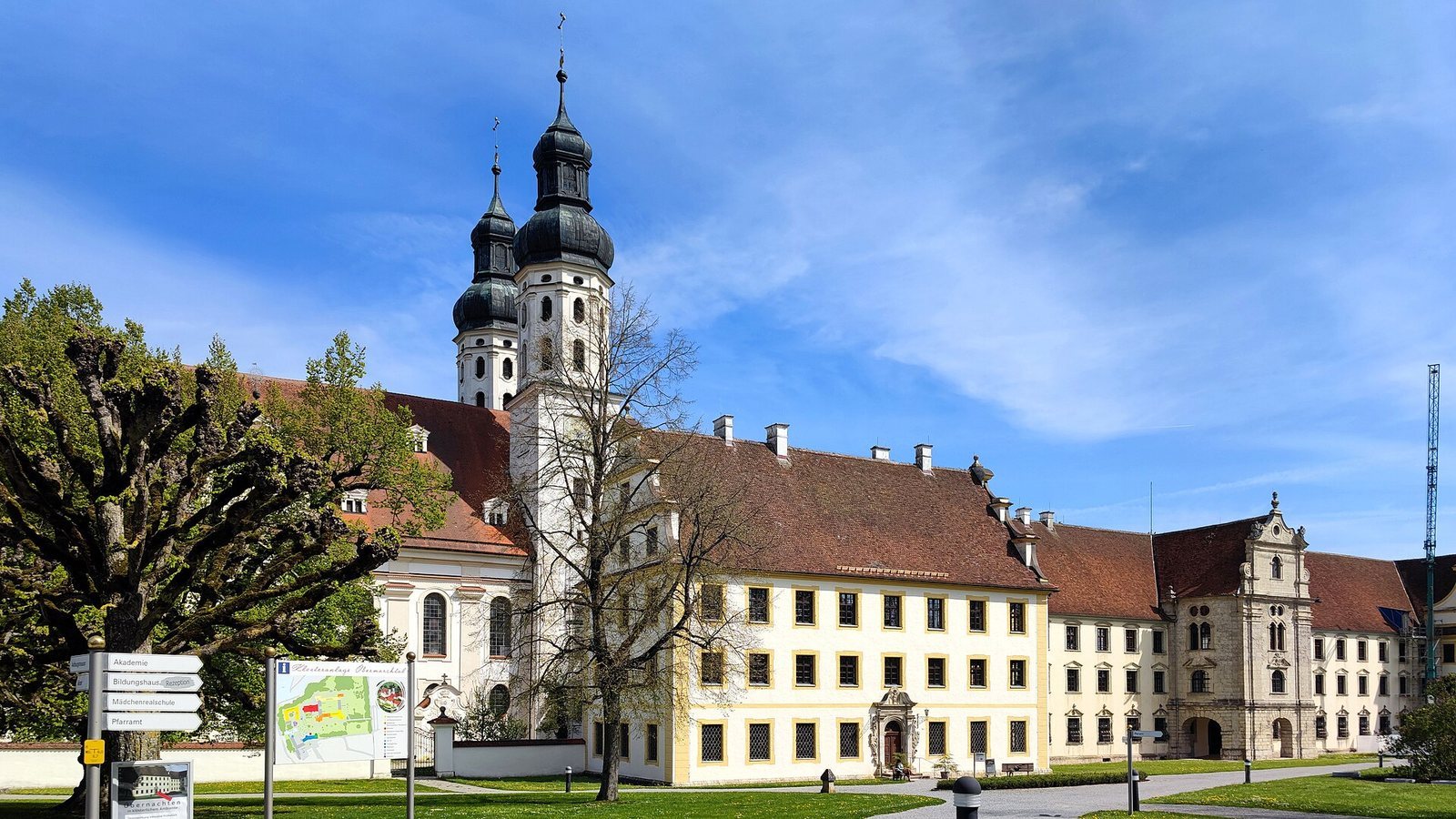
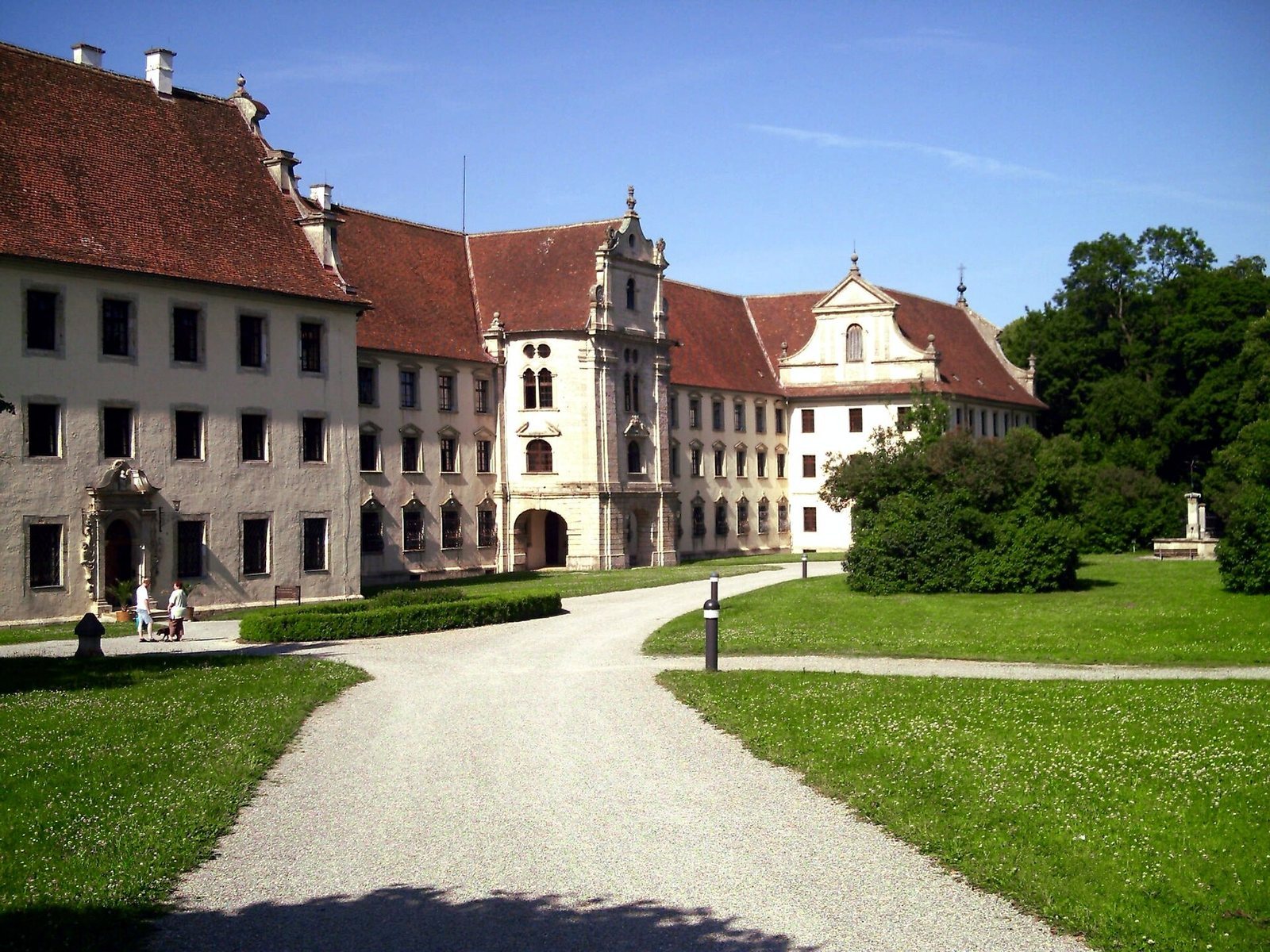
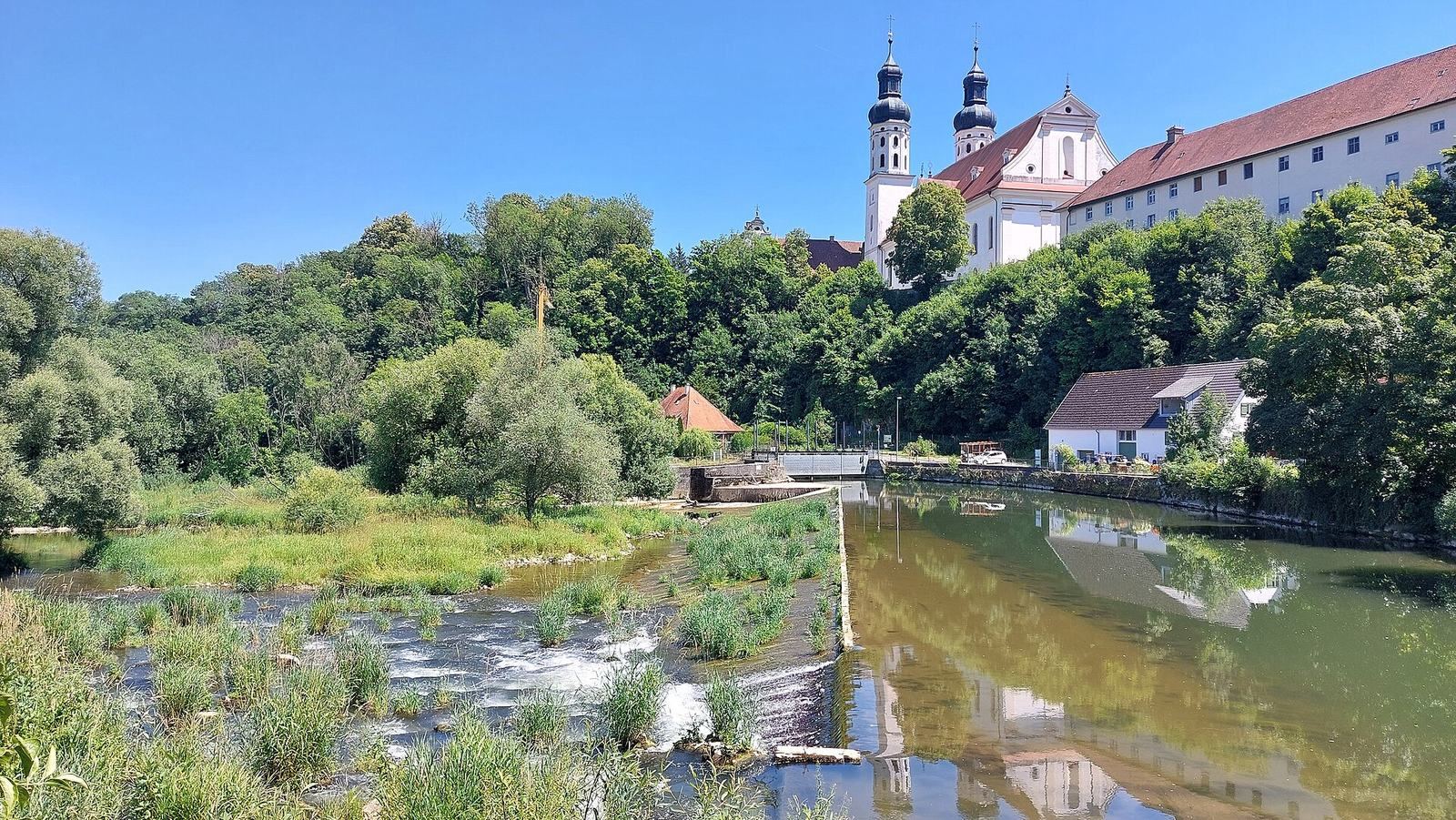
A wall encloses the abbey complex, which includes the church of Saints Peter and Paul, the former monastic enclosure, and service buildings. The church occupies a prominent elevation and dominates the surrounding landscape for miles. The surviving complex brings together the Baroque church and buildings that served the religious community and its practical needs.
The abbey church
Baroque structure
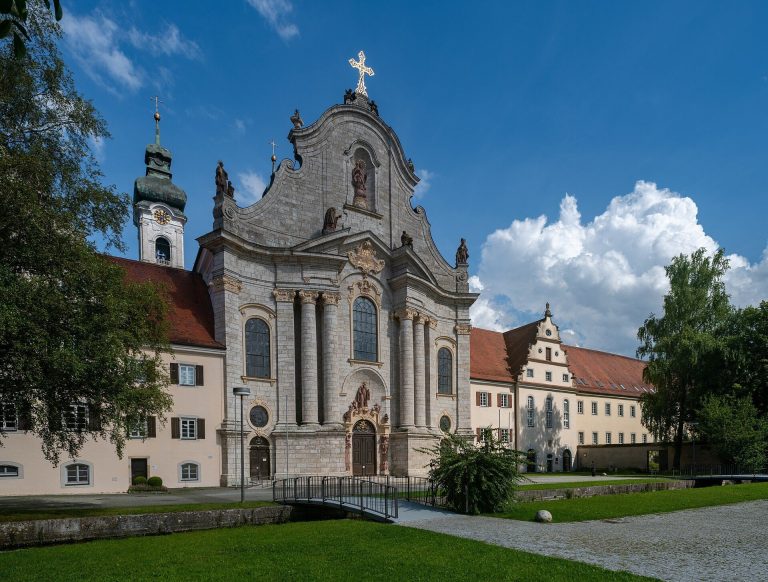
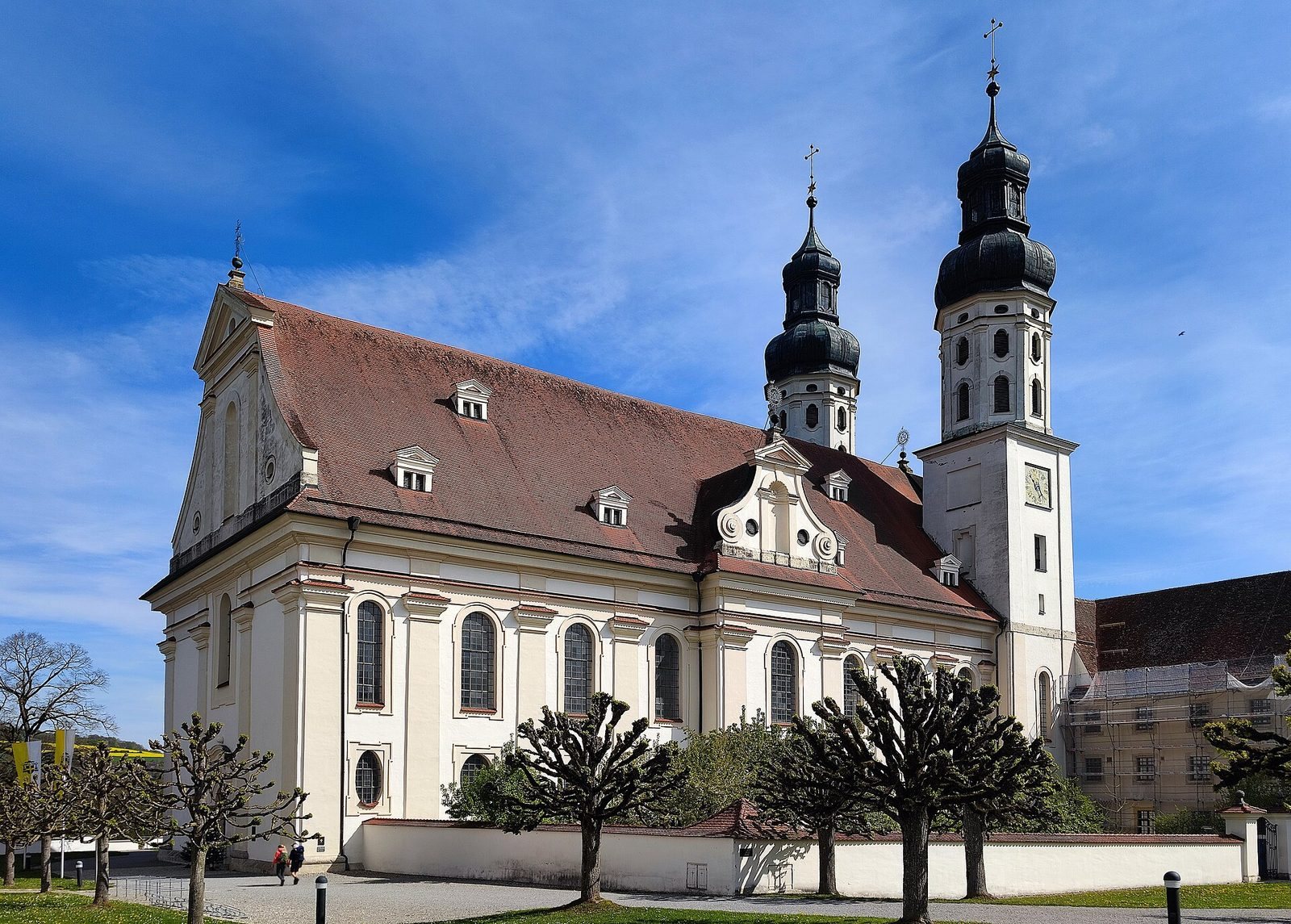
The church is a noted example of South German Baroque architecture. The medieval church had been enlarged into a basilica, with a central nave flanked by two side aisles, before the later building took its Baroque form. Michael Thumb began the work; after his death in 1690, his brother Christian Thumb and Franz Beer von Bleichten continued it. Joseph Schmutzer executed the stucco decoration.
Interior features
The church contains choir stalls, seats for clergy or choir members, and a putto, a childlike figure in art. A monastery window bears Rocaille ornament, an asymmetrical, shell-like form of decoration associated with Rococo art.
Organs
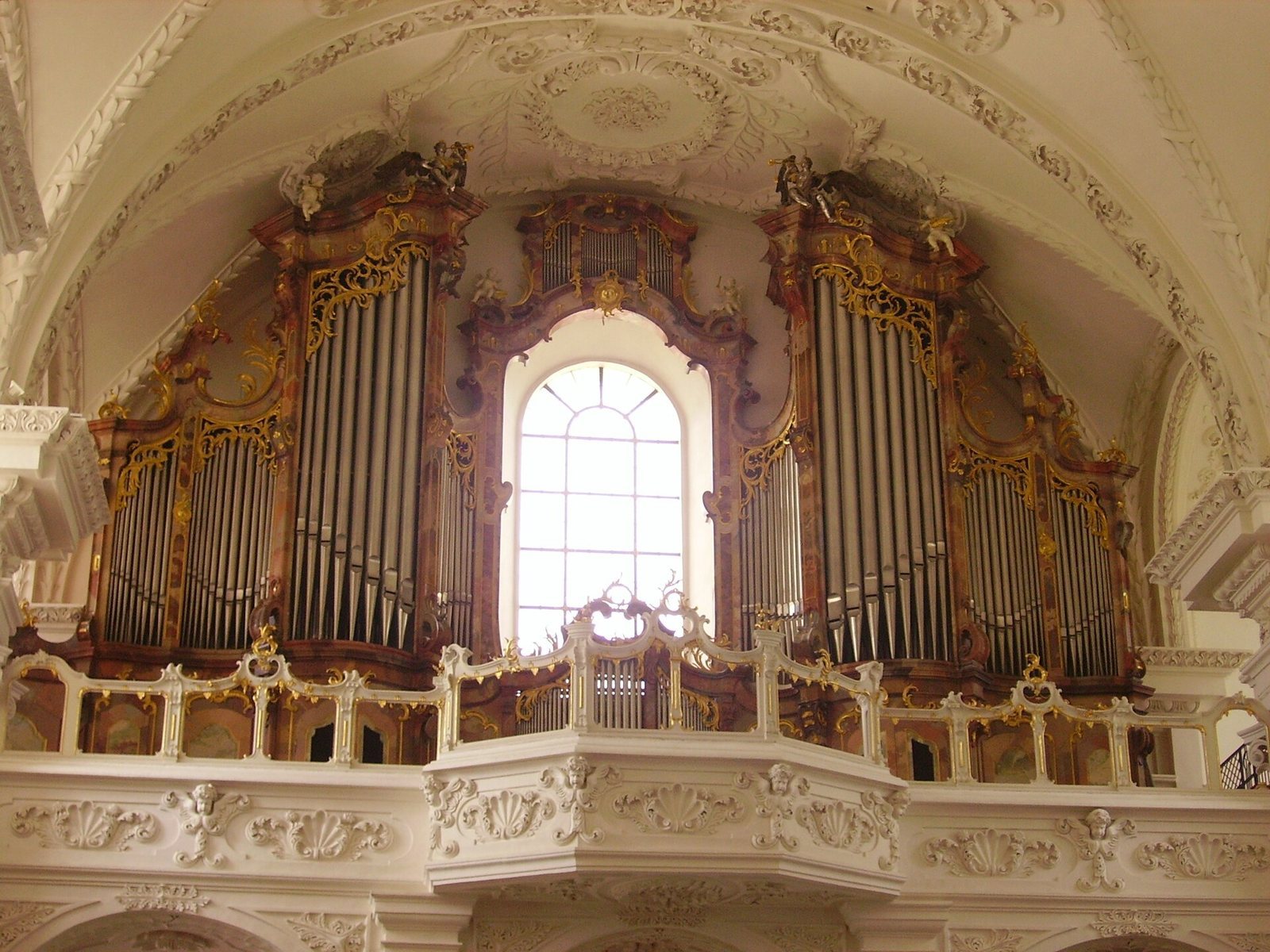
Johann Nepomuk Holzhey built the main organ between 1778 and 1780 and added a separate choir organ in 1782–1784. Repairs, changing musical preferences, alterations in the 1960s, and damage from wood-boring pests had erased the main organ’s original musical design. A full restoration in 2011–2012 reconstructed its original sound.
Other identified features
The complex also includes a building identified as the Sebastian Sailer Building and a plaque associated with it.