Malostranská beseda: Former Town Hall and Cultural Centre of Malá Strana
Site at a Glance
- Popularity
- Medium
- Country
- Czechia
- Primary era
- Early Modern
- Eras represented
- Medieval, Early Modern, Modern
- Civilizations
- Habsburg, Habsburg Austria, Holy Roman Empire, Kingdom of Bohemia
- Site type
- Civic
- Remains
- Town Hall
On this page15 sections
History
Malostranská beseda is the former town hall of Malá Strana in Prague, Czechia. It was built as the district’s third town hall in Gothic form in 1478, with construction completed in less than two years. Its later character reflects late Renaissance, the European cultural movement that preceded the Baroque, and early Baroque design. The building served as the seat of local government while Malá Strana remained an independent town.
Earlier halls and the Gothic town hall
An earlier town hall stood across the square, between the Romanesque Church of St Wenceslas and the Gothic Church of St Nicholas. A report from 1407 refers to it. On 4 and 5 November 1419, Hussite forces, followers of a religious reform movement associated with Jan Hus, attacked and burned the building, taking its valuables and destroying its official records. The Hussite military leaders Jan Žižka and Mikuláš z Husi commanded the attackers.
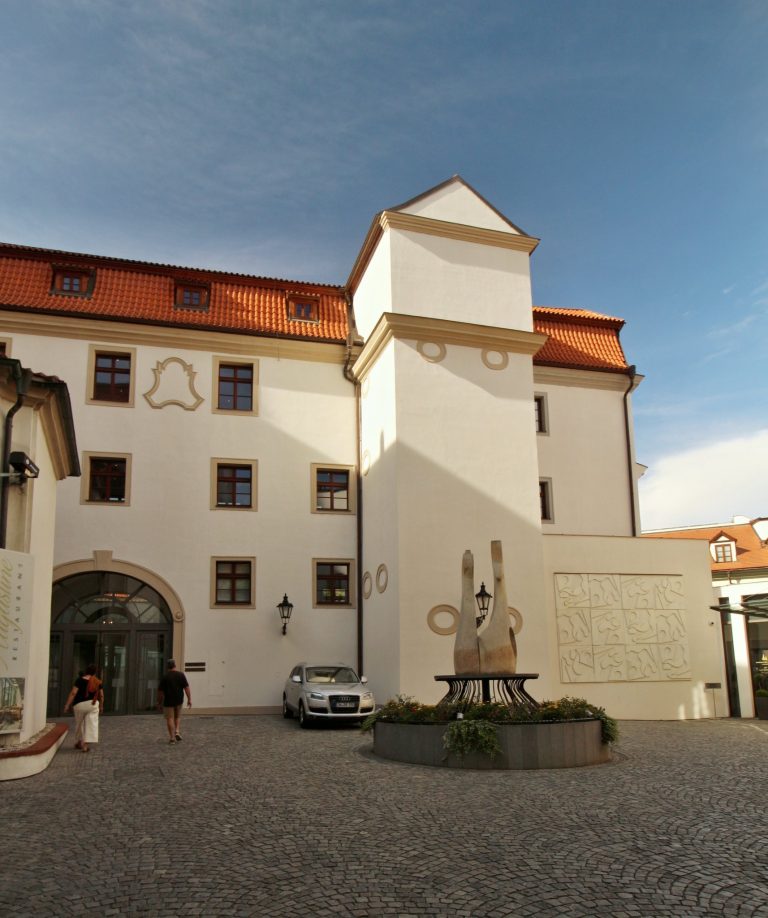
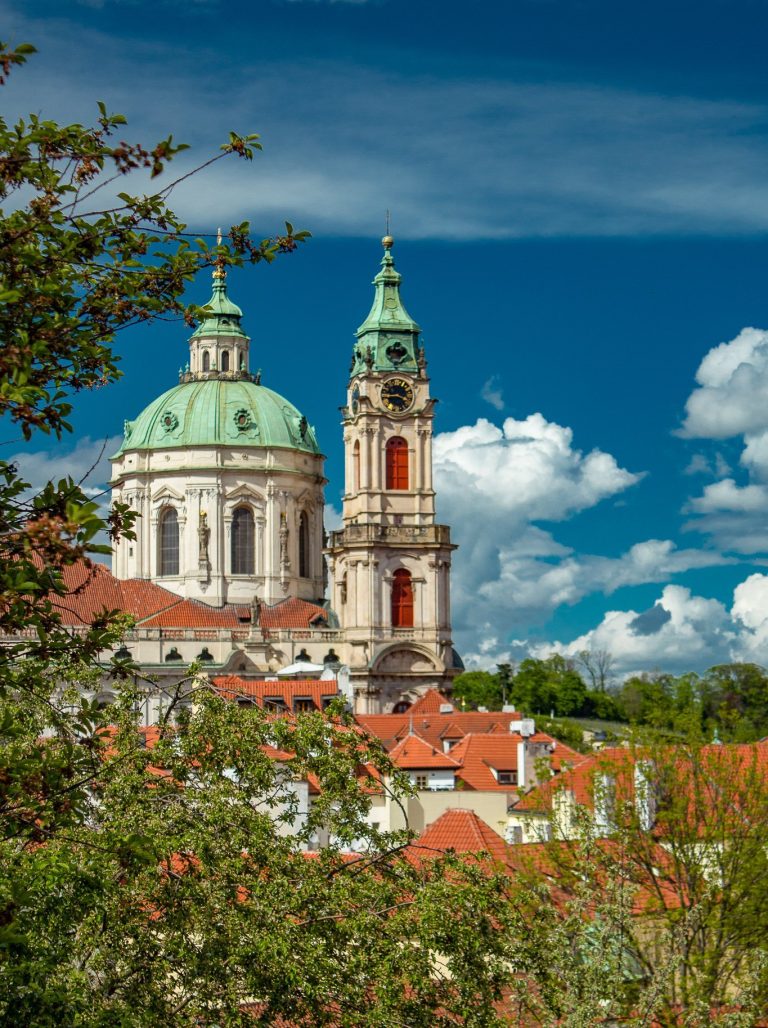
The former town-hall plot remained empty for many years. Meanwhile, a house in the square’s southern part, left to the town by Václav z Bítova, served as a temporary town hall. Its courtyard retains portals from the municipal prison and an iron gate from that period. In 1478, the townspeople acquired a plot from Jan Tovačovský of Cimburk for a new hall. A burned-out Sternberg house had occupied the site; the Gothic building that replaced it was completed in under two years.
Renaissance civic life and religious negotiations
A fire badly damaged the hall in 1503. The much larger blaze that devastated Malá Strana and Prague Castle in 1541 did not reach it. In 1575, the council chamber was used to draft the Bohemian Confession, a Protestant statement of faith prepared by the Bohemian estates as a basis for negotiations over religious toleration.
Further changes took place in the 1580s. A poem by Blažej Jičínský and differences between depictions of the hall dated 1562 and 1606 point to alterations during that decade.
Rebuilding and wartime damage
Passau troops inflicted serious damage during their incursion of 1611, requiring repairs and rebuilding. A major campaign from 1617 to 1622 gave the town hall its late-Renaissance and early-Baroque character. Political and military upheavals extended the work beyond the Thirty Years’ War, the major European conflict fought from 1618 to 1648. Before rebuilding was complete, Swedish troops damaged and plundered the building during the 1648 siege of Prague. Vilém Oppenried repaired it in 1660 and made further Baroque alterations.
Municipal change and new uses
In 1784, Malá Strana joined Hradčany, the Old Town and the New Town in a single municipal unit. The administration moved to the Old Town Hall, and the former town hall was converted between 1784 and 1793 for use by the fiscal office and tax archive. During this work, a library belonging to the scholar Václav Vřesovec of Vřesovice was found in the basement. He had left it to the town in 1583, and councillors had hidden it after the Battle of White Mountain in 1620, a key battle in the Bohemian phase of the Thirty Years’ War.
In the 1820s, major exterior alterations removed the towers and cupolas for structural reasons and filled in the arcades. The north wing, which had contained the municipal brewery, was demolished in 1870 during construction of a school on Josefská Street. From the mid-19th century the building served as Malostranská beseda, a patriotic social club with a pub; it was operating as a club by 1868.
Reconstruction and present role
Investigations before a major reconstruction from 2006 to 2009 found the building in worse condition than expected. The project followed extended public and professional debate. Malostranská beseda now functions as a cultural centre for Malá Strana, with a concert hall, restaurant and café. It is protected as a cultural monument and became a National Cultural Monument on 1 July 2024.
Remains
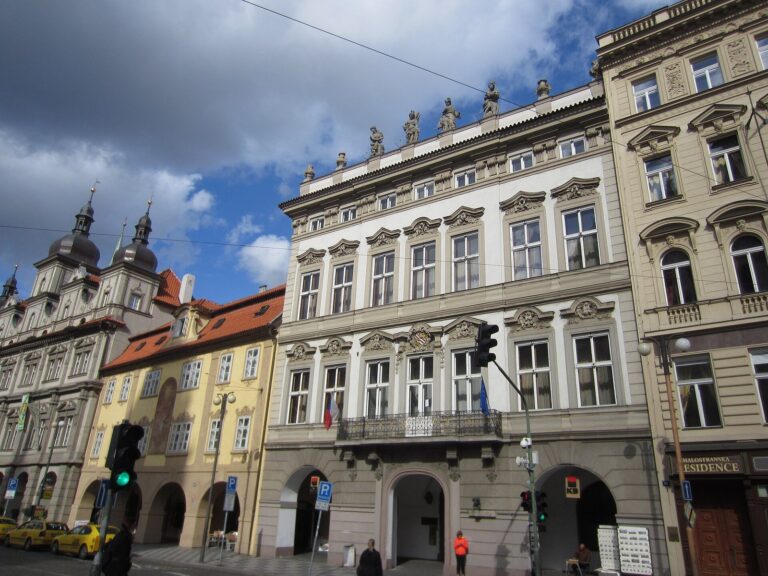
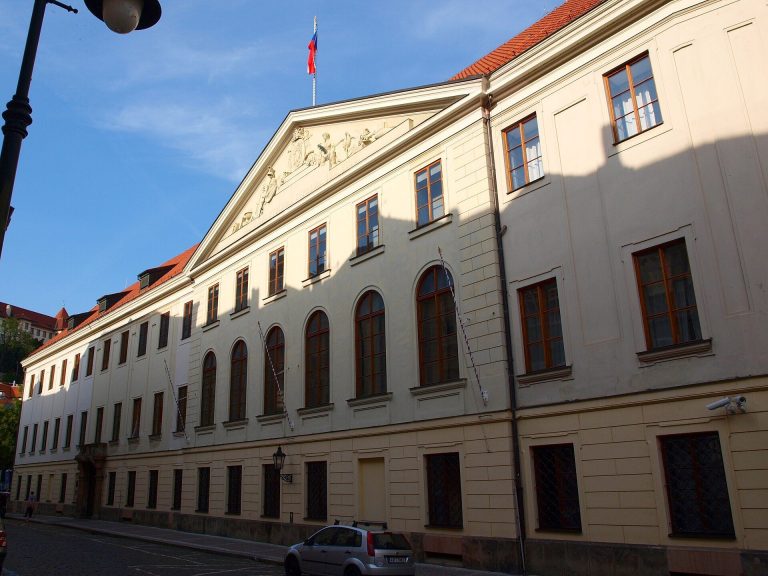
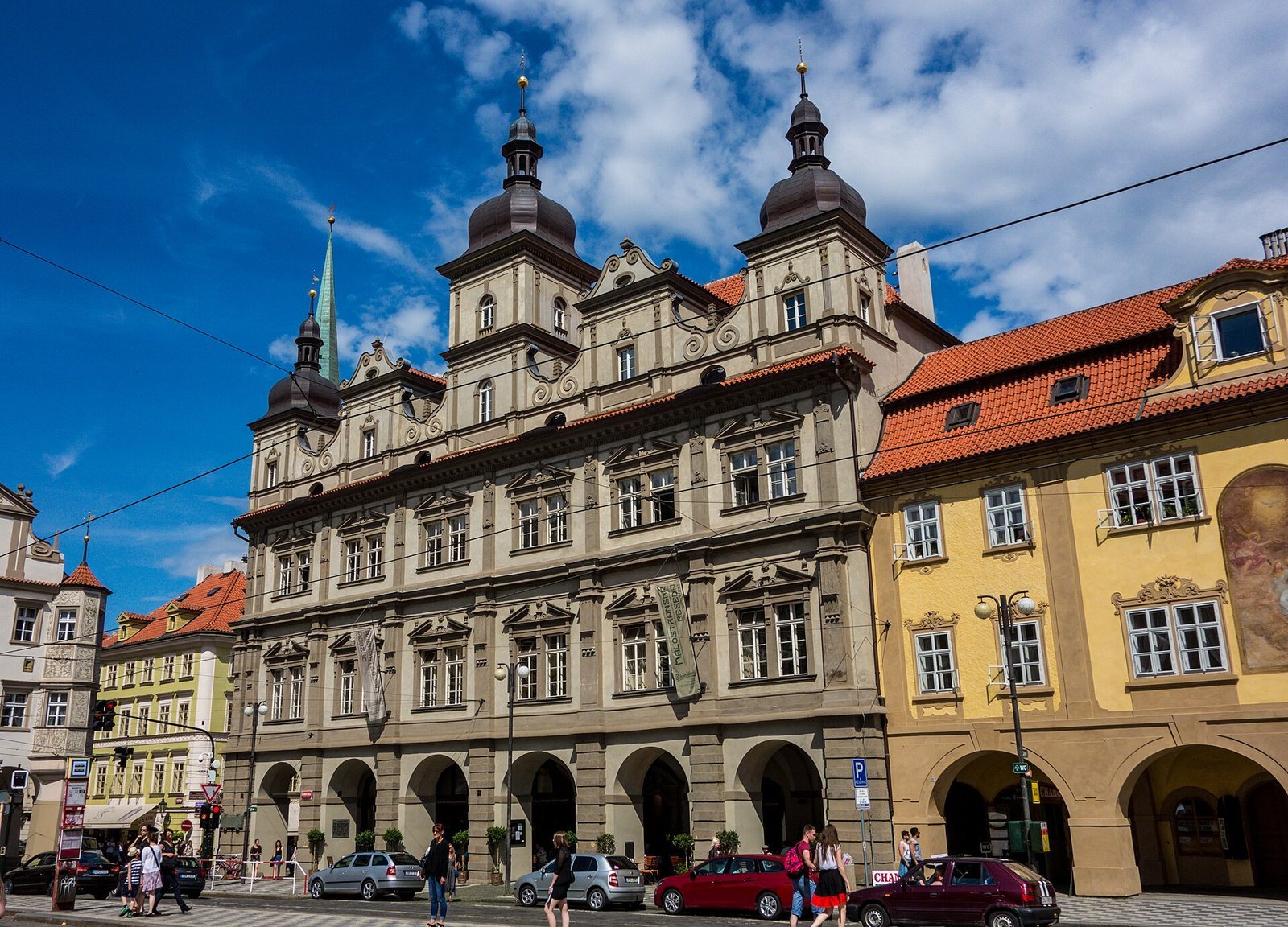
The late-Renaissance corner building occupies the east side of Malostranské náměstí. Its side façade faces Letenská Street, while its courtyard opens onto Josefská Street. The surviving structure combines late-Renaissance and early-Baroque features with elements from its earlier Gothic phase.
Exterior and structural fabric
Building arrangement
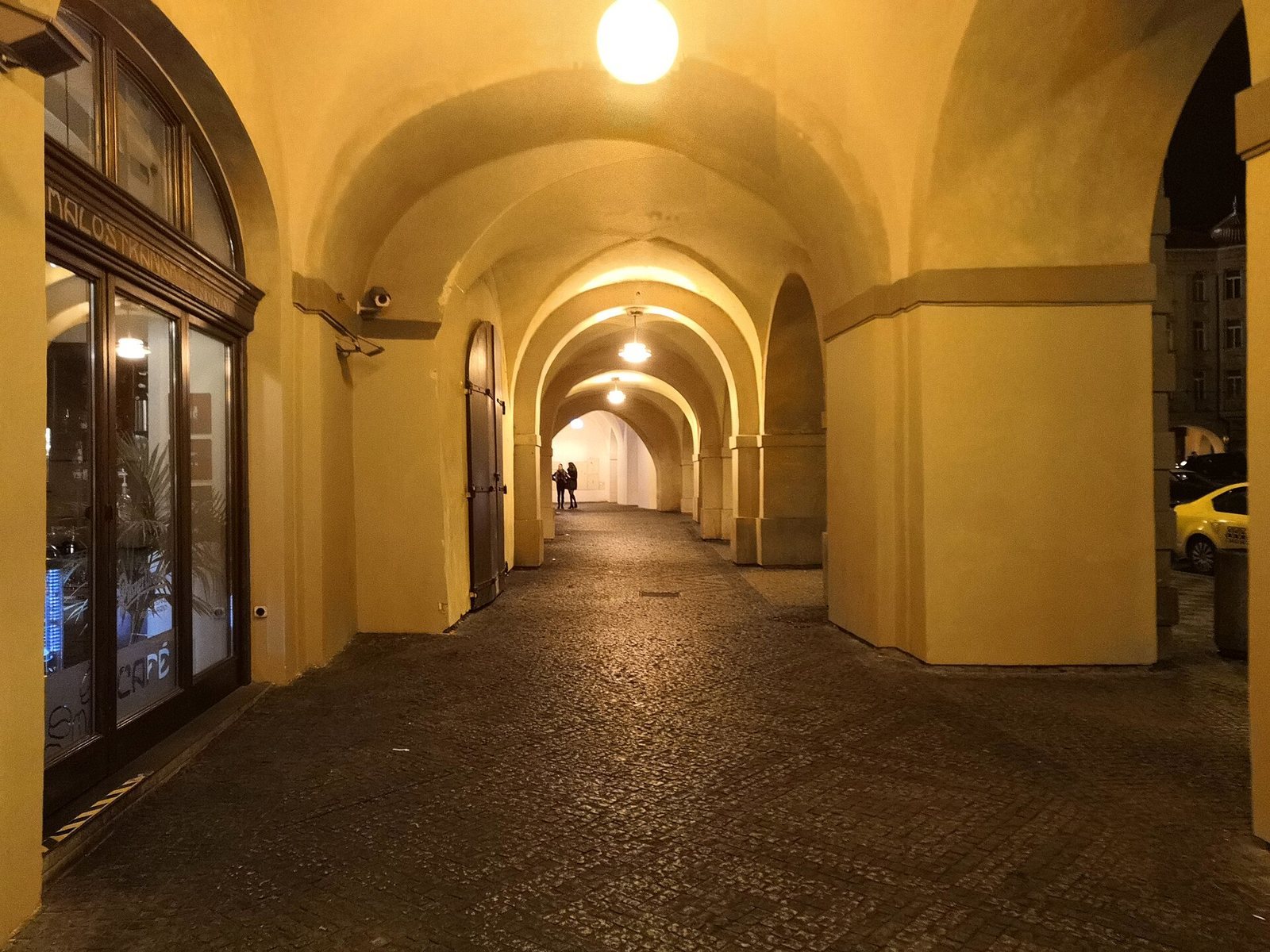
In its late-16th-century arrangement, the town hall comprised two asymmetrical sections of unequal height. The taller section had a tent-shaped roof; the lower one had a gabled roof and a small tower. Both had arcades, meaning sequences of arches.
Façade and arcades
The stone façade is decorated with mascarons, carved ornamental faces, and half-figure atlantes, sculpted male figures used as supports. They stand on pilasters, shallow column-like projections from a wall, and are attributed to Giovanni Baptista Bossi. Most of the arcades were restored in 1949. A bronze memorial plaque is fixed to the building.
Towers and roof
The towers with cupolas, removed in the 1820s, were reinstated during the 2006–2009 reconstruction. An engraving made by J. J. Dietzler in 1743 provided the model because the building plans had not survived. The original wooden framework that carried the towers’ weight through the building was replaced with a steel support system. The Renaissance roof structure, which was in very poor condition, was preserved using carpentry methods of the period.
Former civic and religious interiors
Gothic cellars
Two cellars survive from the Gothic phase. They served as the prison of Malá Strana.
Council chamber
An allegorical painting of Justice by Bartholomeus Spranger, a painter associated with the court of Rudolf II in Prague, was later placed in the chamber; it is now in the National Gallery. The inlaid entrance doors bore the Latin inscription Senatus, meaning “Senate,” and were transferred to the Old Town Hall toward the end of the 18th century.
Marian chapel
A chapel dedicated to Mary occupied the first floor. After it was deconsecrated, its altar painting of the Entombment of Christ was moved to the Thun Chapel in St Vitus Cathedral.