Maijishan Grottoes: A Buddhist Cave Complex in China
Site at a Glance
- Rating
- 4.7
- Popularity
- Low
- Country
- China
- Primary era
- Medieval
- Eras represented
- Classical, Medieval, Early Modern
- Civilizations
- Ming, Qing, Song, Tang, Yuan
- Site type
- Religious
- Remains
- Sanctuary
On this page13 sections
History
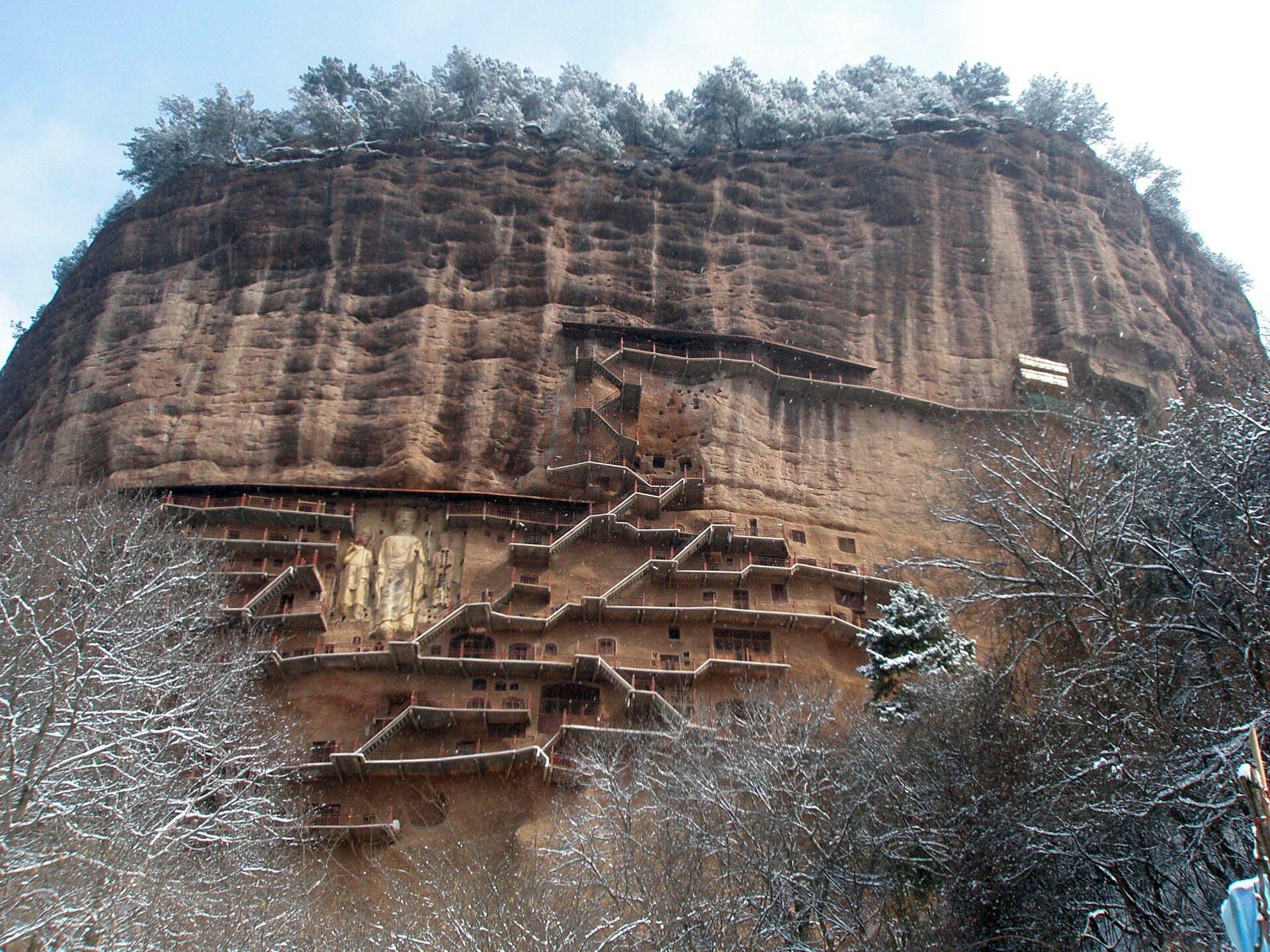
The Maijishan Grottoes are a Chinese Buddhist cave complex in Maiji District, Tianshui, China. Construction probably began during the Later Qin period, around AD 384–417, when Buddhist patronage was encouraged by the ruler Yao Xing. Cut into a steep cliff near routes linking Xi’an, Lanzhou, Dunhuang, Chengdu, and regions toward India, the grottoes became a meeting place for religious and artistic influences from Central Asia, India, Southeast Asia, and China.
Origins and Early Buddhist Community
The Later Qin was one of the states of the Sixteen Kingdoms period, which lasted from AD 304 to 439. Yao Xing’s support for Buddhism helped create the religious setting in which the grottoes were probably begun. An inscription dated AD 502 records the excavation of Cave 115, while later inscriptions describe continued expansion supported by wealthy donors. Another inscription-based tradition associates the beginning of construction with the Western Qin period, but the surviving caves cannot be securely assigned to that phase.
Between AD 420 and 422, the monk Tanhung established a small monastic community at Maijishan. The senior monk Xuangao later joined him with about 100 followers, and the community eventually grew to approximately 300 members. Its organization and fate during the Buddhist persecution of AD 444 remain uncertain. Xuangao left for the Northern Wei court and died during the persecution, while Tanhung later travelled south and burned himself to death there around AD 455.
Dynastic Expansion and Transformation
The Northern Wei, a dynasty that ruled much of northern China from AD 386 to 534, brought increased recognition and probable patronage to Maijishan. The site stood near the route west from the Wei capital, encouraging further religious activity. Construction, dedication, and enlargement continued under the Northern Wei, Western Wei, Northern Zhou, Sui, Tang, Five Dynasties, Song, Yuan, Ming, and Qing dynasties.
During the Tang period, Maijishan was probably partly controlled by Tibetans after the An Lushan Rebellion, a major eighth-century conflict that weakened Tang authority. In AD 845, during a great Buddhist persecution, both Maijishan and Dunhuang were under Tibetan control, yet both sites were spared. The Song dynasty later carried out major restoration. Older grottoes received new or replacement Song-period sculptures, and some areas placed greater emphasis on bodhisattvas, Buddhist figures who postpone final Buddhahood to help other beings, rather than on Buddhas alone. During the middle Ming period, large groups on the eastern and western cliff faces were repaired, including a seated Maitreya group on the southeast cliff and an incomplete standing Buddha group on the southwest cliff.
Damage, Conservation, and Modern Recognition
Earthquakes and other natural and human-caused disasters damaged the complex. Some caves in the central area collapsed, and several sculptures were damaged. During the 1970s, a five-year conservation project investigated the earthquake vulnerability of the rock mass and used structural supports, injected consolidation, and crack sealing. Cement concealed some original architectural details, including ancient pillar holes, while concrete increased humidity in some cavities and created risks for murals and other remains.
A Beijing archaeological team explored the grottoes in 1952–1953 and established the numbering system still used for the caves. The site was designated a National Key Cultural Relic Protection Unit in 1961. In 2014, it became part of the UNESCO World Heritage property Silk Roads: the Routes Network of Chang’an–Tianshan Corridor. The grottoes preserve 194 caves, more than 7,200 Buddhist sculptures, and over 1,000 square metres of murals, representing construction and restoration across twelve dynastic periods.
Remains
The grottoes are cut into a purplish-red sandstone cliff whose face rises roughly 30–80 metres above the ground and reaches an angle of about 85 degrees. Caves occupy the eastern and western sides of the southern cliff face, with their numbering divided between the two cliff groups. Terraces, stairs, planks, and wooden walkways connect the surviving spaces. Some walkways reach about 60 metres above the ground and project as much as 6–8 metres beyond the cliff base.
Cliff Caves and Porticoes
Nine caves have exterior porticoes. Caves 1 and 30 each contain a column-supported portico and an interior Buddha figure. In Cave 1, four octagonal columns enclose the space around a reclining Buddha, and the columns retain the same size from their bases to their tops. Cave 43 uses another octagonal design, with a broader pillar base, a shaft that narrows toward the top, and a decorated capital.
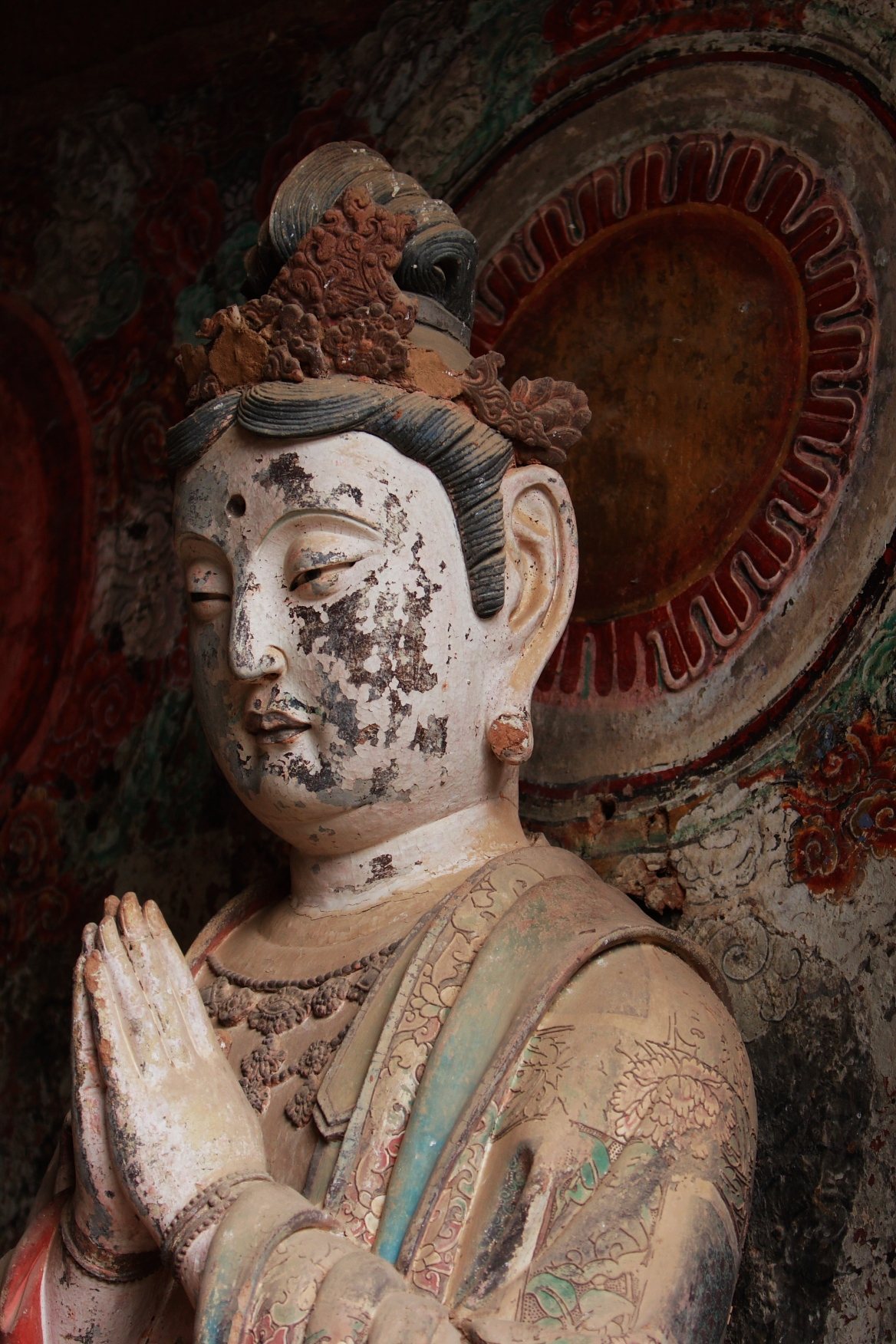
The sculptures are exclusively Buddhist and include reliefs as well as freestanding figures. Most were formed from clay or stucco with a binding agent and then painted in vivid colours. Some were carved from stone brought from elsewhere because the local rock was considered too soft for sculpture. Solid clay figures stand alongside works built around wooden armatures covered with wheat husks, hemp, reeds, and mud before receiving a final clay coating.
Sculptural Imagery
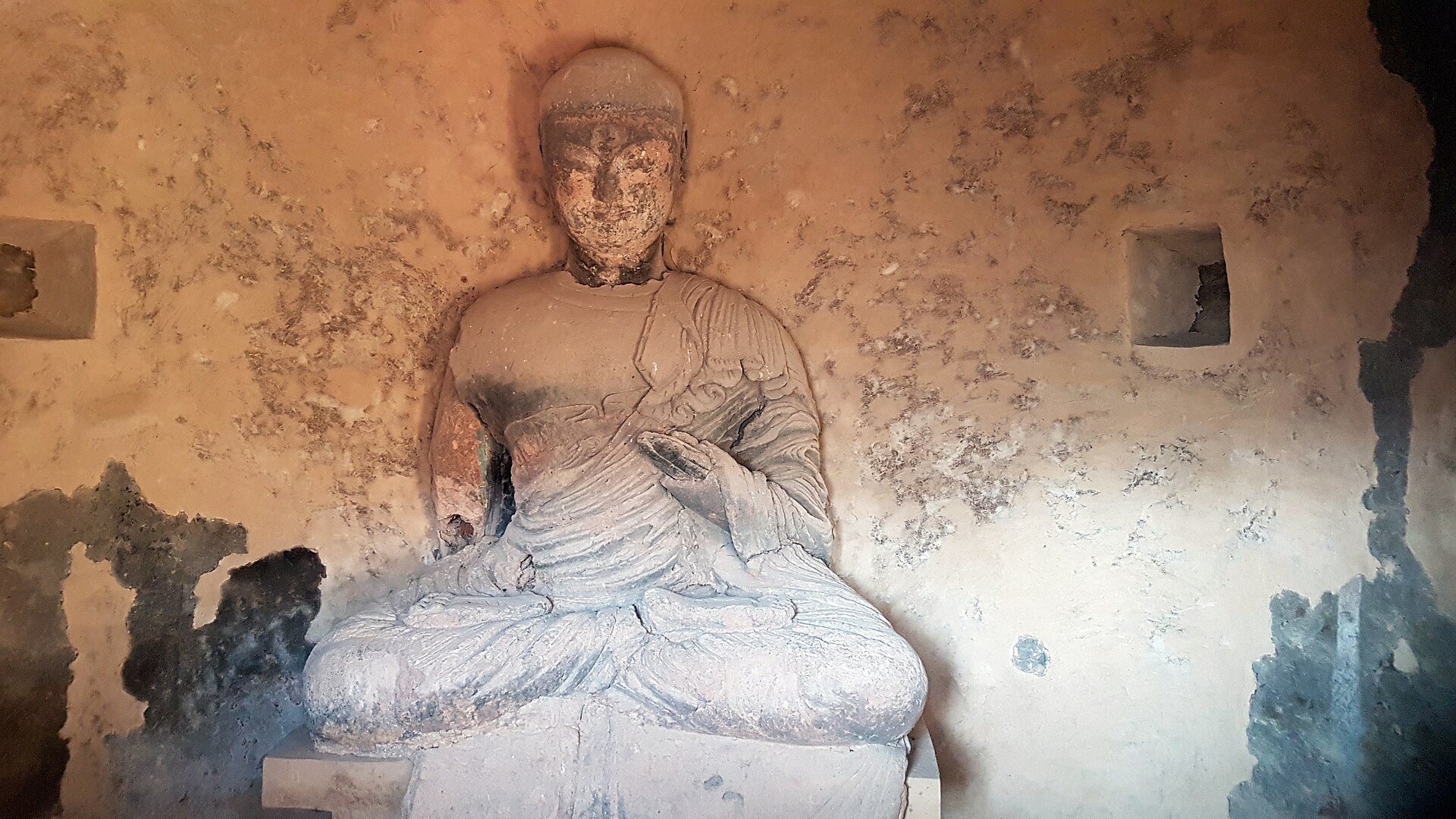
The imagery includes seated Buddhas with bodhisattvas and attendants, along with monks, nuns, lay worshippers, and donors. Amitabha, the Buddha associated with the Pure Land, Sakyamuni, the historical Buddha, Maitreya, guardian deities, pairs of temple guardians, and the Four Heavenly Kings also appear. Some figures show Central Asian and Gandharan influence through their bodily proportions, large robes, and drapery. The sculptures trace a movement from Indian and Central Asian Buddhist styles toward more distinctly Chinese forms. Northern Zhou figures are generally fewer than Northern Wei examples and more solid and massive, while later works use more fluid poses and changing emphases in Buddhist imagery.
Cave 78 contains a colossal Buddha seated in the vajra-paryankasana cross-legged meditation posture, with the right hand raised in the abhaya mudra, a gesture signifying freedom from fear. Stone sculptures in Caves 117, 127, 133, and 135 are generally made from sandstone of unknown origin. Cave 133 contains 23 stone stelae and is organized around a central niche with twin Buddhas. Its imagery includes events from the life of Sakyamuni, including an elephant rider representing entry into the womb, the Buddha’s birth, meditation beneath the Bodhi tree, and Sumedha prostrating before Dipamkara Buddha. The arrangement commemorates the donor’s deceased parents and presents an imagined spiritual journey toward Tusita, a Buddhist heaven associated especially with Maitreya.
Architectural Murals
Murals in Caves 4, 27, 127, and 140 depict buildings and architectural settings, providing evidence for the development of Chinese architecture.
Cave 4
Cave 4 preserves five Zhou-period ceiling panels showing a residential courtyard. A main gate occupies the centre of the composition, with a single-bay opening and a gabled roof.
Cave 27
The mural in Cave 27 covers the front face of the pyramidal ceiling. Its eastern section shows a walled enclosure containing palace-style buildings and apparently enclosing a city. The wall is represented with light and dark grey bricks.
Cave 127
Cave 127 contains a detailed palace-like architectural representation, regarded as one of the most detailed depictions of Chinese architecture from the sixth century. The imagery may be connected with scenes from the life of Prince Siddhartha.
Cave 140
Cave 140 is cubical, with a square entrance and a lintel roof. Its rear and side walls hold a seated Buddha flanked by two standing bodhisattvas with halos, sculptures dating to the Northern Wei period. The cave’s murals include early examples of jiehua, a Chinese technique that uses measured lines and straightedges to depict buildings accurately. One scene shows two halls arranged along a courtyard, with pale green gabled roofs, grey rows of roof tiles, and ornaments along the ridges.
Terraces and Surviving Connections
A very large temple guardian stands on a narrow open terrace leading toward the Seven Buddha Halls and displays Tang-period sculptural influence. The original cliff paths collapsed at an early stage, leaving the dispersed grottoes isolated for centuries. Many statues and much of the original decoration nevertheless survive across the connected cliff surfaces, terraces, stairs, planks, and walkways.