Basilica di Santa Maria del Lauro: A Marian Parish Church in Meta, Italy
Site at a Glance
- Popularity
- Medium
- Country
- Italy
- Primary era
- Early Modern
- Eras represented
- Early Modern, Modern
- Civilizations
- Kingdom of Naples, Spanish
- Site type
- Religious
- Remains
- Basilica
On this page18 sections
History
The Basilica di Santa Maria del Lauro, associated with the venerated Madonna del Lauro, is a Roman Catholic parish church in Meta, Italy, dedicated to the Virgin Mary. A larger church replaced an earlier chapel in 1569, and restorations shaped its overall eighteenth-century appearance. The Madonna statue is regarded as Meta’s patron, and the parish belongs to the Archdiocese of Sorrento-Castellammare di Stabia.
The statue and the first chapel
Local tradition places the statue’s discovery on 12 September in the eighth century. Teresita, a deaf-mute woman tending a cow, followed a bright light to a statue beneath a laurel shrub. Tradition associates the place with an ancient temple to Minerva, the Roman goddess of wisdom, warfare, and crafts. A golden hen with twelve chicks was said to surround the statue. After finding it, Teresita regained her hearing and speech.
A bishop carried the statue in procession to Sorrento Cathedral, but it was gone the next day and had returned to its discovery place. The same disappearance and return happened twice more. The statue was then placed in the nearby Chapel of the Savior, which received the dedication of Santa Maria del Lauro in 1206.
Growth and recognition
As the number of worshippers grew, the chapel could no longer accommodate them. It was demolished and a larger church built in its place. The building underwent several restorations, producing the overall appearance associated with the eighteenth century.
On 29 November 1913, the church was declared a monumental building in recognition of its historical and artistic importance, an initiative promoted by historian Antonio Filangieri di Candida. On 25 March 1914, it became a minor basilica, an honorific church status rather than a cathedral rank. During the Holy Year of 2000, a special Catholic year of spiritual observance and pilgrimage, the church served as a Jubilee site.
Remains
A broad staircase leads to the church. Inside, a long central nave crossed by a shorter transept forms a Latin-cross plan. The nave has a barrel vault, a continuous arched ceiling, while the two side aisles have cross vaults, formed where arched ceilings intersect. Fourteen columns, seven on each side, support the arches between the nave and aisles.
Exterior and entrance
Approach and façade
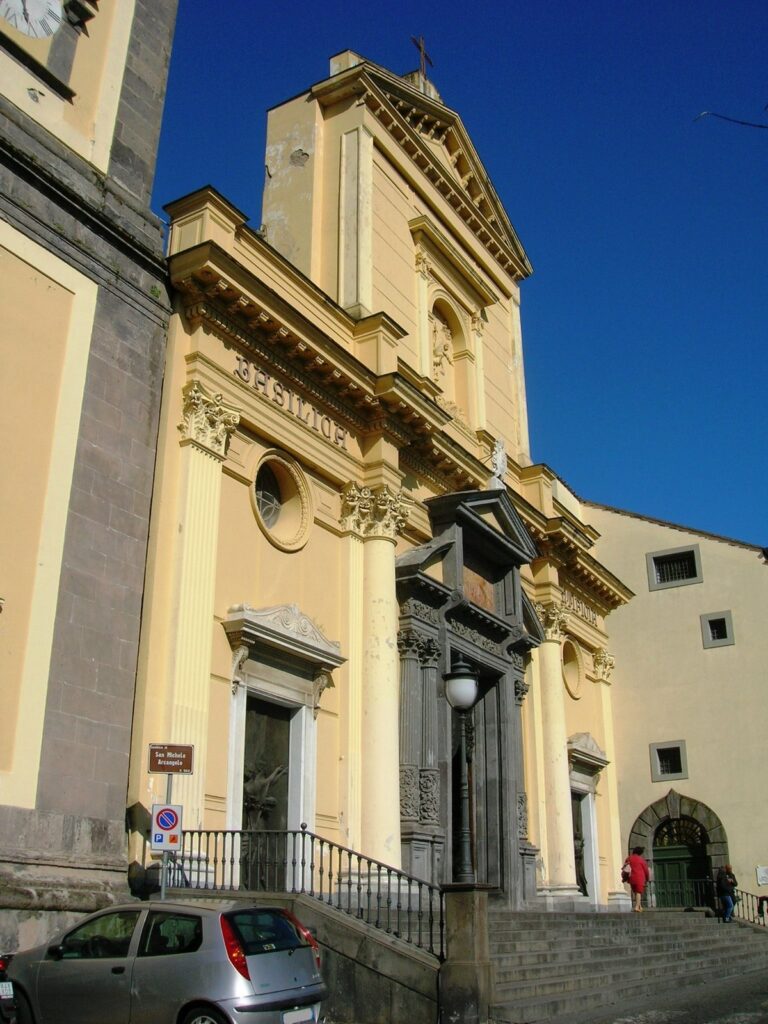
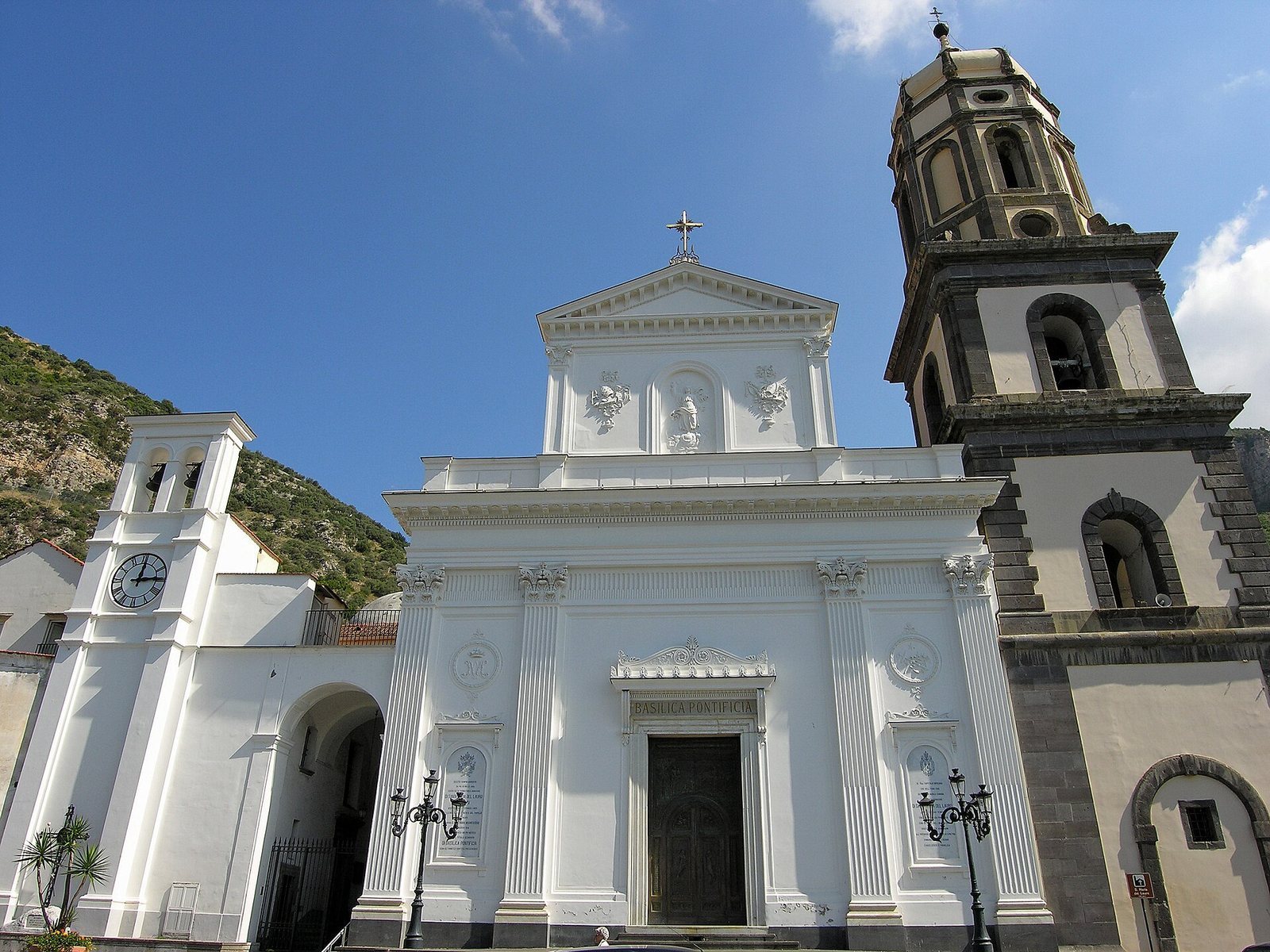
The neoclassical façade dates to the first half of the nineteenth century and is decorated with stucco. Paired pilasters, flat attached supports, flank the entrance and carry a horizontal entablature. Above it, two columns frame a small shrine-like niche containing an image of the Madonna, topped by an iron cross.
Entrance doors
An iron door stands in front of an older sixteenth-century wooden door. The wooden door has twenty-four inlaid panels depicting the mysteries of the Rosary, episodes from the lives of Jesus and Mary contemplated during Catholic prayer.
Interior chapels and furnishings
High altar and choir
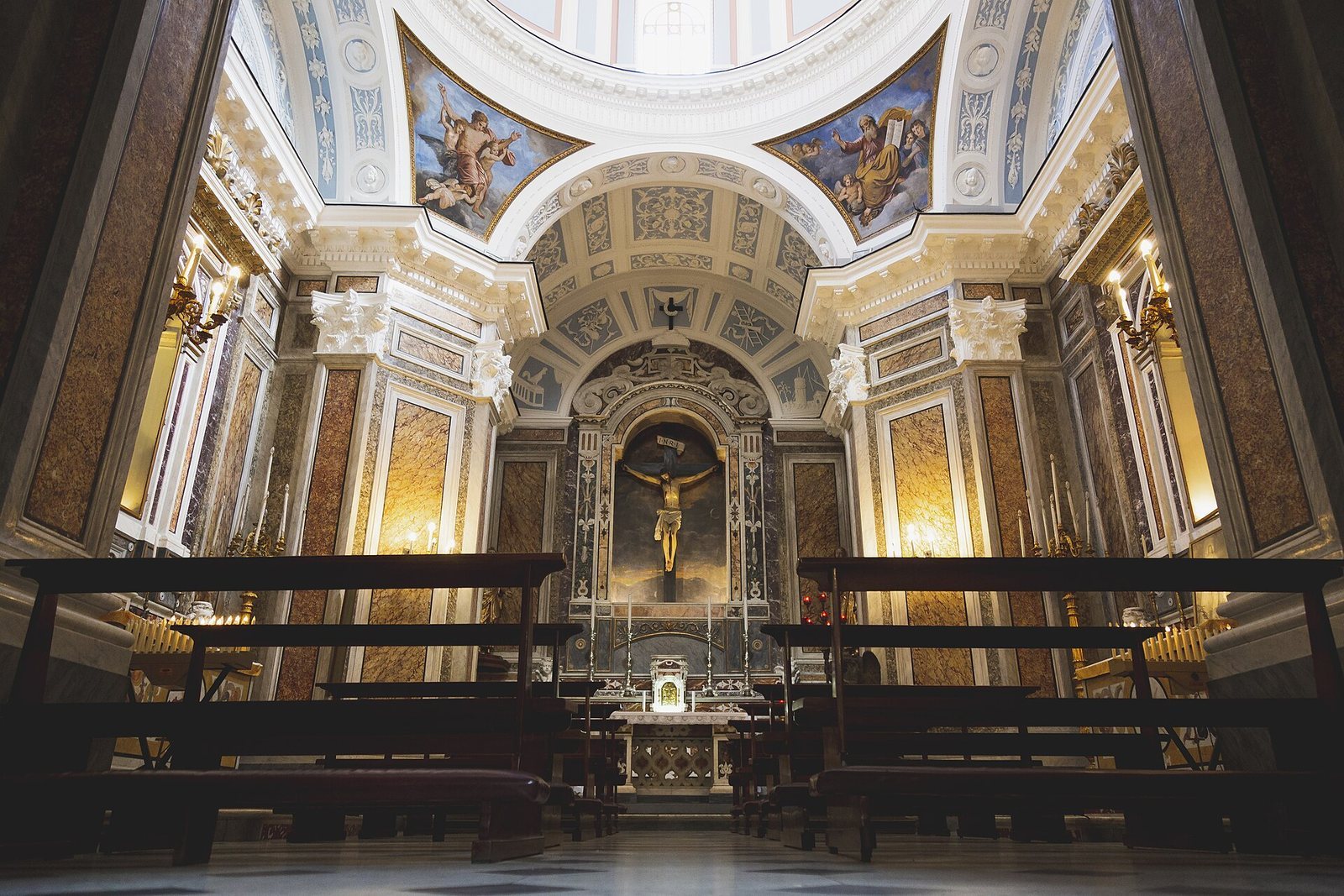
The seventeenth-century high altar is decorated with marble in several colors and includes a Madonna statue carved from linden wood. The wooden choir dates to 1782. At the church’s sanctuary end is an eighteenth-century sculpture of the Redeemer by Giacomo Colombo, an Italian sculptor associated with Baroque art in southern Italy.
Chapel of Madonna del Lauro
The principal chapel is dedicated to Madonna del Lauro and contains a wooden statue of the Virgin in Gothic style. Marble finishes cover the chapel, while curved sections called pendentives support the dome above its corners. Giuseppe Bonito painted frescoes of the Evangelists on the pendentives in 1785. Bonito was an eighteenth-century painter associated with Naples.
De Martino family chapel
Patronized by the De Martino family, this chapel contains a statue of Saint Peter from the second half of the sixteenth century and a sculpture of the dead Christ from the nineteenth century.
Chapel with the Saint Joseph bust
A separate chapel contains a nineteenth-century wooden bust of Saint Joseph.
Chapel of the Madonna of the Rosary
On the left side of the transept, the chapel of the Madonna of the Rosary holds a sixteenth-century panel painting by Girolamo Imparato, a painter of the Neapolitan school, a tradition associated with Naples.
Other artworks and fittings
Two statues, of the Guardian Angel and Saint Michael, date to 1640. Other furnishings include an eighteenth-century marble baptismal font and votive offerings given by sailors in fulfillment of vows or in thanks for perceived divine help. Two sixteenth-century panels depict Saint Francis and Saint Dominic.
Pulpit
The nineteenth-century pulpit has a marble spiral staircase. Local tradition places it where the laurel tree beneath which the Madonna statue was found once stood.
Sacristy
The sacristy contains frescoes of the Triumph of Faith painted by Costantino Desiderio in 1783, and a canvas by Luca Giordano depicting the expulsion of merchants from the Temple in Jerusalem. Its inlaid wooden cupboards were made in 1765 by artisans from Nocera.
Pipe organ
Built by Agostino Benzi in 1913, the pipe organ stands on the choir loft opposite the main entrance. Its pneumatic-tubular action uses air pressure and tubes. The instrument has two keyboards of fifty-eight notes each and a straight pedalboard of twenty-seven notes. Its elaborate Baroque wooden case is divided into five fields by twisted half-columns with Ionic capitals. Each field holds principal pipes arranged in a cusp, with shield-shaped mouths.
Bell tower
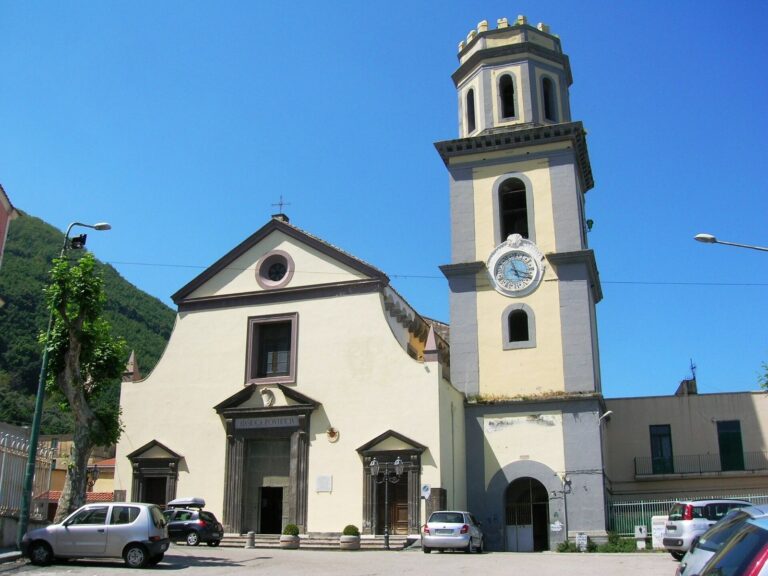
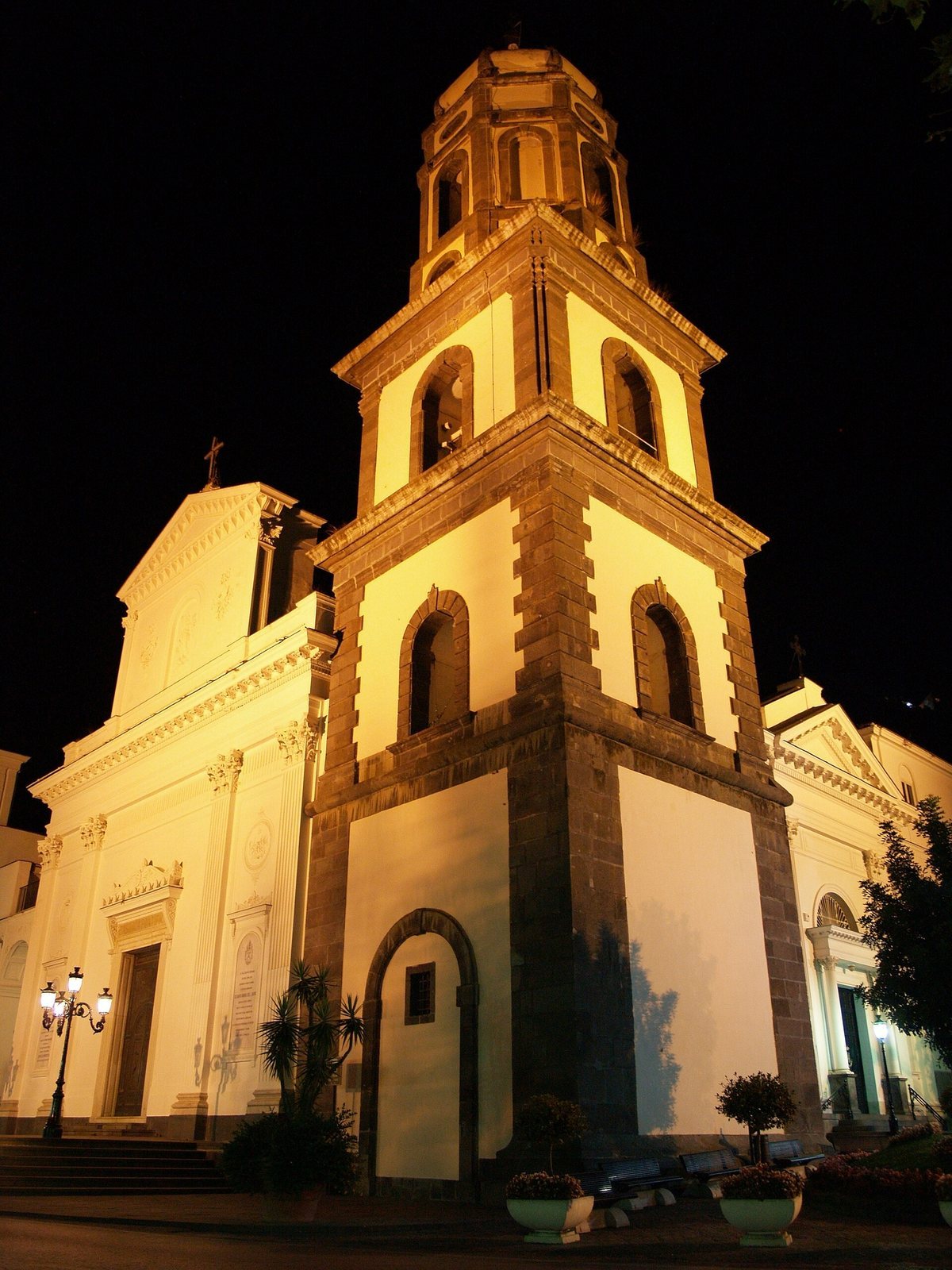
The Baroque bell tower rises forty-one metres and has five levels. Its lower three levels are square in plan, while the upper two are octagonal. A bulbous dome crowns the tower. The tower and dome are built of grey tuff with yellow plaster panels.