Llantrisant Castle: A Ruined Welsh Stronghold in Glamorgan


Site at a Glance
- Rating
- 4.4
- Popularity
- Low
- Country
- United Kingdom
- Primary era
- Medieval
- Eras represented
- Medieval
- Civilizations
- English, Norman, Welsh
- Site type
- Military
- Remains
- Castle
On this page9 sections
History
Llantrisant Castle is a ruined castle in Llantrisant, Wales, United Kingdom, whose builder and date of construction remain uncertain. The period in which it was erected has not been established, although its masonry has been compared with buildings associated with the establishment of several castles in Glamorgan.
Traditional origins
One tradition attributes the castle to Gwrgan ab Ithel, a lord of Glamorgan, with repair or rebuilding later undertaken by Einion ab Collwyn after the invasion of Robert Fitzhamon, an Anglo-Norman lord involved in the Norman conquest and settlement of Glamorgan. Other antiquarian traditions connect the castle with Robert, Earl of Gloucester, also known as Robert of Caen, or with the period when castles were being established at Cardiff, Newport, Kenfig, and Neath. These traditions reflect the uncertainty surrounding the castle’s early history.
Royal administration and the de Clare lordship
By the reign of Edward I, the English king who ruled from 1272 to 1307 and consolidated royal authority in Wales, Llantrisant Castle belonged to Gilbert de Clare, the powerful Anglo-Norman lord of Glamorgan known as the Red Lord of Glamorgan. After inheriting his family’s titles and estates, Gilbert paid homage to Edward.
The castle’s administration is recorded in a writ dated 15 July 1297. Walter de Hacklut, the castle’s custos, meaning its keeper or custodian, was ordered to complete the gate he had begun. This reference shows that the entrance remained an active concern of the lordship and royal administration at the end of the thirteenth century.
Conflict in the early fourteenth century
Gilbert de Clare died in 1314. Two years later, William Fleming was appointed bailiff and custodian of Llantrisant Castle and the Forest of Miskin. He later lost royal favour and was executed for treason at Cardiff.
After Gilbert’s death, his executors received a writ dated 15 July 1317 ordering them to give seisin, the formal legal possession of an estate, to the heirs. Bartholomew de Badlesmere was then placed in charge of Glamorgan. Instructions required the lordship’s officers to retain their former fees and ensured that the castles were stocked.
Llantrisant Castle was drawn into the political and military disturbances of the 1316 Glamorgan rebellion led by Llewellyn Bren, a local landowner. Royal officials were ordered to supply troops, provisions, money, and command to suppress the rising. Peace was restored, and Llewellyn Bren, his wife, and their sons were sent to the Tower. The castle may have been demolished during these disturbances, but that possibility remains uncertain. Llewellyn Bren is recorded as having destroyed several other castles in Glamorgan, including those at St Georges, Sully, Tregaron, Barry, Foulkes, Fitzwain, St Athan, and Ruthyn.
Later medieval history
In 1404, the dower assigned to the widow of Thomas, Earl of Gloucester, included Llantrisant, Neath, and Kenfig castles. A dower was property or income granted to a widow from her deceased husband’s estates. Henry V later seized these properties. Little further information about Llantrisant Castle is recorded until 1533, and the length of time during which it served as a residence remains uncertain.
Remains
Ruins and landscape
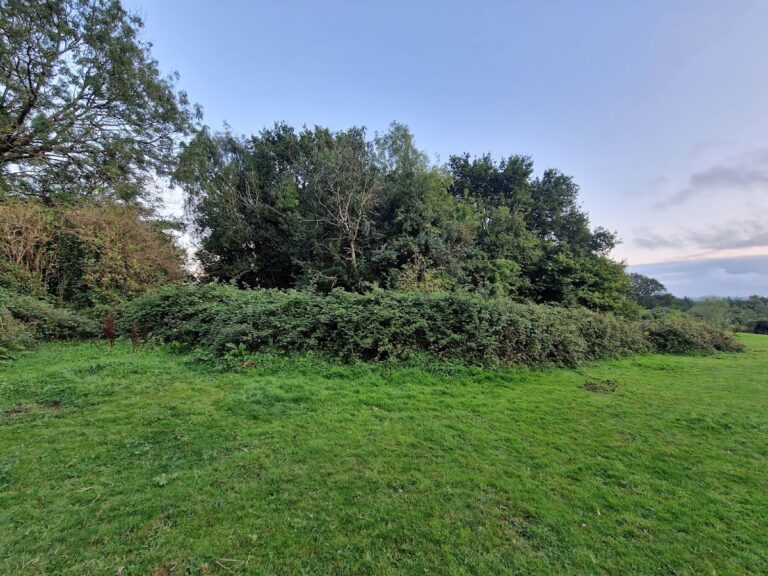
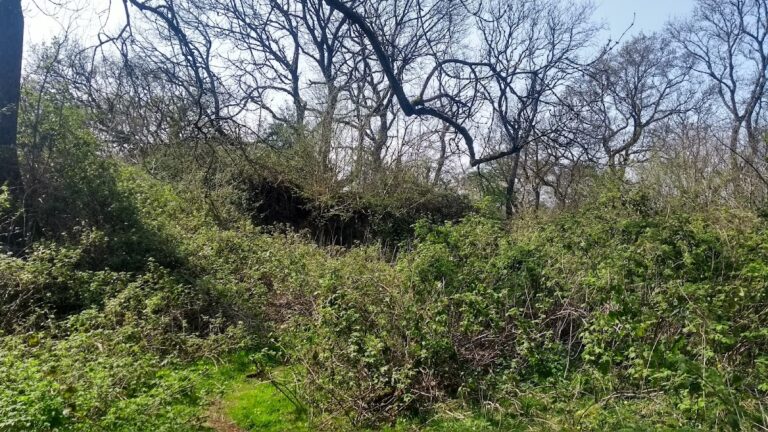
The castle stands at an elevated position of about 144 metres above sea level. The ground is hilly to the north and flatter to the south, with the land generally sloping southward across an area mainly covered by grassland. This elevated setting appears to have provided a strong defensive position and extensive views over the surrounding country.
Tower and outer walls
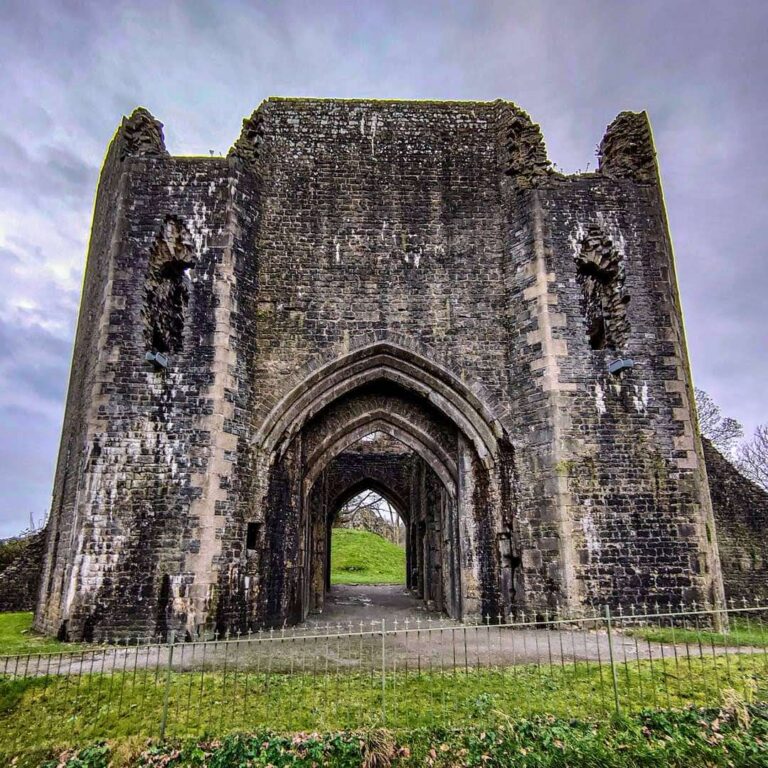
Only part of a tower and sections of the outer walls remain standing. The surviving masonry forms the visible core of the ruined castle, including the gate whose completion was ordered in 1297. The remains are described as neglected, and the fragmentary tower and wall sections provide the principal surviving evidence of the site’s fortified construction.
Parks and surrounding farms
The castle appears to have been associated with two large parks. Their traditional name survives indirectly in the names of nearby farmhouses, which have been regarded as confirming the former association. The parks themselves are not otherwise described, but the surviving farmhouse names preserve part of the landscape tradition connected with Llantrisant Castle.