Penllyn Castle: A Norman Castle and Victorian Country House in Wales


Site at a Glance
- Rating
- 5
- Popularity
- Very Low
- Country
- United Kingdom
- Primary era
- Modern
- External website
- Open
- Eras represented
- Medieval, Early Modern, Modern
- Civilizations
- Norman
- Site type
- Domestic
- Remains
- Manor House
On this page8 sections
History
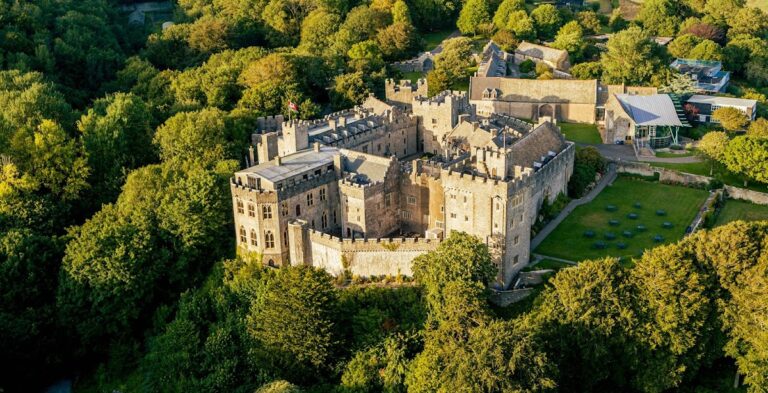
Penllyn Castle is a Norman-style country house in the United Kingdom, built in 1135 by Robert Fitzhamon during his occupation of Glamorgan. Fitzhamon was a Norman lord and military leader associated with Norman expansion in south Wales. The castle’s early date supports the academic theory that it was among the first Norman structures built in the area, when strong masonry towers and fortified enclosures were characteristic of Norman military architecture.
Norman Origins and Medieval Use
The early castle included an oblong tower and stood in a high position overlooking the valleys of the River Thaw and the Ewenny River. It was reportedly attacked by Owain Glyndŵr, the Welsh prince who led the early-fifteenth-century Welsh revolt against English rule.
Tudor and Eighteenth-Century Transformation
During the Tudor period, the Turbeville family built a manor house within the remaining castle grounds. The former keep was incorporated as one corner of the new house, linking the later residence directly to the medieval stronghold.
Between 1780 and 1790, a new manor house was built for Miss Gwinnett. The earlier manor house was subsequently converted into a stable block and later became derelict, adding another change of use to the estate’s long architectural development.
Homfray Rebuilding and Later Ownership
John Homfray purchased Penllyn Castle in 1846 after returning from Boulogne, where his father, the ironmaster Jeremiah Homfray, had lived to escape creditors after his bankruptcy. John Homfray rebuilt the estate between 1846 and 1860 in a Tudorbethan style, a nineteenth-century revival that combined features associated with Tudor and later medieval English buildings. The work was intended to complement the earlier Turbeville construction.
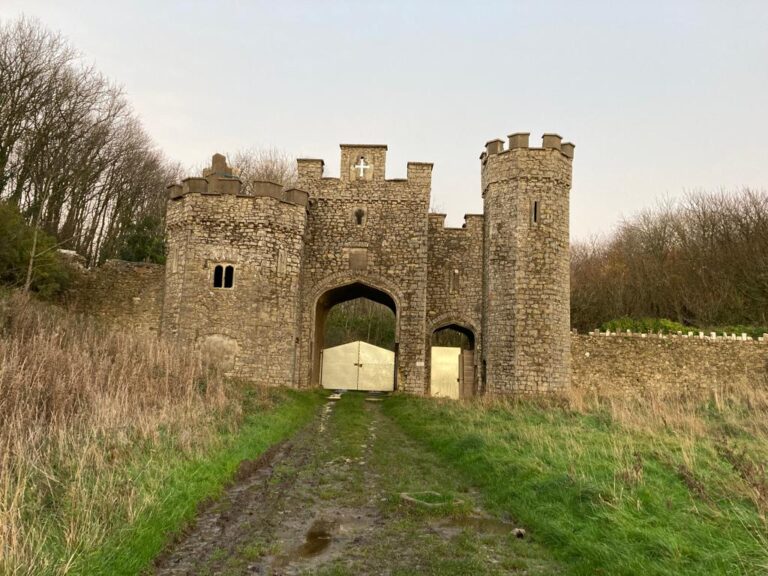
In 1961, the castle was sold to the Cory family to meet death-duty expenses. Terence and Judith Edgell bought it in October 2018 with the intention of restoring it and using it as their family home. The entrance lodge is a Grade I listed building, meaning that it has exceptional national architectural or historic interest in the United Kingdom. The Victorian manor house is Grade II listed, a designation for special architectural or historic interest.
Remains
Penllyn Castle’s surviving fabric brings together early Norman masonry, Tudor-period work, the late-eighteenth-century manor-house phase, and the nineteenth-century rebuilding. The estate occupies high ground above the River Thaw, with the original castle remains positioned along the edge of a low cliff.
Norman Castle Remains
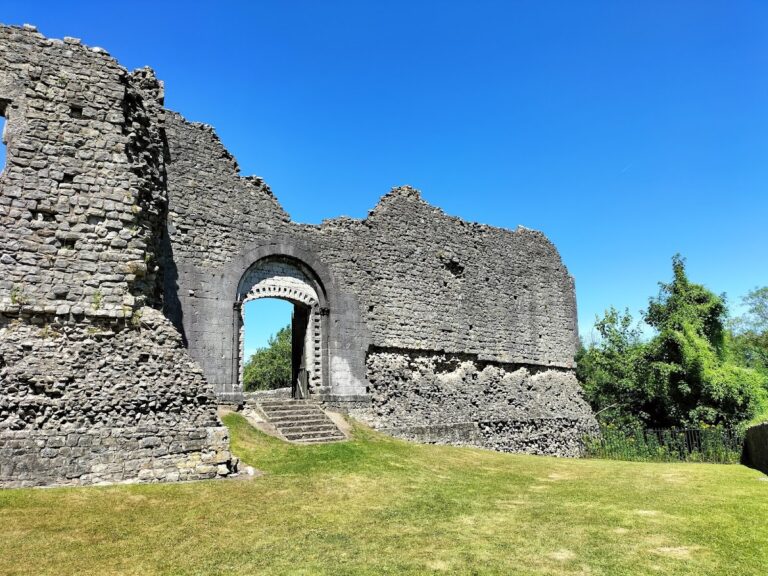
Two principal walls of the original castle survive beside the cliff above the River Thaw. Near their bases, six courses of herringbone masonry remain visible. This arrangement of masonry is associated with early Norman construction. The original oblong tower formed part of the castle, while the former keep was later absorbed into the Tudor manor house.
Manor Houses and Stable Block
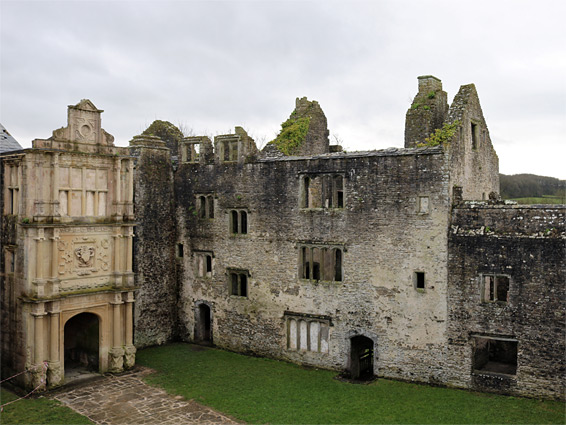
The Tudor manor house incorporated the former keep as one of its corners, preserving a physical connection between the medieval castle and the later residence. The manor house built for Miss Gwinnett between 1780 and 1790 was largely demolished during John Homfray’s rebuilding. Its predecessor, converted into a stable block, survives in a semi-derelict state.
Victorian Estate Buildings
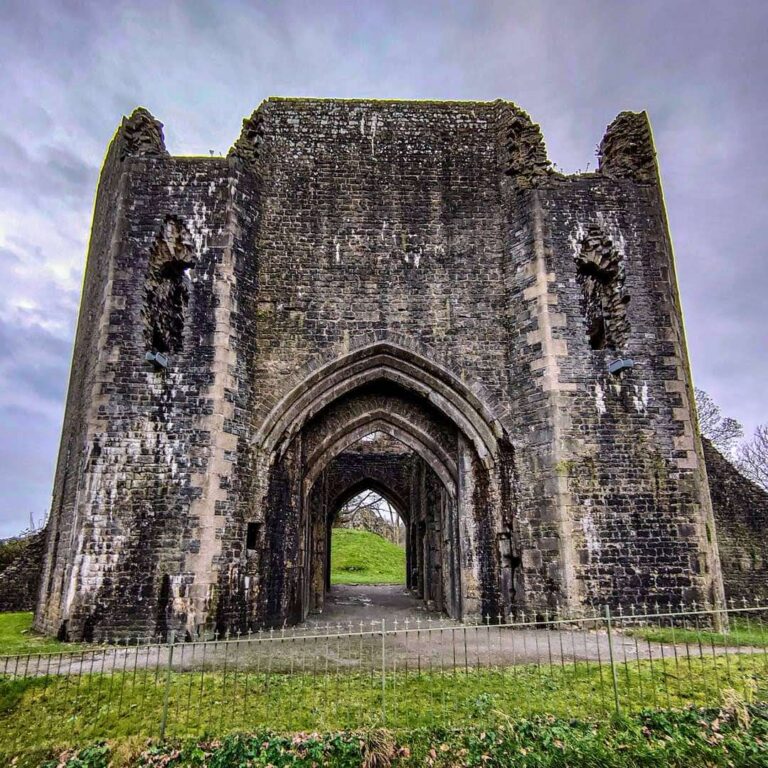
John Homfray’s nineteenth-century works included a new entrance lodge and a replacement manor house. The manor house was built in a contemporary Victorian style with stucco-plaster walls, while the wider rebuilding adopted Tudorbethan forms intended to work with the earlier Turbeville elements. Together, these structures give the estate its mainly Victorian character while retaining earlier phases of construction.
Nearby sites