Leña Square: A Historic Market Square in Spain
Site at a Glance
- Popularity
- Medium
- Country
- Spain
- Primary era
- Early Modern
- Eras represented
- Medieval, Early Modern, Modern
- Civilizations
- Crown of Castile, Spanish
- Site type
- Economic
- Remains
- Market
On this page10 sections
History
Leña Square is a historic market square in Spain whose origins date to the 15th century. From the late Middle Ages, its market served household needs by selling firewood and pine cones for ovens, fireplaces, and other heating.
Medieval market and changing names
The square was known as Eirado or Eiradiño in the late Middle Ages, and it was called Eirado in 1635. Sellers came from nearby villages. Mule-cart drivers brought firewood, while women carried bundles of twigs and baskets of pine cones. Mondays were especially busy, with oak wood brought in for bakers’ ovens.
In 1854, the square took the firewood-related name Leña, also used in the form Eiradiño da Leña. It was renamed Jaime Vera Square in 1931, after the Spanish physician and Republican who helped found the Socialist Party. In 1950, its official name returned to Eiradiño da Leña.
Redesign and changing uses
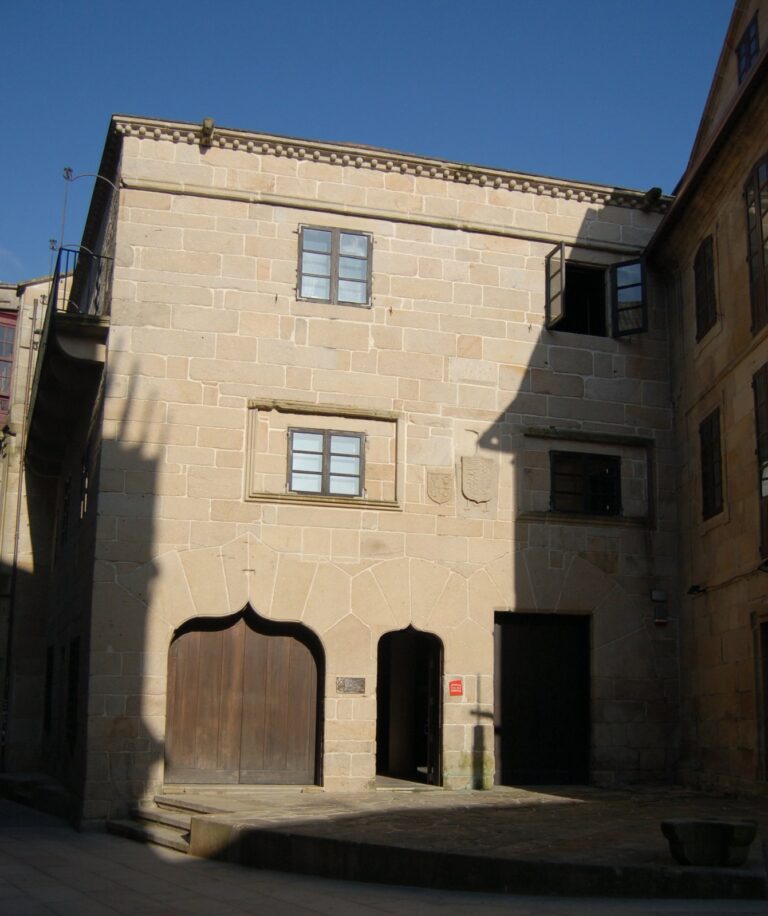
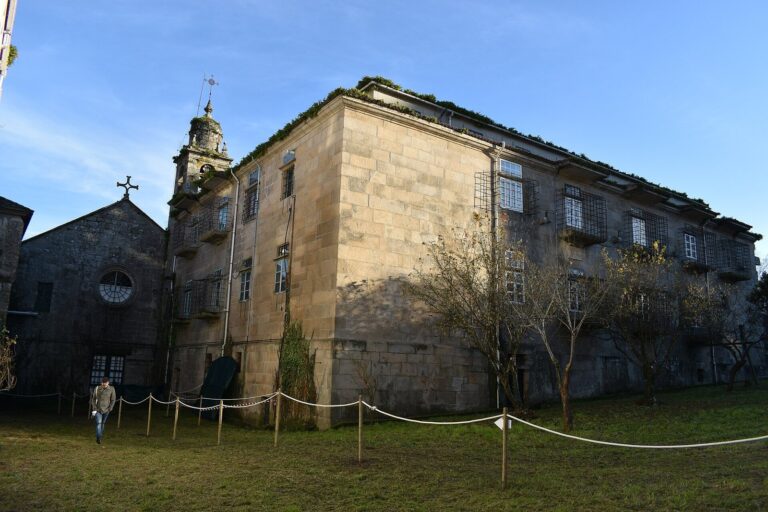
The square was enlarged and redesigned in the 18th century, when the two palaces on its eastern side and the surrounding traditional Galician houses were built. The Castro Monteagudo Palace served several purposes over time. Its ground floor was used for shops and restaurants, including the La Flor restaurant in the early 20th century, while a boys’ school occupied the upper floor. It opened to the public as part of the Pontevedra Museum on 10 August 1929. The García Flórez Palace housed a teacher-training college from 1881 to 1930 and was inaugurated as a museum on 15 August 1943.
At the request of Castelao, a prominent Galician artist, writer, and political figure, the granite cross was placed in the square around 1941. It had been broken into several pieces, and Castelao temporarily restored it while working on Galicia’s stone crosses. The square returned to pedestrian use on 7 April 1990. Restaurants are among its current commercial uses. It has also inspired drawings, engravings, watercolors, oil paintings, and writing by authors and poets including Cándido Viñas Calvo.
Remains
Plan and position
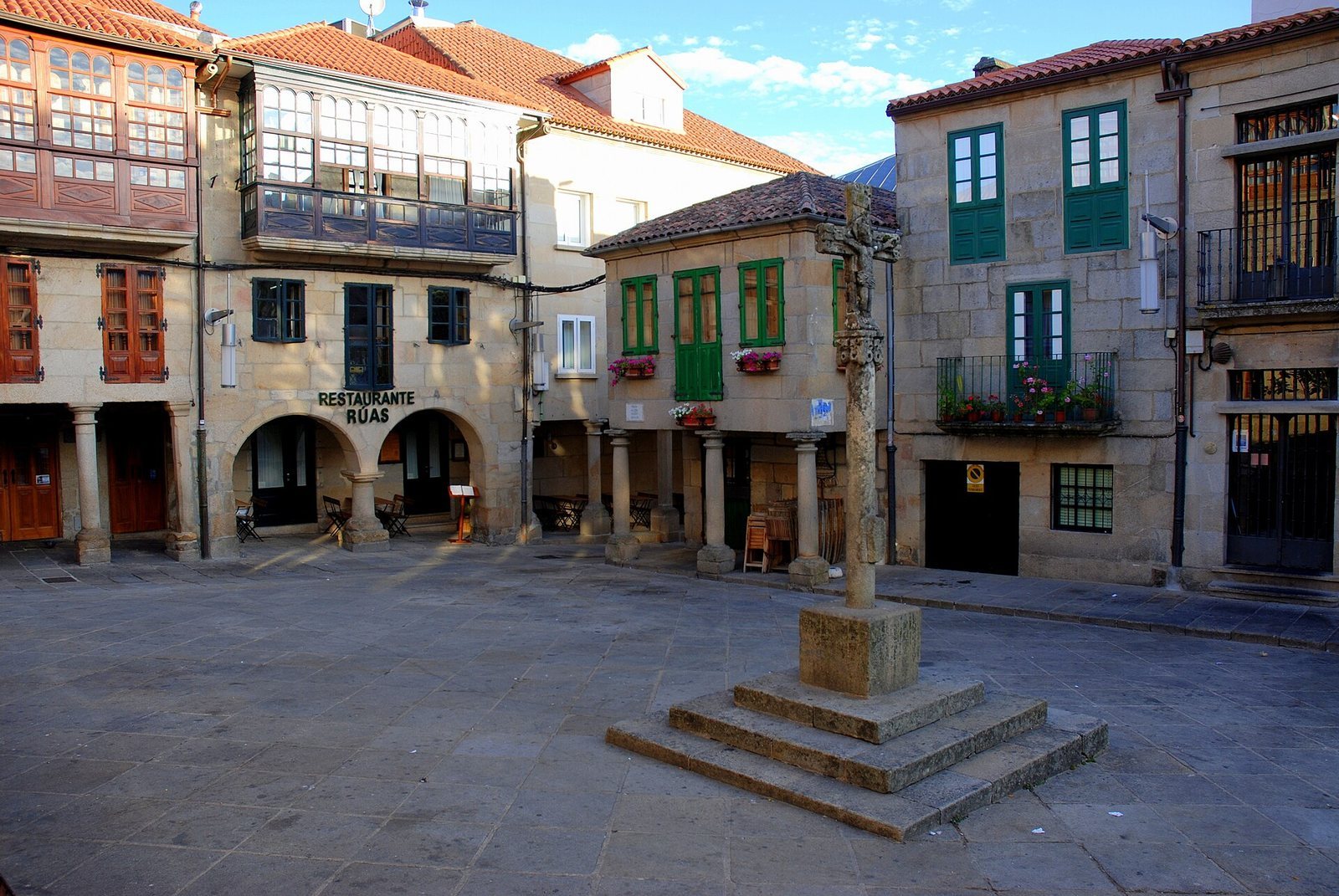
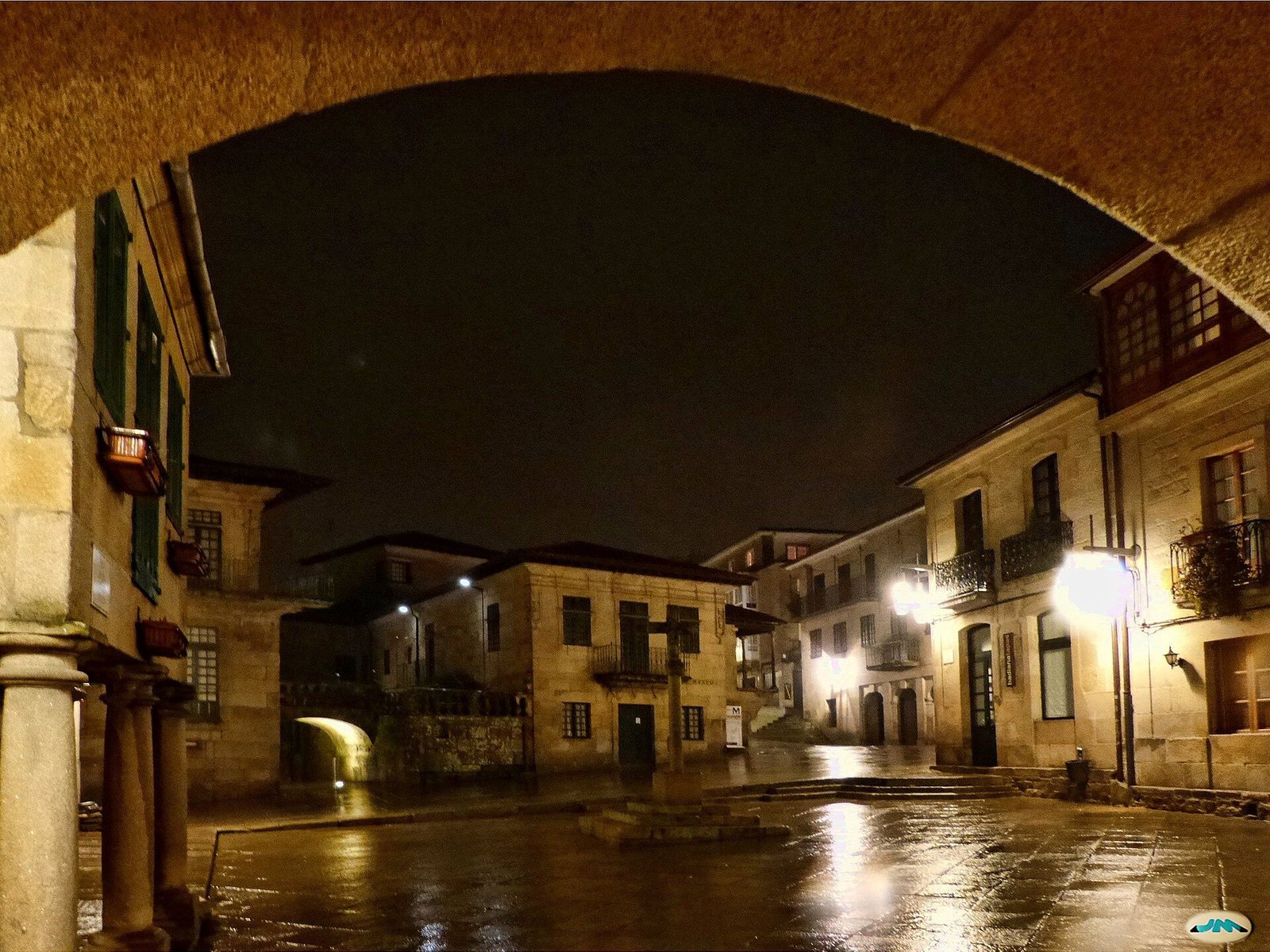
The square has an irregular rectangular outline. Two 18th-century palaces occupy its eastern side, and traditional Galician houses border the north, south, and west. Pasantería and Figueroa streets converge here. The square measures 13 m by 18 m, has a stated area of 255 m², and stands at an elevation of 10 m.
Traditional houses
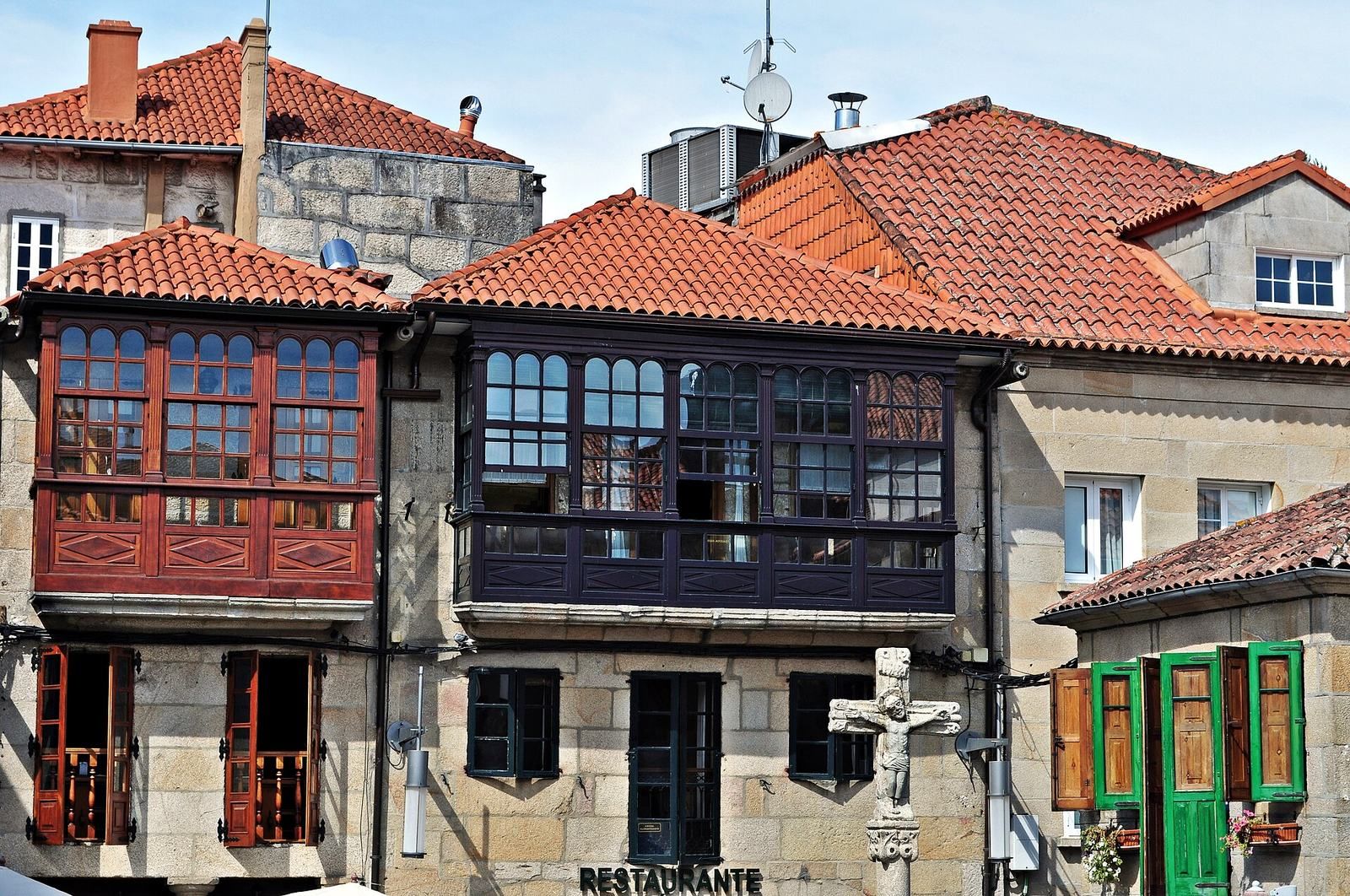
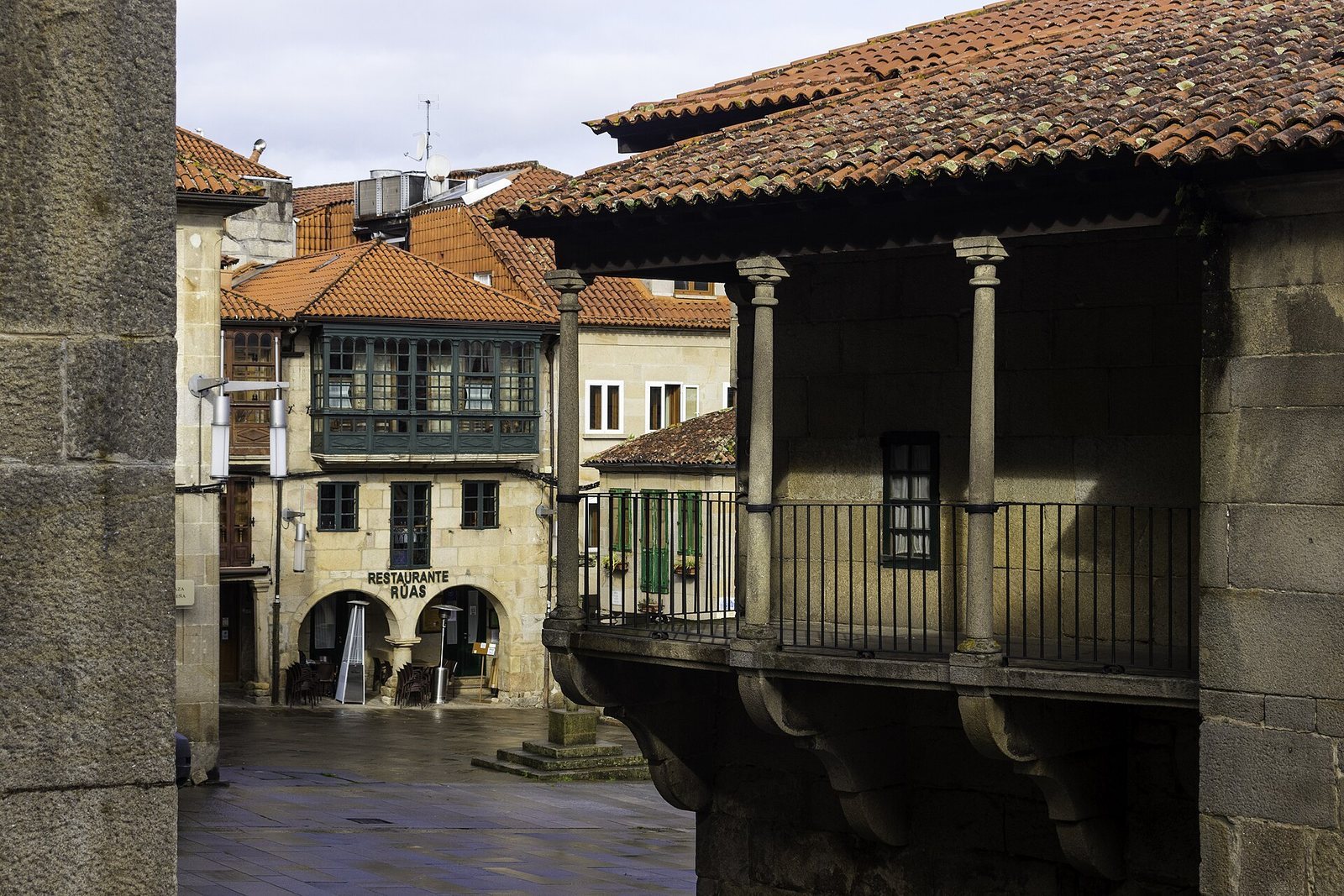
The one- and two-storey houses have wooden arcades and galleries on their western and southern sides. Balconies decorated with flowers face the square on the north and south. The upper floors were formerly used as residences.
Central stone cross
The 15th-century granite cross, brought from Caldas de Reis, stands at the square’s centre. It rests on a stepped platform of three levels, above which is a cubic base with slightly bevelled edges. A cylindrical shaft without a separate foot supports a cube-shaped capital with vertical ornament. Christ appears crucified on the front of the cross; on the reverse, the standing Virgin holds the Child Jesus.
Eastern palaces
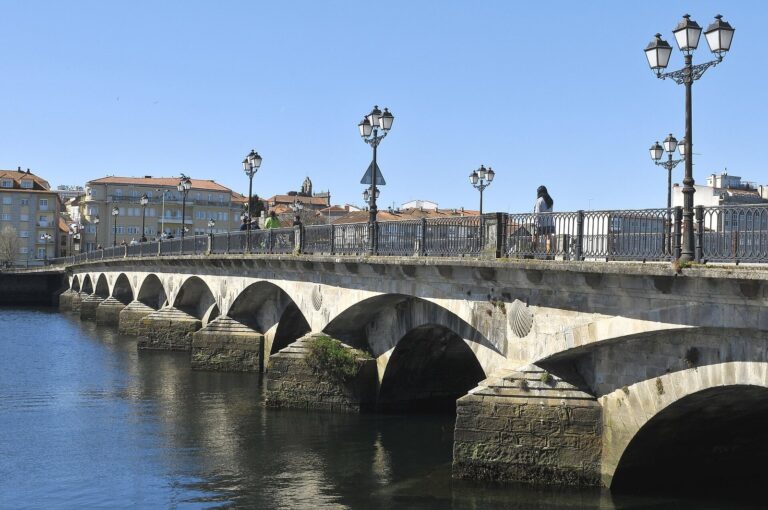
The two palaces are Baroque, an ornate architectural style, and a granite arch bridge connects them.
Castro Monteagudo Palace
On the southeast side, the Castro Monteagudo Palace dates to 1760. Its balcony rests on large projecting stone supports.
García Flórez Palace
The García Flórez Palace stands to the northeast. Its large stone coat of arms includes a helmet, while stone figures at the roof corners represent hope and strength.