Burgo Bridge: A Medieval Crossing on the Portuguese Way in Pontevedra
Site at a Glance
- Rating
- 4.4
- Popularity
- High
- Country
- Spain
- Primary era
- Medieval
- Eras represented
- Medieval, Early Modern, Modern
- Civilizations
- Crown of Castile, Kingdom of León, Spanish
- Site type
- Infrastructure
- Remains
- Bridge
On this page13 sections
History
Burgo Bridge is a medieval granite crossing over the Lérez River in Pontevedra, Spain, whose construction began in the middle decades of the 12th century. It carries the Portuguese Way, a pilgrimage route to Santiago de Compostela, and served trade and strategic travel as well as pilgrims.
Early crossings and the medieval town
The bridge stands in marshland near the mouth of the Lérez, a crossing that may have been important for travel since prehistoric times. The medieval bridge followed an earlier crossing traditionally regarded as Roman. Roman Road XIX, listed in the Antonine Itinerary, an ancient guide to roads and their stages, is said to have crossed the river here.
In 1165, Ferdinand II of León and Galicia and Afonso I of Portugal made peace at the old bridge. The event is known as the Peace of Lérez, and its record is also the earliest documentary evidence for Pontevedra as an urban settlement. In 1169, a Leonese king granted the settlement a charter intended to attract inhabitants and develop a town to protect the crossing.
Construction of the medieval bridge took more than a century and appears to have remained unfinished in 1399. The crossing served commerce and pilgrims, and had military importance amid tensions with territories that would later form Portugal. For a long period it was the only crossing of the Lérez on the Portuguese Way. The archbishops of Santiago also valued its importance to pilgrims. In 1180, Pontevedra passed from royal jurisdiction into their domains, where it remained for much of its history. A combat between Pero Niño and Gómez Domao took place at the bridge in 1397.
Damage, conflict, and repair
In the 15th century, a new embankment built to deepen the city’s port led to the loss of one of the bridge’s arches. Later changes in transport, natural and human-caused damage, and sediment accumulating in the riverbed brought repeated alterations and repairs. A major flood on 26 November 1646 nearly destroyed the bridge. Repairs followed in 1674, with more extensive restoration in 1697 and 1698.
During the British attack on Pontevedra in 1719, troops under General George Wade and commanded by Brigadier-General Honywood burned the prison and a defensive tower at one end of the bridge. A tower was rebuilt after the attack, but its remains were demolished around 1805 and 1806. The bridge’s castle was in ruins by 1732, and its surface was in very poor condition by 1780.
Widening and modern changes
In the late 18th and early 19th centuries, the arches were widened and the turrets at the ends were demolished on the initiative of Archbishop Malvar of Santiago. During the Spanish War of Independence, when Spanish forces resisted Napoleonic French rule, skirmishes took place between the bridge and the prison, then occupied by French troops. Pontevedra’s defenders considered making their stand at this bridge or at Sampayo Bridge, but chose the latter. Pedro de Acuña oversaw repair and consolidation work in 1823.
A widening and consolidation project began in 1886. Replacing the bridge was considered, but repair was chosen instead. Work included replacing damaged stones, repointing joints, and lengthening the first five arches on the town side. The approved project provided a five-metre carriageway and two metres of combined footpaths, as well as for a temporary wooden bridge beside it. The stone parapet was removed in 1890 and a cast-metal railing installed in 1891.
Engineer Juan Llansó de Viñals proposed a major widening and renovation in 1949. Work carried out in 1953 and 1954 added two vehicle lanes and footpaths on both sides. From 2019 to 2020, the bridge was converted to fully pedestrian use.
Remains
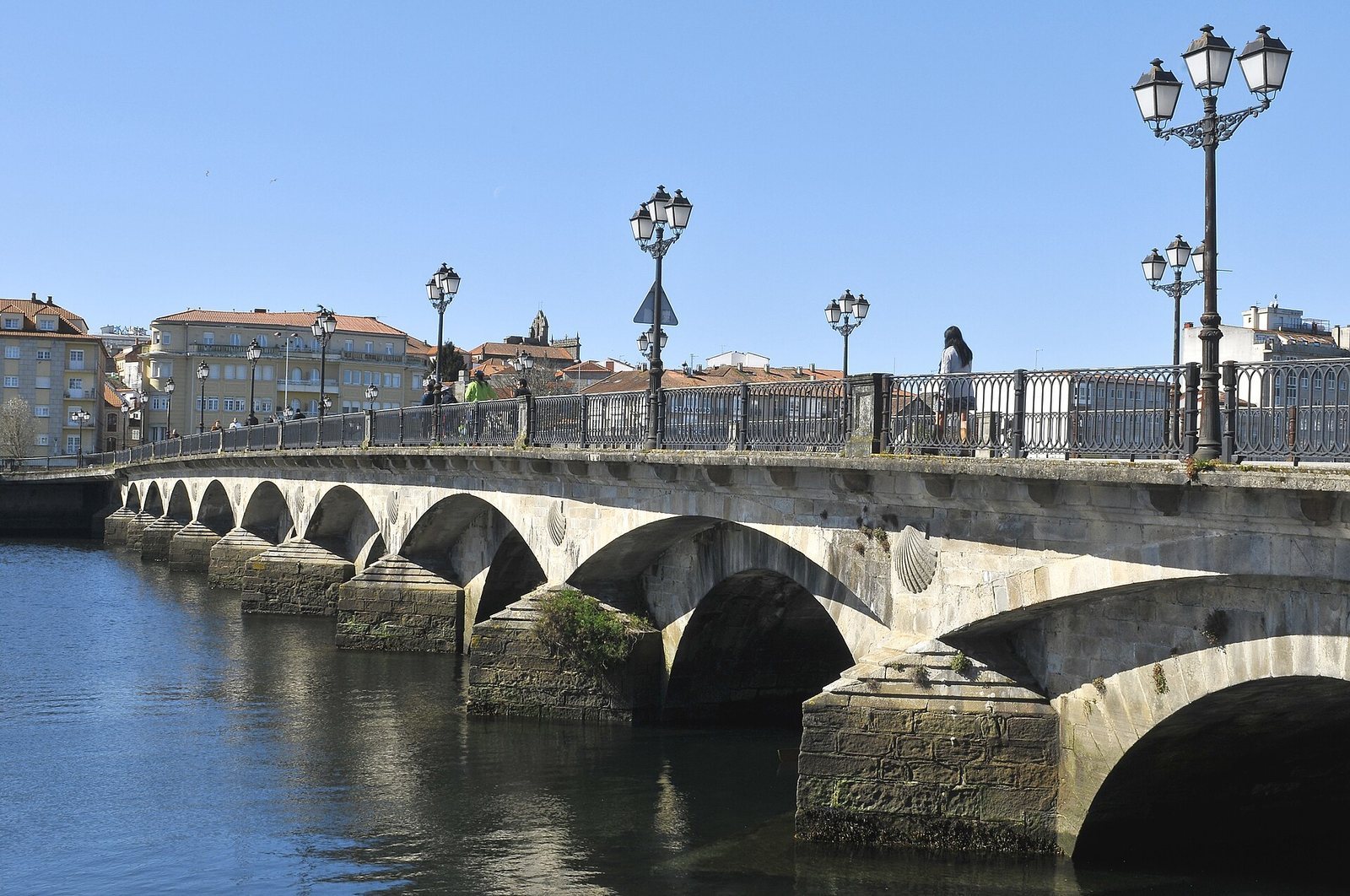
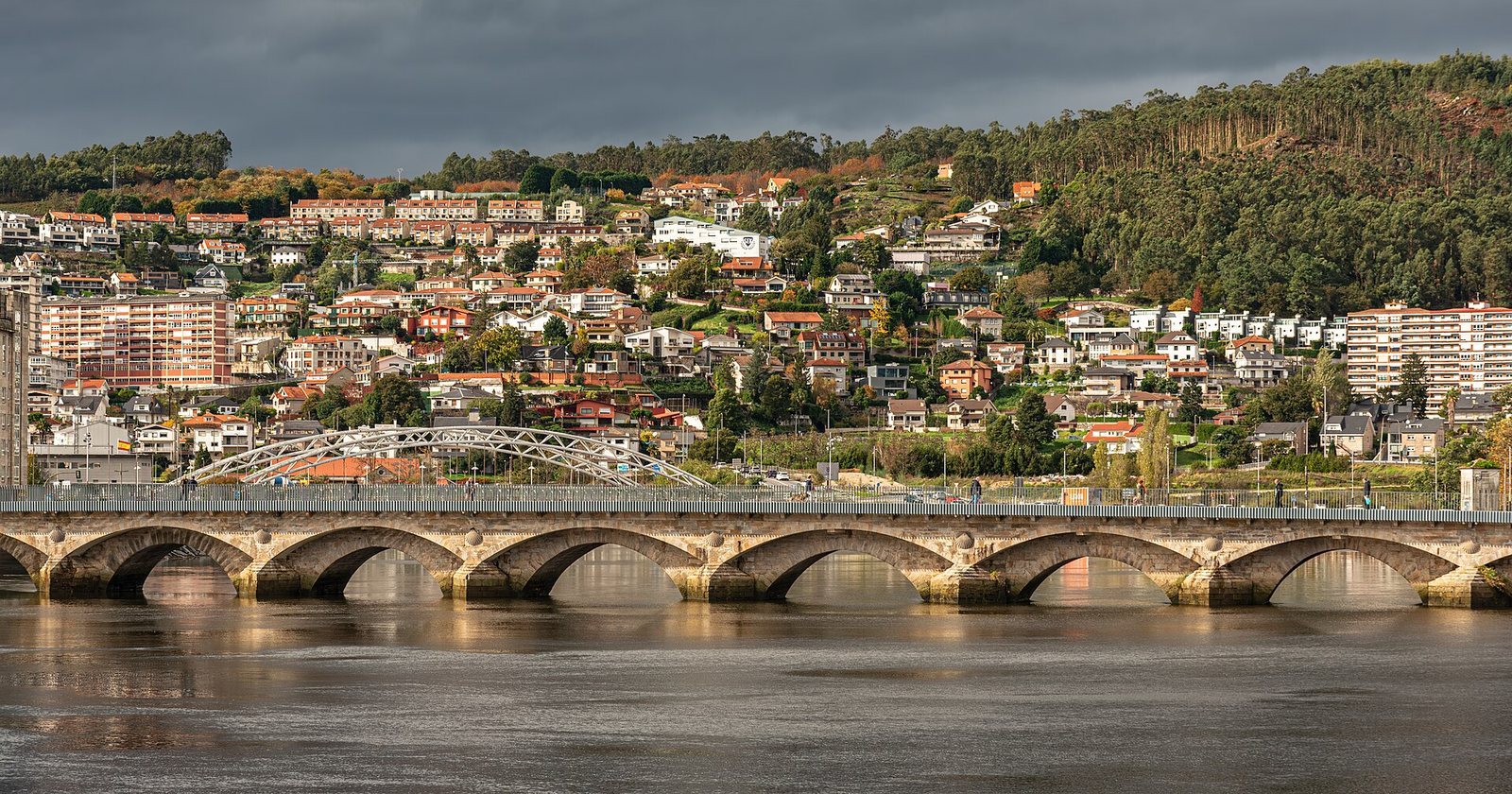
The bridge crosses the Lérez north of Pontevedra’s historic centre and south of the Burgo neighbourhood. Its granite structure is 158 metres long and 11.2 metres wide. The present bridge has eleven low, semicircular arches, ten of which are visible; concrete platforms conceal the eleventh.
Bridge structure
Present form
Projecting cutwaters, parts of the bridge supports shaped to deflect flowing water, extend from the supports between the arches. The pedestrian surface is paved in granite. A grey, galvanised-steel railing, 1.10 metres high, has integrated lighting, while small blue lights mark the Portuguese Way.
Medieval design
The original 12th-century bridge was about 2.9 metres wide. It had two end supports, each roughly 30 metres long, joined by a central section with at least fifteen arches. Its southern end began at the edge of the medieval borough, at the place now occupied by Calle del Puente, north of the historic centre.
Archaeological remains at the southern end
Buried arches
Archaeological remains of the 14th and 15th arches form part of the area at the bridge’s southern end. Excavations in 2006 revealed these arches in a part of the site where construction over the centuries had buried portions of the medieval bridge and port. A further buried arch was rediscovered during works in 1888; arches found in 1831 had been left buried.
Medieval harbour
The southern archaeological area also includes remains of the medieval port. Excavation in 2006 revealed a 15th-century jetty with a blind pointed arch, a pointed arch filled in rather than open. The port area is also identified with Galicia’s only preserved medieval wharf, dated to the 16th century.
Roman milestones
A milestone is a stone marker carrying distance or travel information along a road. A milestone dedicated to Emperor Hadrian and dated to AD 134 was found during excavations in 1988. Two more were recovered in 2006, one dedicated to the 1st-century emperor Nerva and the other to the 4th-century emperor Maximinus Daia. These finds provide evidence for the Roman-road connection associated with the crossing.
Pilgrim and commemorative features
Stone scallop-shell medallions are set above the bridge supports between the arches. The shell is a traditional symbol of pilgrimage; the medallions were commissioned from Raymundo Vázquez in the early 1950s and carved by one of his stonemasons. A stone cross that once stood in the bridge’s centre was moved in the mid-19th century to the vicinity of Plaza de Alonso de Fonseca, beside the Basilica of Saint Mary Major. The bridge, a tower, and the cross also appear on Pontevedra’s coat of arms.