Castleknock Castle: A Norman Fortress in Dublin, Ireland


Site at a Glance
- Rating
- 5
- Popularity
- Very Low
- Country
- Ireland
- Primary era
- Medieval
- External website
- Open
- Eras represented
- Medieval
- Civilizations
- Norman
- Site type
- Military
- Remains
- Castle
On this page14 sections
History
Castleknock Castle is a ruined Norman fortress at Castleknock in Dublin, Ireland, founded in the late twelfth century after the Anglo-Norman conquest. Built by the Norman knight Hugh Tyrrel, it occupied a strategic position overlooking the route from the west toward Dublin. Its Irish name, Caisleán Cnucha, preserves the older name Cnucha, which was associated with the site before the castle was erected.
Before and after the Norman conquest
The site had an earlier historical and traditional importance. Medieval annals place the death of Congalach at Cnucha in 726, apparently in his own fort. The location appears in different annalistic forms, including Cnucha and Castleknock. In 1171, Castleknock served as the final rallying point for the forces of Rory O’Connor, the last traditionally recognized High King of Ireland, during his unsuccessful effort to drive the Anglo-Normans from the Dublin area.
After the conquest, Hugh Tyrrel received the barony of Castleknock and established the castle in the late twelfth century. Its position gave it command over the western approach to Dublin, and the fortress was strengthened with defensive methods available at the time. Richard Tyrrel, the second Baron of Castleknock, founded St. Brigid’s Abbey in 1184 on the site now occupied by a Protestant church. The abbey continued until the sixteenth-century dissolution of the monasteries, after which it was demolished and replaced by the church. Castleknock also supplied two canons to St. Patrick’s Cathedral, and two cathedral prebends retained titles connected with the area.
The Bruce campaign
Castleknock was captured around 1316 or 1317 during the Bruce campaign in Ireland. Edward Bruce, the brother of Robert the Bruce, king of Scotland, led Scottish-backed forces advancing toward Dublin with an army of about 20,000 men. Hugh Tyrrel was taken prisoner, and his wife was also said to have been captured. The castle became a headquarters before the army withdrew after failing to secure Dublin. The prisoners were later released when a ransom was paid.
A separate tradition tells of Eibhleen O’Brinn, the daughter of a Wicklow chieftain. According to the story, Roger Tyrrel, Hugh Tyrrel’s brother, abducted her and confined her in a castle tower. She killed herself with a brooch pin, after which her relatives and allies attacked Castleknock and Roger Tyrrel was killed in battle. The tale gave rise to the legend of the Lady of the Castle, or the White Lady of Castleknock, whose white-clad ghost was said to wander around the castle at midnight. An anonymous nineteenth-century poem also preserved the story.
Seventeenth-century warfare
Castleknock became involved in the Wars of the Three Kingdoms, the interconnected civil and religious conflicts that affected England, Scotland, and Ireland during the 1640s and early 1650s. In 1642, an English Protestant force commanded by the Earl of Ormond besieged the castle with 4,000 infantry and 500 cavalry. Lady de Lacy, a relative of the Earl of Fingal, defended it with about 50 men while her husband served with the Irish Catholic forces.
After four days of resistance, Lady de Lacy ordered the castle’s valuables to be burned and its surplus weapons destroyed. The defenders then set the castle on fire and made a final sortie. The besiegers suffered heavy losses, and Lady de Lacy was captured. Later in the same year, General Monck, a leading English Parliamentary commander, took the castle after a heavy artillery bombardment. About 80 defenders were killed, while surviving defenders were tried and hanged on the castle walls. Monck left a garrison because the damaged fortress still held an important strategic position.
In 1647, Owen Roe O’Neill, an Irish Confederate commander, besieged Castleknock while it was held by an English garrison. Colonel Trevor’s cavalry was defeated, and O’Neill’s forces subsequently retook the castle. After the wars, the Commonwealth government ordered the battered fortress to be dismantled, and the Castleknock estate was divided among private tenants.
College and cemetery
In 1834, forty acres at Castleknock, including the ruins, were sold to John McCann, a Vincentian friar. He established St. Vincent’s Ecclesiastical Seminary there, now known as St. Vincent’s Castleknock College. The Vincentians, also called the Congregation of the Mission, are a Catholic religious congregation associated with missionary and clerical work.
The ground enclosed by the former castle walls later became a cemetery for priests associated with St. Vincent de Paul and for missionaries. The ruined castle remains protected within the college grounds.
Remains
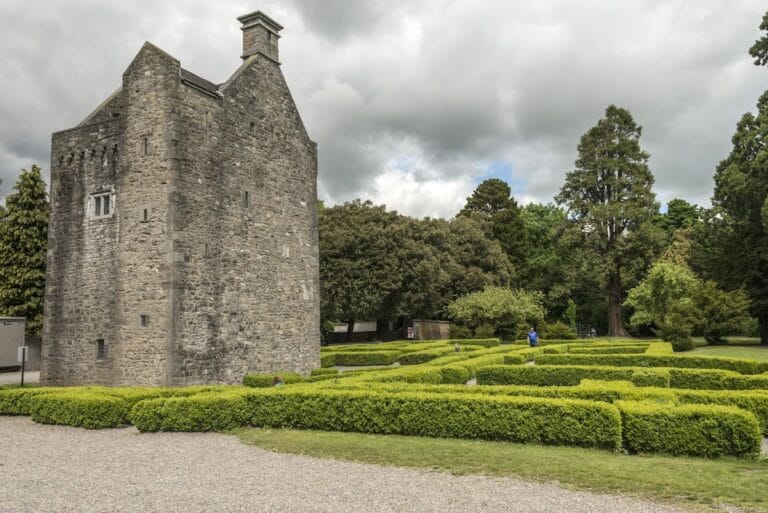
Castleknock Castle was a lowland Norman stone fortification built on two mounds along an esker, a long ridge of sand and gravel formed by meltwater beneath or within a glacier. The position extended between Galway and Dublin and commanded the route toward Dublin from the west. Its defensive layout combined a central polygonal keep, an attached building, enclosing walls, towers, battlements, narrow openings, and two deep moats.
Keep and defensive enclosure
Polygonal keep
The principal structure was a polygonal keep, the main fortified tower of a Norman castle. It formerly stood about 24 metres high. A large, squat building was attached to the keep, forming part of the main mass of the fortress. The surviving structure is now fragmentary, following the artillery damage of the seventeenth-century conflicts and the later dismantling ordered under the Commonwealth.
Curtain wall and towers
A curtain wall enclosed the castle compound and incorporated multiple towers. Heavy battlements, deep-set or narrow openings, and two deep moats formed part of an arrangement intended to resist battering rams and projectile attacks. The remaining masonry is heavily covered by ivy, while large trees surround the site and often obscure the ruins from the road. The remains become more visible in winter when the trees lose their leaves.
Surrounding features
Windmill Hill
A small mound west of the main Castleknock College grounds is known as Windmill Hill. A water tower now occupies the mound. Its earlier structure was built as an observatory by a previous owner.
Castle cemetery
The former castle enclosure is used as a cemetery, including burials associated with the Vincentian community and local priests. This later use occupies the ground within the former defensive boundaries.
Site of St. Brigid’s Abbey
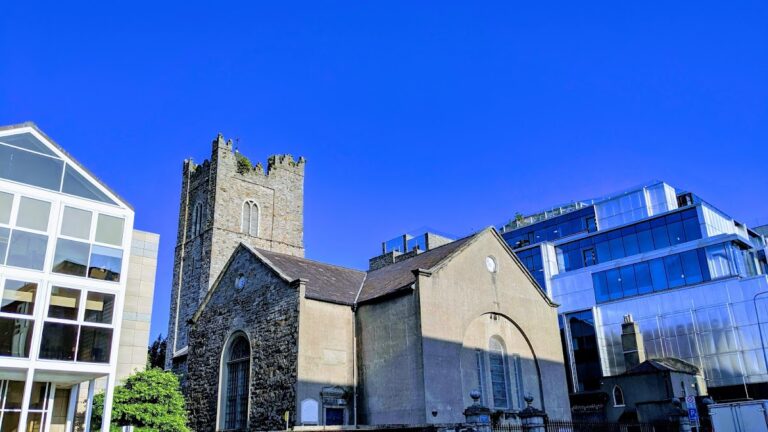
The former site of St. Brigid’s Abbey is occupied by a Protestant church. The church replaced the medieval abbey after the abbey was demolished following the dissolution of the monasteries.
Earlier remains and visual records
In 1861, workers opening the grave of Reverend Thomas Plunket discovered what was described as an ancient altar tomb or cromlech inside the castle. A cromlech is a prehistoric megalithic monument often associated with a tomb or stone-built ritual structure. The structure was destroyed during the work. A human skeleton lay beneath a large flat stone, and some bones apparently disintegrated into white dust when exposed to air. The interpretation of the find as a prehistoric or druidic burial monument remains traditional or conjectural.
The oldest known drawing of Castleknock Castle, made by Francis Place, shows the fortress already in ruins. It depicts the remains as less deteriorated and less heavily wooded than they are today.