Lány Castle: A Presidential Residence and Renaissance-Baroque Manor House in Czechia


Site at a Glance
- Rating
- 4.7
- Popularity
- Medium
- Country
- Czechia
- Primary era
- Early Modern
- External website
- Open
- Eras represented
- Early Modern, Modern
- Civilizations
- Habsburg
- Site type
- Domestic
- Remains
- Castle
On this page13 sections
History
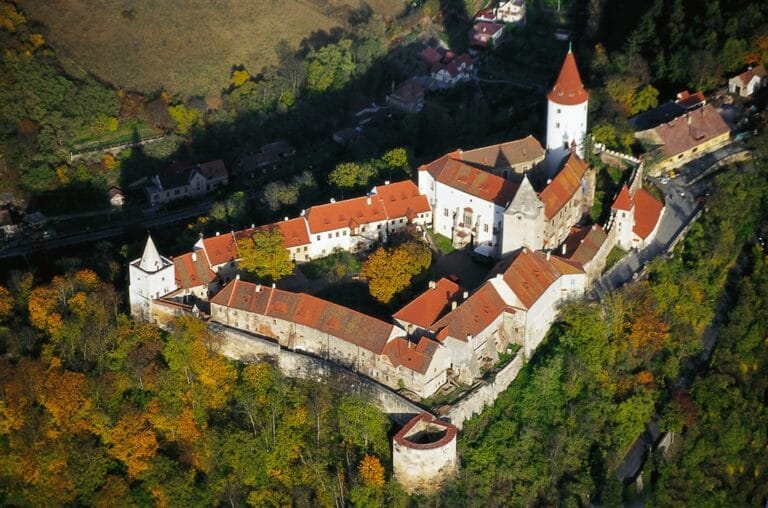
Lány Castle is a Renaissance and Baroque manor house in Czechia, rebuilt as a royal hunting and summer residence from 1592 on the site of an earlier fortress. Located at the southern edge of Lány beside the Křivoklát forests, it later became an important Fürstenberg residence and, after 1921, the country retreat and workplace of the Czechoslovak president.
Medieval Origins and Renaissance Rebuilding
A wooden fortress or dwelling stood at Lány by 1392, when the settlement belonged to Hašek of Lány. It may first have been a wooden residence within a manorial farmyard. Lány later became part of the Stochov estate, acquired in 1528 by the Žejdlice of Šenfeld family. A Renaissance fortress was probably built during their ownership.
Jiří Bořita of Martinice, a senior provincial official and owner of the neighbouring Smečno estate, purchased Lány in 1581. The royal chamber of Emperor Rudolf II acquired the estate in 1589 and permanently attached it to the royal Křivoklát estate. Křivoklát Castle no longer offered sufficiently comfortable accommodation for royal stays in the late sixteenth century, so the Lány fortress was rebuilt from 1592 as a one-storey Renaissance hunting and summer residence.
Wallenstein and Fürstenberg Ownership
In 1658, the Křivoklát estate, including Lány, was pledged to Johann Adolf of Schwarzenberg. Count Arnošt Josef of Wallenstein acquired it as hereditary property in 1685. The estate was economically important to him, and he established the Lány game preserve, an enclosed and managed area reserved for protecting and hunting wild animals, to combat widespread poaching.
The preserve originally covered almost 10,000 hectares and became the largest hunting preserve in Bohemia. Its wooden fence was replaced by a 27-kilometre-long wall in 1787. Emperor Charles VI stayed at Lány in 1723 during his visit to Bohemia for his coronation as King of Bohemia. The Renaissance residence otherwise remained largely unchanged during Arnošt Josef of Wallenstein’s ownership.
Johann Josef of Wallenstein began a major reconstruction shortly before his death. The building gained an additional storey in 1730. His daughter and heir, Maria Anna Theresa, enlarged the adjoining church between 1748 and 1752. She had married Prince Joseph Wilhelm Ernst of Fürstenberg in 1723, and the Fürstenberg family retained the Křivoklát estate and Lány until the twentieth century. The family ranked among Bohemia’s largest landowners, and around the turn of the nineteenth and twentieth centuries the estate covered approximately 39,000 hectares.
Prince Karl Egon II of Fürstenberg altered the castle again between 1821 and 1825, adding a second floor. The moat was filled in and the surrounding wall demolished in 1849 and 1850, although more extensive rebuilding plans were not carried out. Neo-Gothic stables and greenhouses were constructed in 1861. After the Fürstenberg Palace in Prague was sold in 1883, Lány became the family’s principal residence. Further work in 1902 and 1903 expanded the habitable attic spaces on the third floor, bringing the castle to 60 rooms.
Conversion into a Presidential Residence
After Czechoslovakia was established, the state sought a presidential residence outside Prague. Legislation enacted on 15 April 1920 authorized the National Assembly to acquire secondary official residences for the president. The Czechoslovak government purchased the Lány estate from Max Egon Fürstenberg in July 1921. The acquisition included Lány, Ploskov, about 5,000 hectares of land, the Lány, Běleč, and Ploskov forest districts, and church patronage with associated easements in Lány.
The castle, park, and ancillary buildings were valued at 12.5 million Czechoslovak crowns, while the remaining property was valued at 12.37 million crowns. The stated total was 24.87 million crowns, and the purchase price was approximately 25 million crowns. Some movable property belonging to the castle and its dependencies, along with some property of Lány Arsenal No. 3, was excluded. The state confiscated items including the library fireplace, the reserve engine and dynamo of the castle power station, and all furnishings.
The architect Jože Plečnik directed the alterations for presidential use. Work began on 2 May 1921 with the prince’s consent, and the main reconstruction took place from 15 July to 6 August. It involved 358 permanent workers and 120 workers from 33 subcontracting firms, at a cost of 3 million Czechoslovak crowns. President Tomáš Garrigue Masaryk, the first president of Czechoslovakia and a central figure in the country’s early republican history, personally approved Plečnik’s proposals, including while receiving medical treatment on Capri. The builder Karel Fiala and building technician Jaroslav Veverka supervised the work.
Masaryk arrived at Lány by special train on 11 August 1921. He used the castle as both a retreat and a quiet workplace and lived there for 17 years, with Czechoslovak legionaries providing security. He received state visitors as well as prominent cultural and scientific figures. After resigning in 1935, Masaryk and his family lived at the castle almost permanently. He died on 14 September 1937 and was buried with his wife Charlotta, son Jan, and daughter Alice in the old section of Lány municipal cemetery, rather than in the castle park.
On 16 December 1921, Austrian President Michael Hainisch and Chancellor Johann Schober visited Lány, where they signed the Treaty of Lány, also called the Treaty of Prague. It confirmed a policy of friendly cooperation between Czechoslovakia and Austria. After Masaryk’s death, the castle was used only occasionally, although legislation passed in December 1935 had granted him lifetime use of the residence.
War, Communist Rule, and the Czech Presidency
During the Second World War, Emil Hácha, president of the Protectorate of Bohemia and Moravia, frequently stayed at Lány. The Protectorate was the German-controlled political entity established in the Czech lands during the war. During this period, Lány served as the seat of the protectorate presidency, while Prague Castle remained the Protector’s official residence. The 1st Battalion of the Government Army provided security and public duties at the estate.
Lány later became a summer residence for Communist President Klement Gottwald and for subsequent Communist presidents. After 1989, it was used by Presidents Václav Havel, Václav Klaus, and Miloš Zeman. Reconstruction after 1989 included interiors designed by the architect Franziska Diana Sternberg. The radio programme Hovory z Lán became associated with presidential commentary by Václav Havel and, briefly, Miloš Zeman. On 17 December 2021, Miloš Zeman appointed Petr Fiala’s government at Lány Castle. The castle remains the official summer residence of the presidents of the Czech Republic.
The estate’s administration also changed during the twentieth century. In 1960, the Lány estate of the Office of the President of the Republic was transferred to the Agricultural University as a teaching farm, while the castle and forestry administration were placed within the joint Forest and Castle Administration of Lány. The castle, adjoining church, and castle park are protected as cultural monuments of the Czech Republic.
Remains
Lány Castle stands as a multi-storey Renaissance and Baroque residence at the southern edge of Lány, beside the northern edge of the extensive Křivoklát forests and the Křivoklátsko protected landscape area. The original hunting residence had a U-shaped plan, sgraffito decoration, and a surrounding moat. Sgraffito is a wall technique in which a surface coating is cut through to reveal a contrasting layer beneath it. The building began as a one-storey structure, gained another storey in 1730, received a further floor during the 1821 to 1825 alterations, and had its upper attic level fitted out in 1902 and 1903.
Castle and Church
Castle Interior
Plečnik’s 1921 conversion reorganized the building for presidential work and residence. The ground floor held administrative offices, kitchens, staff apartments, changing rooms, and guard rooms. The first floor served presidential functions while retaining part of its French Renaissance character. It included a balcony linked to the smoking room, a music room, a ladies’ salon, a large dining room with indirect lighting, and five salons. Hunting scenes covered the smoking room’s walls.
Four presidential rooms adjoined the salons: a waiting room, an audience room furnished as a salon, an office, and the presidential library. Much of the furniture came from Prague Castle. The second floor contained 16 rooms for the president and his family. The park-facing presidential bedroom occupied the projecting part of the tower and connected with a dressing room and bathroom. A small family dining room stood beside the presidential salon, with the president’s wife’s salon and bedroom adjoining it. Other rooms accommodated guests, while the third floor was arranged for guests and officials, with individual guest rooms having their own bathrooms.
Three elevators and heating rooms were installed during the 1921 reconstruction. The presidential conversion also brought a post office, telegraph and telephone facilities, electric lighting, barracks for 40 castle guards, apartments and a dining room for officials and servants, a large reading room, and a children’s playground. A cinema was installed for local residents, and the last film shown there in Masaryk’s presence was The Heroic Captain Korkorán, starring Vlasta Burian.
Church of the Holy Name of Jesus
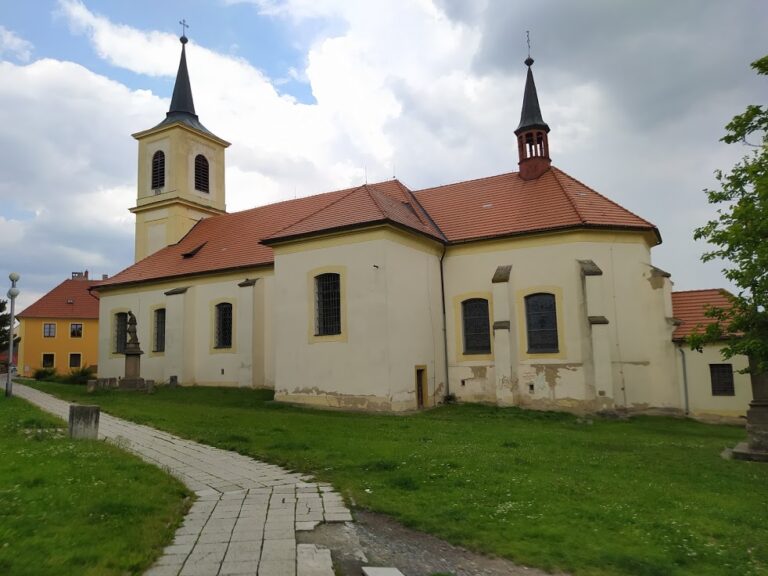
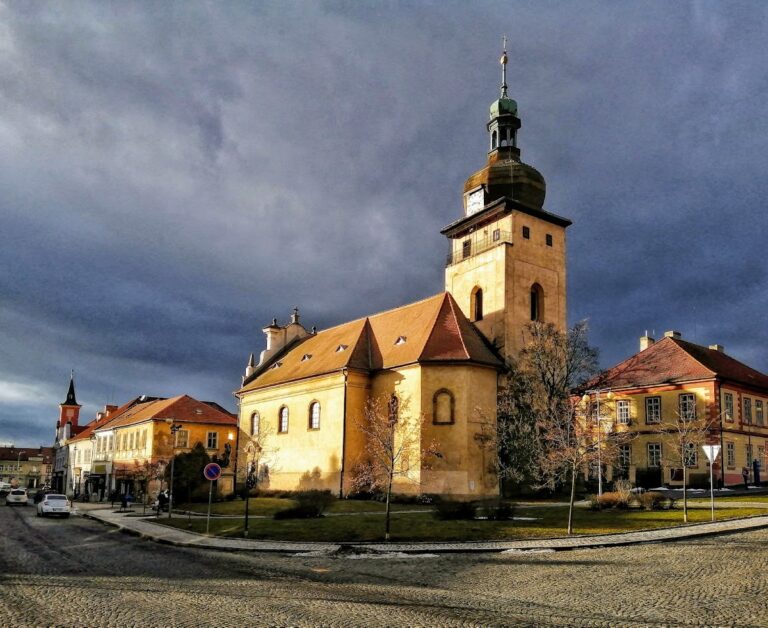
The Church of the Holy Name of Jesus adjoins the castle and connects to it by a passage. Maria Anna Theresa enlarged the church between 1748 and 1752 in the Rococo style, an eighteenth-century manner known for light, ornamental, and often asymmetrical decoration. The church forms part of the protected architectural group with the castle and park.
Park, Preserve, and Estate Buildings
Park and Water Features
The grounds include a large English landscape park, the Bahňák pond, a large palm greenhouse, the adjacent Lánská obora hunting preserve, and a farmyard. Repaired summerhouses, the greenhouse, and a shooting gallery form part of the garden features. Plečnik redesigned sections of the grounds, including the area around Bahňák pond.
An older fountain near the grounds has Doric pilasters and five lions spouting water. The lions represent Bohemia, Moravia, Silesia, Slovakia, and Carpathian Ruthenia as the five pillars of Czechoslovakia. The castle moat was closed and its surrounding wall demolished in 1849 and 1850, while the later boundary wall of the hunting preserve extended for 27 kilometres.
Stables, Greenhouses, and Agricultural Buildings
Neo-Gothic stables were built in 1861. During the 1921 presidential conversion, much of the older stable complex was demolished and replaced or supplemented by service and administrative facilities. The castle’s agricultural and estate buildings, farmyards, garden structures, greenhouse, and shooting gallery were repaired at the same time.
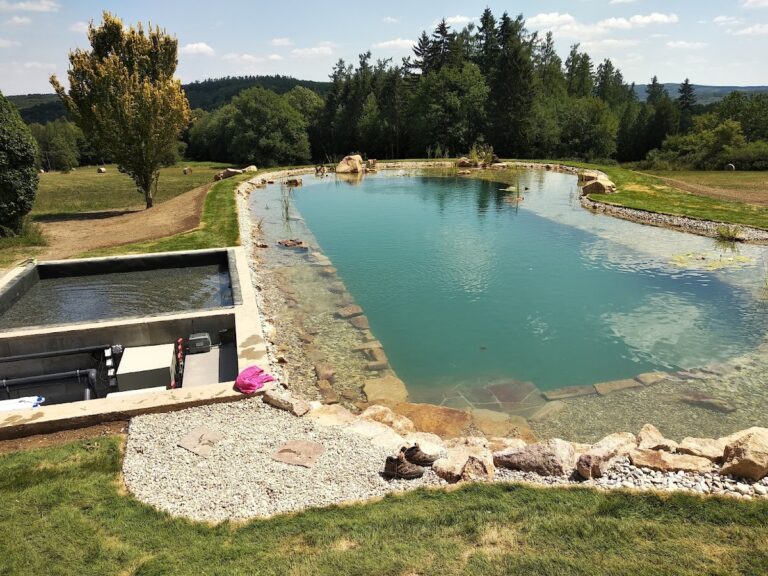
A public natural swimming pool was built mainly of wood during the Protectorate period behind the painter Horník’s Jurkovič villa at the edge of Lánská obora. The remains of its water surface survive. The Buštěhrad Railway also built a new station at Lány for Masaryk’s arrival in 1921, modified the tracks and station buildings, and provided a special presidential waiting room. From 1 August 1921, all express trains were ordered to stop at Lány station.
Lány Cemetery
Masaryk’s grave lies in the old section of Lány municipal cemetery. He was buried there with his wife Charlotta, their son Jan, and their daughter Alice, rather than in the castle park.
Nearby sites