Tomb of Ladislaus of Durazzo: A Royal Monument in Naples
Site at a Glance
- Popularity
- Medium
- Country
- Italy
- Primary era
- Medieval
- Eras represented
- Medieval
- Civilizations
- Kingdom of Naples
- Site type
- Burial
- Remains
- Tomb
On this page11 sections
History
Commission, attribution, and completion
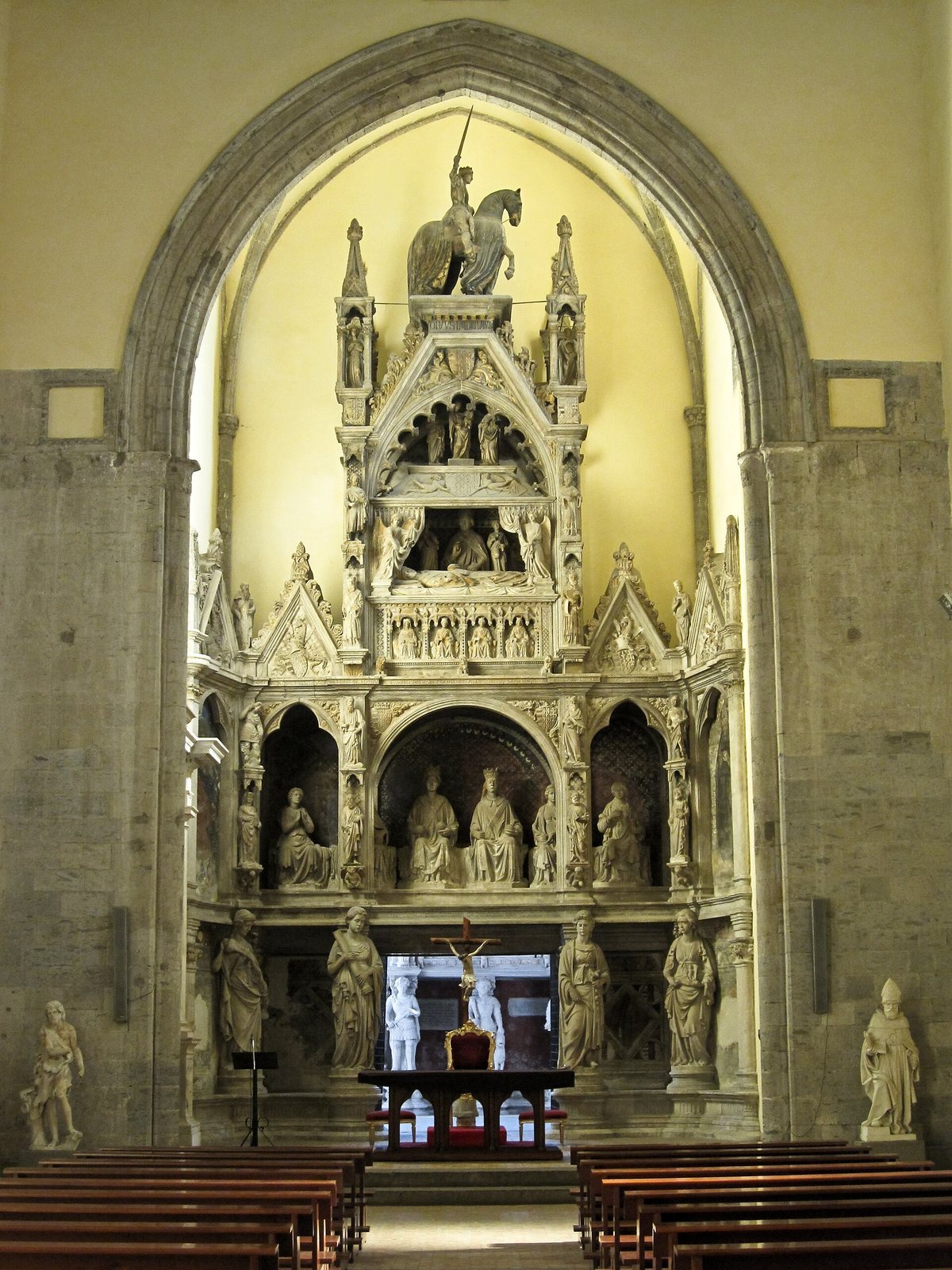
The Tomb of Ladislaus of Durazzo is a late-Gothic marble monument at the altar end of San Giovanni a Carbonara in Naples, Italy. Queen Joanna II of Anjou commissioned it in 1414, the year her brother, King Ladislaus, died. Work continued until about 1428. The tomb commemorates the Angevin-Durazzo dynasty, a branch of the House of Anjou associated with the medieval Kingdom of Naples. Its execution is regarded among the most important in fifteenth-century southern Italy.
Andrea da Firenze, a Florentine sculptor, has traditionally been credited with the monument, though its authorship remains uncertain. The attribution has been linked to an inscription on the tomb of Simone Vigilanti, an Augustinian bishop of Senigallia, in San Francesco alle Scale in Ancona. That inscription had disappeared by the eighteenth century. Andrea also worked on other sculptures at San Giovanni a Carbonara, some of them close in style to this tomb. He probably did not complete the monument; changes between its sections point to the involvement of several sculptors.
On 12 January 1428, sculptor Giovanni di Gante and his collaborators Leonardo Riccomanni, his brother Francesco, Tommaso di Matteo, and Leonardo di Vitale Pardini made an agreement in Lucca to go to Naples and complete sculptures for the marble monument.
Remains
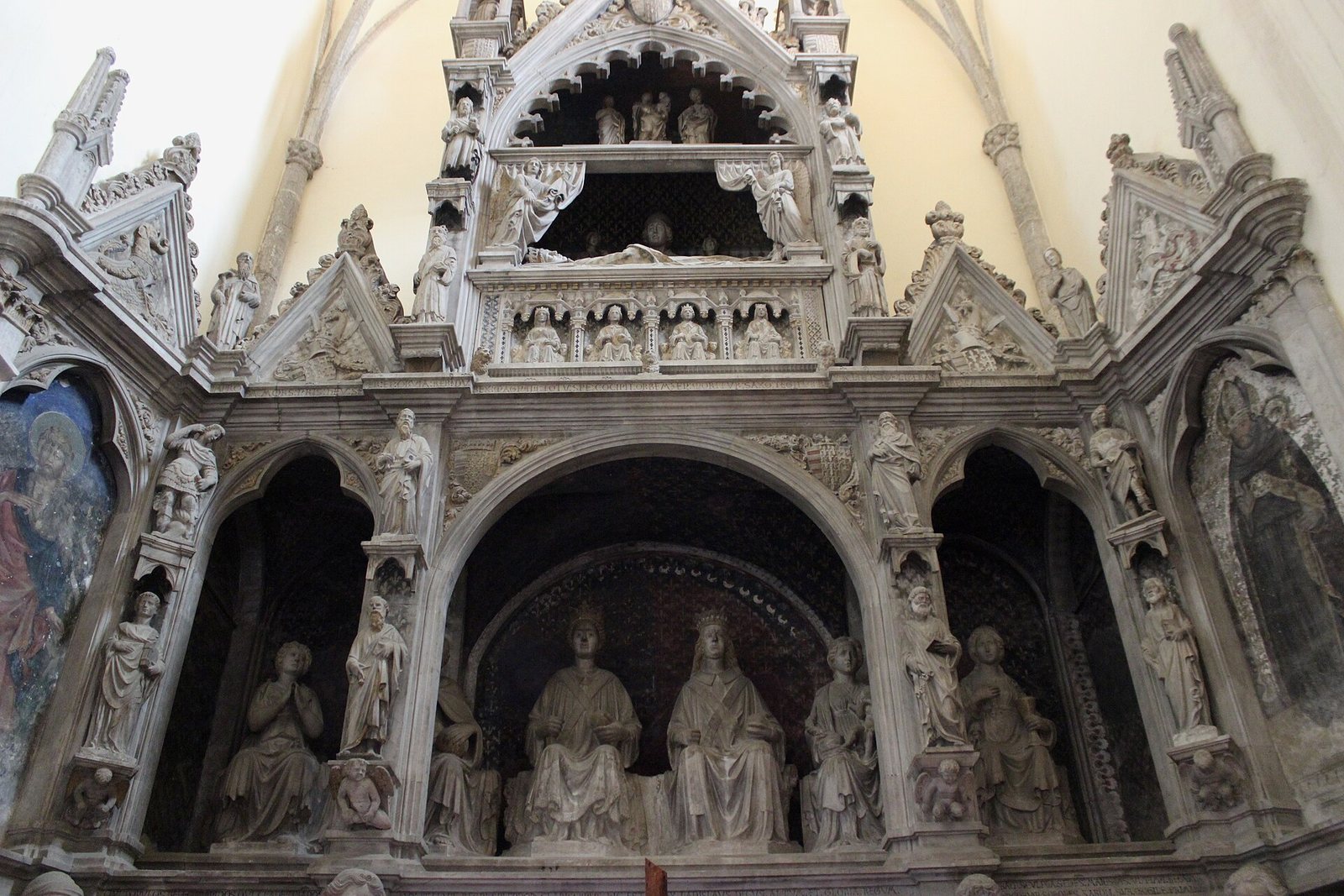
The tomb stands behind the high altar in the church’s apse, the projecting end that contains the altar area. Made of marble and 18 metres high, it is arranged in four horizontal levels and five vertical divisions. The central division is about twice as wide as each of the other four, while the outer divisions meet the apse’s side walls.
First and second levels
Base and supporting figures
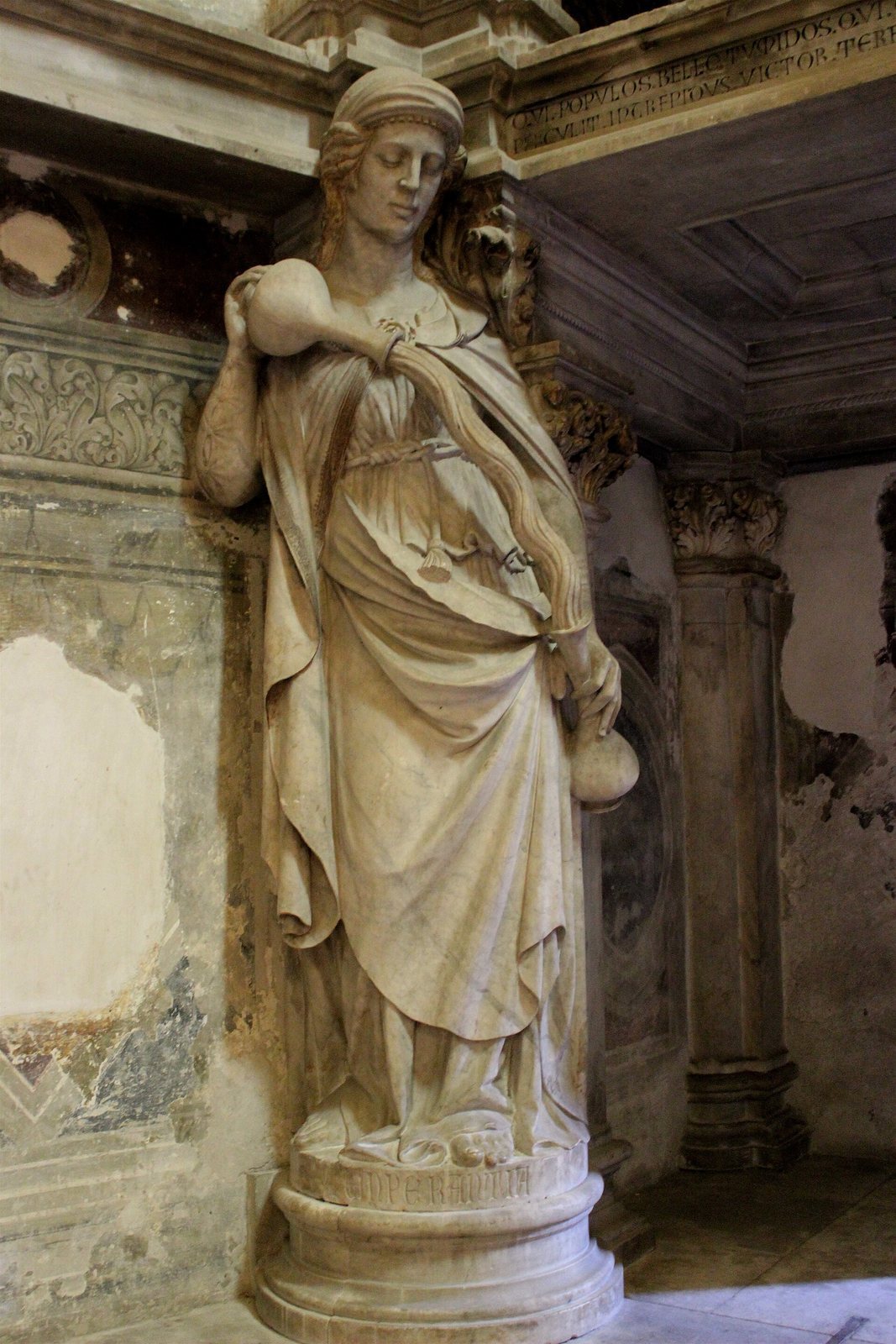
A marble base forms the first level. Four figures on its front, placed at the pillars of the second, third, and fourth divisions, serve as caryatids, sculpted figures that support the structure above. From left to right, they represent Temperance, Fortitude, Prudence, and Magnanimity. Columns support the outer ends. Geometric fresco patterns fill spaces between the figures and extend across parts of the side walls. An opening at the centre leads to the Caracciolo del Sole chapel. Two panels on the vault, which forms the underside of the second level’s base, display the arms of the Angevin and Durazzo houses.
Front niches and royal figures
The second level contains five niches, one in each division. The three facing forward connect internally to form a gallery-like space. Its central niche is a large aedicule, a small architectural frame, with a rounded arch. The four smaller niches have trefoil arches with three-lobed outlines: two face forward, and two occupy the sections along the apse’s side walls. Six seated figures fill the three front niches. Ladislaus and Joanna II sit enthroned at the centre; Hope and Justice appear to the king’s left, while Charity and Faith are beside the queen. The frescoes behind them show yellow lilies against blue.
Side compartments and upper panels
The side-wall compartments contain frescoes dated 1428 by Leonardo da Besozzo, an Italian painter. Saint John the Baptist appears on the left and Saint Augustine of Hippo on the right. Reliefs and friezes bearing the family arms decorate the arched upper panels of the first, second, fourth, and fifth divisions.
Upper levels and supporting figures
Sarcophagus and devotional group
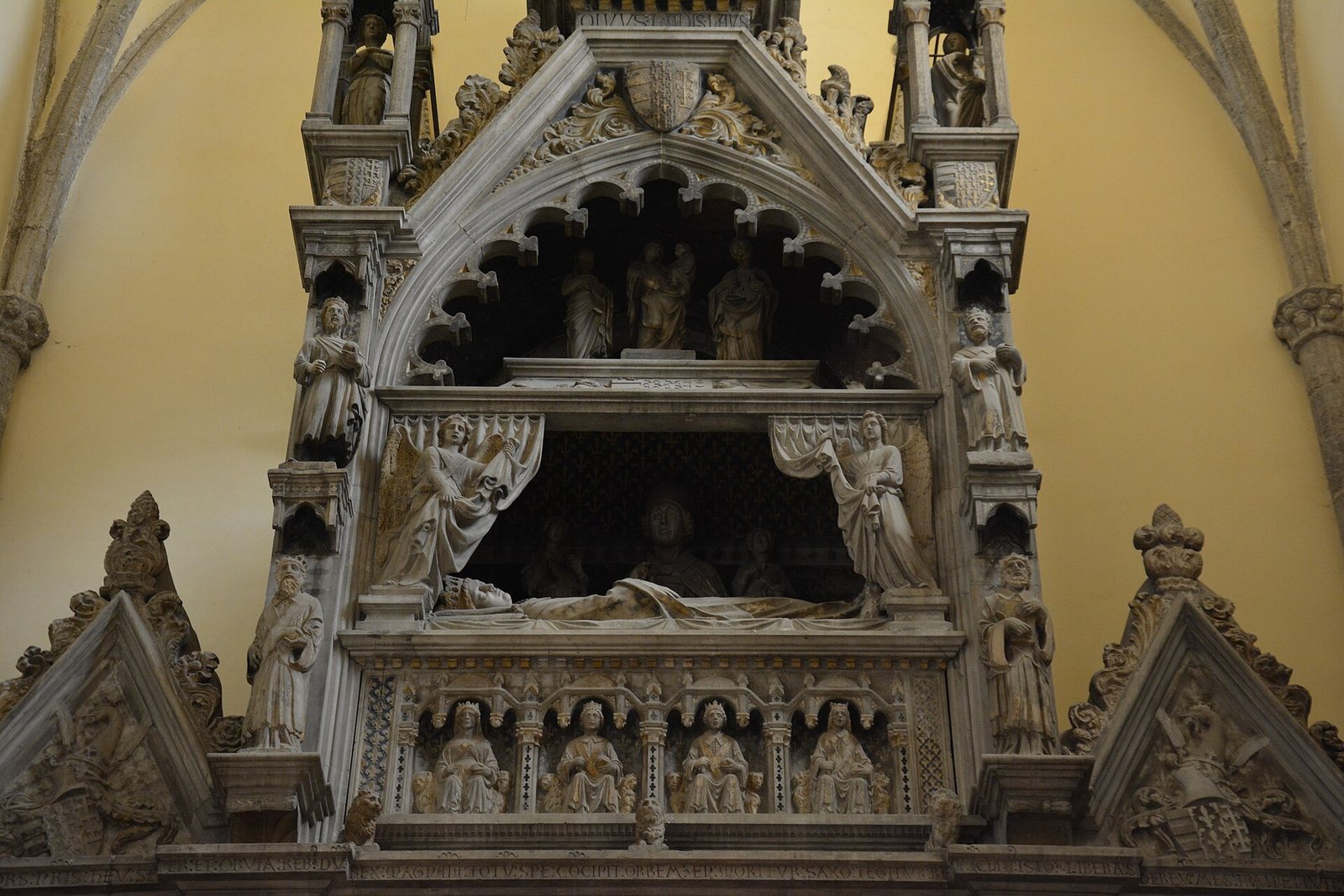
The third level occupies only the central division. Two angels draw aside a curtain to reveal the king’s sarcophagus. Four seated figures in small niches at its base portray, from left to right, Ladislaus, Joanna II, and their parents, Charles III of Naples and Margaret of Durazzo. Above the sarcophagus, Ladislaus’s effigy lies on its back. Saint Louis of Toulouse, a medieval Franciscan bishop and saint, stands behind him in bishop’s dress with two deacons and blesses his body. This scene depicts Ladislaus receiving a blessing despite having died excommunicated. A canopy above bears the Durazzo shield, held by two angels. Above it, the Madonna and Child appear between Saint John the Baptist and Saint Augustine; Angevin emblems decorate the niche’s rear wall.
Equestrian statue
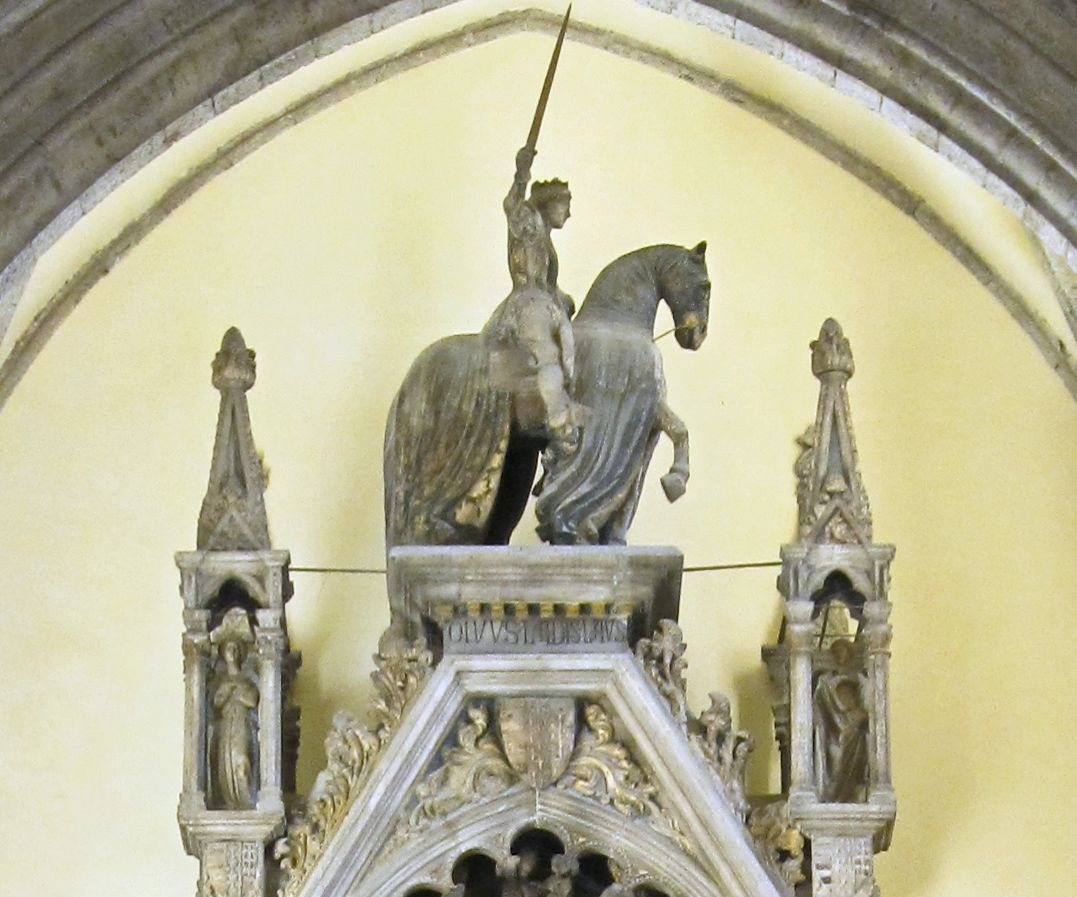
The central division’s fourth and highest level ends in an equestrian statue of Ladislaus. He wears armour and holds a drawn sword. The inscription beneath him reads Divus Ladislaus, meaning “Divine Ladislaus.” The horse’s form has been associated with Gothic sculpture from Lombardy.
Gothic supports
Four decorated supports carry the monument from the second level upward. Their ornament includes four small male supporting figures, called telamons, and sixteen statuettes of apostles, prophets, and monarchs in small niches. Each outer support has three statuettes, while each central support has five. The decoration on the central supports continues to the fourth level.