La Mothe-en-Bassigny: A Fortified Town and Castle in France
Site at a Glance
- Popularity
- Medium
- Country
- France
- Primary era
- Early Modern
- Eras represented
- Early Modern, Modern
- Civilizations
- Duchy of Lorraine, French, Holy Roman Empire
- Site type
- Military
- Remains
- Fortified Town
On this page12 sections
History
La Mothe-en-Bassigny was a fortified town and castle founded in July 1258 in Haute-Marne, France, by Thiébaut II, Count of Bar. It stood in Champagne near the Duchy of Lorraine, then an imperial territory within the Holy Roman Empire, a political union of central European territories headed by an emperor. Intended to defend Bar, the stronghold was soon held as a fief, land governed under obligations to a superior lord, of the Counts of Champagne after military disputes.
Foundation and early role
Thiébaut acquired the land from the lord of Joinville and established the settlement under a charter of enfranchisement for the castle of Saint-Hilairemont. The place was also known as Clermont, Château de Saint-Hilairemont, and Château de La Mothe. In 1259, Thiébaut founded an Augustinian convent, whose religious rule followed the teachings associated with Augustine of Hippo.
Ducal stronghold and new defenses
After the Duchies of Bar and Lorraine were united, La Mothe was strengthened from about 1400. It became Lorraine’s strongest stronghold after Nancy and an important commercial and military center. Its population, including soldiers and civilians, reached as many as 4,000. The Estates, representative assemblies of a territory’s social and political orders, met there in 1506 and 1580 to establish the customary law of Bassigny, the body of locally established legal rules.
From about 1520, the town’s original walls began to give way to bastioned defenses. Work on the new fortifications began around 1547, apparently at the initiative of Christina of Denmark, while Duke Charles III was strengthening Nancy. The Italian engineer Ambrosio Precipiano directed the project. Lime kilns were installed in 1554, and the fortification works were complete around 1600. Florent de Belleau built the drawbridge at the Porte de France between 1560 and 1565; repairs to the ramparts and Porte Neuve followed in 1590.
Sieges during the Thirty Years’ War
The Thirty Years’ War, a major European conflict fought from 1618 to 1648, placed La Mothe at the center of the struggle between France and Lorraine. Duke Charles IV sided with the Holy Roman Emperor and the Habsburgs against France, and supported opponents of Cardinal Richelieu, France’s chief minister. La Mothe was the only one of Charles’s strongholds not quickly captured by French royal forces. Its position also allowed it to control the old Roman road south toward Toul.
The first siege began in 1634, when French forces under Marshal de La Force encircled the fortress on Richelieu’s orders. Its garrison numbered 330. On 5 March, the Marquis de Villeroy demanded surrender, but Governor Antoine de Choiseul, seigneur d’Ische, refused on behalf of the inhabitants. A renewed demand on 30 April and two efforts to secure surrender through bribery also failed. A French spy, Desviviers, was discovered, tried, and executed.
On 21 June, a fragment of a cannonball killed d’Ische, a fact concealed from the French. The besiegers then used a mine to destroy Bastion Saint-Nicolas, and artillery demolished Bastion Sainte-Barbe on 24 June. La Mothe surrendered on 26 July, after 141 days. Fewer than a hundred defenders remained healthy. Under the terms, they withdrew with military honors; civilians could take their furniture and clothing, and soldiers could depart with their flags, weapons, and baggage.
La Mothe returned to Charles IV in 1641 and was besieged again from 25 July to 31 August 1642. The French abandoned the effort after Charles defeated their forces at Liffol-le-Grand. A third siege, led by François de L’Hospital, ran from December 1642 until King Louis XIII died in May 1643. It also failed: heavy snow and severe cold weakened the besiegers. Charles had repaired the fortress and allied with Spain against France, prompting Richelieu to send troops against it.
The fourth siege and destruction
Richelieu urged his successor to destroy La Mothe. After consolidating his position, Cardinal Mazarin continued that policy and ordered General Pierre Magalotti to capture the fortress. The fourth siege began on 4 December 1644 with 20 French and Italian mercenary regiments. The besiegers constructed a six-kilometre siege wall, supported by seven detached defensive works called redoubts, and advanced through trenches and mines.
A Lorraine attempt to break through the siege lines and bring reinforcements on 30 March 1645 was repelled by the Italian regiment Mazarin. Three mines exploded beneath Sainte-Barbe on 18 May, causing little military gain but alarming the inhabitants. On 20 May, Héraudel, head of the collegiate church’s canons, shot Magalotti while he inspected trenches near the Bastion de Vaudémont. Magalotti died two days later. Villeroy took command and continued the trench and mine works. A Lorraine relief force of 6,000 men was defeated by the Prince de Condé at Longwy. On 24 June, another mine and heavy artillery fire demolished two bastions. The besiegers also fired bombs packed with explosives and fitted with burning fuses from mortars.
Cold, disease, and hunger eventually forced the defenders to negotiate. After hostages were exchanged between 28 and 30 June, the governor agreed to surrender. La Mothe capitulated on 1 July 1645 after 205 days of resistance, with military honors. Contrary to the surrender terms, Mazarin ordered the town’s complete destruction, including its defenses, houses, and church. About 3,000 inhabitants were driven away, while 1,500 peasants were compelled to level the plateau.
The destruction marked the end of Lorraine as a fully sovereign state. Its later dukes depended heavily on the French Bourbons, and Lorraine was formally incorporated into France in 1766. The community’s final civil-status entry was a baptism signed by vicar Anthonie Vigneron on 8 September 1645. It names Antoinette, daughter of Claude Godard Mibril and his wife, as the last child baptized at La Mothe.
Memory and preservation
The loss remained a deep wound in Lorraine and was recalled in an eighteenth-century poem. When France was divided into departments, the boundary of Haute-Marne was drawn to include the site, placing it within Champagne. This was presented as a way of associating a troubling reminder of Lorraine’s past with a region linked to the French kingdom.
A memorial column was erected on the former keep site in 1896 and inaugurated the following year. The fortress received France’s statutory historic-monument designation in 1923, and the former town received the same status in 2001. Restoration and measures to secure the ruins have been undertaken. The site also lies within Natura 2000, the European Union network of designated conservation areas.
Remains
The remains occupy the wooded plateau of Saint-Hilairemont, about 500 metres above sea level, overlooking the Mouzon valley and around 30 villages. Before the Thirty Years’ War, the fortified area covered about 37 hectares and measured roughly 700 metres long by 250 metres wide. The town lay inside a masonry defensive circuit that followed the plateau’s steep outer slopes.
Fortifications and entrances
Defensive circuit
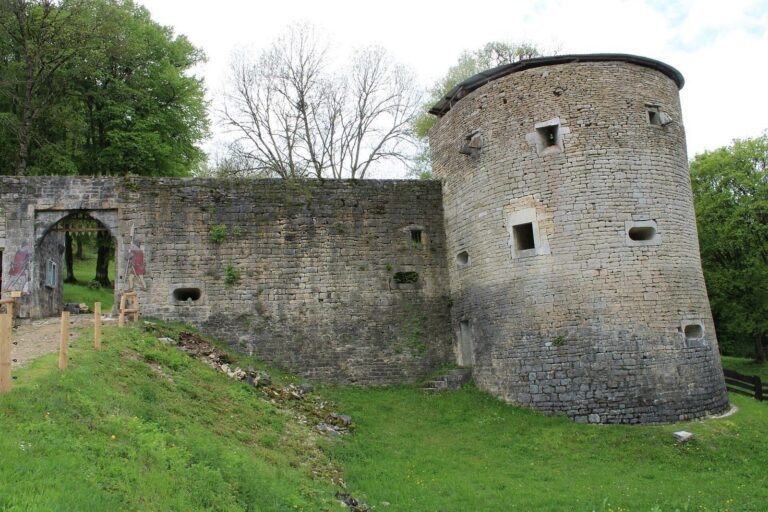
Seven projecting bastions, defensive structures extending outward from a wall, were linked by curtain walls, the stretches between fortified works. The bastions rose as much as 30 metres, while the connecting walls stood 17 to 20 metres high. Parts of the circuit were protected by a dry ditch. Its outer face, called the counterscarp, reached 13 metres; beyond it lay a glacis, a sloping surface intended to expose attackers.
Advanced works
The bastions used orillons, rounded projections that shielded nearby positions. The two northern works were named Bastion de Danemark and Bastion de Vaudémont. To the northwest, a forward defensive work could be approached only by a drawbridge; its outline and that of Bastion Saint-Georges remain identifiable. To the southeast, a ravelin, a detached defense in front of the main walls, stood between Bastions Sainte-Barbe and Saint-Nicolas. Its remains are associated with the name Point d’Iche.
Gates
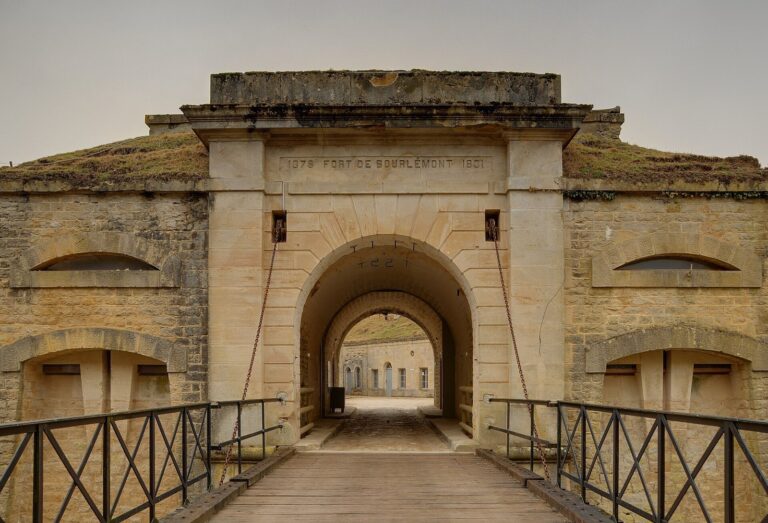
The Porte de France, or France Gate, was the only entrance passable by carts. It had a drawbridge, and the keystone displayed the arms of Lorraine. The left projection of Bastion Saint-Georges shielded the gate. Other surviving features are identified as an underground gate and a principal gate, with a pedestrian passage on the left and the main passage on the right.
Central keep and town remains
The central keep, a fortified stronghold, had four cylindrical towers at its corners and later housed the government. It has disappeared, and the memorial column marks its former position.
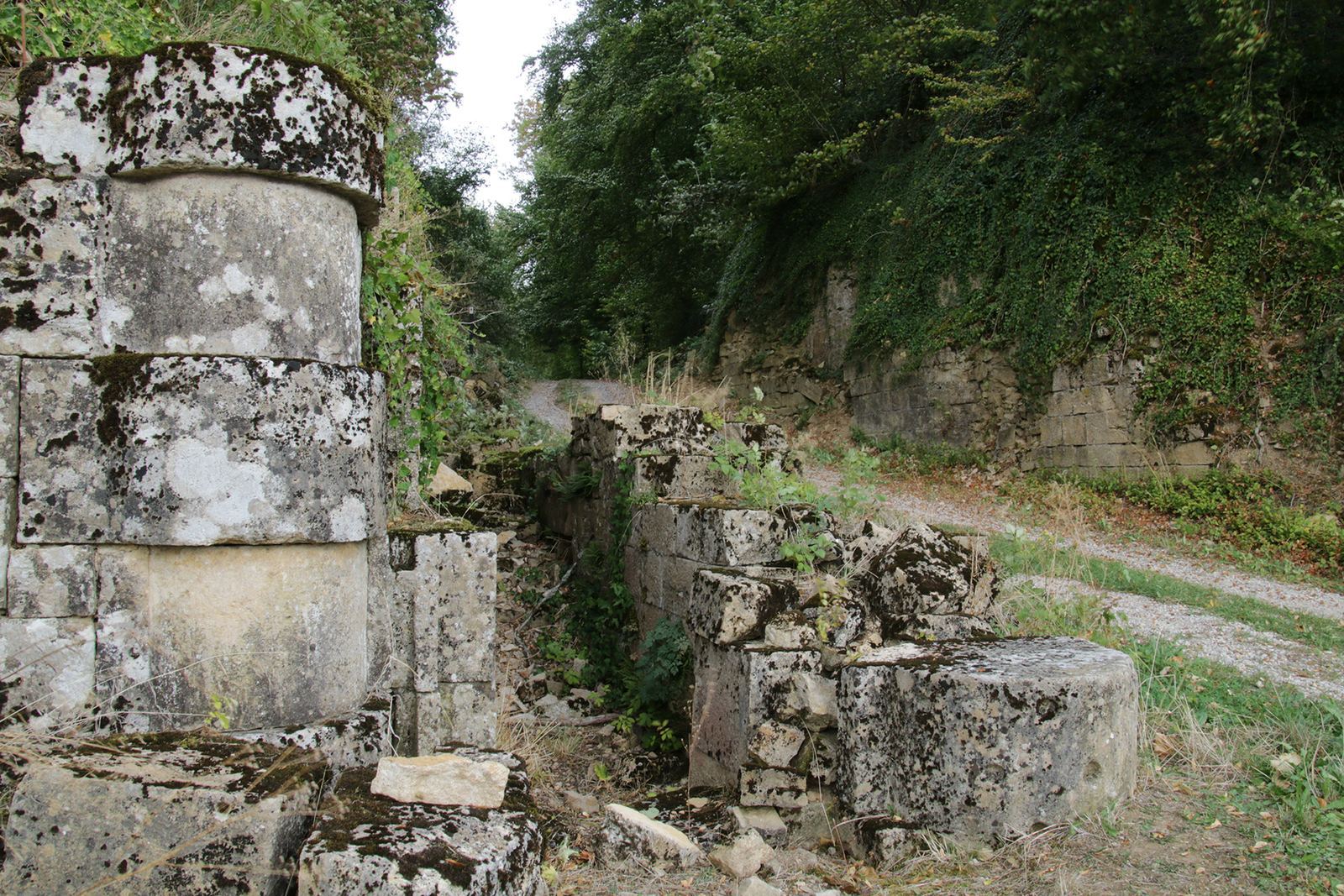
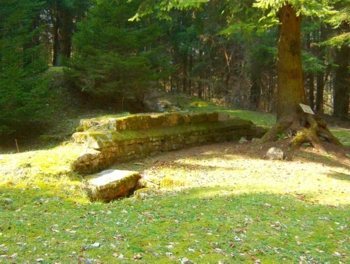
The wooded plateau contains scattered stone heaps and limited remains of the former town, including church masonry, the eastern end of the collegiate church, a large cistern, streets, and part of the defensive ditch. The church’s sacred objects are now in the parish church at Outremécourt, which was built with stones from the fortress. A windmill is also associated with the ramparts. The surviving walls and other ruins are subject to measures intended to secure them.