La Bajoulière Dolmen: A Neolithic Chamber Tomb in France
Site at a Glance
- Popularity
- Low
- Country
- France
- Primary era
- Stone Age
- Eras represented
- Stone Age
- Civilizations
- Unclassified
- Site type
- Burial
- Remains
- Tomb
On this page14 sections
History
Neolithic origins and landscape
La Bajoulière dolmen is a Neolithic megalithic tomb in Cumeray, Gennes-Val-de-Loire, France. It is associated with the Bell Beaker culture, a prehistoric tradition known for its distinctive bell-shaped pottery. The surrounding landscape contains eight dolmens and fourteen standing stones within 7 km. Seven of the standing stones align between the dolmen and the Neolithic village of Thoureil. C. Fraysse proposed that this alignment formed a “way of the dead” linking the two places.
Roman-era alterations
During the Gallo-Roman period, the era of Roman rule in Gaul, the chamber was substantially altered and was probably inhabited. The dolmen’s cairn, a mound or structure of stones built around or over a monument, was quarried during this period.
Medieval use
A record from 1144 in the cartulary of Saint-Aubin Abbey in Angers reports that nuns from Nyoiseau Abbey used the dolmen as a chapel. A cartulary is a collection of copied charters and other institutional records.
Modern study and protection
The dolmen’s oldest known photograph dates to 1890. It was classified as a French historic monument in 1936 and belongs to the commune of Saint-Rémy-la-Varenne. Excavations carried out between 1979 and 1983 were followed by a full restoration.
Remains
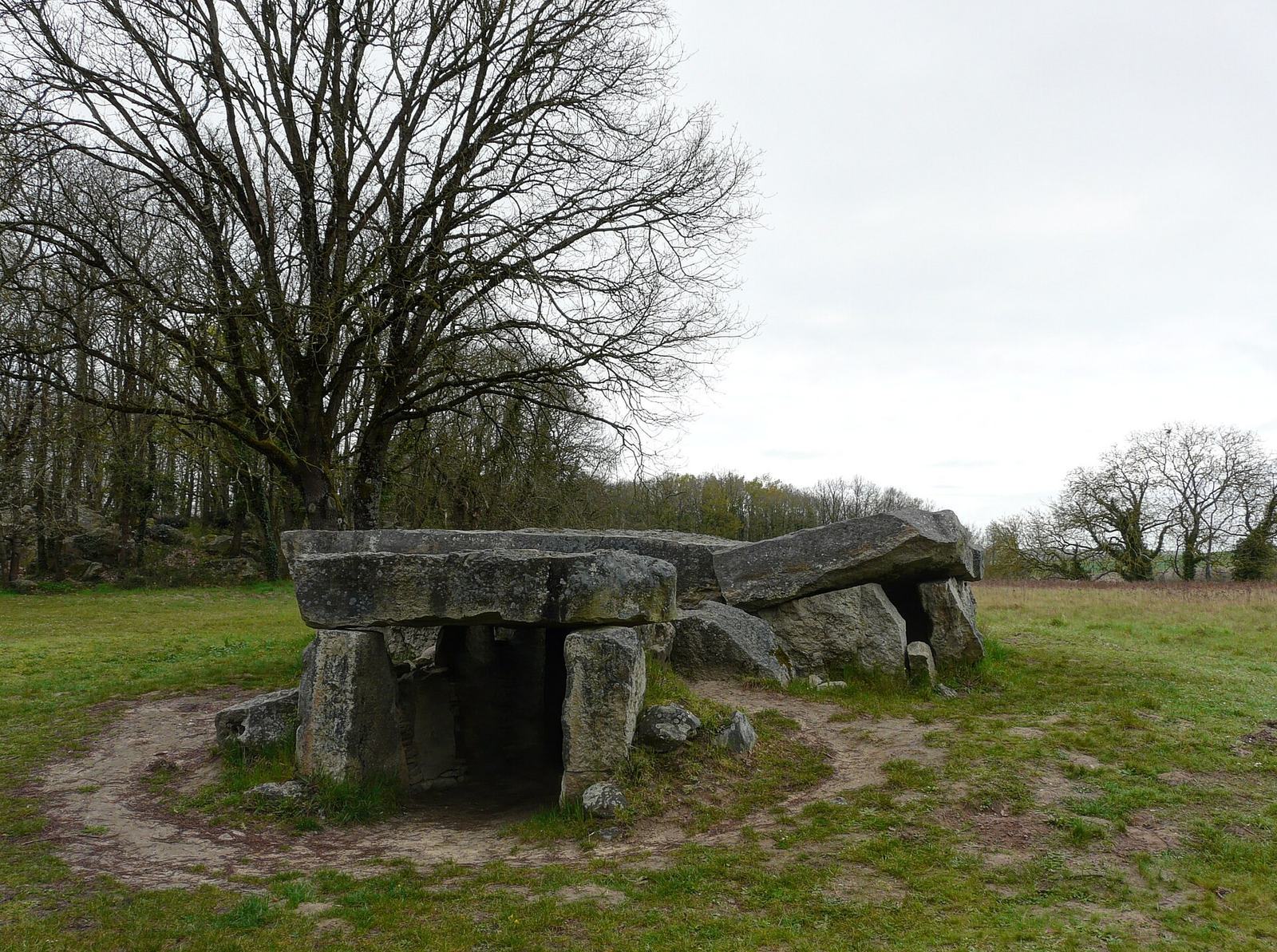
The monument stands in a meadow at La Fontaine, in Saint-Rémy-la-Varenne. It is an Angevin dolmen, a Loire-style covered passage with a recessed entrance framed by trilithons, structures of two upright stones supporting a horizontal one. It is the largest of the Angevin type-A examples, a group whose plans are generally nearly square. The chamber opens to the southeast, with evidence of surrounding stonework and a separate curved feature in front.
Chamber and entrance
Burial chamber
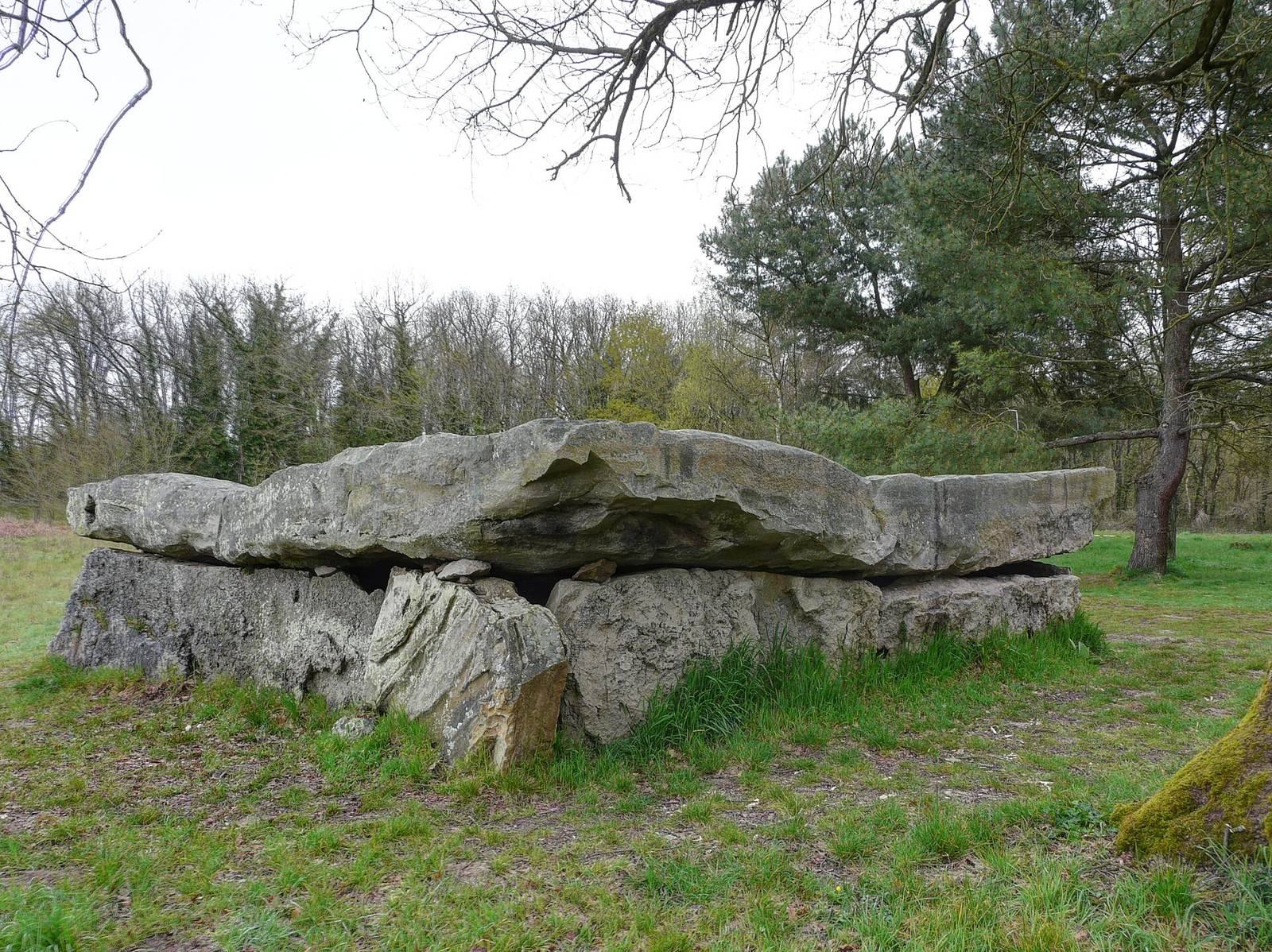
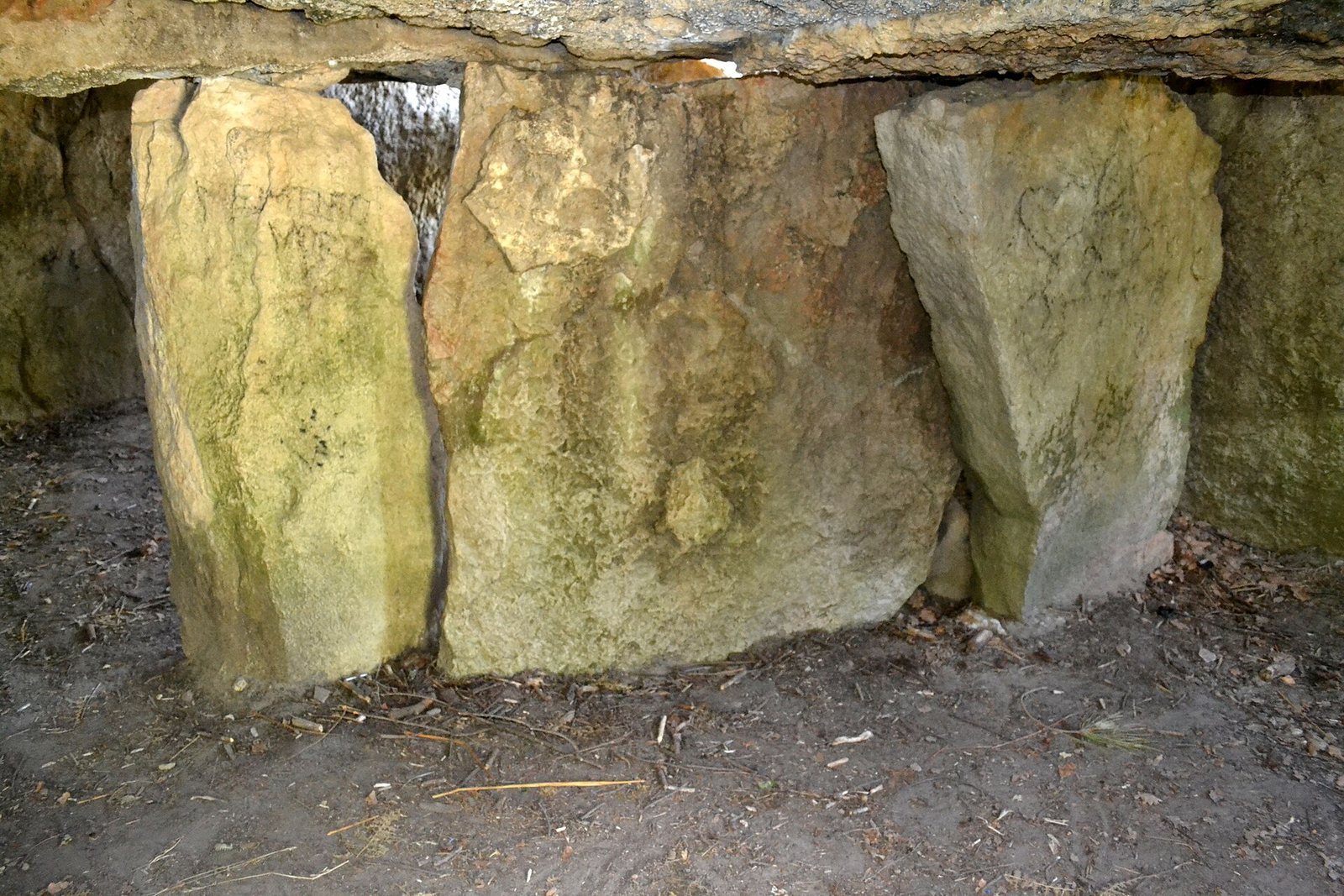
The chamber covers about 40 square metres and is slightly trapezoidal because its side walls draw closer together. Eight upright stones, two along each side, enclose it; one has fallen inward. The space beneath the roof slab is about 1.8 metres high. The roughly square capstone is made of sandstone associated with Late Cretaceous rock formations. It measures about 7 to 8 metres across and 0.70 to 0.90 metres thick, and weighs an estimated 70 tonnes. It fits closely against the upper edges of its supports and is among the largest capstones in France, comparable with the one at the Dolmen de Bagneux. The slab broke into four pieces when its supports collapsed. Local tradition blames lightning, though Godard fils’s 1865 lithograph already depicts it fractured.
Entrance frame
The southeast-facing entrance has a double trilithon, with two pairs of uprights supporting horizontal stones. The first entrance frame has square-section pillars flattened by pecking, or repeated blows against the stone; blocks used in this work were found at the site. Its two capstones include one weighing about 6 tonnes. A fragment from a broken corner of that slab lies on the ground. The double-trilithon arrangement also occurs at the Dolmen de la Roche-aux-Fées.
Interior partition
Four slabs set across the chamber formed a partition while leaving a passage through the middle. They were placed in foundation pits and held with wedges. One wedge carries hammer marks from shaping it to fit the lower corner of the slab it secured.
Surrounding stonework
Cairn outline
Stripping around the dolmen revealed the arrangement of its cairn. Parallel walls lay about 2 metres and 2.5 metres from the chamber walls and stood at least 0.60 metres high; they may have risen to the capstone. Behind the monument, they joined in a gentle curve about 10 metres beyond the rear slab. Toward the entrance, they met the first upright stones at rounded angles. Together, the walls formed an oval with a flattened base, or a very elongated trapezoid with softened corners. Scattered stones suggest that a lighter outer wall may also have existed. Small slabs crushed in place may indicate that the cairn played a part in setting the capstone.
Curved stone structure
A curved, horn-shaped structure made of stone blocks lies about 2.5 metres in front of the dolmen and extends for 9 metres. It may have been built either before or after the chamber.
Finds from the chamber
Finds include a fragment of a human upper jaw, roughly worked flint flakes and numerous scrapers, and two fragments of polished axes, one made of dolerite and the other of millstone rock. A large barbed arrowhead is attributed to the Bell Beaker culture, while a dagger fragment dates to the Chalcolithic, the period when copper was used alongside stone tools. The chamber also yielded fine, well-fired pottery from large vessels decorated with curved raised bands. It belongs to the Linear Pottery culture, an earlier Neolithic culture named for its pottery decoration, and predates the dolmen.