Dajti Castle: A Late-Antique Fortification in Albania


Site at a Glance
- Rating
- 3.9
- Popularity
- Very Low
- Country
- Albania
- Primary era
- Medieval
- Eras represented
- Iron Age, Classical, Medieval
- Civilizations
- Byzantine, Illyrian, Roman
- Site type
- Military
- Remains
- Fort
On this page8 sections
History
Dajti Castle is a late-antique archaeological site in Albania, probably built in the sixth century within the East Roman defensive program and over earlier Illyrian foundations. Late antiquity was the period of transition from the Roman world to the medieval eastern Mediterranean, conventionally spanning the third through seventh centuries. The site includes a Roman fortification and associated dwellings on the western side of Mount Dajti.
Earlier Foundations and East Roman Defence
The first phase of the walls uses large quadrangular stones fitted without mortar, a method known as dry-stone construction. This work suggests an earlier Illyrian fortification. The Illyrians were ancient peoples of the western Balkans, including the region of present-day Albania.
The later fortification belongs to the Roman period and is generally placed in the sixth century. Its construction fits the defensive activity of Justinian I, the East Roman, or Byzantine, emperor who ruled from 527 to 565 and sponsored extensive military building and reconstruction. These works in Epirus Nova were intended to protect the region from Slavic attacks.
Procopius of Caesarea, a sixth-century East Roman historian, described Justinian’s building and defensive projects in his work Buildings of Justinian. He also mentioned a nearby castle called Tirkan, dated to the first century BC. That reference may instead concern Tujani Castle, which stands at a substantially lower elevation, so its connection with Dajti Castle remains uncertain.
Discovery and Conservation
Historian and archaeologist Neritan Ceka discovered Dajti Castle in 1963. On January 15 of that year, the Rectorate of the State University, now the University of Tirana, declared it a first-category Cultural Monument.
In 2008, archaeologists Spiro Nika and Suela Xhyheri of the Institute of Cultural Monuments prepared a three-year restoration project. Coordinated by Professor Skënder Muçaj of the Institute of Archaeology, the project proposed additional archaeological searches and surveys alongside restoration work. The Institute of Cultural Monuments, the Regional Directorate of Cultural Monuments, the Institute of Archaeology, Dajti Commune, and Dajti Mountain National Park took part in the project.
Remains
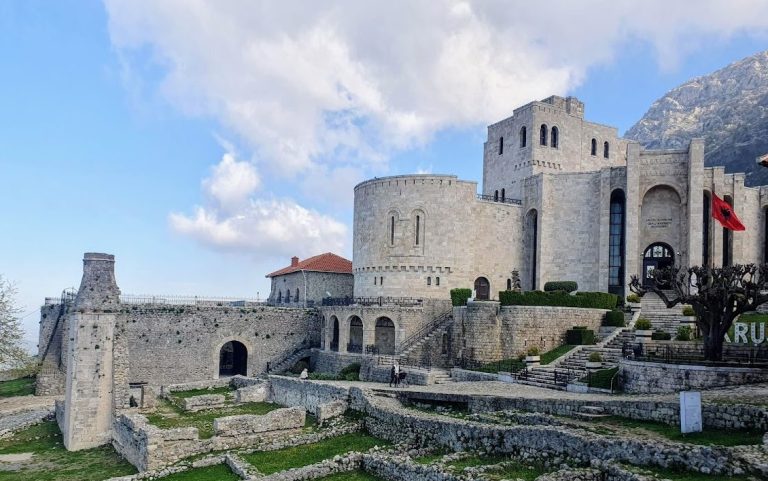
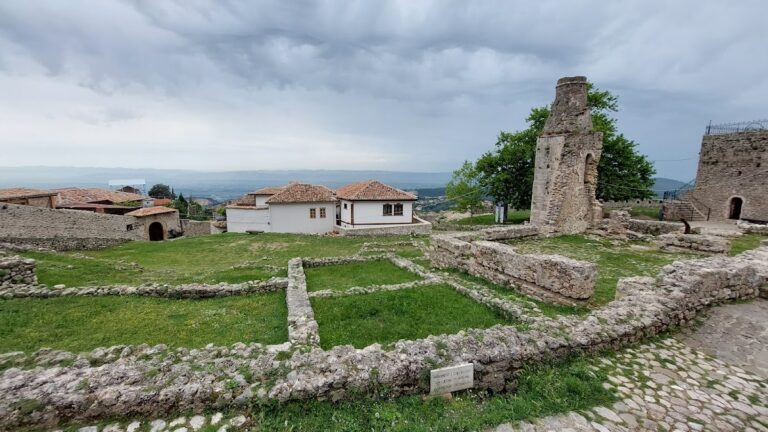
Dajti Castle occupies about 11,200 square metres on a saddle-shaped hill roughly 1,200 metres above sea level within Dajti Mountain National Park. The ruins and adjacent dwellings occupy the hilltop. The fortification follows the slope and forms a triangular enclosure with a perimeter of approximately 550 metres. Its elevated position provides views across western Albania, including Durrës and the Adriatic Sea, while the site stands about 1,100 metres above Tirana and the surrounding plain.
Triangular Fortification
Enclosure Walls
The three sides of the enclosure measure about 150 metres on the north, 190 metres on the east, and 210 metres on the south. The walls are approximately 2.3 metres thick. Their masonry preserves two principal building phases. The earlier phase consists of large, quadrangular blocks laid without mortar, while the later Roman phase uses smaller, unworked stones bonded with mortar.
A cross-wall divides the northern part of the fortification and forms a smaller fortified inner enclosure. Towers stand at the three corners of the triangular plan, reinforcing the shape of the hilltop defences.
Southern Tower
The southern tower is circular, with an external diameter of approximately 7.3 metres and walls 1.15 metres thick. A small entrance, about 0.85 metres wide, leads toward the tower. Its position forms part of the southern corner of the triangular fortification.
Archaeological Finds and Working Areas
Several Byzantine coins of the East Roman emperor Tiberius II Constantine, who ruled from 578 to 582, were found at the site. They provide evidence for activity at Dajti Castle during or after his reign. An iron, knife-shaped tool measuring about 18 centimetres long was also recovered.
Ceramic fragments occur inside the castle and on its level terraces. Most are pieces of typical Roman roof tiles made from almost pure, well-fired clay; fewer fragments come from pottery and everyday vessels. One tile bears stamped figures resembling Illyrian decorative motifs. A fluted vessel and the remains of a profiled loom add evidence of Roman cultural influence within the settlement.
Slag from ore smelting was found at the site, indicating familiarity with extracting metal from mineral-bearing rock by heating it. Mount Dajti is rich in bauxite, and a bauxite mine remains near the castle.